
Paper:
Timing Matters: Contrasting Public Sentiment During Wuhan’s and Shanghai’s COVID-19 Lockdowns
Xuanda Pei*1,†
 , Yuzuru Isoda*1
, Tomoki Nakaya*1,*2
, and Clive E. Sabel*3,*4
, Yuzuru Isoda*1
, Tomoki Nakaya*1,*2
, and Clive E. Sabel*3,*4
*1Graduate School of Science, Tohoku University
6-3 Aoba, Aramaki, Aoba-ku, Sendai, Miyagi 980-8578, Japan
†Corresponding author
*2Graduate School of Environmental Studies, Tohoku University
Sendai, Japan
*3School of Geography, Earth and Environmental Sciences, University of Plymouth
Plymouth, United Kingdom
*4School of Geography and Ocean Science, Nanjing University
Nanjing, China

Optimal crisis management depends on how much the public can tolerate stringent measures. Using large-scale Weibo microblog data and two sentiment analysis models, this study investigated and compared public sentiment responses during the COVID-19 lockdowns in Wuhan and Shanghai, focusing on how residents’ emotional expressions evolved across different stages of the pandemic. Binary and six-emotion sentiment analysis models based on bidirectional encoder representations from transformers (BERT) were employed to examine how the two cities developed distinct emotional trajectories. Emotional responses in Wuhan followed emotional Phases of Disaster, with sharp transitions from shock to solidarity, followed by disillusionment. Conversely, Shanghai’s residents displayed stable emotional fluctuations with sustained management-oriented discourse. Word frequency analysis revealed that Wuhan citizens emphasized community self-help and mutual support, while Shanghai residents focused on systematic management processes, reflecting their approach to the crisis as an administrative challenge rather than an unprecedented disaster. These differences suggest that temporal positioning within the entire pandemic timeline fundamentally shapes how cities emotionally process extended health crises. In the early stage, the public responded primarily to the health threat itself, while in the later stage, they responded predominantly to the societal disruptions caused by containment policy. This study contributes to the crisis-management literature by providing methods to gauge public sentiment and demonstrating how temporal positioning influences public emotional responses during extended crises; and to the social-sensing literature by advancing methods for large-scale sentiment tracking.
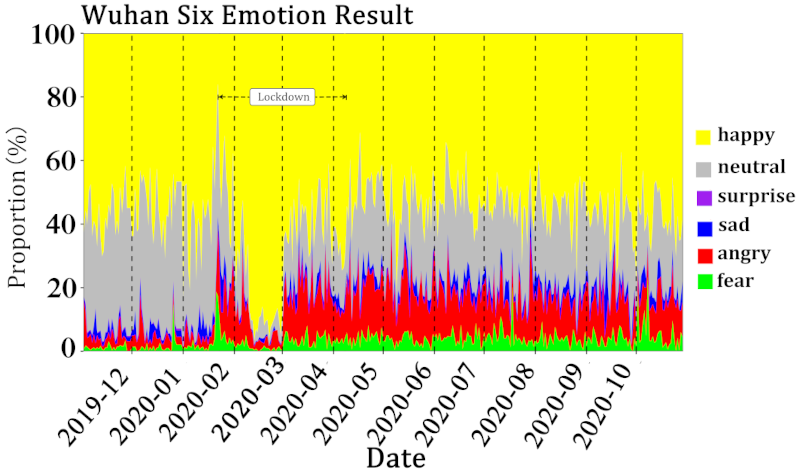
Why “happy” rose in the Wuhan lockdown?
- [1] V. Alfano, S. Ercolano, and M. Pinto, “Fighting the COVID pandemic: National policy choices in non-pharmaceutical interventions,” J. Policy Model., Vol.44, No.1, pp. 22-40, 2022. https://doi.org/10.1016/j.jpolmod.2021.11.003
- [2] S. Lai et al., “Effect of non-pharmaceutical interventions to contain COVID-19 in China,” Nature, Vol.585, No.7825, pp. 410-413, 2020. https://doi.org/10.1038/s41586-020-2293-x
- [3] Y. Liu et al., “The impact of non-pharmaceutical interventions on SARS-CoV-2 transmission across 130 countries and territories,” BMC Med., Vol.19, No.1, Article No.40, 2021. https://doi.org/10.1186/s12916-020-01872-8
- [4] A. Siddique et al., “Unprecedented environmental and energy impacts and challenges of the COVID-19 pandemic,” Environ. Res., Vol.193, Article No.110443, 2021. https://doi.org/10.1016/j.envres.2020.110443
- [5] K. Liu and Y. Lou, “Optimizing COVID-19 vaccination programs during vaccine shortages,” Infect. Dis. Model., Vol.7, No.1, pp. 286-298, 2022. https://doi.org/10.1016/j.idm.2022.02.002
- [6] N. Donthu and A. Gustafsson, “Effects of COVID-19 on business and research,” J. Bus. Res., Vol.117, pp. 284-289, 2020. https://doi.org/10.1016/j.jbusres.2020.06.008
- [7] J. Crawford, “COVID-19 and higher education: A pandemic response model from rapid adaptation to consolidation and restoration,” Int. Educ. J.: Comp. Perspect., Vol.22, No.1, pp. 7-29, 2023.
- [8] R. L. Jewett, S. M. Mah, N. Howell, and M. M. Larsen, “Social cohesion and community resilience during COVID-19 and pandemics: A rapid scoping review to inform the United Nations Research Roadmap for COVID-19 Recovery,” Int. J. Health Serv., Vol.51, No.3, pp. 325-336, 2021. https://doi.org/10.1177/0020731421997092
- [9] P. Śleszyński, P. Legutko-Kobus, M. Rosenberg, V. Pantyley, and M. J. Nowak, “Assessing urban policies in a COVID-19 world,” Int. J. Environ. Res. Public Health, Vol.19, No.9, Article No.5322, 2022. https://doi.org/10.3390/ijerph19095322
- [10] F. Procentese, F. Gatti, and E. Ceglie, “Technostress and work-family interface in the face of COVID-19-related remote work: The moderator role of goals setting and prioritization skills,” Community Work Fam., Vol.28, No.2, pp. 272-290, 2025. https://doi.org/10.1080/13668803.2023.2247147
- [11] E. Velasco, T. Agheneza, K. Denecke, G. Kirchner, and T. Eckmanns, “Social media and Internet-based data in global systems for public health surveillance: A systematic review,” Milbank Q., Vol.92, No.1, pp. 7-33, 2014. https://doi.org/10.1111/1468-0009.12038
- [12] A. H. Alamoodi et al., “Sentiment analysis and its applications in fighting COVID-19 and infectious diseases: A systematic review,” Expert Syst. Appl., Vol.167, Article No.114155, 2021. https://doi.org/10.1016/j.eswa.2020.114155
- [13] J.-L. Wybo, “Percolation, temporal coherence of information, and crisis prevention,” Saf. Sci., Vol.57, pp. 60-68, 2013. https://doi.org/10.1016/j.ssci.2013.01.021
- [14] L. Otero-García et al., “Austerity measures and underfunding of the Spanish health system during the COVID-19 pandemic—Perception of healthcare staff in Spain,” Int. J. Environ. Res. Public Health, Vol.20, No.3, Article No.2594, 2023. https://doi.org/10.3390/ijerph20032594
- [15] C. Deana et al., “Learning from the Italian experience during COVID-19 pandemic waves: Be prepared and mind some crucial aspects,” Acta Biomed., Vol.92, No.2, Article No.e2021097, 2021. https://doi.org/10.23750/abm.v92i2.11159
- [16] D. J. DeWolfe, “Training manual for mental health and human service workers in major disasters,” 2nd edition, U.S. Department of Health and Human Services, Substance Abuse and Mental Health Services Administration, Center for Mental Health Services, 2000.
- [17] Substance Abuse and Mental Health Services Administration, “Phases of disaster.” https://www.samhsa.gov/mental-health/disaster-preparedness [Accessed January 18, 2026]
- [18] C. Aubrecht, S. Fuchs, and C. Neuhold, “Spatio-temporal aspects and dimensions in integrated disaster risk management,” Nat. Hazards, Vol.68, No.3, pp. 1205-1216, 2013. https://doi.org/10.1007/s11069-013-0619-9
- [19] J. Stogner, B. L. Miller, and K. McLean, “Police stress, mental health, and resiliency during the COVID-19 pandemic,” Am. J. Crim. Just., Vol.45, No.4, pp. 718-730, 2020. https://doi.org/10.1007/s12103-020-09548-y
- [20] L. Wang, Z. Li, and Z. Zhang, “City profile: Wuhan 2004–2020,” Cities, Vol.123, Article No.103585, 2022. https://doi.org/10.1016/j.cities.2022.103585
- [21] Y. Yang and S. S. Han, “Wrestling between central and local: Planning and development of the Wuhan High-Speed Rail Station and its vicinity, China,” Cities, Vol.105, Article No.102828, 2020. https://doi.org/10.1016/j.cities.2020.102828
- [22] N. James, M. Menzies, and P. Radchenko, “COVID-19 second wave mortality in Europe and the United States,” Chaos, Vol.31, No.3, Article No.031105, 2021. https://doi.org/10.1063/5.0041569
- [23] S. Chen et al., “Uncovering sentiment and retweet patterns of disaster-related tweets from a spatiotemporal perspective: A case study of Hurricane Harvey,” Telemat. Inform., Vol.47, Article No.101326, 2020. https://doi.org/10.1016/j.tele.2019.101326
- [24] V. K. Neppalli, C. Caragea, A. Squicciarini, A. Tapia, and S. Stehle, “Sentiment analysis during Hurricane Sandy in emergency response,” Int. J. Disaster Risk Reduct., Vol.21, pp. 213-222, 2017. https://doi.org/10.1016/j.ijdrr.2016.12.011
- [25] F. Yuan, M. Li, and R. Liu, “Understanding the evolutions of public responses using social media: Hurricane Matthew case study,” Int. J. Disaster Risk Reduct., Vol.51, Article No.101798, 2020. https://doi.org/10.1016/j.ijdrr.2020.101798
- [26] M. Karimiziarani and H. Moradkhani, “Social response and disaster management: Insights from Twitter data assimilation on Hurricane Ian,” Int. J. Disaster Risk Reduct., Vol.95, Article No.103865, 2023. https://doi.org/10.1016/j.ijdrr.2023.103865
- [27] K. Bathina, M. ten Thij, and J. Bollen, “Quantifying societal emotional resilience to natural disasters from geo-located social media content,” PLoS One, Vol.17, No.6, Article No.e0269315, 2022. https://doi.org/10.1371/journal.pone.0269315
- [28] D. Karmegam and B. Mappillairaju, “Spatio-temporal distribution of negative emotions on Twitter during floods in Chennai, India, in 2015: A post hoc analysis,” Int. J. Health Geogr., Vol.19, No.1, Article No.19, 2020. https://doi.org/10.1186/s12942-020-00214-4
- [29] E. Tanaka, H. Tennichi, S. Kameoka, and H. Kato, “Long-term psychological recovery process and its associated factors among survivors of the Great Hanshin-Awaji Earthquake in Japan: A qualitative study,” BMJ Open, Vol.9, No.8, Article No.e030250, 2019. https://doi.org/10.1136/bmjopen-2019-030250
- [30] L. Croll et al., “The psychosocial implications of COVID-19 for a neurology program in a pandemic epicenter,” J. Neurol. Sci., Vol.416, Article No.117034, 2020. https://doi.org/10.1016/j.jns.2020.117034
- [31] H.-W. Wang et al., “Learning from each other in the management of natural disaster and the COVID-19 pandemic: A case study in Taiwan,” Front. Public Health, Vol.9, Article No.777255, 2021. https://doi.org/10.3389/fpubh.2021.777255
- [32] C. H. Procopio and S. T. Procopio, “Do you know what it means to miss New Orleans? Internet communication, geographic community, and social capital in crisis,” J. Appl. Commun. Res., Vol.35, No.1, pp. 67-87, 2007. https://doi.org/10.1080/00909880601065722
- [33] K. D. Sweetser and E. Metzgar, “Communicating during crisis: Use of blogs as a relationship management tool,” Public Relat. Rev., Vol.33, No.3, pp. 340-342, 2007. https://doi.org/10.1016/j.pubrev.2007.05.016
- [34] American Red Cross, “Web users increasingly rely on social media to seek help in a disaster.” http://www.redcross.org/portal/site/en/menuitem.94aae335470e233f6cf911df43 [Accessed January 18, 2026]
- [35] Y. Jin, B. F. Liu, and L. L. Austin, “Examining the role of social media in effective crisis management: The effects of crisis origin, information form, and source on publics’ crisis responses,” Commun. Res., Vol.41, No.1, pp. 74-94, 2014. https://doi.org/10.1177/0093650211423918
- [36] L. E. Pechta, D. C. Brandenburg, and M. W. Seeger, “Understanding the dynamics of emergency communication: Propositions for a four-channel model,” J. Homel. Secur. Emerg. Manag., Vol.7, No.1, 2010. https://doi.org/10.2202/1547-7355.1671
- [37] A. L. Hughes and L. Palen, “The evolving role of the public information officer: An examination of social media in emergency management,” J. Homel. Secur. Emerg. Manag., Vol.9, No.1, 2012. https://doi.org/10.1515/1547-7355.1976
- [38] S. Mukhtar, “Psychological health during the coronavirus disease 2019 pandemic outbreak,” Int. J. Soc. Psychiatry, Vol.66, No.5, pp. 512-516, 2020. https://doi.org/10.1177/0020764020925835
- [39] C. VanRoo, J. M. Norvilitis, H. M. Reid, and K. O’Quin, “The new normal: Amotivation, sense of purpose, and associated factors among college students during the COVID-19 pandemic,” Psychol. Rep., Vol.128, No.4, pp. 2336-2352, 2025. https://doi.org/10.1177/00332941231181485
- [40] H. Cho, W. Li, J. Cannon, R. Lopez, and C. Song, “Testing three explanations for stigmatization of people of Asian descent during COVID-19: Maladaptive coping, biased media use, or racial prejudice?,” Ethn. Health, Vol.26, No.1, pp. 94-109, 2021. https://doi.org/10.1080/13557858.2020.1830035
- [41] D. Tsoy, T. Tirasawasdichai, and K. I. Kurpayanidi, “Role of social media in shaping public risk perception during the COVID-19 pandemic: A theoretical review,” Int. J. Manag. Sci. Bus. Adm., Vol.7, No.2, pp. 35-41, 2021. https://doi.org/10.18775/ijmsba.1849-5664-5419.2014.72.1005
- [42] R. Lamsal, “Design and analysis of a large-scale COVID-19 tweets dataset,” Appl. Intell., Vol.51, No.5, pp. 2790-2804, 2021. https://doi.org/10.1007/s10489-020-02029-z
- [43] J. Xue et al., “Twitter discussions and emotions about the COVID-19 pandemic: Machine learning approach,” J. Med. Internet Res., Vol.22, No.11, Article No.e20550, 2020. https://doi.org/10.2196/20550
- [44] H. Fang, G. Jiang, and D. Li, “Sentiment analysis based on Chinese BERT and fused deep neural networks for sentence-level Chinese e-commerce product reviews,” Syst. Sci. Control Eng., Vol.10, No.1, pp. 802-810, 2022. https://doi.org/10.1080/21642583.2022.2123060
- [45] B. Poblete, R. Garcia, M. Mendoza, and A. Jaimes, “Do all birds tweet the same?: Characterizing Twitter around the world,” Proc. 20th ACM Int. Conf. Inf. Knowl. Manag. (CIKM), pp. 1025-1030, 2011. https://doi.org/10.1145/2063576.2063724
- [46] Y. Yang, Y. Zhang, X. Zhang, Y. Cao, and J. Zhang, “Spatial evolution patterns of public panic on Chinese social networks amidst the COVID-19 pandemic,” Int. J. Disaster Risk Reduct., Vol.70, Article No.102762, 2022. https://doi.org/10.1016/j.ijdrr.2021.102762
- [47] Wuhan Statistics Bureau, “Communiqué of the Seventh National Population Census of Wuhan (No.1),” May 28, 2021 (in Chinese). https://tjj.wuhan.gov.cn/tjfw/tjgb/202105/t20210528_1707390.shtml [Accessed January 18, 2026]
- [48] A. Pan et al., “Association of public health interventions with the epidemiology of the COVID-19 outbreak in Wuhan, China,” JAMA, Vol.323, No.19, pp. 1915-1923, 2020. https://doi.org/10.1001/jama.2020.6130
- [49] F. Zhang, Y. Han, and B. Cong, “How to respond effectively to COVID-19? Reports based on environmental changes in Wuhan and Shanghai,” Research Square, 2021. https://doi.org/10.21203/rs.3.rs-795086/v1
- [50] G. Yang, “Demobilizing the emotions of online activism in China: A civilizing process,” Int. J. Commun., Vol.12, pp. 1945-1965, 2018.
- [51] M. O’Sullivan et al., “The role of the state in shaping zero hours work in an atypical liberal market economy,” Econ. Ind. Democr., Vol.41, No.3, pp. 652-671, 2020. https://doi.org/10.1177/0143831X17735181
- [52] J. Liu, M. Liu, and W. N. Liang, “The dynamic COVID-zero strategy in China,” China CDC Wkly., Vol.4, No.4, pp. 74-75, 2022. https://doi.org/10.46234/ccdcw2022.015
- [53] B. Goh and R. Woo, “COVID-hit Shanghai to end two-month lockdown on June 1,” Reuters, May 30, 2022. https://www.reuters.com/world/china/some-beijing-back-work-shanghai-inches-closer-ending-covid-lockdown-2022-05-30/ [Accessed January 18, 2026]
- [54] K. Jafari, A. Özduran, and M. B. Saydam, “Hospitality and tourism industry amid COVID-19 pandemic: Voices from a small Mediterranean town,” Int. Hosp. Rev., Vol.37, No.2, pp. 243-264, 2023. https://doi.org/10.1108/IHR-07-2021-0054
- [55] Z. Chen et al., “Epidemiological characteristics and transmission dynamics of the outbreak caused by the SARS-CoV-2 Omicron variant in Shanghai, China: A descriptive study,” Lancet Reg. Health West. Pac., Vol.29, Article No.100592, 2022. https://doi.org/10.1016/j.lanwpc.2022.100592
- [56] D. Zhu, Y. Li, J. Shi, Y. Xu, and W. Shen, “A service-oriented city portal framework and collaborative development platform,” Inf. Sci., Vol.179, No.15, pp. 2606-2617, 2009. https://doi.org/10.1016/j.ins.2009.01.038
- [57] G. Bristow and A. Healy, “Regional resilience: An agency perspective,” Reg. Stud., Vol.48, No.5, pp. 923-935, 2014. https://doi.org/10.1080/00343404.2013.854879
- [58] Z. Wu and J. M. McGoogan, “Characteristics of and important lessons from the coronavirus disease 2019 (COVID-19) outbreak in China: Summary of a report of 72 314 cases from the Chinese Center for Disease Control and Prevention,” JAMA, Vol.323, No.13, pp. 1239-1242, 2020. https://doi.org/10.1001/jama.2020.2648
- [59] World Health Organization, “Archived: WHO timeline—COVID-19,” April 27, 2020. https://www.who.int/news/item/27-04-2020-who-timeline---covid-19 [Accessed January 18, 2026]
- [60] National Health Commission of the People’s Republic of China, “Notice on strengthening community prevention and control of the COVID-19 pandemic,” January 26, 2020 (in Chinese). https://www.gov.cn/xinwen/2020-01/26/content_5472235.htm [Accessed January 18, 2026]
- [61] World Health Organization, “Constitution of the World Health Organization.” https://apps.who.int/gb/bd/PDF/bd47/EN/constitution-en.pdf?fbclid=IwAR3bSPmEMO5GR9oP9tFp5lD0BZFJM-fAtc12ogjAp8kFTD2t_fahFbfFeNY [Accessed January 18, 2026]
- [62] H. Pratomo, “From social distancing to physical distancing: A challenge for evaluating public health intervention against COVID-19,” Kesmas, Vol.15, No.5, pp. 60-63, 2020. https://doi.org/10.21109/kesmas.v15i2.4010
- [63] S. G. S. Shah, D. Nogueras, H. C. van Woerden, and V. Kiparoglou, “The COVID-19 pandemic: A pandemic of lockdown loneliness and the role of digital technology,” J. Med. Internet Res., Vol.22, No.11, Article No.e22287, 2020. https://doi.org/10.2196/22287
- [64] M. Park and T. Jones, “Going virtual: The impact of COVID-19 on internships in tourism, events, and hospitality education,” J. Hosp. Tour. Educ., Vol.33, No.3, pp. 176-193, 2021. https://doi.org/10.1080/10963758.2021.1907198
- [65] D. Agostino and M. Arnaboldi, “A measurement framework for assessing the contribution of social media to public engagement: An empirical analysis on Facebook,” Public Manag. Rev., Vol.18, No.9, pp. 1289-1307, 2016. https://doi.org/10.1080/14719037.2015.1100320
- [66] E. Bonsón, D. Perea, and M. Bednárová, “Twitter as a tool for citizen engagement: An empirical study of the Andalusian municipalities,” Gov. Inf. Q., Vol.36, No.3, pp. 480-489, 2019. https://doi.org/10.1016/j.giq.2019.03.001
- [67] M. W. Graham, E. J. Avery, and S. Park, “The role of social media in local government crisis communications,” Public Relat. Rev., Vol.41, No.3, pp. 386-394, 2015. https://doi.org/10.1016/j.pubrev.2015.02.001
- [68] Y. Hu, H. Huang, A. Chen, and X.-L. Mao, “Weibo-COV: A large-scale COVID-19 social media dataset from Weibo,” Proc. 1st Workshop NLP COVID-19 (Pt.2) EMNLP 2020, 2020. https://doi.org/10.18653/v1/2020.nlpcovid19-2.34
- [69] L. Liu et al., “Assessing reliability of Chinese geotagged social media data for spatiotemporal representation of human mobility,” ISPRS Int. J. Geo-Inf., Vol.11, No.2, Article No.145, 2022. https://doi.org/10.3390/ijgi11020145
- [70] C. Liu, Y. Tian, Y. Shi, Z. Huang, Y. Shao, “An analysis of public topics and sentiments based on social media during the COVID-19 Omicron variant outbreak in Shanghai 2022,” Comput. Urban Sci., Vol.4, No.1, Article No.19, 2024. https://doi.org/10.1007/s43762-024-00128-y
- [71] Jinhuakst, “weibo_senti_100k dataset,” GitHub. https://github.com/SophonPlus/ChineseNlpCorpus/blob/master/datasets/weibo_senti_100k [Accessed January 18, 2026]
- [72] S. Peng et al., “Emotion classification of text based on BERT and broad learning system,” Proc. 5th Int. Jt. Conf. APWeb-WAIM 2021, Part 1, pp. 382-396, 2021. https://doi.org/10.1007/978-3-030-85896-4_30
- [73] P. Ekman, “An argument for basic emotions,” Cogn. Emot., Vol.6, Nos.3-4, pp. 169-200, 1992. https://doi.org/10.1080/02699939208411068
- [74] A. Moreo and F. Sebastiani, “Tweet sentiment quantification: An experimental re-evaluation,” PLOS One, Vol.17, No.9, Article No.e0263449, 2022. https://doi.org/10.1371/journal.pone.0263449
- [75] Shanghai Municipal Government, “Press release for media briefing of the Shanghai Municipal Government on May 18, 2021 – Section 1: Introduction to the Seventh National Census,” May 18, 2021 (in Chinese). https://www.shanghai.gov.cn/nw12344/20210518/001a0cef127c499eb381fa8dc3208e95.html [Accessed January 18, 2026]
- [76] J. Y. M. Nip and K.-W. Fu, “Networked framing between source posts and their reposts: An analysis of public opinion on China’s microblogs,” Inf. Commun. Soc., Vol.19, No.8, pp. 1127-1149, 2016. https://doi.org/10.1080/1369118X.2015.1104372
- [77] G. King, J. Pan, and M. E. Roberts, “Reverse-engineering censorship in China: Randomized experimentation and participant observation,” Science, Vol.345, No.6199, Article No.1251722, 2014. https://doi.org/10.1126/science.1251722
This article is published under a Creative Commons Attribution-NoDerivatives 4.0 Internationa License.