
Review:
AI_MDD Approaches for Generating Adaptive and Intelligent UIs: A Systematic Literature Review
Ahmad Aljabri*1, Haytham Hijazi*2
 , Sami Al-Salamin*3
, and Maha Khemaja*4
, Sami Al-Salamin*3
, and Maha Khemaja*4
*1Higher Institute of Applied Science and Technology of Sousse, University of Sousse
Cité Taffala (Ibn Khaldoun), Sousse 4003, Tunisia
*2Faculty of Engineering and Information Technology, Palestine Ahliya University
Jabal Daher P.O. Box 1041, Bethlehem, West Bank 90907, Palestine
*3Computer Engineering Department, Palestine Polytechnic University
P.O. Box 198 Dahiat albaladia, Hebron, Palestine
*4Higher Institute of Applied Science and Technology of Sousse
Rue Hedi Mzabi, Khezama Ouest, Sousse 4003, Tunisia

This study presents a combined bibliometric analysis and systematic literature review of artificial intelligence (AI)_model-driven development (MDD) approaches for generating adaptive and intelligent user interfaces. Based on an initial set of 3,335 records retrieved from Scopus, a structured filtering process following preferred reporting items for systematic reviews and meta-analyses guidelines resulted in 51 relevant studies for in-depth analysis. The findings indicate a rapid growth in research within this area, particularly over the last five years, with substantial contributions from the fields of computer science and engineering. The analysis shows that current approaches increasingly rely on integrating machine learning techniques within model-driven pipelines to support context-aware adaptation, particularly in emerging environments such as augmented reality, virtual reality, virtual humans, and metaverse environments. This review further identified a set of dominant methodological trends, including AI-assisted code generation, models@runtime adaptation, and generative user interface approaches. However, several limitations remain evident in the literature, particularly regarding real-time adaptation, cross-platform interoperability, and energy efficiency. Overall, the results suggest that while AI_MDD combination has progressed toward more adaptive and intelligent interface generation, existing approaches remain largely experimental and lack standardized frameworks for deployment. These findings highlight the need for robust methodologies that combine model-based abstraction with data-driven adaptation in a consistent and scalable manner.
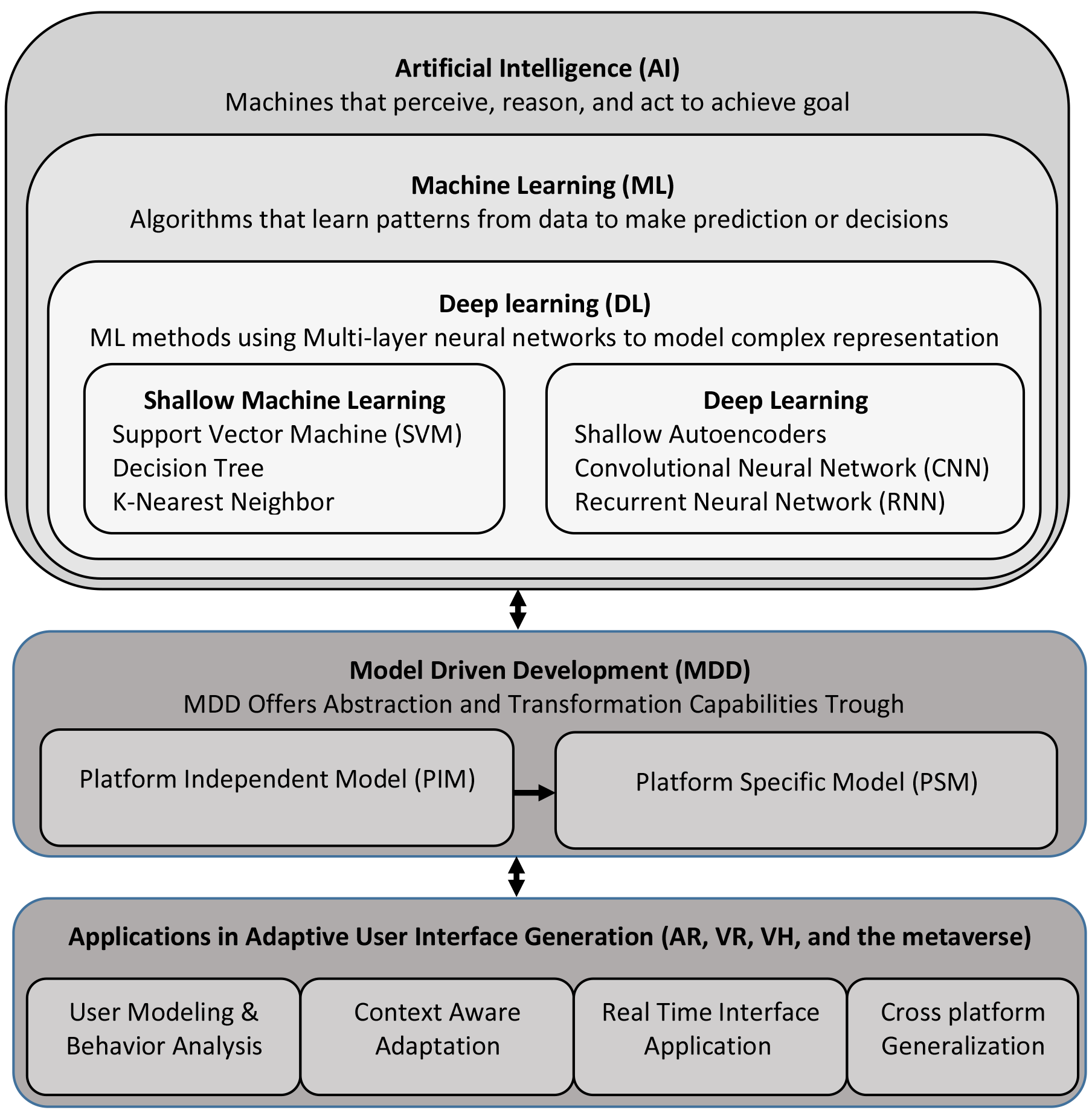
AI–MDD framework for adaptive UIs
- [1] K. Z. Gajos, M. Czerwinski, D. S. Tan, and D. S. Weld, “Exploring the design space for adaptive graphical user interfaces,” Proc. of the Working Conf. on Advanced Visual Interfaces, pp. 201-208, 2006. https://doi.org/10.1145/1133265.1133306
- [2] P. Langley, “The changing science of machine learning,” Machine Learning, Vol.82, No.3, pp. 275-279, 2011. https://doi.org/10.1007/s10994-011-5242-y
- [3] S. Brdnik, T. Heričko, and B. Šumak, “Intelligent User Interfaces and Their Evaluation: A Systematic Mapping Study,” Sensors, Vol.22, Issue 15, Article No.5830, 2022. https://doi.org/10.3390/s22155830
- [4] M. Kristić, I. Zakarija, F. Škopljanac-Mačina, and Ž. Car, “Machine Learning for Adaptive Accessible User Interfaces: Overview and Applications,” Applied Sciences, Vol.15, Issue 23, Article No.12538, 2025. https://doi.org/10.3390/app152312538
- [5] K. Todi, G. Bailly, L. Leiva, and A. Oulasvirta, “Adapting User Interfaces with Model-based Reinforcement Learning,” Proc. of the 2021 CHI Conf. on Human Factors in Computing Systems, Article No.573, 2021. https://doi.org/10.1145/3411764.3445497
- [6] J. Cha, J. Kim, and S. Kim, “Hands-Free User Interface for AR/VR Devices Exploiting Wearer’s Facial Gestures Using Unsupervised Deep Learning,” Sensors, Vol.19, Issue 20, Article No.4441, 2019. https://doi.org/10.3390/s19204441
- [7] D. C. Schmidt, “Guest Editor’s Introduction: Model-Driven Engineering,” Computer, Vol.39, Issue 2, pp. 25-31, 2006. https://doi.org/10.1109/MC.2006.58
- [8] R. France and B. Rumpe, “Model-driven Development of Complex Software: A Research Roadmap,” Future of Software Engineering (FOSE’07), pp. 37-54, 2007. https://doi.org/10.1109/FOSE.2007.14
- [9] M. Brambilla, J. Cabot, and M. Wimmer, “Model-Driven Software Engineering in Practice,” Springer Cham, 2017. https://doi.org/10.2200/S00751ED2V01Y201701SWE004
- [10] S. Kelly and J.-P. Tolvanen, “Domain-Specific Modeling: Enabling Full Code Generation,” John Wiley & Sons, 2008. https://doi.org/10.1002/9780470249260
- [11] J. Martí-Parreño, E. Méndez-Ibáñez, and A. Alonso-Arroyo, “The use of gamification in education: A bibliometric and text mining analysis,” J. of Computer Assisted Learning, Vol.32, Issue 6, pp. 663-676, 2016. https://doi.org/10.1111/jcal.12161
- [12] J. Baas, M. Schotten, A. Plume, G. Côté, and R. Karimi, “Scopus as a curated, high-quality bibliometric data source for academic research in quantitative science studies,” Quantitative Science Studies, Vol.1, Issue 1, pp. 377-386, 2020. https://doi.org/10.1162/qss_a_00019
- [13] M. Tober, “PubMed, ScienceDirect, Scopus or Google Scholar – Which is the best search engine for an effective literature research in laser medicine?,” Medical Laser Application, Vol.26, Issue 3, pp. 139-144, 2011. https://doi.org/10.1016/j.mla.2011.05.006
- [14] M. L. Rethlefsen and M. J. Page, “PRISMA 2020 and PRISMA-S: Common questions on tracking records and the flow diagram,” J. of the Medical Library Association, Vol.110, No.2, pp. 253-257, 2022. https://doi.org/10.5195/jmla.2022.1449
- [15] N. J. van Eck and L. Waltman, “Software survey: VOSviewer, a computer program for bibliometric mapping,” Scientometrics, Vol.84, No.2, pp. 523-538, 2010. https://doi.org/10.1007/s11192-009-0146-3
- [16] N. F. S. Jeffri and D. R. A. Rambli, “A review of augmented reality systems and their effects on mental workload and task performance,” Heliyon, Vol.7, Issue 3, Article No.e06277, 2021. https://doi.org/10.1016/j.heliyon.2021.e06277
- [17] A. Hietanen, R. Pieters, M. Lanz, J. Latokartano, and J.-K. Kämäräinen, “AR-based interaction for human-robot collaborative manufacturing,” Robotics and Computer-Integrated Manufacturing, Vol.63, Article No.101891, 2020. https://doi.org/10.1016/j.rcim.2019.101891
- [18] E. Chang et al., “A User Study on the Comparison of View Interfaces for VR-AR Communication in XR Remote Collaboration,” Int. J. of Human-Computer Interaction, Vol.40, Issue 19, pp. 5794-5809, 2024. https://doi.org/10.1080/10447318.2023.2241294
- [19] A. Liccardo and F. Bonavolontà, “VR, AR, and 3-D User Interfaces for Measurement and Control,” Future Internet, Vol.15, Issue 1, Article No.18, 2023. https://doi.org/10.3390/fi15010018
- [20] H.-J. Joo and H.-Y. Joo, “A study on eye-tracking-based Interface for VR/AR education platform,” Multimedia Tools and Applications, Vol.79, pp. 16719-16730, 2020. https://doi.org/10.1007/s11042-019-08327-0
- [21] X. Pan and A. F. de C. Hamilton, “Why and how to use virtual reality to study human social interaction: The challenges of exploring a new research landscape,” British J. of Psychology, Vol.109, Issue 3, pp. 395-417, 2018. https://doi.org/10.1111/bjop.12290
- [22] V. Bucur and M. Lungu-Cristian, “Entering the Metaverse from the JVM: The State of the Art, Challenges, and Research Areas of JVM-Based Web 3.0 Tools and Libraries,” Future Internet, Vol.15, Issue 9, Article No.305, 2023. https://doi.org/10.3390/fi15090305
- [23] C. R. Viñals, M. G, Ibáñez, and J. L. Del Olmo Arriaga, “Metaverse and Fashion: An Analysis of Consumer Online Interest,” Future Internet, Vol.16, Article No.199, 2024. https://doi.org/10.3390/fi16060199
- [24] S. Choi, K. Yoon, M. Kim et al., “Building Korean DMZ Metaverse Using a Web-Based Metaverse Platform,” Applied Sciences, Vol.12, Issue 15, Aricle No.7908, 2022. https://doi.org/10.3390/app12157908
- [25] M. G. Bertrand, H. B. Sezer, and I. K. Namukasa, “Exploring AR and VR Tools in Mathematics Education Through Culturally Responsive Pedagogies,” Digital Experiences in Mathematics Education, Vol.10, pp. 462-486, 2024. https://doi.org/10.1007/s40751-024-00152-x
- [26] S. Schutera et al., “On the Potential of Augmented Reality for Mathematics Teaching with the Application cleARmaths,” Education Sciences, Vol.11, Issue 8, Article No.368, 2021. https://doi.org/10.3390/educsci11080368
- [27] C. Reardon, R. Wright, D. Cihak, and L. E. Parker, “Intelligent Context-Aware Augmented Reality to Teach Students with Intellectual and Developmental Disabilities,” Proc. of 29th Int. Florida Artificial Intelligence Research Society Conf. (FLAIRS 2016), pp. 505-509, 2016.
- [28] J. Grubert, T. Langlotz, S. Zollmann, and H. Regenbrecht, “Towards Pervasive Augmented Reality: Context-Awareness in Augmented Reality,” IEEE Trans. on Visualization and Computer Graphics, Vol.23, Issue 6, pp. 1706-1724, 2016. https://doi.org/10.1109/TVCG.2016.2543720
- [29] T. Scargill, Y. Chan et al., “Environmental, User, and Social Context-Aware Augmented Reality for Supporting Personal Development and Change,” 2022 IEEE Conf. on Virtual Reality and 3D User Interfaces Abstracts and Workshops (VRW), pp. 155-162, 2022. https://doi.org/10.1109/VRW55335.2022.00042
- [30] T. Tahara, T. Seno, G. Narita, and T. Ishikawa, “Retargetable AR: Context-aware Augmented Reality in Indoor Scenes based on 3D Scene Graph,” 2020 IEEE Int. Symp. on Mixed and Augmented Reality Adjunct (ISMAR-Adjunct), pp. 249-255, 2020. https://doi.org/10.1109/ISMAR-Adjunct51615.2020.00072
- [31] S. Kardong-Edgren, S. L. Farra, G. Alinier, and H. M. Young, “A Call to Unify Definitions of Virtual Reality,” Clinical Simulation in Nursing, Vol.31, pp. 28-34, 2019. https://doi.org/10.1016/j.ecns.2019.02.006
- [32] E. Childs, F. Mohammad, L. Stevens et al., “An Overview of Enhancing Distance Learning Through Emerging Augmented and Virtual Reality Technologies,” IEEE Trans. on Visualization and Computer Graphics, Vol.30, Issue 8, pp. 4480-4496, 2024. https://doi.org/10.1109/TVCG.2023.3264577
- [33] X. Chen, T. Jiang, J. Song. J. Yang et al., “gDNA: Towards Generative Detailed Neural Avatars,” 2022 IEEE/CVF Conf. on Computer Vision and Pattern Recognition (CVPR), pp. 20395-20405, 2022. https://doi.org/10.1109/CVPR52688.2022.01978
- [34] D. Chattopadhyay, T. Ma, H. Sharifi, and P. Martyn-Nemeth, “Computer-Controlled Virtual Humans in Patient-Facing Systems: Systematic Review and Meta-Analysis,” J. of Medical Internet Research, Vol.22, No.7, Article No.e18839, 2020. https://doi.org/10.2196/18839
- [35] R. Sajja, Y. Sermet et al., “Artificial Intelligence-Enabled Intelligent Assistant for Personalized and Adaptive Learning in Higher Education,” Information, Vol.15, Issue 10, Article No.596, 2024. https://doi.org/10.3390/info15100596
- [36] G. D. Ritterbusch and M. R. Teichmann, “Defining the Metaverse: A Systematic Literature Review,” IEEE Access, Vol.11, pp. 12368-12377, 2023. https://doi.org/10.1109/ACCESS.2023.3241809
- [37] M. Faridan, B. Kumari, and R. Suzuki, “ChameleonControl: Teleoperating Real Human Surrogates through Mixed Reality Gestural Guidance for Remote Hands-on Classrooms,” Proc. of the 2023 CHI Conf. on Human Factors in Computing Systems, Article No.203, 2023. https://doi.org/10.1145/3544548.3581381
- [38] Y. Huang, T. Kanij et al. “Unlocking Adaptive User Experience with Generative AI,” arXiv preprint, arXiv:2404.05442, 2024. https://doi.org/10.48550/arXiv.2404.05442
- [39] K. Sharma, M. Giannakos, and P. Dillenbourg, “Eye-tracking and artificial intelligence to enhance motivation and learning,” Smart Learning Environments, Vol.7, Article No.13, 2020. https://doi.org/10.1186/s40561-020-00122-x
- [40] Z. Lyu, “State-of-the-Art Human-Computer-Interaction in Metaverse,” Int. J. of Human-Computer Interaction, Vol.40, Issue 21, pp. 6690-6708, 2024. https://doi.org/10.1080/10447318.2023.2248833
- [41] A. Burlacu, C. Brinza, and N. N. Horia, “How the Metaverse Is Shaping the Future of Healthcare Communication: A Tool for Enhancement or a Barrier to Effective Interaction?,” Cureus, Vol.17, No.3, Article Noe80742, 2025. https://doi.org/10.7759/cureus.80742
- [42] A. H. Glasscock, “Navigating the Metaverse: Potential Applications and Implications for State Government,” NASCIO Report, 2023.
- [43] A. Aljabari, M. Moreb, T. Sarsour, and M. Khemaja, “Exploring Metaverse Technologies in E-Learning: Methods, Benefits, Challenges, and Future Agenda,” 2025 Int. Conf. on Smart Learning Courses (SCME), pp. 7-14, 2025.
- [44] G. Grambow, D. Hieber, R. Oberhauser, and C. Pogolski, “Leveraging Augmented Reality to Support Context-Aware Tasks in Alignment with Business Processes,” Int. J. of Virtual Reality, Vol.21, pp. 17-20, 2021.
- [45] O. J. Nwobodo, K. Wereszczyński et al., “An Adaptation of Fitts’ Law for Performance Evaluation and Optimization of Augmented Reality (AR) Interfaces,” IEEE Access, Vol.12, pp. 169614-169627, 2024. https://doi.org/10.1109/ACCESS.2024.3498444
- [46] I. Ruiz-Rube, R. Baena-Pérez et al., “Model-driven development of augmented reality-based editors for domain specific languages,” IxD&A, Vol.45, pp. 246-263, 2020. https://doi.org/10.55612/s-5002-045-011
- [47] B. Mildenhall, P. P. Srinivasan, M. Tancik, J. T. Barron, R. Ramamoorthi, and R. Ng, “NeRF: Representing scenes as neural radiance fields for view synthesis,” Communications of the ACM, Vol.65, Issue 1, pp. 99-106, 2021. https://doi.org/10.1145/3503250
- [48] C. Cichiwskyj, S. Schmeißer, C. Qian et al., “Elastic AI: system support for adaptive machine learning in pervasive computing systems,” CCF Trans. on Pervasive Computing and Interaction, Vol.3, pp. 300-328, 2021. https://doi.org/10.1007/s42486-021-00070-6
- [49] S. Mohseni, N. Zarei, and E. D. Ragan, “A Multidisciplinary Survey and Framework for Design and Evaluation of Explainable AI Systems,” ACM Trans. on Interactive Intelligent Systems (TiiS), Vol.11, Issues 3-4, Article No.24, 2021. https://doi.org/10.1145/3387166
- [50] P. A. Akiki, A. K. Bandara, and Y. Yu, “Adaptive Model-Driven User Interface Development Systems,” ACM Computing Surveys (CSUR), Vol.47, Issue 1, Article No.9, 2014. https://doi.org/10.1145/2597999
- [51] J. Moon, M. Jeong et al., “Data Collection Framework for Context-Aware Virtual Reality Application Development in Unity: Case of Avatar Embodiment,” Sensors, Vol.22, Issue 12, Article No.4623, 2022. https://doi.org/10.3390/s22124623
- [52] A. Steed, “Three technical challenges of scaling from social virtual reality to metaverse(s): Interoperability, awareness and accessibility,” Frontiers in Virtual Reality, Vol.5, Article No.1432907, 2024. https://doi.org/10.3389/frvir.2024.1432907
- [53] J. S. Boyd, L. S. Smith et al., “Technology primer: Augmented and virtual reality for the metaverse,” Technical Report, 2023.
- [54] Md. Shamsujjoha, J. Grundy, L. Li, H. Khalajzadeh, and Q. Lu, “Developing Mobile Applications Via Model Driven Development: A Systematic Literature Review,” Information and Software Technology, Vol.140, Article No.106693, 2021. https://doi.org/10.1016/j.infsof.2021.106693
- [55] I. Gligorea, M. Cioca, R. Oancea, A.-T. Gorski, H. Gorski, and P. Tudorache, “Adaptive Learning Using Artificial Intelligence in e-Learning: A Literature Review,” Education Sciences, Vol.13, Issue 12, Article No.1216, 2023. https://doi.org/10.3390/educsci13121216
- [56] C. Halkiopoulos and E. Gkintoni, “Leveraging AI in E-Learning: Personalized Learning and Adaptive Assessment through Cognitive Neuropsychology – A Systematic Analysis,” Electronics, Vol.13, Issue 18, Article No.3762, 2024. https://doi.org/10.3390/electronics13183762
- [57] A. Ezzaim, A. Dahbi, A. Haidine, and A. Aqqal, “AI-Based Adaptive Learning: A Systematic Mapping of the Literature,” J. of Universal Computer Science, Vol.29, No.10, pp. 1161-1197, 2023. https://doi.org/10.3897/jucs.90528
- [58] J. S. Jauhiainen and A. G. Guerra, “Generative AI and ChatGPT in School Children’s Education: Evidence from a School Lesson,” Sustainability, Vol.15, Issue 18, Article No.14025, 2023. https://doi.org/10.3390/su151814025
- [59] C. A. Fidas, M. Belk, A. Constantinides, D. Portugal, P. Martins, A. M. Pietron, A. Pitsillides, and N. Avouris, “Ensuring Academic Integrity and Trust in Online Learning Environments: A Longitudinal Study of an AI-Centered Proctoring System in Tertiary Educational Institutions,” Education Sciences, Vol.13, Issue 6, Article No.566, 2023. https://doi.org/10.3390/educsci13060566
- [60] J. Xiang and C. Ma, “Modeling the Effectiveness of Blended Learning Promotion with Artificial Intelligence Adaptive Learning System,” J. of Logistics, Informatics and Service Science, Vol.10, No.3, pp. 88-97, 2023. https://doi.org/10.33168/JLISS.2023.0307
- [61] S. Borsci, E. Prati, A. Malizia, M. Schmettow, A. Chamberlain, and S. Federici, “Ciao AI: the Italian adaptation and validation of the Chatbot Usability Scale,” Personal and Ubiquitous Computing, Vol.27, No.6, pp. 2161-2170, 2023. https://doi.org/10.1007/s00779-023-01731-2
- [62] H. Naveed, C. Arora, H. Khalajzadeh, J. Grundy, and O. Haggag, “Model driven engineering for machine learning components: A systematic literature review,” Information and Software Technology, Vol.169, Article No.107423, 2024. https://doi.org/10.1016/j.infsof.2024.107423
- [63] A. R. Sadik, S, Brulin, and M. Olhofer, “LLM as a code generator in Agile Model Driven Development,” arXiv preprint, arXiv:2410.18489, 2024. https://doi.org/10.48550/arXiv.2410.18489
- [64] R. Matinnejad, “Agile Model Driven Development: An Intelligent Compromise,” 2011 9th Int. Conf. on Software Engineering Research, Management and Applications, pp. 197-202, 2011. https://doi.org/10.1109/SERA.2011.17
- [65] R. Campos-López, E. Guerra et al., “Model-Driven Engineering for Augmented Reality,” J. of Object Technology, Vol.22, No.2, pp. 2:1-15, 2023. https://doi.org/10.5381/jot.2023.22.2.a7
- [66] A. Moin, M. Challenger, A. Badii, and S. Günnemann, “A model-driven approach to machine learning and software modeling for the IoT: Generating full source code for smart Internet of Things (IoT) services and cyber-physical systems (CPS),” Software and Systems Modeling, Vol.21, pp. 987-1014, 2022. https://doi.org/10.1007/s10270-021-00967-x
- [67] J. Straub, “Development of an Adaptive Multi-Domain Artificial Intelligence System Built using Machine Learning and Expert Systems Technologies,” arXiv preprint, arXiv:2406.11272, 2024. https://doi.org/10.48550/arXiv.2406.11272
- [68] E. Yigitbas, H. Stahl, S. Sauer, and G. Engels, “Self-adaptive UIs: Integrated Model-Driven Development of UIs and Their Adaptations,” 13th European Conf. on Modelling Foundations and Applications (ECMFA 2017), pp. 126-141, 2017. https://doi.org/10.1007/978-3-319-61482-3_8
- [69] E. Yigitbas, I. Jovanovikj, K. Biermeier, S. Sauer, and G. Engels, “Integrated model-driven development of self-adaptive user interfaces,” Software and Systems Modeling, Vol.19, pp. 1057-1081, 2020. https://doi.org/10.1007/s10270-020-00777-7
- [70] E. Planas, G. Daniel, M. Brambilla, and J. Cabot, “Towards a model-driven approach for multiexperience AI-based user interfaces,” Software and Systems Modeling, Vol.20, pp. 997-1009, 2021. https://doi.org/10.1007/s10270-021-00904-y
- [71] W. S. Sayed, A. M. Noeman, A. Abdellatif et al., “AI-based adaptive personalized content presentation and exercises navigation for an effective and engaging E-learning platform,” Multimedia Tools and Applications, Vol.82, pp. 3303-3333, 2023. https://doi.org/10.1007/s11042-022-13076-8
- [72] B. Alsanousi, A. S. Albesher et al., “Investigating the User Experience and Evaluating Usability Issues in AI-Enabled Learning Mobile Apps: An Analysis of User Reviews,” Int. J. of Advanced Computer Science and Applications, Vol.14, Issue 6, 2023. https://doi.org/10.14569/IJACSA.2023.0140602
- [73] M. A. Almaiah, R. Alfaisal et al., “Measuring Institutions’ Adoption of Artificial Intelligence Applications in Online Learning Environments: Integrating the Innovation Diffusion Theory with Technology Adoption Rate,” Electronics, Vol.11, Issue 20, Article No.3291, 2022. https://doi.org/10.3390/electronics11203291
- [74] O. Tapalova and N. Zhiyenbayeva, “Artificial Intelligence in Education: AIEd for Personalised Learning Pathways,” Electronic J. of e-Learning, Vol.20, No.5, pp. 639-653, 2022. https://doi.org/10.34190/ejel.20.5.2597
- [75] H. Wiemer, D. Schneider et al., “Need for UAI – Anatomy of the Paradigm of Usable Artificial Intelligence for Domain-Specific AI Applicability,” Multimodal Technologies and Interaction, Vol.7, Issue 3, Article No.27, 2023. https://doi.org/10.3390/mti7030027
- [76] P. Battistoni, M. Di Gregorio et al., “Can AI-Oriented Requirements Enhance Human-Centered Design of Intelligent Interactive Systems? Results from a Workshop with Young HCI Designers,” Multimodal Technologies and Interaction, Vol.7, Issue 3, Article No.24, 2023. https://doi.org/10.3390/mti7030024
This article is published under a Creative Commons Attribution-NoDerivatives 4.0 Internationa License.