
Review:
AI_MDD Approaches for Generating Adaptive and Intelligent UIs: A Systematic Literature Review
Ahmad Aljabri*1, Haytham Hijazi*2
 , Sami Al-Salamin*3
, and Maha Khemaja*4
, Sami Al-Salamin*3
, and Maha Khemaja*4
*1Higher Institute of Applied Science and Technology of Sousse, University of Sousse
Cité Taffala (Ibn Khaldoun), Sousse 4003, Tunisia
*2Faculty of Engineering and Information Technology, Palestine Ahliya University
Jabal Daher P.O. Box 1041, Bethlehem, West Bank 90907, Palestine
*3Computer Engineering Department, Palestine Polytechnic University
P.O. Box 198 Dahiat albaladia, Hebron, Palestine
*4Higher Institute of Applied Science and Technology of Sousse
Rue Hedi Mzabi, Khezama Ouest, Sousse 4003, Tunisia

This study presents a combined bibliometric analysis and systematic literature review of artificial intelligence (AI)_model-driven development (MDD) approaches for generating adaptive and intelligent user interfaces. Based on an initial set of 3,335 records retrieved from Scopus, a structured filtering process following preferred reporting items for systematic reviews and meta-analyses guidelines resulted in 51 relevant studies for in-depth analysis. The findings indicate a rapid growth in research within this area, particularly over the last five years, with substantial contributions from the fields of computer science and engineering. The analysis shows that current approaches increasingly rely on integrating machine learning techniques within model-driven pipelines to support context-aware adaptation, particularly in emerging environments such as augmented reality, virtual reality, virtual humans, and metaverse environments. This review further identified a set of dominant methodological trends, including AI-assisted code generation, models@runtime adaptation, and generative user interface approaches. However, several limitations remain evident in the literature, particularly regarding real-time adaptation, cross-platform interoperability, and energy efficiency. Overall, the results suggest that while AI_MDD combination has progressed toward more adaptive and intelligent interface generation, existing approaches remain largely experimental and lack standardized frameworks for deployment. These findings highlight the need for robust methodologies that combine model-based abstraction with data-driven adaptation in a consistent and scalable manner.
AI–MDD framework for adaptive UIs
1. Introduction
Artificial intelligence (AI) has become a key enabler in the design and development of adaptive user interfaces (UIs), particularly through machine learning (ML) techniques that allow systems to model user behavior and contextual information. Early research has demonstrated the feasibility of automatically generating personalized interfaces by leveraging optimization and learning-based techniques. For instance, the SUPPLE framework introduced by Gajos et al. demonstrates the automatic generation of adaptive interfaces to accommodate user abilities, device characteristics, and interaction constraints, thereby improving accessibility and usability 1.
Subsequent studies further explored adaptive graphical interfaces and demonstrated how interaction data can be utilized to dynamically configure interface components and workflows 2. Recent advances in ML and DL have enabled the development of intelligent UIs capable of analyzing large-scale behavioral data and adapting interaction mechanisms in real time. These approaches are particularly relevant in complex and multimodal environments, where user interactions involve heterogeneous input modalities and contextual signals. Recent surveys and empirical studies indicate that learning-based adaptation mechanisms significantly improve personalization, accessibility, and user experience across a variety of digital platforms 3,4. In addition, reinforcement learning and deep neural models have been proposed to adjust interface layouts and interaction flows dynamically based on continuous feedback from user interactions 5. Within this evolving landscape, combining AI techniques with model-driven development (MDD) has emerged as a promising research direction for the systematic engineering of adaptive UIs. By embedding learning models into model-transformation pipelines, MDD can support automated interface generation while enabling adaptive behavior driven by user data and contextual information. This provides a structured pathway for combining data-driven intelligence with model-based software engineering to facilitate the development of scalable intelligent UI systems.
MDD is an approach that elevates models from documentation tools used prior to coding to the primary resources of the software development life cycle, enabling automatic generation of code from a series of models. Further, MDD offers several important software quality attributes, including reusability, portability, and interoperability, largely because of the object management group (OMG) model-driven architecture (MDA) standard. However, it is essential to recognize that MDD is not a specific methodology; rather, it is a general approach that can be applied to software development processes to harness its potential 6.
MDD emerged from earlier model-based software engineering approaches that emphasized the use of abstract models to support software design and development 7,8. Early model-based methodologies focused on representing the system structure and behavior using formal models, such as UML, primarily to improve documentation and design consistency 8. However, these approaches have limited automation capabilities 9. The concept of model-driven engineering evolved significantly in the early 2000s with the introduction of MDA by the OMG, which proposed a structured development process based on the separation of platform-independent model (PIM) and platform-specific model (PSM). This paradigm enabled automated model transformations and code generation, rendering models as central artifacts within the development process 7,9. Subsequent research has expanded MDD methodologies by integrating domain-specific modeling languages, automated transformation pipelines, and runtime adaptation mechanisms 10,9.
These advancements have enabled models to drive not only system implementation but also interface generation and user interaction logic 9. Recently, the combination of AI and ML techniques has opened up new opportunities for combining data-driven adaptation with model-based engineering processes, particularly for the development of adaptive and intelligent UIs 3,4.
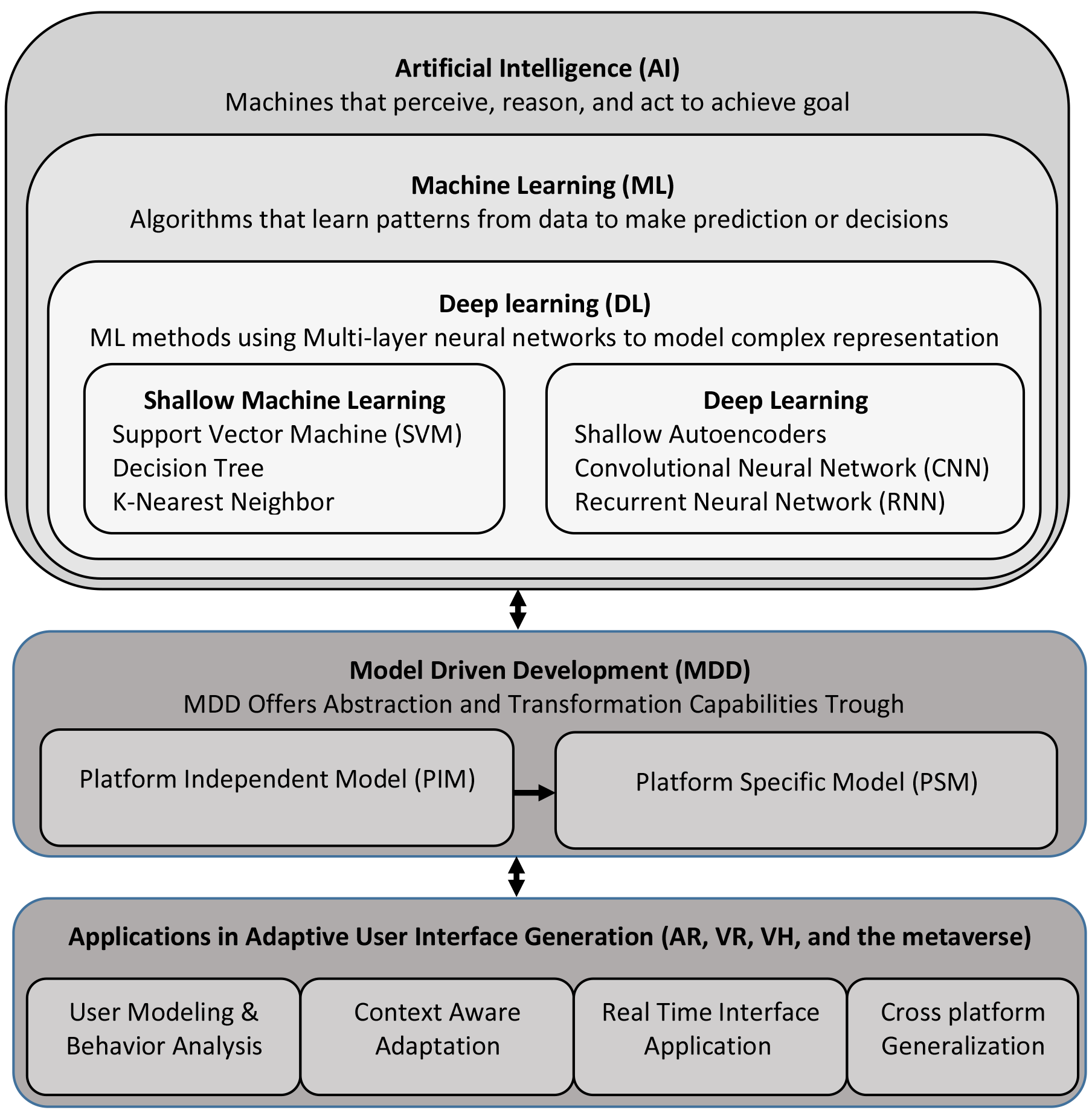
Figure 1 presents the conceptual framework underlying this survey, illustrating how AI techniques and MDD jointly contribute to adaptive UI generation. AI methods provide data-driven intelligence through learning, prediction, and adaptation mechanisms, whereas MDD offers abstraction and transformation capabilities through models such as PIM and PSM. These processes have been applied across emerging interaction domains, including augmented reality (AR), virtual reality (VR), virtual human (VH), and metaverse environments. The integration of these layers enables the generation of adaptive and intelligent UIs that respond dynamically to user behaviors and contextual information.
Fig. 1. Conceptual framework illustrating the integration of AI and MDD for generation of adaptive and intelligent UIs across emerging interaction environments.
The MDD and AI paradigms are transforming software design and development. Specifically, MDD emphasizes the abstraction of system design through high-level models, whereas AI leverages data-driven methods to facilitate intelligent decision-making and automation. Although several review studies have independently examined MDD, adaptive UIs, and AI-enabled interaction systems, the literature still lacks an integrated survey explaining how these strands converge in the generation of adaptive and intelligent UIs. Existing MDD surveys primarily focus on software engineering abstractions, transformation mechanisms, and tooling, whereas reviews of intelligent or adaptive UIs often emphasize personalization, usability, or interaction technologies without sufficiently addressing model-driven processes. Consequently, the specific role of AI within the MDD pipelines in adaptive UI generation remains unclear.
In this context, the purpose of this review is not only to collect and summarize prior studies but also to provide a structured analytical perspective on the emerging convergence between AI and MDD in adaptive UI engineering. To this end, this study combines the bibliometric analysis (BA) and systematic literature review (SLR). The BA phase identified publication trends, dominant keywords, and disciplinary patterns in the field, whereas the SLR phase examined interface types, context-awareness mechanisms, AI methods, MDD methodologies, and unresolved gaps. The central argument of this survey is that AI_MDD should be understood as a unified research direction in which model-based abstractions provide structural rigor and portability, whereas AI techniques provide data-driven adaptation, personalization, and intelligent interface behaviors.
This study aims to provide a structured survey of AI_MDD approaches for generating adaptive and intelligent UIs, with particular attention to their methodological foundations, application contexts, and unresolved research challenges. Rather than considering AI, MDD, and adaptive interaction technologies as isolated topics, this study examined their convergence as an emerging interdisciplinary field. Through a combination of BA and SLR, this study seeks to map the evolution of this field, identify its dominant research directions, and clarify conceptual and practical gaps that hinder the development of next-generation adaptive UIs.
It addresses specific questions and discusses limitations, challenges, and the future. This study employed the preferred reporting items for systematic reviews and meta-analyses (PRISMA) approach to filter the collected publication databases. For BA, this study aims to address the following research questions:
-
・
RQ1: What is the publication trend over the past decade regarding AI_MDD approaches for generating adaptive and intelligent UIs?
-
・
RQ2: What are the primary research keywords used in this field?
-
・
RQ3: Which subject areas are the most common in the field during this same period?
For the SLR analysis, this study aims to address the following extended research questions:
-
・
RQ4: What type of interfaces along with their usage and interactions, emerge within AR, VR, VHs, and metaverse environments?
-
・
RQ5: How is context-awareness conceptualized within these interfaces?
-
・
RQ6: What approaches and synergies exist for combining AI with MDD to generate adaptive UIs?
-
・
RQ7: What are the research gaps and challenges that hinder the integration of AI with MDD for adaptive UI generation?
This study extends beyond providing a simple overview of adaptive UIs. This offers a structured synthesis of the integration of AI and MDD. Unlike existing surveys, which typically address UIs, AI, MDD, or immersive integration techniques separately, this study integrates business analysis with SLR to investigate the convergence of these fields in the generation of intelligent and adaptive UIs. Specifically, this study contributes in three ways: (1) identifying prevailing research trends and thematic structures through business analysis; (2) systematically analyzing how AI techniques are integrated into MDD pathways to generate intelligent and adaptive UIs; and (3) providing a conceptual synthesis that clarifies the relationships among AI, MDD, and emerging interaction technologies.
2. Materials and Methods
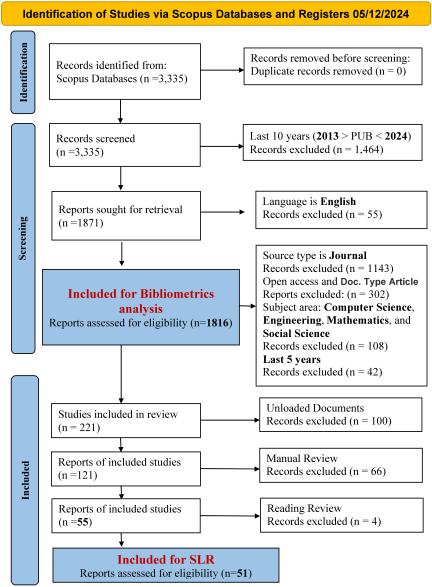
Fig. 2. PRISMA flowchart, which depicts the systematic review process outlining the identification, screening, eligibility, and inclusion steps used to select studies for the AI_MDD analysis.
This section outlines the methodologies employed in previous studies and reviews earlier research efforts. The goal is to provide readers with sufficient information regarding the original data sources, methodology, analysis, evaluation, and verification of the reported results. The proposed modifications should be detailed and areas for further research should be suggested. Research methods for reviewing literature are essential for determining the indicators of past achievements and identifying their weaknesses and gaps. Therefore, it is important to adopt scientific methods such as BA for literature reviews. BA involves tracking studies on a specific topic and analyzing them based on various characteristics to obtain insightful results 11. Therefore, this study adopted BA to review the literature and extract the criteria used to filter articles for an SLR, following the flowchart illustrated in Fig. 2. This review included relevant articles from the Scopus database to ensure access to high-quality research 12. This research covered studies published before December 5, 2024. the methodology can be summarized in several steps, starting with the identification of keywords for the search process. Keywords are extracted from the research title (AI) as the primary research field, and a combination of at least one of the other keywords (MDD, human-computer interfaces, adaptation, educational domain, or experience) that must be in the title, abstract, or keyword search options to reduce the inclusion of irrelevant studies. The search query was formalized to explicitly capture the intersection between AI, MDD, and adaptive UIs. Instead of relying on broad keyword combinations, a structured Boolean query was employed to ensure that the retrieved studies addressed these three dimensions simultaneously. The query retrieved 3,335 records. As previously mentioned, Scopus was used in this study because it offers smart tools to visualize, analyze, and track study outcomes in different fields 13.
2.1. PRISMA Flow
We applied the PRISMA methodology to track the search criteria and obtain articles for BA and SLR in a clear, transparent, and detailed manner following 14.
2.2. Inclusion/Exclusion Criteria
The flowchart in Fig. 2 and the inclusion and exclusion criteria listed in Table 1 were used to screen the retrieved records. For BA, only English-language documents published within the last 10 years were included, resulting in 1,816 records. For the SLR, we selected articles published within the last five years in the subject areas of computer science, engineering, mathematics, and social sciences following the recommendations from the BA results. The filtering criteria that are illustrated in Table 1 were then applied. A total of 121 articles were identified. After a manual review, we identified 51 relevant articles for our study. For more details, please refer to Section 3.
| Cr. | Search query | Methodological purpose |
| BA | TITLE (“artificial intelligence” OR “AI”) | Main keyword |
| TITLE-ABS-KEY (“model-driven development” OR “model-driven software” OR “MDD” OR “human computer interfaces” OR “HCI” OR “adaptation” OR “educational domain” OR “user experience” OR “UX”) | Ensure thematic relevance and high recall | |
| PUBYEAR \(> 2013\) AND PUBYEAR \(< 2024\) | Capture field evolution | |
| LIMIT-TO (LANGUAGE, “English”) | International research | |
| SLR | LIMIT-TO (SRCTYPE, “j”) | Ensure quality and peer-review rigor |
| LIMIT-TO (DOCTYPE, “ar”) AND LIMIT-TO (OA, “all”) | Open access article | |
| LIMIT-TO (SUBJAREA, “COMP”) OR LIMIT-TO (SUBJAREA, “ENGI”) OR LIMIT-TO (SUBJAREA, “SOCI”) OR LIMIT-TO (SUBJAREA, “MATH”) | Align SLR with BA findings | |
| PUBYEAR \(>\) 2017 AND PUBYEAR \(<\) 2024 Focus on state-of-the-art | ||
| Cr. = Criteria | ||
To ensure methodological rigor and reproducibility, explicit inclusion and exclusion criteria were defined and applied consistently across all screening stages.
Inclusion criteria: Studies explicitly addressing the integration of AI and MDD; research focusing on adaptive, intelligent, or context-aware UIs; peer-reviewed journal articles; studies published between 2017 and 2024 (for SLR); and articles written in English.
Exclusion criteria: Studies focusing solely on AI or MDD without a combination; papers unrelated to UIs or human-computer interaction; short papers, editorials, or non-peer-reviewed content; duplicate or inaccessible full-text articles; and studies lacking sufficient methodological or experimental detail.
These criteria were iteratively refined during the screening process to ensure consistency and relevance.
The filtering criteria summarized in Table 1 were designed to ensure both the relevance and methodological rigor of the selected corpus. In particular, different criteria were applied at the BA and SLR stages to balance breadth and depth of the analysis. The BA phase employed a broader time window (last 10 years) to capture the evolution of the research field, identify publication trends, and detect dominant themes and subject areas. In contrast, the SLR phase focused on a more recent subset (the last five years) to analyze state-of-the-art approaches and current research directions in greater detail. The restriction on journal articles and peer-reviewed publications was intended to ensure scientific quality and reliability while limiting the corpus to open-access sources to improve the transparency and reproducibility of the review process. Furthermore, the selection of subject areas was guided by the BA results, enabling the SLR phase to focus on the most relevant and representative disciplines rather than relying on predefined or arbitrary domain boundaries. Overall, these criteria collectively support a two-stage review strategy in which BA provides a global mapping of the research landscape, and the subsequent SLR enables a focused and in-depth examination of methodologies, applications, and research gaps.
2.3. Content Analysis and Thematic Synthesis
Beyond the bibliometric filtering process, the final set of eligible studies was subjected to a structured qualitative content analysis to ensure that the findings of this survey were grounded in the substantive contributions of prior work rather than in bibliographic metadata alone. Although BA was used to identify publication trends, dominant keywords, and disciplinary distributions, it did not provide sufficient depth for extracting methodological insights, research gaps, or future directions. The full texts of the selected articles were systematically examined following the PRISMA-based selection process. Each study was analyzed using a predefined coding framework designed to capture both the technical and conceptual dimensions of the research. Specifically, the analysis considered (i) the type of UI or interaction environment (e.g., AR, VR, VHs, or metaverse applications); (ii) the interaction paradigm and modalities employed; (iii) the context-awareness mechanisms and contextual data sources; (iv) AI techniques applied (e.g., ML, DL, and reinforcement learning); (v) MDD methodology or modeling strategy adopted (e.g., PIM–PSM transformations, domain-specific modeling, and runtime adaptation); (vi) the application domain; (vii) the reported limitations and challenges; and (viii) the future research directions identified by the authors. Accordingly, the methodological workflow of this study combines the strengths of the BA and SLR: the former provides a high-level mapping of the research landscape, whereas the latter enables an in-depth interpretation of methodologies, applications, and unresolved challenges in the integration of AI and MDD for adaptive UI generation.
The outcomes of this content analysis are reflected in the thematic organization and synthesis presented in Sections 3 and 4.
2.4. Screening and Selection Process
The screening process was conducted in multiple stages following PRISMA guidelines. First, title and abstract screening were performed to eliminate irrelevant studies. Subsequently, full-text screening was conducted to assess the eligibility based on the defined inclusion and exclusion criteria. To improve the reliability, the screening process was independently performed by two reviewers. Disagreements were resolved through discussion, and when necessary, a third opinion was considered. This process ensured consistency and reduced subjective bias during study selection. The transition from 121 to 51 studies resulted from the application of stricter relevance criteria during the full-text analysis, particularly focusing on studies that explicitly combined AI and MDD for adaptive UI generation. Studies that partially addressed only one of these aspects were also excluded.
The reduction from 3,335 initial records to 51 final studies reflects a progressive filtering strategy aimed at ensuring both relevance and quality. While early filtering stages relied on automated criteria (e.g., year, subject area, document type), the final reduction was driven by conceptual relevance to the AI_MDD integration problem, ensuring that only studies directly addressing adaptive interface generation were retained.
3. BA and its Interpretive Role
The BA in this study was not intended merely as a descriptive overview of publication statistics. Rather, it was used as an interpretive step to understand how the field has evolved, which concepts have become dominant, and which disciplinary areas have shaped the convergence among AI, MDD, and adaptive UIs. Three bibliometric indicators were selected: publication trends, keyword co-occurrence, and subject_area distribution. Publication trends help reveal the historical growth and maturity of the field; keyword co-occurrence captures its conceptual structure and thematic evolution; and subject-area analysis highlights its interdisciplinary foundations. Together, these indicators provide a rationale for the subsequent SLR and help distinguish this survey from prior review studies, which typically focuses on only one dimension of the field. The BA assists in the filtering process to extract research for implementation in the SLR. Therefore, this study uses BA to examine the most frequently used keywords, publication trends over the last 10 years, the most common subject areas, and the relationships between these keywords and their usage. The research aims to investigate the thematic structure of “AI and MDD to generate intelligent and adaptive UIs” by using accurate ML methods to automatically scan all documented literature data with a Scopus analyzer and the VOSViewer application. VOSViewer is a widely used software for visualizing bibliometric networks 15. This study aims to explore the research portfolio on the integration of “AI and MDD to create intelligent and adaptive UIs” over the last 10 years, focusing on high quality, globally ranked research. The results of this review are discussed based on the aforementioned research questions.
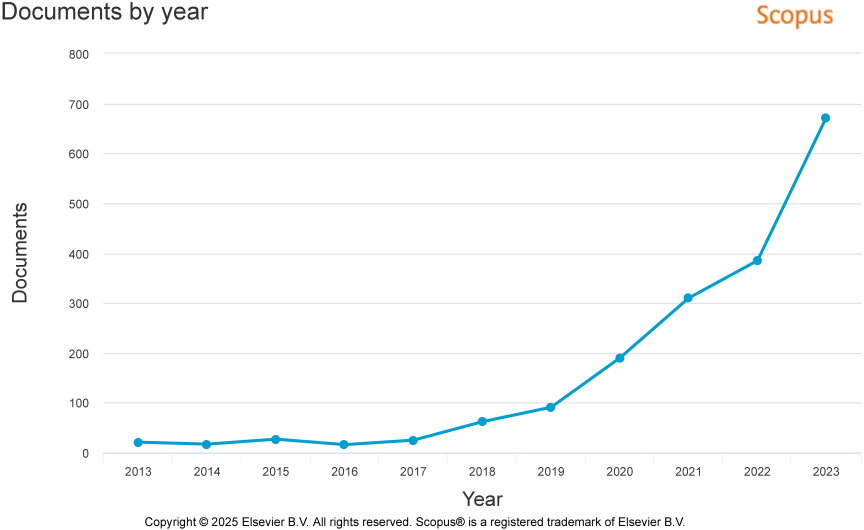
Fig. 3. Rising trend in AI_MDD research publications, highlighting significant growth during the last 10 years.
3.1. Publication Trends Over the Past 10 Years
Referring to RQ1 for BA, to address this, an analysis of the documents was performed; Fig. 3 illustrates that 1,648 out of 1,816 publications were published in the last five years, with a publication ratio of approximately 91% of the total publications. This indicates that the authors and researchers have shown increased interest in AI_MDD approaches and that these technologies are increasingly applied across various fields. This result suggests focusing on studies from the last five years, as this represents the largest proportion of published research. This result was adopted as a criterion for filtering articles in the Scopus database for the SLR. In addition to reporting publication counts, this indicator is important because it reflects the historical acceleration of research at the intersection of AI, MDD, and UIs. The concentration of publications in recent years suggests that this is not a mature or stable field but an emerging and rapidly expanding field. This historical pattern also justifies the decision to focus on the SLR phase in recent studies because they are more likely to capture current methodological developments than older, more generic MDD or HCI studies.
3.2. Primary Research Keywords
Referring to RQ2 for BA, co-occurrence was selected as the analysis type, and “Author’s keywords” was designated as the unit for the bibliometric study of the most popular keywords. In this regard, Fig. 4 and Table 2 present the most frequent keywords found in the dataset, totaling 682. As shown in Table 2, the keywords utilized in the research were as follows: AI 957, ML 525, human 147, and human-computer interface 206. Further, other prolific keywords in the research topic field are presented in Table 2. In addition, Table 2 also shows the total link strength (TLS) for each keyword in the field of research topic. The results regarding keywords specific to a research topic can be used as criteria when conducting research in this field. The use of keyword co-occurrence was motivated by the need to identify how the field is conceptually organized rather than simply the most frequently appearing terms. This analysis reveals the thematic evolution of the literature and shows that the field is shaped not only by technical AI terms but also by concepts related to human-computer interaction, user experience, and adaptation. In contrast to previous survey studies that have often examined MDD or intelligent interfaces separately, the present study used a keyword structure to demonstrate the hybrid and convergent nature of the research landscape.
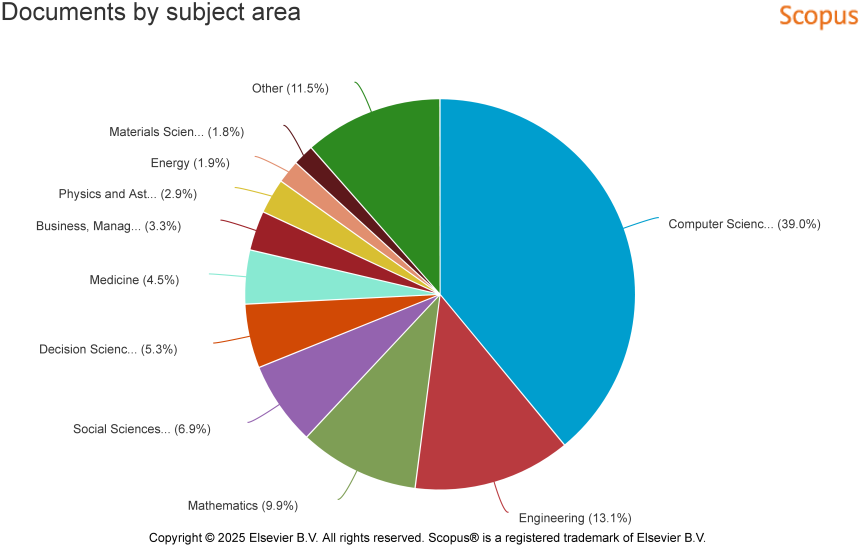
Fig. 4. Dominant research fields, with computer science leading AI_MDD studies, followed by engineering, mathematics, and social sciences.
| Keyword | Occurrences | TLS |
| artificial intelligence | 957 | 2,287 |
| machine learning | 525 | 884 |
| human | 147 | 760 |
| human computer interface | 206 | 660 |
| user experience | 241 | 655 |
| article | 94 | 543 |
| user experiences | 179 | 512 |
| deep learning | 142 | 495 |
| humane | 92 | 478 |
| user interface | 166 | 477 |
| TLS = Total link strength | ||
3.3. Most Common Subject Areas
Referring to RQ3 for BA, according to the Scopus database analyzer, an analysis was conducted on the publication subject areas of the articles over the previous 10 years; the first subject area is “computer science,” which accounts for approximately 39%. This is followed by engineering, mathematics, and social sciences, as illustrated in Fig. 4. This result was selected as a criterion for filtering articles in the Scopus database for the SLR. Subject area distribution was selected as a bibliometric indicator because it helps to explain the disciplinary breadth of the field and its historical positioning across different research communities. The prominence of computer science, engineering, mathematics, and social sciences confirms that AI_MDD for adaptive UIs cannot be understood as a purely technical problem. Rather, it is an interdisciplinary research area that combines software engineering, intelligent systems, and human-centered design. This supports one of the central premises of the present survey, namely that a meaningful review must bridge these domains rather than analyze them in isolation.
3.4. Findings from BA
After showing the results of the most popular and reliable analysis applications (Scopus analyzer and VOSViewer) conducted on the research topic, these results were discussed and summarized as follows. Publication trends: Growth in publications over the last five years, with 91% of the research output occurring in the last 10 years. Primary keywords: “AI,” “ML,” “human,” and “human computer interface” dominate the field. Subject areas: this research is interdisciplinary and involves computer science, engineering, mathematics, and social sciences. In the next section, we use these results as the criteria to conduct a more focused and accurate SLR. These criteria were used to filter 1,816 records following the steps shown in Fig. 2 and Table 1. The bibliometric findings also help to clarify how this study differs from previous survey studies. Earlier reviews often concentrated on a single research stream, such as MDE, adaptive UIs, intelligent tutoring systems, or XR-based interaction technologies. By contrast, the present study used BA to map a broader research landscape before conducting a systematic review of the intersection between these streams. In this sense, the contribution of this review lies not only in summarizing prior work but also in providing an integrated perspective on how AI methods, MDD methodologies, and emerging interaction environments are evolving together as part of a unified research direction.
4. SLR
The first stage of SLR involves analyzing the articles and summarizing the results as categories, article labels, descriptive approaches, techniques, frameworks, methodologies, limitations/challenges, results/contributions, and future work. In this section, we answer and discuss the research questions mentioned in Section 1.
4.1. Types of Interfaces, Their Uses and Interactions
Referring to RQ4 (of SLR), the types of interfaces, their uses, and interactions are described as follows.
4.1.1. Types of Interfaces
Table 3 compares the four key digital technologies (VR, AR, VH, and MV) in terms of five critical aspects. VR creates fully immersive, computer-generated environments that replace physical reality, typically accessed through headsets and motion controllers. It is widely used in gaming, simulations, and training and requires model-driven representations that capture spatial context, sensor data, and environmental dynamics. These models can be transformed into adaptive interface components, whereas AI techniques enable real-time interpretation of contextual signals and dynamic interface adjustment. AR overlays digital content onto the real world via devices such as smartphones or AR glasses, thereby enhancing real-world experiences in navigation, education, and marketing without isolating users. In VR environments, MDD supports the modeling of immersive scenes and interaction flows, whereas AI methods contribute to the adaptive behavior, user modeling, and personalization of virtual experiences. VHs are AI-driven digital characters that simulate human behavior and interactions and serve roles in customer service, companionship, and storytelling within VR, AR, or standalone applications. VH interfaces further illustrate the combination of AI and MDD, where behavioral and conversational models are defined at the modeling level, and AI techniques are used to generate adaptive dialogue, gestures, and user interaction patterns. The MV represents a persistent, interconnected virtual universe that blends VR, AR, and social elements, enabling real-time interactions across social media, commerce, gaming, and education. In MV environments, the combination of AI and MDD becomes even more critical, as models must support interoperability, persistence, and cross-platform deployment, whereas AI enables intelligent coordination and adaptation across distributed interaction spaces. Each technology offers distinct user experiences: VR immerses, AR enhances, VHs interact, and MV converges these elements into a unified digital ecosystem 16,17,6,18,19,20,21,22,23,24 . Table 4 categorizes cutting-edge interfaces powered by AR, VR, VH, and MV technologies, highlighting their diverse applications and innovations. AR interfaces include educational tools with 3D visualizations and adaptive tutoring 25,26,27, industrial guides with real-time annotations 17,28, and context-aware systems that respond to biometric or environmental cues 29,30. VR encompasses immersive training simulations for high-risk professions 31,32 and social platforms featuring collaborative virtual classrooms 24,33. VHs serve as healthcare assistants and AI tutors, offering personalized support through natural conversations 34,31,35,23. MV combines multi-user virtual worlds with hybrid AR/VR environments for shared experiences 24,36,18,37, whereas EI leverage generative AI for dynamic content creation and neuro-adaptive systems for brain-controlled interactions 38,33,39. These technologies are transforming how we learn, work, and connect by blending the digital and physical worlds through intuitive adaptive interfaces.
| AS | VR | AR | VH | MV |
| D | Computer-generated simulation or recreation of a real-world or fictional environment | Technology that superimposes digital content (such as images, sounds, or information) onto the real world in real-time | Computer-generated characters or avatars that simulate human behavior, appearance, and interactions in a digital environment | Collective, virtual shared space created by the convergence of virtually enhanced physical reality and persistent digital environments |
| E | Completely virtual; fully replaces the real world | Blends virtual content with the physical world | Exists in VR/AR environments or standalone as digital applications | Combines virtual worlds, AR elements, and real-time social interactions |
| IM | VR headsets, controllers, motion sensors | Smartphones, AR glasses, tablets, or other AR-enabled devices | Interfaces like AI systems, chat platforms, or avatar-based environments | Computers or other internet-connected platforms |
| UX | Fully immersive, blocking out the surrounding physical environment | Enhances real-world experiences without isolating users | Focuses on human interaction, communication, or task performance | Relates to users interacting with virtual content in real time |
| A | Games, simulations, virtual tours, and training | Navigation, education, retail, and interactive marketing | AI-powered customer service, digital companions, interactive stories | Social media, commerce, gaming, education, and virtual economies |
| RE | Immersive scene and interaction modeling | Spatial/context-aware modeling | Behavior and dialogue modeling | Interoperability and persistent world modeling |
| RO | Context-aware modeling + adaptive rendering | Immersive model transformation + AI-driven personalization | Behavioral modeling + AI dialogue generation | Cross-platform modeling + AI orchestration |
| AS \(=\) aspect, D \(=\) definition, E \(=\) environment, IM \(=\) interaction medium, UX \(=\) user experiences, A \(=\) application, RE \(=\) MDD relevance, RO \(=\) AI_MDD role | ||||
| Interface | Interface type | Key features |
| AR | Educational AR | 3D visualizations; gesture-based interaction; adaptive tutoring |
| Industrial AR | Step-by-step assembly guidance; real-time annotations | |
| Context-aware AR | Biometric and environmental adaptation (e.g., stress, lighting) | |
| VR | Immersive training | Medical simulations; hazardous environment practice |
| Social VR | Multi-user classrooms; avatar-mediated collaboration | |
| VH | Healthcare assistants | Conversational agents for therapy and empathy training |
| AI tutors/guides | Personalized learning; retail assistance | |
| MV | Multi-user worlds | Educational hubs (e.g., DMZ metaverse); decentralized social spaces |
| Hybrid AR/VR | Cross-reality collaboration (e.g., shared annotations) | |
| EI | Generative AR/VR | AI-dynamic content (e.g., quizzes, 3D models) |
| Neuron-adaptive interfaces | Brain–computer interaction (BCI) for VR control |
From the perspective of MDD, these emerging interaction technologies are significant not only as application domains but also as distinct modeling targets that enforce different abstraction and transformation requirements. In AR, the UI must often be modeled in relation to real-world objects, spatial positioning, sensor inputs, and contextual overlays. In VR, modeling focuses more strongly on immersive scenes, interaction flows, embodiment, and multimodal control. VHs introduce additional requirements related to conversational behavior, gesture representation, emotional interaction, and avatar-driven user engagement. MV extends these demands by requiring interoperability across platforms, persistent virtual spaces, and coordinated social interaction models. This diversity is precisely what makes MDD highly relevant. MDD provides the abstraction mechanisms required to represent heterogeneous interface structures independently of implementation platforms, whereas transformation processes enable these models to be adapted, specialized, and deployed across different interaction environments. Accordingly, the significance of VR, AR, VHs, and MV in this survey lies not only in their technological differences but also in how they reshape the requirements of modeling, adaptation, and cross-platform interface generation. This perspective also explains the growing importance of domain-specific modeling, self-adaptive MDD, and multi-experience MDD approaches in recent research.
4.1.2. Interactions
The interaction provided by the interface changes the human-computer interaction by offering a rich blend of experiences between the physical and virtual worlds. Its integration enables new forms of interaction, collaboration, and communication. VR and AR: these technologies pioneered the development of human-computer interaction. These technologies provide users with an immersive experience that closely mimics the real world, allowing them to interact with data that are difficult or sometimes impossible to handle in real life. For example, AR can provide digital information to the real world by overlaying digital elements onto the real world, thereby enhancing user interactions through immediate feedback 40. VHs and avatars are computer-generated characters that utilize virtual data. These avatars allow users to interact with their virtual environments in a manner similar to communicating with real humans, thereby providing a sense of immersion and lively interaction. They also offer great opportunities to modify the avatar as desired by the user, such as changing its appearance or behavior. A unique advantage of VHs is their ability to communicate visually with groups of users simultaneously 41. A metaverse is a blended virtual world that combines real and virtual spaces using technologies such as VR and AR. These technologies work together to create immersive experiences based on virtual data. These technologies allow users to interact in real time without being physically present. MV users can also create and sell digital assets and properties in real life, enabling them to profit from the metaverse-based digital economy 42,43. Table 5 lists the emerging interaction modes across the four key technologies from the referenced studies. AR primarily utilizes gesture-based and gaze-tracking interactions for hands-free control 44,45,46,20,39, along with context-aware systems that adapt to environmental and biometric cues 28,29. VR focuses on immersive, motion-controlled experiences with haptic feedback and social avatar interactions that feature realistic nonverbal communication 24,31,32,33,39. VH specializes in conversational AI through natural language dialogues and embodied guidance systems for remote operations 35,34,37. MV enables cross-reality collaboration through shared persistent spaces and user-generated content with integrated digital economies 18,37,36,24. Emerging modes (EM) include AI-generated adaptive interfaces and proximity-aware social interactions, with neuro-adaptive systems introducing brain-computer control 38,33,18. The data reveal a progression toward increasingly natural, multimodal interaction paradigms that blend physical and digital experiences, although gaps remain in the comprehensive haptic feedback and ethical frameworks for advanced neurotechnologies.
| Interface | Interaction mode | Key characteristics |
| AR | Gesture-based interaction | Hand/finger tracking; mid-air gestures for manipulation |
| Gaze/eye-tracking | Pupil tracking for attention-aware interfaces | |
| Context-aware adaptation | Biometric (stress) and environmental (lighting) triggers | |
| VR | Motion-controlled | Full-body tracking with haptic controllers |
| Social avatar interaction | Expressive avatars with realistic nonverbal cues | |
| Neuroadaptive control | Brain–computer interfaces (BCI) for thought-based commands | |
| VH | Conversational AI | Voice/NLP dialogues with emotional intelligence |
| Embodied guidance | Gesture-driven remote human surrogate control | |
| MV | Cross-reality collaboration | Shared annotations across AR/VR devices |
| Persistent world building | User-generated 3D content with economic incentives | |
| EM | Generative UI | AI-driven dynamic interfaces adapting to user behavior |
| Proxemics interaction | Spatial awareness of users/objects for social dynamics |
Table 6 highlights critical challenges across four emerging technologies: AR faces hardware limitations, such as narrow field-of-view and sensor inaccuracies, along with cognitive overload risks and privacy concerns from biometric data collection 20,28,39,29. VR suffers from motion sickness owing to latency, inadequate haptic feedback, and the uncanny valley effect in social interactions, compounded by demanding hardware requirements 32,37,34,47. VH encounters authenticity barriers, including emotional shallowness and the uncanny valley phenomenon, along with ethical dilemmas regarding human–AI relationships and high development costs 34,31,35,33. MV grapples with platform interoperability issues, data privacy risks, digital addiction concerns, and unstable virtual economies 36,24,21,23. The challenges of cross-cutting issues (CCI) include poor accessibility for disabled users, excessive energy consumption, lack of technical standards, and lagging ethical and legal frameworks, with notable gaps in comprehensive haptic solutions and robust energy-efficient designs 27,48,36,49. These limitations collectively hinder adoption despite the transformative potential of technologies, revealing the urgent need for hardware improvements, better content design, and stronger governance protocols.
| Interface | Key challenges and limitations |
| AR | Hardware limitations (field of view (FOV), latency), noisy sensor data causing misalignment, cognitive overload in complex interfaces, and privacy concerns with biometric tracking |
| VR | Motion sickness due to latency, limited haptic feedback, interaction barriers (uncanny avatars), and high-performance hardware requirements |
| VH | Uncanny valley effect, limited emotional depth, ethical concerns about AI–human relationships, and high development costs for realism |
| MV | Interoperability issues between platforms, data privacy and surveillance risks, digital addiction concerns, and immature virtual economies |
| CCI | Accessibility gaps for disabled users, energy-intensive computations, lack of standardization, and lagging ethical and legal frameworks |
Referring to RQ2 (of SLR), the term “context-awareness” refers to the system’s awareness of its context, that is, the environment in which it operates. A UI is considered context-aware when it can detect changes and adapt accordingly to maintain usability 50. In AI interfaces, context-awareness is a critical component for improving the user experience by providing more comprehensive and accurate interactions with the real world in which the user is located 29. Context-awareness in VR and AR: it helps design and develop interactive experiences based on real-time information from the user’s surroundings and their interactions with them. For example, sensors that monitor physiological cues such as eye movement, facial expressions, and heart rate can help VR automatically adjust content to match the user’s physical and emotional states, enabling more effective immersion in VR. Context-aware AR applications can create virtual objects tailored to specific contexts, thereby increasing the efficiency and responsiveness of the system. These designs are particularly useful for applications requiring real-time interactions with complex virtual components added to the real world 51. Contextual awareness in VHs: VHs benefit greatly from contextual awareness, facilitating more natural and effective interactions. By sensing environmental cues, user behavior, and social contexts, VHs can tailor their precise responses, resulting in more engaging and realistic interactions 52. Contextual awareness in MV: MV relies on contextual awareness to create unified and interactive experiences by understanding user decisions, environmental conditions, and real-world social contexts. The content and interactions are then tailored for each user to create a more personalized interactive world 52. Environmental interoperability, scalable awareness, and accessibility are key factors in building a context-aware MV 53. Table 7 summarizes the comparison of context awareness across interfaces.
| Feature | VR | AR | VHs | MV |
| Key technologies | Motion tracking, physiological sensors, AI-based content adaptation | GPS, LiDAR, spatial mapping, real-time data processing | AI, natural language processing, emotion recognition | Blockchain, AI, big data, cross-platform interoperability |
| User context awareness | Adapts experiences based on emotional and physical states | Responds to real-world conditions and user location | Detects user emotions, behaviors, and environmental factors | Tracks user decisions, environmental data, and social interactions |
| Personalization level | High—adjusts virtual content in real-time for deeper immersion | High—overlays relevant digital information based on context | High—customizes interactions dynamically for social engagement | Very high—tailors entire virtual-world experiences based on behavior and preferences |
| Impact on user experience | Enhances immersion and emotional engagement | Improves efficiency and usability in real-world tasks | Creates more realistic and meaningful social interactions | Provides a dynamic, adaptive, and interactive virtual ecosystem |
4.1.3. Methodological Evolution and Future Research Directions
The analysis included 51 studies. However, several of these are systematic reviews and mapping studies that collectively cover more than 300 primary studies.
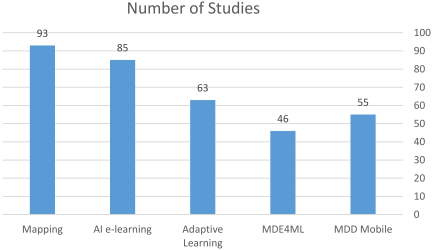
Fig. 5. Evidence base from major review studies related to AI, MDD, and adaptive interfaces.
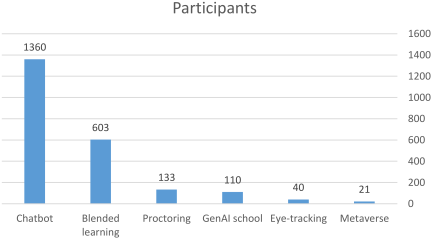
Fig. 6. Sample sizes in representative empirical studies across AI-enabled adaptive interface and learning systems.
To move beyond descriptive coverage of prior studies, we synthesized the uploaded literature from both quantitative and methodological perspective. As shown in Fig. 5, the evidence base was substantial, spanning major review studies with 55, 46, 63, 85, and 93 analyzed primary studies, respectively. This confirms that the field is no longer defined by isolated efforts but by a growing and methodologically diverse body of work 54,55,56,57. Fig. 6 further shows that the empirical evaluations vary considerably in scale, ranging from exploratory usability studies with a few dozen participants to large-scale questionnaire-based studies with more than 1,000 responses. This variation reflects the transition from proof-of-concept approaches toward more mature evaluation practices 39,58,59,60,61 . Most importantly, Fig. 7 shows a clear methodological profile of MDE4ML research, which is still largely academic (89%), strongly centered on PIM-level abstraction (93%), heavily dependent on model-to-text transformations (91%), and predominantly fully automated (85%), whereas tool availability remains limited (50%) 62. Taken together, these findings suggest that the field has evolved from classic transformation-driven MDD to hybrid AI_MDD approaches. However, industrial maturity, tooling, and scalable deployment remain important future research directions.
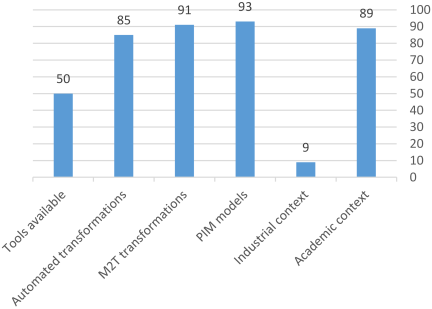
Fig. 7. Quantitative methodological profile of MDE4ML studies, highlighting abstraction level, automation, tooling, and evaluation context.
4.2. Approaches and Synergies
Referring to RQ6 (of SLR), AI and MDD are two paradigms that shape the way in which software is designed, developed, and deployed. While AI employs data-driven approaches to enable intelligent decision-making and automation, MDD focuses on abstracting the system design by relying on high-level models. Table 8 presents the MDD approaches in distinct methodologies, highlighting their key characteristics and application domains. Classic MDD using UML/SysML focuses on code generation from platform-independent models for UI and ML component design 62,50, whereas agile MDD incorporates iterative refinement with large language models (LLMs) assistance for rapid prototyping 63,64. Domain-specific modeling (DSM) employs custom languages tailored for AR/VR and internet of things (IoT) systems, enabling specialized applications such as educational AR tools and industrial IoT solutions 65,66. AI-enhanced MDD leverages LLMs and ML for automated model-to-code transformations, particularly in generating ML pipelines 62,67. Self-adaptive MDD supports runtime model updates for context-aware UIs and adaptive systems 68,69. Multi-experience MDD enables cross-platform development of AR/VR and web interfaces from a single model 70.
| Approaches | Key characteristics | Application domains |
| Classic MDD (UML/SysML) | Code generation from platform-independent models | UI development, ML component design |
| Agile MDD | Iterative model refinement with LLM assistance | Rapid prototyping, code generation |
|
Domain-specific modeling (DSM) |
Custom DSLs for AR/VR and IoT systems | AR education apps, industrial IoT |
| AI-enhanced MDD | LLMs/ML for model-to-code transformations | Automated ML pipeline generation |
| Self-adaptive MDD | Runtime model updates based on context | Context-aware UIs, adaptive systems |
| Multi experience MDD | Single model generation for AR/VR/web platforms | Cross-reality interfaces |
Table 8 shows the trend toward integrating AI, particularly LLMs, to automate and enhance MDD processes, with domain-specific approaches dominating AR/VR and IoT applications. However, gaps remain in standardizing MDD for generative AI and addressing the ethical implications, underscoring the need for further research in these areas. AI approaches can be broadly classified into several categories based on their application areas, methodologies, and underlying principles. Table 9 organizes these approaches into key methodologies and their respective application domains and highlights several dominant trends. Supervised and unsupervised learning techniques are commonly used for predictive modeling and pattern detection, particularly in educational and institutional adoption studies 71,72,73. DL drives applications in computer vision and natural language processing (NLP), such as AR scene reconstruction and interactions with VHs 47,35. Generative AI, particularly through LLMs and generative adversarial networks (GANs), has become a transformative approach to dynamic content generation and AI-assisted development, particularly in adaptive AR and model-driven systems 38,63,33,47. Reinforcement learning facilitates the creation of personalized learning pathways 74,48, whereas model-driven AI automates code generation for IoT and ML systems 62,66. Explainable AI (XAI) focuses on enhancing transparency in healthcare and ensuring ethical design practices 49,75, whereas edge AI supports real-time processing of AR and VR applications 48,17. Computer vision enhances spatially aware AR experiences and facilitates the creation of lifelike avatars 30,33, whereas conversational AI enables responsive, human-like interactions in the virtual tutoring and service domains 35,34. Table 9 highlights the prevalence of generative learning and DL in recent research, as well as synergies such as LLMs enhancing MDD, but notes gaps in privacy-preserving federated learning and neurosymbolic AI integration. These approaches collectively demonstrate the role of AI in creating adaptive, intelligent systems across education, healthcare, AR/VR, and industrial applications, with methodological choices heavily influenced by domain-specific requirements for real-time processing, personalization, and transparency. The combination of MDD and AI is a promising advancement in software engineering. MDD emphasizes abstraction and automation through models, thereby facilitating more efficient software development. In contrast, AI provides intelligent capabilities that enhance decision-making and adaptability within software systems. The integration of these approaches could lead to more efficient, adaptive, and intelligent software solutions 66.
| Approaches | Key characteristics | Application domains |
| Supervised learning | Predictive modeling using labeled data | Personalized learning, usability analysis |
| Unsupervised learning | Clustering and pattern detection in unlabeled data | Institutional AI adoption patterns |
| Deep learning (CV/NLP) | Neural networks for image and text processing | AR scene reconstruction, VHs |
| Generative AI (LLMs/GANs) | Content generation (text, 3D models, code) | Adaptive AR content, AI-assisted MDD |
| Reinforcement learning | Adaptive systems via reward-based optimization | Personalized learning pathways |
| Model-driven AI | Automated code generation from formal models | IoT/ML system development |
| Explainable AI (XAI) | Interpretable and transparent decision-making | Ethical AI design, healthcare |
| Computer vision | Object detection and scene understanding | AR object placement, avatar synthesis |
| Conversational AI | NLP techniques for dialogue systems | Virtual tutors, customer service |
| Edge AI | Lightweight ML for real-time on-device processing | Low-latency AR/VR adaptation |
Furthermore, the article “Using AI and MDD to Generate Intelligent and Adaptive UIs” explores how MDD and AI complement each other, highlighting their potential to transform software development by improving productivity and adaptability.
Table 10 outlines the six core methodologies for integrating AI with MDD to develop an adaptive and intelligent UI. Each method has its distinct advantages:
- 1.
- 2.
- 3.
- 4.
- 5.
- 6.
| Synergy approach | Methods used | Key benefits |
| AI-assisted code generation | LLMs translate models to code (e.g., UML \(\rightarrow\) Python) | Reduces manual coding effort; accelerates development |
| Model@runtime adaptation | AI analyzes context (user/environment) and dynamically updates UI models | Enables real-time UI personalization |
| DSM + AI components | Domain-specific languages (DSLs) integrated with ML models | Tailored solutions for AR/VR/IoT |
| Self-learning UI Models | Reinforcement learning (RL) optimizes UI layouts based on user interactions | Continuous UI improvement |
| Generative UI design | GANs/LLMs create UI prototypes from high-level requirements | Rapid design exploration; democratizes UI creation |
| XAI_MDD combination | Explainable AI (XAI) techniques make model decisions interpretable | Builds trust in adaptive UIs; supports debugging |
Emerging Architectural Patterns
Beyond the individual techniques, the reviewed literature reveals several recurring architectural patterns. The first pattern is a model-to-code pipeline in which platform-independent models are transformed into executable interface implementations. The second pattern is model@runtime adaptation, in which the interface models are continuously updated during execution in response to user and contextual signals. The third pattern combines domain-specific models with embedded AI components, particularly in AR/VR and IoT-oriented systems. More recent studies have pointed toward a fourth pattern, namely generative AI-assisted interface engineering, in which LLMs or other generative methods participate in model refinement, transformation, or interface synthesis. These recurring patterns provide a more integrative understanding of the field than an isolated categorization of techniques.
Comparative Analysis of AI_MDD Approaches
A comparative reading of the reviewed studies suggests that AI_MDD approaches differ not only in methodological orientation, but also in their practical effectiveness for adaptive interface generation. Classic MDD approaches remain valuable for structural consistency and code generation but provide limited support for runtime adaptation. DSM is particularly effective in AR/VR contexts because it enables tailored abstractions for specialized interaction environments; however, its applicability is often constrained by interoperability limitations. In contrast, self-adaptive and model@runtime approaches offer stronger support for personalization and context-aware behavior; however, they face challenges related to latency, computational cost, and system complexity. Generative AI-based methods accelerate prototyping and interface production; however, they often raise concerns regarding maintainability, predictability, and transparency. Taken together, these findings indicate that no single AI_MDD approach dominates all scenarios; instead, effectiveness depends on the balance between structural rigor, adaptive intelligence, and platform heterogeneity.
Table 11 provides a comparative overview of the key AI_MDD approaches and highlights their strengths, limitations, and suitable application environments. Classical MDD approaches remain effective in ensuring structural rigor and portability, particularly in the traditional web and UI engineering contexts; however, they offer limited support for runtime adaptation. In contrast, domain-specific modeling combined with AI enables tailored solutions for specialized domains, such as AR/VR and IoT. However, this advantage comes at the cost of reduced interoperability across platforms. Model@runtime approaches introduce dynamic personalization capabilities by adapting interfaces based on contextual information. However, they often face challenges related to latency and system complexity. Recent approaches that integrate generative AI within MDD pipelines facilitate rapid prototyping and design exploration. However, they raise concerns regarding the predictability and explainability of the generated outputs. Finally, multi-experience MDD approaches aim to ensure cross-platform consistency across heterogeneous environments, including the web, AR, VR, and metaverse systems, although their adoption is still constrained by the limited maturity of the supporting tools. Overall, the comparison suggests that no single approach fully satisfies the requirements for adaptive UI generation, thereby reinforcing the need for hybrid solutions that balance structural control, adaptability, and scalability.
| Approach | Main strength | Main limitation | Best-fit environments |
| Classic MDD | Structural rigor, portability | Limited runtime adaptation | Web/UI engineering |
| DSM + AI | Domain specialization | Low interoperability | AR/VR, IoT |
| Model@runtime | Dynamic personalization | Latency, complexity | Context-aware UIs, VR/AR |
| Generative AI + MDD | Fast prototyping | Low predictability, explainability issues | Adaptive UI design |
| Multi-experience MDD | Cross-platform consistency | Limited mature tool support | AR/VR/Web/Metaverse |
The reviewed studies indicate that AI and MDD are not independent components but complementary elements in the generation of adaptive interfaces. Although the MDD provides a structural backbone for modeling and transforming UIs, AI methods introduce intelligence through learning, prediction, and runtime adaptation. This combination is particularly important in complex interaction environments, where interface requirements are dynamic, context-dependent, and heterogeneous.
4.3. Gaps and Challenges
To better contextualize the identified challenges, it is important to clarify how emerging interaction technologies (AR, VR, VH, and MV) relate to MDD. In most existing literature, these technologies are primarily discussed as application domains. However, from a model-driven perspective, these can be understood more accurately as environments that impose specific constraints on the representation, transformation, and execution. For instance, AR systems require interface elements to be modeled in relation to the physical space and sensor data, whereas VR environments introduce immersive interaction flows that depend on user movement and multimodal inputs. Similarly, VHs involve conversational and behavioral modeling, and metaverse platforms emphasize interoperability and persistent multi-user interaction. These characteristics extend beyond the assumptions of traditional MDD, which have largely focused on screen-based and relatively static interfaces. This perspective suggests that interaction technologies are not external to MDD but instead redefine their requirements. They highlighted the need for richer modeling abstractions, more flexible transformation mechanisms, and stronger support for runtime adaptation within model-driven frameworks. While the relationship between interaction technologies and MDD highlights evolving modeling requirements, the role of AI introduces an additional dimension that enables these requirements to be operationalized. In recent studies, AI techniques (particularly ML and DL) have been increasingly used to support dynamic adaptation, user modeling, and decision-making within interface generation processes. In this context, MDD provides a structural foundation through model abstraction and transformation, whereas AI contributes to the capability of learning from user behavior and the environmental context. Interaction technologies define the conditions under which these mechanisms must operate, often requiring real-time responsiveness, multimodal interaction, and cross-platform consistency. Rather than functioning independently, these three dimensions form an interdependent system in which modeling, adaptation, and interaction are tightly coupled. Despite this convergence, current approaches often integrate AI into MDD pipelines in a limited or ad hoc manner, without a clear alignment between learned models and model-driven representations. This lack of combination restricts the scalability and generalizability of the adaptive interface solutions. Therefore, a more cohesive combination of AI and MDD is required, particularly in complex environments. Future research is likely to focus on frameworks in which models are continuously updated through AI-driven insights, enabling runtime adaptation and supporting multi-experience interfaces across heterogeneous platforms. Such an approach would allow MDD to evolve from a static design paradigm into a dynamic, learning-enabled system capable of responding to diverse interaction contexts.
Referring to RQ7 (of SLR), while combining AI with MDD to generate an adaptive UI offers benefits, gaps and challenges exist in its implementation and use. Table 12 systematically organizes the key gaps in combining AI with MDD to generate an adaptive UI into six critical categories, each with its distinct manifestations and underlying causes. Technical limitations (TL) stem from immature AI code generation tools that produce poorly structured codes and edge computing constraints that introduce latency in dynamic UI adaptation, fundamentally restricting real-time responsiveness 63,69. Explainability challenges (EC) arise from insufficient combinations of XAI techniques with MDD workflows, resulting in opaque decision-making that erodes user trust and complicates the debugging of complex model transformations 49,75.
| C | Specific challenges | Root causes |
| TL | AI-generated code lacks maintainability and scalability, and suffers from high latency in runtime UI adaptation. | Immature AI code generation tools; edge computing constraints |
| EC | Black-box AI decisions undermine UI trust, and debugging complex model transformations is difficult. | XAI techniques not fully integrated with MDD |
| DD | Bias in training data propagates into UIs and requires unrealistic interaction volumes for correction. | Lack of diverse datasets; cold-start problems |
| TG | No unified platforms for AI_MDD co-development; DSM tools resist AI combination. | Proprietary formats; lack of standardization |
| ER | Unintended UI discrimination (e.g., accessibility issues), and IP/copyright risks with generative UIs. | No governance frameworks for AI_MDD pipelines |
| HF | Over-reliance on AI reduces designer control and introduces steep learning curves for hybrid workflows. | Lack of human-in-the-loop mechanisms |
Data dependencies (DD) reveal how biased training datasets perpetuate discrimination in UI outputs, while reinforcement learning approaches demand impractical volumes of user interactions owing to cold-start problems and inadequate data diversity 74,48. Tool chain gaps (TG) highlight the absence of unified development platforms caused by proprietary formats and lack of standardization, particularly hindering AI integration with domain-specific modeling tools 66,65. Ethical risks (ER) expose vulnerabilities in current AI_MDD pipelines, where missing governance frameworks allow for accessibility violations and intellectual property ambiguities in AI-generated UI components 76,38. Finally, human factors (HF) demonstrates how excessive automation diminishes designer agency and how complex hybrid workflows create adoption barriers, both rooted in inadequate human-in-the-loop mechanisms 62,50. These challenges reveal a multidimensional problem space in which technical immaturity intersects methodological gaps, ethical blind spots, and human-centered design shortcomings. This situation demands coordinated advances in tools, standards, and frameworks to realize the full potential of AI_MDD synergies for next-generation UIs. There exists critical unresolved issues, such as real-time adaptation; most AI_MDD systems struggle with sub-second UI updates due to model inference delays 69,68, cross-platform generalization (interoperability); generated UIs often fail to port seamlessly across AR/VR/web 70, and energy efficiency; no studies address the high computation costs of continuous AI_MDD co-processing 48. Although the identified challenges are categorized into distinct groups, they are inherently interconnected and often reinforce each other. For instance, DD, such as limited or biased datasets, directly affect the performance of AI-driven adaptation, which, in turn exacerbates TL, particularly in terms of real-time responsiveness. Similarly, the lack of a standardized TG hinders the integration of explainable AI mechanisms, thereby intensifying EC and reducing system transparency. Further, ER and HF issues are not isolated concerns but are closely linked to the level of automation introduced by AI_MDD systems. Increased reliance on automated decision-making without sufficient human-in-the-loop mechanisms can reduce user trust and limit designer control. These interdependencies suggest that addressing individual challenges in isolation is insufficient, and that a holistic perspective is required to effectively advance AI_MDD-based adaptive UI generation.
5. Conclusion
This study explores the gaps, challenges, and limitations in applying generative approaches, combining AI with MDD to generate adaptive UIs and human-computer interaction. This article presented the SLR and BA of AI_MDD approaches and methods for creating adaptive and intelligent UIs. This study highlights the interdisciplinary research trends over the past decade, including the most important disciplines, peaks, research types, and keywords in this area. It focuses on context-sensitive interfaces, such as AR, VR, VHs, and MV, while demonstrating the types of interactions between users and these systems. The study points out important connections between AI and MDD, including the use of AI for code generation and dynamic UI adaptation. It also identifies major issues, such as TL, ethical concerns, and the need for explainable AI systems. Despite rapid advancements and promising applications, gaps remain in terms of real-time adaptation, cross-platform interoperability, and energy efficiency. The article underscores the transformative potential of the AI_MDD combination in enhancing user experiences while highlighting the need for further research to overcome existing barriers and establish standardized practices in this evolving field.
6. Limitations
This study has several limitations. First, the scope of the literature review was restricted to published and indexed articles in the Scopus database, which may have excluded relevant studies available in other databases or specialized journals. Second, the analysis was confined to a five-year timeframe, and given the rapidly evolving nature of the topic, more recent developments may not have been fully captured. Finally, applying the PRISMA guidelines with strict inclusion/exclusion criteria, such as considering only journal articles and English-language publications, could have led to the omission of valuable research, potentially affecting the thoroughness and generalizability of the review. These constraints highlight the areas for improvement in future research to ensure a more comprehensive analysis.
7. Challenges
This study has several key limitations that warrant further consideration. First, the data quality and availability within the Scopus database are inconsistent, potentially compromising BA accuracy. Second, the interdisciplinary nature of AI and MDD research complicates the classification and systematic analysis of contributions, as studies often span multiple domains with different methodologies and terminologies. Finally, the rapid pace of technological advancements in both AI and MDD presents an additional challenge, as current research quickly becomes outdated, making it difficult to conduct long-term trend analyses and reliable predictions. These challenges highlight the need for a careful methodological design and periodic updates to maintain the relevance and validity of the findings.
- [1] K. Z. Gajos, M. Czerwinski, D. S. Tan, and D. S. Weld, “Exploring the design space for adaptive graphical user interfaces,” Proc. of the Working Conf. on Advanced Visual Interfaces, pp. 201-208, 2006. https://doi.org/10.1145/1133265.1133306
- [2] P. Langley, “The changing science of machine learning,” Machine Learning, Vol.82, No.3, pp. 275-279, 2011. https://doi.org/10.1007/s10994-011-5242-y
- [3] S. Brdnik, T. Heričko, and B. Šumak, “Intelligent User Interfaces and Their Evaluation: A Systematic Mapping Study,” Sensors, Vol.22, Issue 15, Article No.5830, 2022. https://doi.org/10.3390/s22155830
- [4] M. Kristić, I. Zakarija, F. Škopljanac-Mačina, and Ž. Car, “Machine Learning for Adaptive Accessible User Interfaces: Overview and Applications,” Applied Sciences, Vol.15, Issue 23, Article No.12538, 2025. https://doi.org/10.3390/app152312538
- [5] K. Todi, G. Bailly, L. Leiva, and A. Oulasvirta, “Adapting User Interfaces with Model-based Reinforcement Learning,” Proc. of the 2021 CHI Conf. on Human Factors in Computing Systems, Article No.573, 2021. https://doi.org/10.1145/3411764.3445497
- [6] J. Cha, J. Kim, and S. Kim, “Hands-Free User Interface for AR/VR Devices Exploiting Wearer’s Facial Gestures Using Unsupervised Deep Learning,” Sensors, Vol.19, Issue 20, Article No.4441, 2019. https://doi.org/10.3390/s19204441
- [7] D. C. Schmidt, “Guest Editor’s Introduction: Model-Driven Engineering,” Computer, Vol.39, Issue 2, pp. 25-31, 2006. https://doi.org/10.1109/MC.2006.58
- [8] R. France and B. Rumpe, “Model-driven Development of Complex Software: A Research Roadmap,” Future of Software Engineering (FOSE’07), pp. 37-54, 2007. https://doi.org/10.1109/FOSE.2007.14
- [9] M. Brambilla, J. Cabot, and M. Wimmer, “Model-Driven Software Engineering in Practice,” Springer Cham, 2017. https://doi.org/10.2200/S00751ED2V01Y201701SWE004
- [10] S. Kelly and J.-P. Tolvanen, “Domain-Specific Modeling: Enabling Full Code Generation,” John Wiley & Sons, 2008. https://doi.org/10.1002/9780470249260
- [11] J. Martí-Parreño, E. Méndez-Ibáñez, and A. Alonso-Arroyo, “The use of gamification in education: A bibliometric and text mining analysis,” J. of Computer Assisted Learning, Vol.32, Issue 6, pp. 663-676, 2016. https://doi.org/10.1111/jcal.12161
- [12] J. Baas, M. Schotten, A. Plume, G. Côté, and R. Karimi, “Scopus as a curated, high-quality bibliometric data source for academic research in quantitative science studies,” Quantitative Science Studies, Vol.1, Issue 1, pp. 377-386, 2020. https://doi.org/10.1162/qss_a_00019
- [13] M. Tober, “PubMed, ScienceDirect, Scopus or Google Scholar – Which is the best search engine for an effective literature research in laser medicine?,” Medical Laser Application, Vol.26, Issue 3, pp. 139-144, 2011. https://doi.org/10.1016/j.mla.2011.05.006
- [14] M. L. Rethlefsen and M. J. Page, “PRISMA 2020 and PRISMA-S: Common questions on tracking records and the flow diagram,” J. of the Medical Library Association, Vol.110, No.2, pp. 253-257, 2022. https://doi.org/10.5195/jmla.2022.1449
- [15] N. J. van Eck and L. Waltman, “Software survey: VOSviewer, a computer program for bibliometric mapping,” Scientometrics, Vol.84, No.2, pp. 523-538, 2010. https://doi.org/10.1007/s11192-009-0146-3
- [16] N. F. S. Jeffri and D. R. A. Rambli, “A review of augmented reality systems and their effects on mental workload and task performance,” Heliyon, Vol.7, Issue 3, Article No.e06277, 2021. https://doi.org/10.1016/j.heliyon.2021.e06277
- [17] A. Hietanen, R. Pieters, M. Lanz, J. Latokartano, and J.-K. Kämäräinen, “AR-based interaction for human-robot collaborative manufacturing,” Robotics and Computer-Integrated Manufacturing, Vol.63, Article No.101891, 2020. https://doi.org/10.1016/j.rcim.2019.101891
- [18] E. Chang et al., “A User Study on the Comparison of View Interfaces for VR-AR Communication in XR Remote Collaboration,” Int. J. of Human-Computer Interaction, Vol.40, Issue 19, pp. 5794-5809, 2024. https://doi.org/10.1080/10447318.2023.2241294
- [19] A. Liccardo and F. Bonavolontà, “VR, AR, and 3-D User Interfaces for Measurement and Control,” Future Internet, Vol.15, Issue 1, Article No.18, 2023. https://doi.org/10.3390/fi15010018
- [20] H.-J. Joo and H.-Y. Joo, “A study on eye-tracking-based Interface for VR/AR education platform,” Multimedia Tools and Applications, Vol.79, pp. 16719-16730, 2020. https://doi.org/10.1007/s11042-019-08327-0
- [21] X. Pan and A. F. de C. Hamilton, “Why and how to use virtual reality to study human social interaction: The challenges of exploring a new research landscape,” British J. of Psychology, Vol.109, Issue 3, pp. 395-417, 2018. https://doi.org/10.1111/bjop.12290
- [22] V. Bucur and M. Lungu-Cristian, “Entering the Metaverse from the JVM: The State of the Art, Challenges, and Research Areas of JVM-Based Web 3.0 Tools and Libraries,” Future Internet, Vol.15, Issue 9, Article No.305, 2023. https://doi.org/10.3390/fi15090305
- [23] C. R. Viñals, M. G, Ibáñez, and J. L. Del Olmo Arriaga, “Metaverse and Fashion: An Analysis of Consumer Online Interest,” Future Internet, Vol.16, Article No.199, 2024. https://doi.org/10.3390/fi16060199
- [24] S. Choi, K. Yoon, M. Kim et al., “Building Korean DMZ Metaverse Using a Web-Based Metaverse Platform,” Applied Sciences, Vol.12, Issue 15, Aricle No.7908, 2022. https://doi.org/10.3390/app12157908
- [25] M. G. Bertrand, H. B. Sezer, and I. K. Namukasa, “Exploring AR and VR Tools in Mathematics Education Through Culturally Responsive Pedagogies,” Digital Experiences in Mathematics Education, Vol.10, pp. 462-486, 2024. https://doi.org/10.1007/s40751-024-00152-x
- [26] S. Schutera et al., “On the Potential of Augmented Reality for Mathematics Teaching with the Application cleARmaths,” Education Sciences, Vol.11, Issue 8, Article No.368, 2021. https://doi.org/10.3390/educsci11080368
- [27] C. Reardon, R. Wright, D. Cihak, and L. E. Parker, “Intelligent Context-Aware Augmented Reality to Teach Students with Intellectual and Developmental Disabilities,” Proc. of 29th Int. Florida Artificial Intelligence Research Society Conf. (FLAIRS 2016), pp. 505-509, 2016.
- [28] J. Grubert, T. Langlotz, S. Zollmann, and H. Regenbrecht, “Towards Pervasive Augmented Reality: Context-Awareness in Augmented Reality,” IEEE Trans. on Visualization and Computer Graphics, Vol.23, Issue 6, pp. 1706-1724, 2016. https://doi.org/10.1109/TVCG.2016.2543720
- [29] T. Scargill, Y. Chan et al., “Environmental, User, and Social Context-Aware Augmented Reality for Supporting Personal Development and Change,” 2022 IEEE Conf. on Virtual Reality and 3D User Interfaces Abstracts and Workshops (VRW), pp. 155-162, 2022. https://doi.org/10.1109/VRW55335.2022.00042
- [30] T. Tahara, T. Seno, G. Narita, and T. Ishikawa, “Retargetable AR: Context-aware Augmented Reality in Indoor Scenes based on 3D Scene Graph,” 2020 IEEE Int. Symp. on Mixed and Augmented Reality Adjunct (ISMAR-Adjunct), pp. 249-255, 2020. https://doi.org/10.1109/ISMAR-Adjunct51615.2020.00072
- [31] S. Kardong-Edgren, S. L. Farra, G. Alinier, and H. M. Young, “A Call to Unify Definitions of Virtual Reality,” Clinical Simulation in Nursing, Vol.31, pp. 28-34, 2019. https://doi.org/10.1016/j.ecns.2019.02.006
- [32] E. Childs, F. Mohammad, L. Stevens et al., “An Overview of Enhancing Distance Learning Through Emerging Augmented and Virtual Reality Technologies,” IEEE Trans. on Visualization and Computer Graphics, Vol.30, Issue 8, pp. 4480-4496, 2024. https://doi.org/10.1109/TVCG.2023.3264577
- [33] X. Chen, T. Jiang, J. Song. J. Yang et al., “gDNA: Towards Generative Detailed Neural Avatars,” 2022 IEEE/CVF Conf. on Computer Vision and Pattern Recognition (CVPR), pp. 20395-20405, 2022. https://doi.org/10.1109/CVPR52688.2022.01978
- [34] D. Chattopadhyay, T. Ma, H. Sharifi, and P. Martyn-Nemeth, “Computer-Controlled Virtual Humans in Patient-Facing Systems: Systematic Review and Meta-Analysis,” J. of Medical Internet Research, Vol.22, No.7, Article No.e18839, 2020. https://doi.org/10.2196/18839
- [35] R. Sajja, Y. Sermet et al., “Artificial Intelligence-Enabled Intelligent Assistant for Personalized and Adaptive Learning in Higher Education,” Information, Vol.15, Issue 10, Article No.596, 2024. https://doi.org/10.3390/info15100596
- [36] G. D. Ritterbusch and M. R. Teichmann, “Defining the Metaverse: A Systematic Literature Review,” IEEE Access, Vol.11, pp. 12368-12377, 2023. https://doi.org/10.1109/ACCESS.2023.3241809
- [37] M. Faridan, B. Kumari, and R. Suzuki, “ChameleonControl: Teleoperating Real Human Surrogates through Mixed Reality Gestural Guidance for Remote Hands-on Classrooms,” Proc. of the 2023 CHI Conf. on Human Factors in Computing Systems, Article No.203, 2023. https://doi.org/10.1145/3544548.3581381
- [38] Y. Huang, T. Kanij et al. “Unlocking Adaptive User Experience with Generative AI,” arXiv preprint, arXiv:2404.05442, 2024. https://doi.org/10.48550/arXiv.2404.05442
- [39] K. Sharma, M. Giannakos, and P. Dillenbourg, “Eye-tracking and artificial intelligence to enhance motivation and learning,” Smart Learning Environments, Vol.7, Article No.13, 2020. https://doi.org/10.1186/s40561-020-00122-x
- [40] Z. Lyu, “State-of-the-Art Human-Computer-Interaction in Metaverse,” Int. J. of Human-Computer Interaction, Vol.40, Issue 21, pp. 6690-6708, 2024. https://doi.org/10.1080/10447318.2023.2248833
- [41] A. Burlacu, C. Brinza, and N. N. Horia, “How the Metaverse Is Shaping the Future of Healthcare Communication: A Tool for Enhancement or a Barrier to Effective Interaction?,” Cureus, Vol.17, No.3, Article Noe80742, 2025. https://doi.org/10.7759/cureus.80742
- [42] A. H. Glasscock, “Navigating the Metaverse: Potential Applications and Implications for State Government,” NASCIO Report, 2023.
- [43] A. Aljabari, M. Moreb, T. Sarsour, and M. Khemaja, “Exploring Metaverse Technologies in E-Learning: Methods, Benefits, Challenges, and Future Agenda,” 2025 Int. Conf. on Smart Learning Courses (SCME), pp. 7-14, 2025.
- [44] G. Grambow, D. Hieber, R. Oberhauser, and C. Pogolski, “Leveraging Augmented Reality to Support Context-Aware Tasks in Alignment with Business Processes,” Int. J. of Virtual Reality, Vol.21, pp. 17-20, 2021.
- [45] O. J. Nwobodo, K. Wereszczyński et al., “An Adaptation of Fitts’ Law for Performance Evaluation and Optimization of Augmented Reality (AR) Interfaces,” IEEE Access, Vol.12, pp. 169614-169627, 2024. https://doi.org/10.1109/ACCESS.2024.3498444
- [46] I. Ruiz-Rube, R. Baena-Pérez et al., “Model-driven development of augmented reality-based editors for domain specific languages,” IxD&A, Vol.45, pp. 246-263, 2020. https://doi.org/10.55612/s-5002-045-011
- [47] B. Mildenhall, P. P. Srinivasan, M. Tancik, J. T. Barron, R. Ramamoorthi, and R. Ng, “NeRF: Representing scenes as neural radiance fields for view synthesis,” Communications of the ACM, Vol.65, Issue 1, pp. 99-106, 2021. https://doi.org/10.1145/3503250
- [48] C. Cichiwskyj, S. Schmeißer, C. Qian et al., “Elastic AI: system support for adaptive machine learning in pervasive computing systems,” CCF Trans. on Pervasive Computing and Interaction, Vol.3, pp. 300-328, 2021. https://doi.org/10.1007/s42486-021-00070-6
- [49] S. Mohseni, N. Zarei, and E. D. Ragan, “A Multidisciplinary Survey and Framework for Design and Evaluation of Explainable AI Systems,” ACM Trans. on Interactive Intelligent Systems (TiiS), Vol.11, Issues 3-4, Article No.24, 2021. https://doi.org/10.1145/3387166
- [50] P. A. Akiki, A. K. Bandara, and Y. Yu, “Adaptive Model-Driven User Interface Development Systems,” ACM Computing Surveys (CSUR), Vol.47, Issue 1, Article No.9, 2014. https://doi.org/10.1145/2597999
- [51] J. Moon, M. Jeong et al., “Data Collection Framework for Context-Aware Virtual Reality Application Development in Unity: Case of Avatar Embodiment,” Sensors, Vol.22, Issue 12, Article No.4623, 2022. https://doi.org/10.3390/s22124623
- [52] A. Steed, “Three technical challenges of scaling from social virtual reality to metaverse(s): Interoperability, awareness and accessibility,” Frontiers in Virtual Reality, Vol.5, Article No.1432907, 2024. https://doi.org/10.3389/frvir.2024.1432907
- [53] J. S. Boyd, L. S. Smith et al., “Technology primer: Augmented and virtual reality for the metaverse,” Technical Report, 2023.
- [54] Md. Shamsujjoha, J. Grundy, L. Li, H. Khalajzadeh, and Q. Lu, “Developing Mobile Applications Via Model Driven Development: A Systematic Literature Review,” Information and Software Technology, Vol.140, Article No.106693, 2021. https://doi.org/10.1016/j.infsof.2021.106693
- [55] I. Gligorea, M. Cioca, R. Oancea, A.-T. Gorski, H. Gorski, and P. Tudorache, “Adaptive Learning Using Artificial Intelligence in e-Learning: A Literature Review,” Education Sciences, Vol.13, Issue 12, Article No.1216, 2023. https://doi.org/10.3390/educsci13121216
- [56] C. Halkiopoulos and E. Gkintoni, “Leveraging AI in E-Learning: Personalized Learning and Adaptive Assessment through Cognitive Neuropsychology – A Systematic Analysis,” Electronics, Vol.13, Issue 18, Article No.3762, 2024. https://doi.org/10.3390/electronics13183762
- [57] A. Ezzaim, A. Dahbi, A. Haidine, and A. Aqqal, “AI-Based Adaptive Learning: A Systematic Mapping of the Literature,” J. of Universal Computer Science, Vol.29, No.10, pp. 1161-1197, 2023. https://doi.org/10.3897/jucs.90528
- [58] J. S. Jauhiainen and A. G. Guerra, “Generative AI and ChatGPT in School Children’s Education: Evidence from a School Lesson,” Sustainability, Vol.15, Issue 18, Article No.14025, 2023. https://doi.org/10.3390/su151814025
- [59] C. A. Fidas, M. Belk, A. Constantinides, D. Portugal, P. Martins, A. M. Pietron, A. Pitsillides, and N. Avouris, “Ensuring Academic Integrity and Trust in Online Learning Environments: A Longitudinal Study of an AI-Centered Proctoring System in Tertiary Educational Institutions,” Education Sciences, Vol.13, Issue 6, Article No.566, 2023. https://doi.org/10.3390/educsci13060566
- [60] J. Xiang and C. Ma, “Modeling the Effectiveness of Blended Learning Promotion with Artificial Intelligence Adaptive Learning System,” J. of Logistics, Informatics and Service Science, Vol.10, No.3, pp. 88-97, 2023. https://doi.org/10.33168/JLISS.2023.0307
- [61] S. Borsci, E. Prati, A. Malizia, M. Schmettow, A. Chamberlain, and S. Federici, “Ciao AI: the Italian adaptation and validation of the Chatbot Usability Scale,” Personal and Ubiquitous Computing, Vol.27, No.6, pp. 2161-2170, 2023. https://doi.org/10.1007/s00779-023-01731-2
- [62] H. Naveed, C. Arora, H. Khalajzadeh, J. Grundy, and O. Haggag, “Model driven engineering for machine learning components: A systematic literature review,” Information and Software Technology, Vol.169, Article No.107423, 2024. https://doi.org/10.1016/j.infsof.2024.107423
- [63] A. R. Sadik, S, Brulin, and M. Olhofer, “LLM as a code generator in Agile Model Driven Development,” arXiv preprint, arXiv:2410.18489, 2024. https://doi.org/10.48550/arXiv.2410.18489
- [64] R. Matinnejad, “Agile Model Driven Development: An Intelligent Compromise,” 2011 9th Int. Conf. on Software Engineering Research, Management and Applications, pp. 197-202, 2011. https://doi.org/10.1109/SERA.2011.17
- [65] R. Campos-López, E. Guerra et al., “Model-Driven Engineering for Augmented Reality,” J. of Object Technology, Vol.22, No.2, pp. 2:1-15, 2023. https://doi.org/10.5381/jot.2023.22.2.a7
- [66] A. Moin, M. Challenger, A. Badii, and S. Günnemann, “A model-driven approach to machine learning and software modeling for the IoT: Generating full source code for smart Internet of Things (IoT) services and cyber-physical systems (CPS),” Software and Systems Modeling, Vol.21, pp. 987-1014, 2022. https://doi.org/10.1007/s10270-021-00967-x
- [67] J. Straub, “Development of an Adaptive Multi-Domain Artificial Intelligence System Built using Machine Learning and Expert Systems Technologies,” arXiv preprint, arXiv:2406.11272, 2024. https://doi.org/10.48550/arXiv.2406.11272
- [68] E. Yigitbas, H. Stahl, S. Sauer, and G. Engels, “Self-adaptive UIs: Integrated Model-Driven Development of UIs and Their Adaptations,” 13th European Conf. on Modelling Foundations and Applications (ECMFA 2017), pp. 126-141, 2017. https://doi.org/10.1007/978-3-319-61482-3_8
- [69] E. Yigitbas, I. Jovanovikj, K. Biermeier, S. Sauer, and G. Engels, “Integrated model-driven development of self-adaptive user interfaces,” Software and Systems Modeling, Vol.19, pp. 1057-1081, 2020. https://doi.org/10.1007/s10270-020-00777-7
- [70] E. Planas, G. Daniel, M. Brambilla, and J. Cabot, “Towards a model-driven approach for multiexperience AI-based user interfaces,” Software and Systems Modeling, Vol.20, pp. 997-1009, 2021. https://doi.org/10.1007/s10270-021-00904-y
- [71] W. S. Sayed, A. M. Noeman, A. Abdellatif et al., “AI-based adaptive personalized content presentation and exercises navigation for an effective and engaging E-learning platform,” Multimedia Tools and Applications, Vol.82, pp. 3303-3333, 2023. https://doi.org/10.1007/s11042-022-13076-8
- [72] B. Alsanousi, A. S. Albesher et al., “Investigating the User Experience and Evaluating Usability Issues in AI-Enabled Learning Mobile Apps: An Analysis of User Reviews,” Int. J. of Advanced Computer Science and Applications, Vol.14, Issue 6, 2023. https://doi.org/10.14569/IJACSA.2023.0140602
- [73] M. A. Almaiah, R. Alfaisal et al., “Measuring Institutions’ Adoption of Artificial Intelligence Applications in Online Learning Environments: Integrating the Innovation Diffusion Theory with Technology Adoption Rate,” Electronics, Vol.11, Issue 20, Article No.3291, 2022. https://doi.org/10.3390/electronics11203291
- [74] O. Tapalova and N. Zhiyenbayeva, “Artificial Intelligence in Education: AIEd for Personalised Learning Pathways,” Electronic J. of e-Learning, Vol.20, No.5, pp. 639-653, 2022. https://doi.org/10.34190/ejel.20.5.2597
- [75] H. Wiemer, D. Schneider et al., “Need for UAI – Anatomy of the Paradigm of Usable Artificial Intelligence for Domain-Specific AI Applicability,” Multimodal Technologies and Interaction, Vol.7, Issue 3, Article No.27, 2023. https://doi.org/10.3390/mti7030027
- [76] P. Battistoni, M. Di Gregorio et al., “Can AI-Oriented Requirements Enhance Human-Centered Design of Intelligent Interactive Systems? Results from a Workshop with Young HCI Designers,” Multimodal Technologies and Interaction, Vol.7, Issue 3, Article No.24, 2023. https://doi.org/10.3390/mti7030024
This article is published under a Creative Commons Attribution-NoDerivatives 4.0 Internationa License.