
Research Paper:
Attention Mechanism Guided Content-Aware No-Reference Image Quality Assessment
Guohong Zhou*,†
 and Longsheng Wei**
*Shanxi Key Laboratory of Ophthalmology, Shanxi Eye Hospital
No.100 Fudong Street, Xinghualing District, Taiyuan, Shanxi 030002, China
†Corresponding author
**School of Artificial Intelligence and Automation, China University of Geosciences
No.388 Lumo Road, Hongshan District, Wuhan, Hubei 430074, China

No-reference image quality assessment (NR-IQA) quantifies image distortion. It plays an important role in computer vision. Distorted images vary greatly in content. Many existing methods tend to fuse content information with quality prediction. However, they often overlook human visual perception. To address this issue, we propose an attention-guided content-aware NR-IQA method. It combines meta-learning with image content understanding. The approach uses refined deep semantic features for quality evaluation. First, we train a meta-model on a baseline network. This improves sensitivity to diverse distortions. Second, we insert an attention module into the meta-model. This captures global information and highlights important regions. We also fuse multi-level semantic features. This enables a comprehensive description of both local and global distortions. Finally, we reduce feature dimensions and learn weights to predict the quality score. Extensive experiments show that our method achieves results closer to human perception. It effectively focuses on regions of interest during feature extraction.
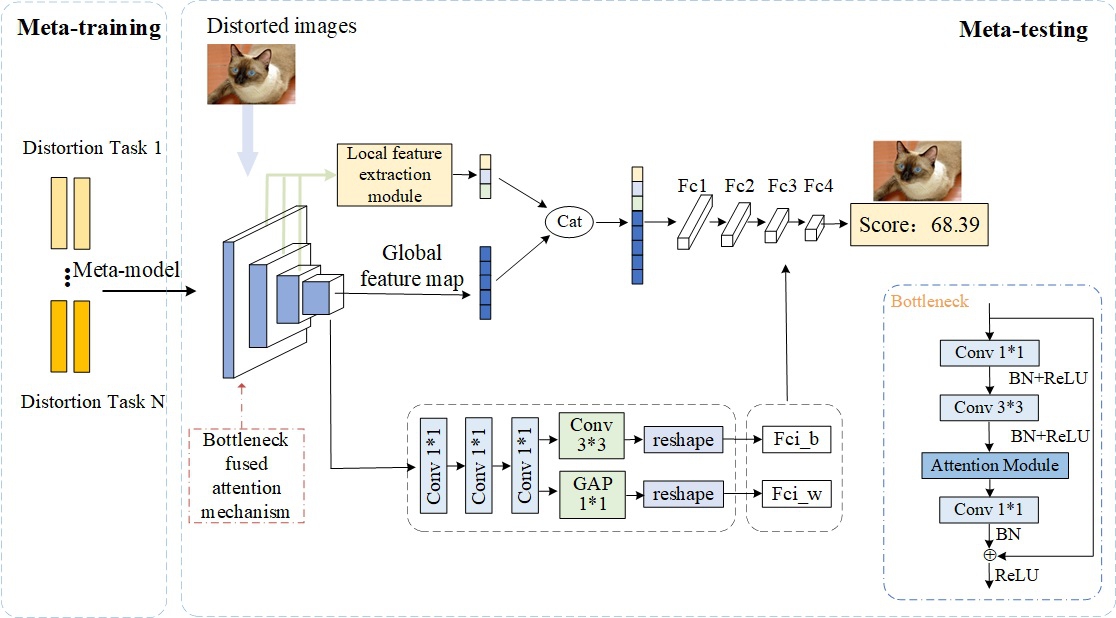
The framework diagram of the paper
- [1] L. Zhou, C. Liu, A. Yadav, S. Azam, and A. Karim, “An image quality assessment method based on edge extraction and singular value for blurriness,” Machine Vision and Applications, Vol.35, No.3, Article No.37, 2024. https://doi.org/10.1007/s00138-024-01522-6
- [2] J. Ryu, “A visual saliency-based neural network architecture for no-reference image quality assessment,” Applied Sciences, Vol.12, No.19, Article No.9567, 2022. https://doi.org/10.3390/app12199567
- [3] S. Su, Q. Yan, Y. Zhu, C. Zhang, X. Ge, J. Sun, and Y. Zhang, “Blindly assess image quality in the wild guided by a self-adaptive hyper network,” 2020 IEEE/CVF Conf. on Computer Vision and Pattern Recognition (CVPR), pp. 3664-3673, 2020. https://doi.org/10.1109/cvpr42600.2020.00372
- [4] D. Li, T. Jiang, W. Lin, and M. Jiang, “Which has better visual quality: The clear blue sky or a blurry animal?,” IEEE Trans. on Multimedia, Vol.21, No.5, pp. 1221-1234, 2019. https://doi.org/10.1109/tmm.2018.2875354
- [5] A. Mittal, A. K. Moorthy, and A. C. Bovik, “No-reference image quality assessment in the spatial domain,” IEEE Trans. on Image Processing, Vol.21, No.12, pp. 4695-4708, 2012. https://doi.org/10.1109/tip.2012.2214050
- [6] J. Xu, P. Ye, Q. Li, H. Du, Y. Liu, and D. Doermann, “Blind image quality assessment based on high order statistics aggregation,” IEEE Trans. on Image Processing, Vol.25, No.9, pp. 4444-4457, 2016. https://doi.org/10.1109/tip.2016.2585880
- [7] J. Kim and S. Lee, “Fully deep blind image quality predictor,” IEEE J. of Selected Topics in Signal Processing, Vol.11, No.1, pp. 206-220, 2017. https://doi.org/10.1109/jstsp.2016.2639328
- [8] J. Wu, J. Ma, F. Liang, W. Dong, G. Shi, and W. Lin, “End-to-end blind image quality prediction with cascaded deep neural network,” IEEE Trans. on Image Processing, Vol.29, pp. 7414-7426, 2020. https://doi.org/10.1109/tip.2020.3002478
- [9] W. Zhang, K. Ma, J. Yan, D. Deng, and Z. Wang, “Blind image quality assessment using a deep bilinear convolutional neural network,” IEEE Trans. on Circuits and Systems for Video Technology, Vol.30, No.1, pp. 36-47, 2020. https://doi.org/10.1109/tcsvt.2018.2886771
- [10] H. Zhu, L. Li, J. Wu, W. Dong, and G. Shi, “MetaIQA: Deep meta-learning for no-reference image quality assessment,” 2020 IEEE/CVF Conf. on Computer Vision and Pattern Recognition (CVPR), pp. 14131-14140, 2020. https://doi.org/10.1109/cvpr42600.2020.01415
- [11] H. Zhu, L. Li, J. Wu, W. Dong, and G. Shi, “Generalizable no-reference image quality assessment via deep meta-learning,” IEEE Trans. on Circuits and Systems for Video Technology, Vol.32, No.3, pp. 1048-1060, 2022. https://doi.org/10.1109/tcsvt.2021.3073410
- [12] N. Ponomarenko, L. Jin, O. Ieremeiev, V. Lukin, K. Egiazarian, J. Astola, B. Vozel, K. Chehdi, M. Carli, F. Battisti, and C.-C. J. Kuo, “Image database tid2013: Peculiarities, results and perspectives,” Signal Processing: Image Communication, Vol.30, pp. 57-77, 2015. https://doi.org/10.1016/j.image.2014.10.009
- [13] H. Lin, V. Hosu, and D. Saupe, “KADID-10k: A large-scale artificially distorted iqa database,” 2019 Eleventh Int. Conf. on Quality of Multimedia Experience (QoMEX), 2019. https://doi.org/10.1109/qomex.2019.8743252
- [14] H. Sheikh, M. Sabir, and A. Bovik, “A statistical evaluation of recent full reference image quality assessment algorithms,” IEEE Trans. on Image Processing, Vol.15, No.11, pp. 3440-3451, 2006. https://doi.org/10.1109/tip.2006.881959
- [15] D. M. Chandler, “Most apparent distortion: Full-reference image quality assessment and the role of strategy,” J. of Electronic Imaging, Vol.19, No.1, Article No.011006, 2010. https://doi.org/10.1117/1.3267105
- [16] D. Ghadiyaram and A. C. Bovik, “Massive online crowdsourced study of subjective and objective picture quality,” IEEE Trans. on Image Processing, Vol.25, No.1, pp. 372-387, 2016. https://doi.org/10.1109/tip.2015.2500021
- [17] V. Hosu, H. Lin, T. Sziranyi, and D. Saupe, “KonIQ-10k: An ecologically valid database for deep learning of blind image quality assessment,” IEEE Trans. on Image Processing, Vol.29, pp. 4041-4056, 2020. https://doi.org/10.1109/tip.2020.2967829
- [18] L. Zhang, L. Zhang, and A. C. Bovik, “A feature-enriched completely blind image quality evaluator,” IEEE Trans. on Image Processing, Vol.24, No.8, pp. 2579-2591, 2015. https://doi.org/10.1109/tip.2015.2426416
- [19] S. Bosse, D. Maniry, K.-R. Muller, T. Wiegand, and W. Samek, “Deep neural networks for no-reference and full-reference image quality assessment,” IEEE Trans. on Image Processing, Vol.27, No.1, pp. 206-219, 2018. https://doi.org/10.1109/tip.2017.2760518
This article is published under a Creative Commons Attribution-NoDerivatives 4.0 Internationa License.