
Research Paper:
Automatic Control System for Mass Production Using Press Forming
Masayuki Aoyama*1, Masato Nagao*2, Ryuzo Mori*2, Minoru Yamashita*3,†, Kohei Furuya*3, Kazuhiro Mitamura*4, and Zhigang Wang*3
*1Tokai Rika Smart Craft Co., Ltd.
3-260 Toyota, Oguchi, Niwa-gun, Aichi 480-0195, Japan
*2Tokai Rika Co., Ltd.
Oguchi, Japan
*3Department of Mechanical Engineering, Gifu University
Gifu, Japan
†Corresponding author
*4Center for Advanced Die Engineering and Technology, Gifu University
Gifu, Japan

In various manufacturing processes, feedback control systems have been investigated to enhance productivity. However, applications in practical mass production are still limited. This study aimed to develop a closed-loop feedback system involving a new die set for nonstop mass production using a transfer press machine and to demonstrate its effectiveness in the real production of millions of pieces. Displacement and load sensors were embedded in the die set to monitor the product dimension and status of the upsetting punch. An actuator was also installed to adjust the product dimension controlled by threshold-type discrete feedback. Complex wiring from the sensors and their power sources were replaced with dedicated wireless data and power transmission devices to improve the mountability and operability when changing the die set. In the demonstration tests, the product thickness was precisely adjusted to 0.016 mm using the actuator controlled with a feedback command of 0.02 mm. The proposed system has been successfully used for the production of more than 6.5 million pieces during the period from the middle of 2023 to the end of 2025, demonstrating good durability and practicality. To detect a partial punch fracture, the Mahalanobis method is effective even when the fracture area is relatively small. To apply this method when a step-like change in the Mahalanobis distance is inevitable owing to interruptions according to the production schedule, the training data of the first several hundreds of shots need to be used for the production schedules.
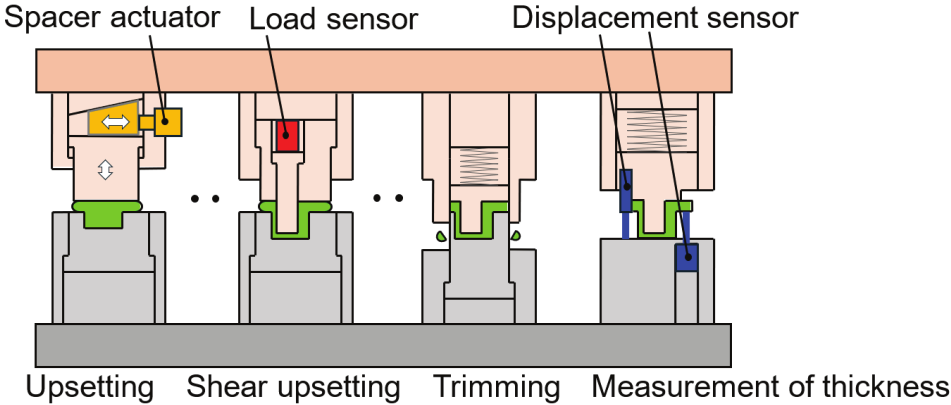
Press die set with measurement and feedback components
- [1] F. Klocke, S. Kratz, T. Auerbach, S. Gierlings, G. Wirtz, and D. Veselovac, “Process monitoring and control of machining operations,” Int. J. Automation Technol., Vol.5, No.3, pp. 403-411, 2011. https://doi.org/10.20965/ijat.2011.p0403
- [2] Y. Ueno and H. Tachiya, “High-precision machining with positioning control considering structural deformation of small machine-tool,” Int. J. Automation Technol., Vol.19, No.6, pp. 1076-1085, 2025. https://doi.org/10.20965/ijat.2025.p1076
- [3] A. Matsubara and S. Ibaraki, “Monitoring and control of cutting forces in machining processes: A review,” Int. J. Automation Technol., Vol.3, No.4, pp. 445-456, 2009. https://doi.org/10.20965/ijat.2009.p0445
- [4] J. M. Allwood, S. R. Duncan, J. Cao, P. Groche, G. Hirt, B. Kinsey, T. Kuboki, M. Liewald, A. Sterzing, and A. E. Tekkaya, “Closed-loop control of product properties in metal forming,” CIRP Ann., Vol.65, Issue 2, pp. 573-596, 2016. https://doi.org/10.1016/j.cirp.2016.06.002
- [5] J. M. Allwood, O. Music, A. Raithathna, and R. S. Duncan, “Closed-loop feedback control of product properties in flexible metal forming processes with mobile tools,” CIRP Ann., Vol.58, Issue 1, pp. 287-290, 2009. https://doi.org/10.1016/j.cirp.2009.03.065
- [6] C. W. Hsu, A. G. Ulsoy, and M. Y. Demeri, “Development of process control in sheet metal forming,” J. Mater. Process. Technol., Vol.127, Issue 3, pp. 361-368, 2002. https://doi.org/10.1016/S0924-0136(02)00321-7
- [7] T. Bäume, W. Zorn, W. G. Drossel, and G. Rupp, “Iterative process control and sensor evaluation for deep drawing tools with integrated piezoelectric actuators,” Manuf. Rev., Vol.3, No.3, Article No.3, 2016. https://doi.org/10.1051/mfreview/2016002
- [8] Y. Lim, R. Venugopal, and A. G. Ulsoy, “Advances in the control of sheet metal forming,” Proc. 17th World Congr. Int. Fed. Autom. Control, Vol.41, No.2, pp. 1875-1883, 2008. https://doi.org/10.3182/20080706-5-kr-1001.00320
- [9] P. Fischer, J. Heingärtner, W. Aichholzer, D. Hortig, and P. Hora, “Feedback control in deep drawing based on experimental datasets,” J. Phys. Conf. Ser., Vol.896, Article No.012035, 2017. https://doi.org/10.1088/1742-6596/896/1/012035
- [10] K. Siegert and D. Schmoeckel, “Compensation of tilting and horizontal displacement of upper die, relative to the lower die, at out-of-center forming load by a closed-loop control system,” CIRP Ann., Vol.43, Issue 1, pp. 267-270, 1994. https://doi.org/10.1016/S0007-8506(07)62210-0
- [11] P. Groche, J. Hohmann, and D. Ubelacker, “Overview and comparison of different sensor positions and measuring methods for the process force measurement in stamping operations,” Measurement, Vol.135, pp. 122-130, 2019. https://doi.org/10.1016/j.measurement.2018.11.058
- [12] M. Yang and T. Kyuno, “Real time monitoring of friction variation in stamping process using die-embedded sensing system,” Proc. 14th Int. Conf. Technol. Plast., pp. 223-232, 2023. https://doi.org/10.1007/978-3-031-40920-2_24
- [13] B. Endelt, “In-process feedback control of tube hydro-forming process,” Int. J. Adv. Manuf. Technol., Vol.119, Nos.11-12, pp. 7723-7733, 2022. https://doi.org/10.1007/s00170-022-08683-6
- [14] K. Manabe and T. Oguchi, “Sensors and their real in-process control application to advanced deformation processing,” Sens. Mater., Vol.31, No.10, pp. 3155-3162, 2019. https://doi.org/10.18494/SAM.2019.2432
- [15] J. Havinga, T. Boogaard, F. Dallinger, and P. Hora, “Feedforward control of sheet bending based on force measurements,” J. Manuf. Process., Vol.31, pp. 260-272, 2018. https://doi.org/10.1016/j.jmapro.2017.10.011
- [16] M. Rekowski, K. C. Grotzinger, A. Schott, and M. Liewald, “Thin-film sensors for data-driven concentricity prediction in cup backward extrusion,” CIRP Ann., Vol.73, No.1, pp. 205-208, 2024. https://doi.org/10.1016/j.cirp.2024.04.035
- [17] X. He, T. Welo, and J. Ma, “In-process monitoring strategies and methods in metal forming: A selective review,” J. Manuf. Process., Vol.138, pp. 100-128, 2025. https://doi.org/10.1016/j.jmapro.2025.02.011
- [18] Z. Chen, Y. Liu, A. Valera-Medina, and F. Robinson, “Characterizing strip snap in cold rolling process using advanced data analytics,” Procedia CIRP, Vol.81, pp. 453-458, 2019. https://doi.org/10.1016/j.procir.2019.03.078
- [19] J. Cao, M. Bambach, M. Merklein, M. Mozaffar, and T. Xue, “Artificial intelligence in metal forming,” CIRP Ann., Vol.73, Issue 2, pp. 561-587, 2024. https://doi.org/10.1016/j.cirp.2024.04.102
- [20] L. Cheng, V. Yaghoubi, W. V. Paepegem, and M. Kersemans, “Mahalanobis classification system (MCS) integrated with binary particle swarm optimization for robust quality classification of complex metallic turbine blades,” Mech. Syst. Signal Process., Vol.146, Article No.107060, 2021. https://doi.org/10.1016/j.ymssp.2020.107060
- [21] M. Rizal, J. A. Ghani, M. Z. Nuawi, and C. H. C. Haron, “Cutting tool wear classification and detection using multi-sensor signals and mahalanobis-taguchi system,” Wear, Vols.376-377, Part B, pp. 1759-1765, 2017. https://doi.org/10.1016/j.wear.2017.02.017
This article is published under a Creative Commons Attribution-NoDerivatives 4.0 Internationa License.