
Paper:
Obstacle Avoidance Using Population Vector Code-Based SNN-CPG Controller for Robotic Fish in Unknown Environment
Takumi Asada*
 , Hideo Furuhashi**
, Kenta Tabata*
, Renato Miyagusuku*
, and Koichi Ozaki*
, Hideo Furuhashi**
, Kenta Tabata*
, Renato Miyagusuku*
, and Koichi Ozaki*
*Graduate School of Engineering, Utsunomiya University
7-1-2 Yoto, Utsunomiya, Tochigi 321-8585, Japan
**Department of Electronics and Electrical Engineering, Aichi Institute of Technology
1247 Yachigusa, Yakusa-cho, Toyota, Aichi 470-0392, Japan

Neurorobotics, which incorporates neuromorphic computing into robotic systems, can emulate biological intelligence and behaviors. The characteristics of neural responses and behavioral patterns are reproduced using spiking neural networks. Many applications utilize mobility robots; however, applications with multiple joints, such as robotic fish, remain limited. The main challenge is that shape types and joint numbers vary among biological organisms, and disturbances affect them in underwater environments. The neural circuit mechanisms used by multi-jointed robots for obstacle avoidance have not yet been clarified. In this study, we propose an obstacle avoidance architecture realized exclusively through neural circuits. The fundamental obstacle avoidance performance of a robotic fish was systematically evaluated, including ablation studies, varying conditions, and the physical environment.
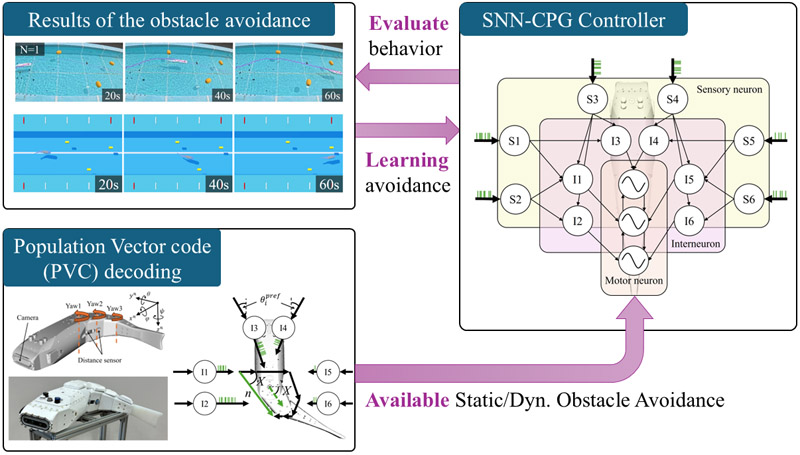
Conceptual overview of PVC-based SNN-CPG controller
- [1] A. J. Ijspeert and M. A. Daley, “Integration of feedforward and feedback control in the neuromechanics of vertebrate locomotion: A review of experimental, simulation and robotic studies,” J. of Experimental Biology, Vol.226, No.15, Article No.jeb245784, 2023. https://doi.org/10.1242/jeb.245784
- [2] M. G. Sirota, G. V. Di Prisco, and R. Dubuc, “Stimulation of the mesencephalic locomotor region elicits controlled swimming in semi-intact lampreys,” European J. of Neuroscience, Vol.12, No.11, pp. 4081-4092, 2000. https://doi.org/10.1046/j.1460-9568.2000.00301.x
- [3] X. Zhang, Y. Cao, J. Huang, J. Liu, and Z.-Q. Zhang, “A systematic review of spiking neural networks for human-robot interaction in rehabilitative wearable robotics,” IEEE Trans. on Cognitive and Developmental Systems, Vol.8, No.1, pp. 6-21, 2026. https://doi.org/10.1109/TCDS.2025.3599432
- [4] M. Aitsam, S. Davies, and A. Di Nuovo, “Neuromorphic computing for interactive robotics: A systematic review,” IEEE Access, Vol.10, pp. 122261-122279, 2022. https://doi.org/10.1109/ACCESS.2022.3219440
- [5] J. Liu, H. Lu, Y. Luo, and S. Yang, “Spiking neural network-based multi-task autonomous learning for mobile robots,” Engineering Applications of Artificial Intelligence, Vol.104, Article No.104362, 2021. https://doi.org/10.1016/j.engappai.2021.104362
- [6] H. Lu, J. Liu, Y. Luo, Y. Hua, S. Qiu, and Y. Huang, “An autonomous learning mobile robot using biological reward modulate STDP,” Neurocomputing, Vol.458, pp. 308-318, 2021. https://doi.org/10.1016/j.neucom.2021.06.027
- [7] Z. Bing, C. Meschede, G. Chen, A. Knoll, and K. Huang, “Indirect and direct training of spiking neural networks for end-to-end control of a lane-keeping vehicle,” Neural Networks, Vol.121, pp. 21-36, 2020. https://doi.org/10.1016/j.neunet.2019.05.019
- [8] Z. Ali, L. Al-Amir, and A. Safa, “On the Importance of Neural Membrane Potential Leakage for LIDAR-based Robot Obstacle Avoidance using Spiking Neural Networks,” arXiv preprint, arXiv:2507.09538, 2025. https://doi.org/10.48550/arXiv.2507.09538
- [9] Y. Wang, B. Dong, Y. Zhang, Y. Zhou, H. Mei, Z. Wei, and X. Yang, “Event-enhanced multi-modal spiking neural network for dynamic obstacle avoidance,” Proc. of the 31st ACM Int. Conf. on Multimedia, pp. 3138-3148, 2023. https://doi.org/10.1145/3581783.3612147
- [10] M. S. Shim and P. Li, “Biologically inspired reinforcement learning for mobile robot collision avoidance,” 2017 Int. Joint Conf. on Neural Networks (IJCNN), pp. 3098-3105, 2017. https://doi.org/10.1109/IJCNN.2017.7966242
- [11] J. Chen, B. Yin, C. Wang, F. Xie, R. Du, and Y. Zhong, “Bioinspired closed-loop CPG-based control of a robot fish for obstacle avoidance and direction tracking,” J. of Bionic Engineering, Vol.18, No.1, pp. 171-183, 2021. https://doi.org/10.1007/s42235-021-0008-0
- [12] L. Zuo, M. Wang, Y. Gong, R. Wang, Q. Zhao, X. Zheng, and H. Gao, “SNN-CPG Hierarchical Control Enhanced Motion Performance of Robotic Fish Based on STDP,” Int. Conf. on Neural Computing for Advanced Applications, pp. 422-436, 2024. https://doi.org/10.1007/978-981-97-7001-4_30
- [13] M. Wang, Y. Zhang, and J. Yu, “An SNN-CPG hybrid locomotion control for biomimetic robotic fish,” J. of Intelligent & Robotic Systems, Vol.105, No.2, Article No.45, 2022. https://doi.org/10.1007/s10846-022-01664-7
- [14] I. Polykretis, M. Aanjaneya, and K. P. Michmizos, “Bioinspired Dynamic Control of Amphibious Articulated Creatures with Spiking Neural Networks,” Proc. of Graphics Interface 2023, 2022.
- [15] J. L. van Hemmen and A. B. Schwartz, “Population vector code: A geometric universal as actuator,” Biological Cybernetics, Vol.98, No.6, pp. 509-518, 2008. https://doi.org/10.1007/s00422-008-0215-3
- [16] R. Levi and J. M. Camhi, “Population vector coding by the giant interneurons of the cockroach,” J. of Neuroscience, Vol.20, No.10, pp. 3822-3829, 2000. https://doi.org/10.1523/JNEUROSCI.20-10-03822.2000
- [17] T. Asada, T. Oki, H. Furuhashi, K. Tabata, R. Miyagusuku, and K. Ozaki, “Performance Evaluation Using Sim2Real of a Robotic Dolphin with Multi-link Body Mechanism and CPG-based Controller,” IEEE Access, Vol.13, pp. 190304-190316, 2025. https://doi.org/10.1109/ACCESS.2025.3624365
- [18] T. I. Fossen, “Handbook of Marine Craft Hydrodynamics and Motion Control, 2nd ed.,” John Wiley & Sons, 2021.
- [19] H. Lamb, “Hydrodynamics,” Cambridge University Press, 1924.
- [20] X. Liao, C. Zhou, Q. Zou, J. Wang, and B. Lu, “Dynamic modeling and performance analysis for a wire-driven elastic robotic fish,” IEEE Robotics and Automation Letters, Vol.7, No.4, pp. 11174-11181, 2022. https://doi.org/10.1109/LRA.2022.3197911
- [21] H. Yang, Z. Yan, W. Zhang, Q. Gong, Y. Zhang, and L. Zhao, “Trajectory tracking with external disturbance of bionic underwater robot based on CPG and robust model predictive control,” Ocean Engineering, Vol.263, Article No.112215, 2022. https://doi.org/10.1016/j.oceaneng.2022.112215
- [22] M. Deger, M. Helias, C. Boucsein, and S. Rotter, “Statistical properties of superimposed stationary spike trains,” J. of Computational Neuroscience, Vol.32, No.3, pp. 443-463, 2012. https://doi.org/10.1007/s10827-011-0362-8
- [23] R. R. Buss and P. Drapeau, “Synaptic drive to motoneurons during fictive swimming in the developing zebrafish,” J. of Neurophysiology, Vol.86, No.1, pp. 197-210, 2001. https://doi.org/10.1152/jn.2001.86.1.197
- [24] E. M. Izhikevich, “Which model to use for cortical spiking neurons?,” IEEE Trans. on Neural Networks, Vol.15, No.5, pp. 1063-1070, 2004. https://doi.org/10.1109/TNN.2004.832719
- [25] J. Moran and R. Desimone, “Selective attention gates visual processing in the extrastriate cortex,” Science, Vol.229, No.4715, pp. 782-784, 1985. https://doi.org/10.1126/science.4023713
- [26] H. Bleckmann and R. Zelick, “Lateral line system of fish,” Integrative Zoology, Vol.4, No.1, pp. 13-25, 2009. https://doi.org/10.1111/j.1749-4877.2008.00131.x
- [27] J. Engelmann and H. Bleckmann, “Coding of lateral line stimuli in the goldfish midbrain in still and running water,” Zoology, Vol.107, No.2, pp. 135-151, 2004. https://doi.org/10.1016/j.zool.2004.04.001
- [28] E. Angelidis, E. Buchholz, J. Arreguit, A. Rougé, T. Stewart, A. von Arnim, A. Knoll, and A. Ijspeert, “A spiking central pattern generator for the control of a simulated lamprey robot running on SpiNNaker and Loihi neuromorphic boards,” Neuromorphic Computing and Engineering, Vol.1, No.1, Article No.014005, 2021. https://doi.org/10.1088/2634-4386/ac1b76
- [29] R. V. Florian, “Reinforcement learning through modulation of spike-timing-dependent synaptic plasticity,” Neural Computation, Vol.19, No.6, pp. 1468-1502, 2007. https://doi.org/10.1162/neco.2007.19.6.1468
- [30] M. Mozafari, S. R. Kheradpisheh, T. Masquelier, A. Nowzari-Dalini, and M. Ganjtabesh, “First-spike-based visual categorization using reward-modulated STDP,” IEEE Trans. on Neural Networks and Learning Systems, Vol.29, No.12, pp. 6178-6190, 2018. https://doi.org/10.1109/TNNLS.2018.2826721
- [31] M. Akl, Y. Sandamirskaya, D. Ergene, F. Walter, and A. Knoll, “Fine-tuning deep reinforcement learning policies with r-STDP for domain adaptation,” Proc. of the Int. Conf. on Neuromorphic Systems 2022, Article No.14, 2022. https://doi.org/10.1145/3546790.3546804
This article is published under a Creative Commons Attribution-NoDerivatives 4.0 Internationa License.