
Survey Report:
Public Perceptions of Artificial Island Development in Majuro: Survey Findings and Implications for Climate Change Adaptation
Daisuke Sasaki*,†
 and Ryo Fujikura**
*Uehiro Disaster Risk Reduction Research Division, International Research Institute of Disaster Science (IRIDeS), Tohoku University
468-1 Aoba Aramaki, Aoba, Sendai, Miyagi 980-8572, Japan
†Corresponding author
**Faculty of Sustainability Studies, Hosei University
Tokyo, Japan

The Republic of the Marshall Islands (RMI) is one of only four nations in the world, whose land mass is composed entirely of atolls, along with Kiribati, Tuvalu, and the Maldives. This study analyzed the dataset of the cross-sectional survey conducted in Majuro, the capital of the RMI, collecting 150 valid responses from general RMI citizens residing in Majuro through face-to-face questionnaire interviews between November 2024 and March 2025. We first conducted an analysis using the grand total to grasp basic response patterns and other characteristics, followed by structural equation modeling to clarify causal relationships among variables. Through this study, we have clarified the following points: strong emotional and cultural attachment to their homeland, clear preference for adaptation strategies that allow people to remain within the RMI, limited interest in overseas migration, and strong consensus that construction of artificial islands should not proceed without agreement from all involved parties. Moreover, the results indicated that the impact of perception of life on artificial islands on the intention to migrate to artificial islands may be critical. Based on the results, we conclude that the quality of the living environment will be an influential factors to promote relocation to artificial islands in a smooth manner.
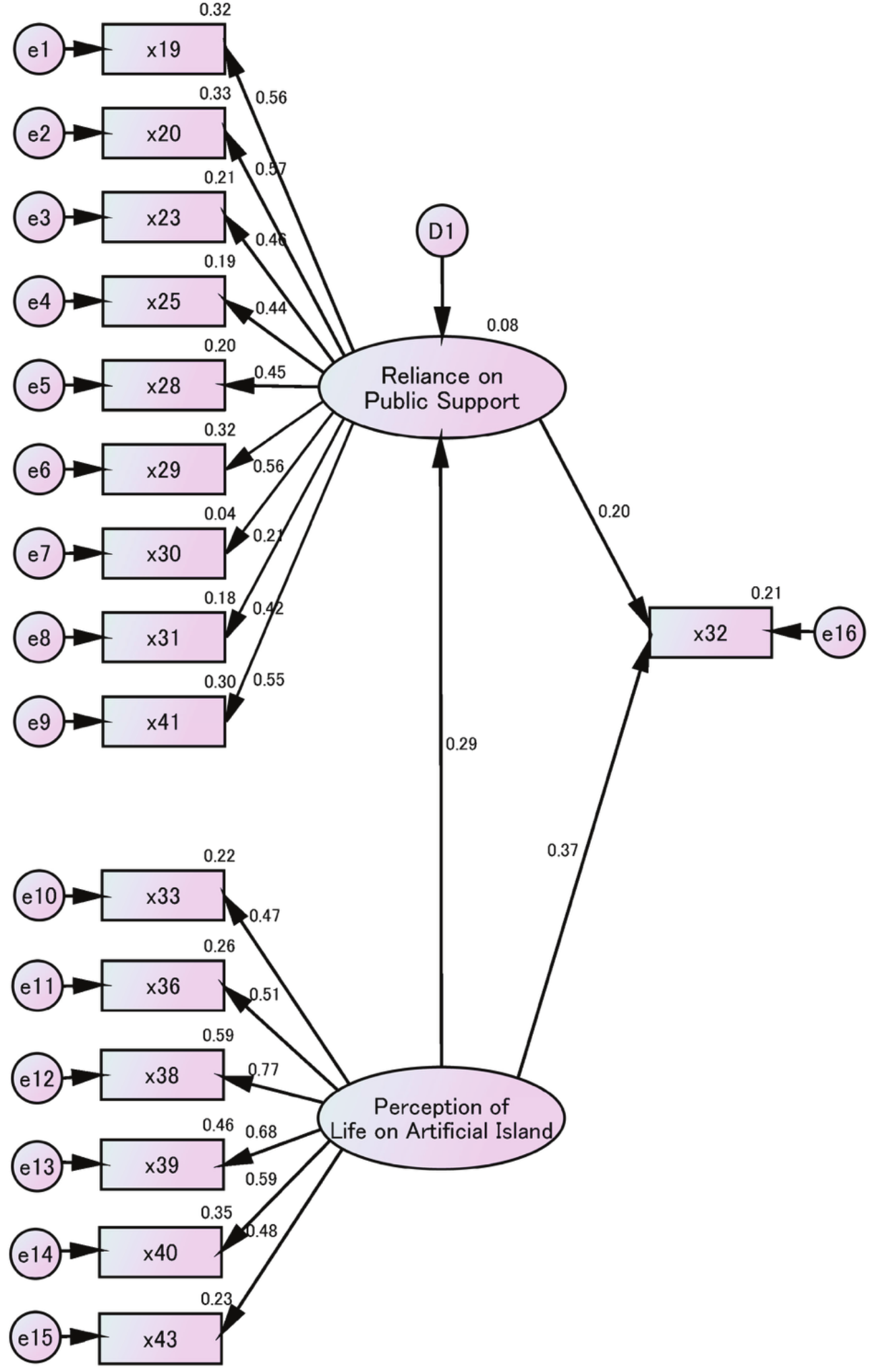
SEM path diagram
- [1] The International Court of Justice, “Advisory opinion of 23 July 2025 – Obligations of states in respect of climate change,” 2025. https://icj-web.leman.un-icc.cloud/sites/default/files/case-related/187/187-20250723-adv-01-00-en.pdf [Accessed December 29, 2025]
- [2] D. Sasaki, “Analysis of the attitude within Asia-Pacific countries towards disaster risk reduction: Text mining of the Official Statements of 2018 Asian Ministerial Conference on Disaster Risk Reduction,” J. Disaster Res., Vol.14, No.8, pp. 1024-1029, 2019. https://doi.org/10.20965/jdr.2019.p1024
- [3] R. Black, W. N. Adger, N. W. Arnell, S. Dercon, A. Geddes, and D. Thomas, “Migration and global environmental change,” Glob. Environ. Chang., Vol.21, Supplement 1, pp. S1-S2, 2011. https://doi.org/10.1016/j.gloenvcha.2011.10.005
- [4] E. Piguet, A. Pécoud, and P. de Guchteneire, “Migration and climate change: An overview,” Refug. Surv. Quart., Vol.30, Issue 3, pp. 1-23, 2011. https://doi.org/10.1093/rsq/hdr006
- [5] R. Obokata, L. Veronis, and R. McLeman, “Empirical research on international environmental migration: A systematic review,” Popul. Environ., Vol.36, pp. 111-135, 2014. https://doi.org/10.1007/s11111-014-0210-7
- [6] M. Nakayama, J. Seru, C. Vila, M. Bilimon, R. Fujikura, A. Sakamoto, and M. Sato, “Artificial island construction as an instrument for the right to stay: Case of the Marshall Islands,” J. Disaster Res., Vol.20, No.1, pp. 44-52, 2025. https://doi.org/10.20965/jdr.2025.p0044
- [7] Republic of the Marshall Islands, “National adaptation plan: Responding to the impact of climate change,” World Bank PREP II Project, 2023. https://rmigov.com/RMI-NAP-2023.pdf [Accessed December 18, 2025]
- [8] M. Nakayama, R. Fujikura, R. Okuda, M. Fujii, R. Takashima, T. Murakawa, E. Sakai, and H. Iwama, “Alternatives for the Marshall Islands to cope with the anticipated sea level rise by climate change,” J. Disaster Res., Vol.17, No.3, pp. 315-326, 2022. https://doi.org/10.20965/jdr.2022.p0315
- [9] D. Sasaki, A. Sakamoto, A. Laila, A. Aslam, S. Feng, T. Kaku, T. Sasaki, N. Shinomura, and M. Nakayama, “Facilitating the smooth migration of inhabitants of atoll countries to artificial islands: Case of the Maldives,” Sustainability, Vol.16, Issue 11, 2024. https://doi.org/10.3390/su16114582
- [10] J. Seru, M. Bilimon, and M. Nakayama, “Comparing perspectives on artificial island development: Analysis of surveys from Majuro general population and College of the Marshall Islands students,” J. Disaster Res., Vol.21, No.4, pp. 714-719, 2026. https://doi.org/10.20965/jdr.2026.p0714
- [11] D. Sasaki, Y. Jibiki, and T. Ohkura, “Tourists’ behavior for volcanic disaster risk reduction: A case study of Mount Aso in Japan,” Int. J. of Disaster Risk Reduction, Vol.78, Article No.103142, 2022. https://doi.org/10.1016/j.ijdrr.2022.103142
- [12] P. Tarka, “An overview of structural equation modeling: Its beginnings, historical development, usefulness and controversies in the social sciences,” Qual. Quant., Vol.52, pp. 313-354, 2017. https://doi.org/10.1007/s11135-017-0469-8
- [13] D. Sasaki, I. Taafaki, T. Uakeia, J. Seru, Y. McKay, and H. Lajar, “Influence of religion, culture and education on perception of climate change and its implications: Applying structural equation modeling (SEM),” J. Disaster Res., Vol.14, No.9, pp. 1303-1308, 2019. https://doi.org/10.20965/jdr.2019.p1303
- [14] M. Ishiwatari, M. Maekawa, and R. Fujikura, “Climate change adaptation strategies and economic challenges in atoll nations: A case study of the Republic of the Marshall Islands,” J. Disaster Res., Vol.20, No.1, pp. 53-60, 2024. https://doi.org/10.20965/jdr.2025.p0053
- [15] IMF, “Republic of the Marshall Islands: Staff Report for the 2023 Article IV consultation,” 2023.
This article is published under a Creative Commons Attribution-NoDerivatives 4.0 Internationa License.