
Survey Report:
Public Perceptions of Artificial Island Development in Majuro: Survey Findings and Implications for Climate Change Adaptation
Daisuke Sasaki*,†
 and Ryo Fujikura**
*Uehiro Disaster Risk Reduction Research Division, International Research Institute of Disaster Science (IRIDeS), Tohoku University
468-1 Aoba Aramaki, Aoba, Sendai, Miyagi 980-8572, Japan
†Corresponding author
**Faculty of Sustainability Studies, Hosei University
Tokyo, Japan

The Republic of the Marshall Islands (RMI) is one of only four nations in the world, whose land mass is composed entirely of atolls, along with Kiribati, Tuvalu, and the Maldives. This study analyzed the dataset of the cross-sectional survey conducted in Majuro, the capital of the RMI, collecting 150 valid responses from general RMI citizens residing in Majuro through face-to-face questionnaire interviews between November 2024 and March 2025. We first conducted an analysis using the grand total to grasp basic response patterns and other characteristics, followed by structural equation modeling to clarify causal relationships among variables. Through this study, we have clarified the following points: strong emotional and cultural attachment to their homeland, clear preference for adaptation strategies that allow people to remain within the RMI, limited interest in overseas migration, and strong consensus that construction of artificial islands should not proceed without agreement from all involved parties. Moreover, the results indicated that the impact of perception of life on artificial islands on the intention to migrate to artificial islands may be critical. Based on the results, we conclude that the quality of the living environment will be an influential factors to promote relocation to artificial islands in a smooth manner.
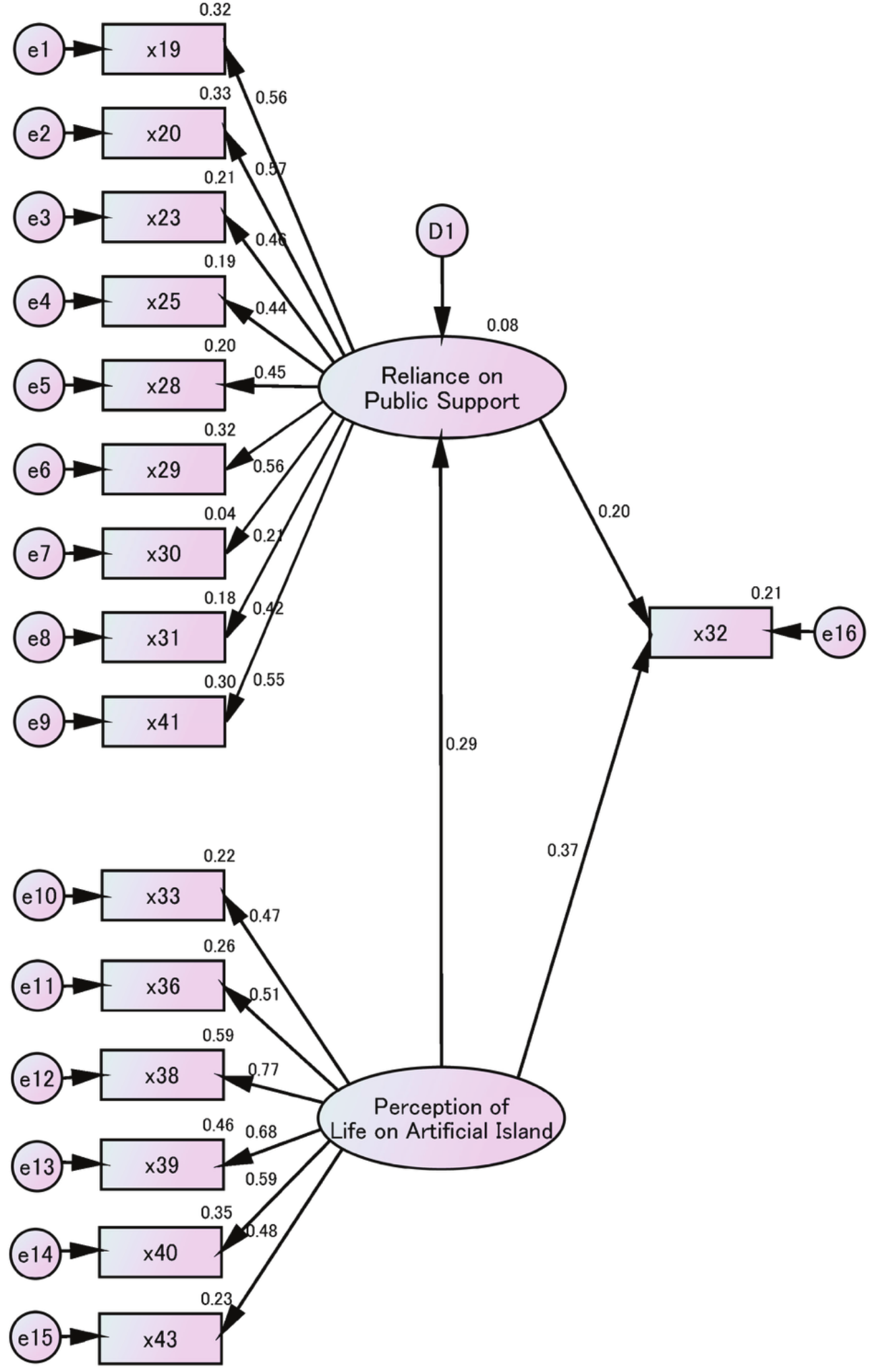
SEM path diagram
1. Introduction
The Republic of the Marshall Islands (RMI) is one of only four nations in the world, whose land mass is composed entirely of atolls, along with Kiribati, Tuvalu and the Maldives. The average elevation of these nations is only a few meters above sea level, making them extremely vulnerable to sea level rise and impacts induced by climate change. Therefore, without appropriate climate change adaptation measures, climate change is likely to threaten residents’ livelihoods. The International Court of Justice stated that “conditions resulting from climate change which are likely to endanger the lives of individuals may lead them to seek safety in another country.” Subsequently, it delivered the Advisory Opinion entitled “Obligations of States in Respect of Climate Change” on July 23, 2025. In this Opinion, the Court indicated that obligations prohibiting the return of persons displaced by climate change and the provision of necessary international protection may be legally supported under international law 1. Nations facing disasters caused by climate change tend to prioritize climate change in their official statements in the international arena for disaster risk reduction 2.
Recent academic studies on climate-induced migration have undergone significant conceptual and empirical shifts, moving away from deterministic narratives toward a more nuanced, multifactorial framework. In early discussions within the general public and the academic community, “climate migrants” were often viewed exclusively as large groups forced to flee owing to environmental changes. However, contemporary studies have challenged these linear causal relationships. For instance, Black et al. 3 fundamentally contributed to this field by proposing a comprehensive framework in which migration decisions are shaped by the interaction of five driving factors: economic, political, social, demographic, and environmental. This model emphasizes that environmental changes rarely act as independent triggers; rather, they alter the existing vulnerabilities and interact with broader structural conditions. Consequently, the outcomes of migration are highly context-dependent and mediated by individual and household characteristics as well as barriers to and facilitators of mobility.
Subsequent studies have supported this multifactorial perspective. For example, Piguet et al. 4 raised two issues: the first one concerned the relative importance of environmental and climatic factors in migration, and how they related to other “push” and “pull” factors of a social, political, or economic nature, while the second one concerned the political framework within which such migration flows should occur, and how people who migrate owing to environmental factors should be treated. Moreover, empirical studies have highlighted the complexities of these causal relationships. For instance, Obokata et al. 5 demonstrated that environmental factors were rarely, if ever, a sole “push” factor of migration, and an individual’s migration patterns in response to environmental stress were determined by the constant interplay of political, economic, social, and demographic factors.
According to Nakayama et al. 6, experts argue in recent discussions on climate change adaptation measures that the “right to stay” for climate migrants should be respected over the right to leave their homeland and migrate to another nation, and thus, the goal is to ensure that the “right to stay” becomes a substantive option for people facing climate-related challenges. Under such circumstances, the RMI has published the “National Adaptation Plan: Responding to the Impact of Climate Change” in October 2023, which examines the feasibility of implementing climate change adaptation measures across 10 atolls in the RMI such as raising existing land levels through landfilling or creating new land 7.
Based on interviews with scholars who have studied the livelihoods of Marshallese migrants in the United States, as well as with individuals knowledgeable about the behavior of the Marshallese both within the Marshall Islands and as migrants in the United States, Nakayama et al. 8 evaluated the performance of four alternatives: (i) migration to developed countries, (ii) migration to other island states, (iii) land reclamation and elevation, and (iv) the development of floating platforms. The results indicate that “migration to developed countries” received the highest overall evaluation; however, this option was found to entail the greatest degree of change for migrants, whereas “land reclamation and elevation” represented the alternative associated with the least change.
In the Republic of Maldives, another atoll nation, an artificial island called Hulhumalé, situated near the capital, Malé, has already been constructed. Some previous studies, such as Sasaki et al. 9 clarified the perception of migration to Hulhumalé and revealed the key factors influencing resident satisfaction after migration. However, few studies have focused on the perception of migration to artificial islands in the RMI.
According to Sasaki et al. 9, they conducted a questionnaire survey of Hulhumalé residents in August and September 2022 by the state-owned Housing Development Corporation and Global Infrastructure Fund Research Foundation Japan. Using snowball sampling, the survey recruited 252 participants through a web-based platform. The questionnaire included 11 questions about respondents’ attributes and 32 questions about various aspects of their lives after moving to Hulhumalé. A major finding of their study was that current inhabitants of Hulhumalé highly valued the factors related to their living conditions, and thus, the quality of the living environment significantly impacted the life satisfaction level.
In the above context, this study aims to examine the following research questions in a manner similar to that of Sasaki et al. 9: (i) How do the citizens of Majuro in the RMI perceive artificial island development? (ii) Are the factors related to living conditions on artificial islands that the findings of the previous study in the Maldives have indicated also valued in the case of Majuro?
2. Methodology
2.1. Study Design and Participants
This study employed the same cross-sectional survey dataset as Seru et al. 10, which was conducted in Majuro, the capital of the RMI, and collected 150 valid responses, representing 0.6% of Majuro’s estimated adult population (aged 18 years or older), through face-to-face questionnaire interviews between November 2024 and March 2025. The survey targeted general RMI citizens residing in Majuro and was designed to capture diverse perspectives across Marshallese society. Although web-based platforms are increasingly used for questionnaire surveys, as in Sasaki et al. 11, this survey adopted a face-to-face method that contributed to direct engagement with respondents and facilitated a more nuanced understanding of their views and experiences related to the climate change adaptation challenges faced by the RMI 10. As also stated in Seru et al. 10, the inclusion criteria were as follows: (1) RMI citizenship, (2) age 18 years or older, (3) residence in Majuro, and (4) ability to provide informed consent, so that the dataset could represent a broader cross-section of the population and encompass various age groups (ranging from 18–20 years to 50 years and above), occupations, and residential backgrounds.
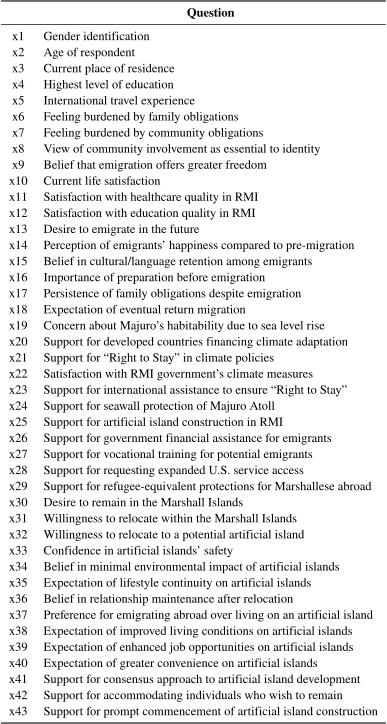
The survey used a standardized questionnaire covering the following domains: demographic characteristics, life satisfaction and service quality, migration attitudes, climate change concerns, climate adaptation policy preferences, and perceptions of artificial islands. Questions, except those related to demographic characteristics, were measured on a 5-point Likert scale ranging from 1 (strongly disagree/very dissatisfied) to 5 (strongly agree/very satisfied). Appendix A presents the question items (x1–x43) used in the survey.
2.2. Statistical Analysis
In this study, we first conducted an analysis using the grand totals to understand the basic response patterns and other characteristics. Subsequently, we applied structural equation modeling (SEM) to clarify the causal relationships among the variables. SEM is a method that comprehensively depicts relationships between variables and enables the handling of “latent variables,” which are not directly observable. Latent variables can be measured indirectly by using a set of observable variables and exploring the causal effects among these latent variables within the SEM framework 12. As for the RMI, Sasaki et al. 13 employed SEM in analyzing a questionnaire survey conducted in the RMI in the past. The statistical software used for SEM analysis was Amos 28.0.
In the SEM analysis, we hypothesized that the following two latent variables have causal relationships: “Reliance on public support,” and “Perception of life on artificial island.” We assumed that “Reliance on public support” affected the following variables (question items): x19, x20, x23, x25, x28, x29, x30, x31, and x41. The latent variable “Reliance on public support” captures an individual’s orientation toward addressing climate-related risks through institutional, governmental, and international assistance. The associated items reflect preferences for externally coordinated and resource-intensive solutions, including support for international financing, policy interventions, and migration-related protection. Even items such as concern about habitability (x19) and desire to remain on the Marshall Islands (x30) are theoretically linked, as they imply problem severity and conditional expectations that continued habitation depends on public support mechanisms. We assumed that “Perception of life on artificial island” affected x33, x36, x38, x39, x40, and x43. These variables collectively capture a multidimensional evaluation of life on artificial islands, encompassing perceived safety, social continuity, economic opportunity, and living convenience. Support for the prompt commencement of construction reflects the behavioral expression of these perceptions, justifying their integration into a single latent variable “Perception of life on artificial island.” Furthermore, we hypothesized that both latent variables affected x32 (I would not hesitate to move to an artificial island to be built within the Marshall Islands.), which was considered to imply the intention to migrate to artificial islands, and also assumed that the effect of “Perception of life on artificial island” on x32 was partially mediated by “Reliance on public support,” which served as a mediator of “Perception of life on artificial island” on x32. The partial mediation model is justified by the presence of both direct and indirect pathways. The latent variable “Perception of life on artificial island” directly influences x32 through favorable evaluations of safety, livability, and opportunity. Simultaneously, such perceptions reinforce “Reliance on public support,” as artificial island development depends on institutional capacity and external assistance. This reliance further promotes willingness to relocate (x32). Thus, perceptions shape relocation both directly and indirectly through institutional dependence. Cronbach’s alpha coefficients for the above two latent variables, “Reliance on public support” and “Perception of life on artificial island,” were 0.679 and 0.745, respectively, indicating a certain degree of internal consistency.
3. Results and Discussion
3.1. Overview of Grand Total
The respondents comprised 56 men (37.3%) and 94 women (62.7%). Those aged 30 or younger numbered 62 (41.3%), while those over 30 numbered 88 (58.7%). Those who resided within Majuro totaled 139 (92.7%), while the others who resided outside Majuro but within the RMI, for example, in neighboring islands, totaled 11 (7.3%); 36 (24.0%) had graduated from a university or college, whereas 114 (76.0%) had not.
The results for the observed variables comprising the latent variable “Reliance on public support” are as follows: There was overwhelming awareness of climate change impacts on habitats. A total of 133 (88.7%) respondents agreed that the Majuro Atoll would be largely uninhabitable by the end of the century owing to sea level rise (x19). Furthermore, respondents strongly believed that developed countries should bear the financial responsibility for climate adaptation. A total of 143 (95.3%) respondents agreed that developed countries should finance all necessary measures in island countries (x20). Thus, artificial island construction is a viable adaptation strategy. A total of 123 (82.0%) people agreed to build an artificial island within the Marshall Islands (x25). There was strong support for seeking assistance from the U.S. government. A total of 133 (88.7%) responded that the RMI government should ask the U.S. government to allow Marshallese access to all services available to U.S. citizens (x28). Furthermore, protecting host countries was considered important. A total of 135 (90.0%) responded that the host country should provide the same protection to expatriate Marshallese as it provides refugees (x29). Most respondents valued staying in their homeland. A total of 126 (84.0%) responded that they wanted to stay in the Marshall Islands for as long as possible (x30). There was a strong consensus that artificial islands should not be constructed without the agreement of all involved parties. A total of 136 (90.7%) responded that an artificial island should be constructed only after all parties involved agreed (x41). The results regarding the observed variables comprising the latent variable “Perception of life on artificial island” are as follows: 91 (60.7%) agreed that artificial islands were more disaster-resistant than natural islands (x33); 96 (64.0%) agreed that people would be able to maintain the same relationships they have now after moving to an artificial island (x36).
The remaining results are described below. Family and community bonds appear strong but can be burdensome: 122 (81.3%) answered that they felt burdened by family obligations (x6), 99 (66.0%) answered that they felt burdened by community obligations (x7), and 117 (78.0%) considered their lives inseparable from the local community (x8). Only 17 (11.3%) believed that leaving would provide them more freedom (x9). Current life satisfaction was moderate, and varied by sector: 94 (62.7%) answered that they were satisfied with their present life (x10); however, only 26 (17.3%) responded that they were satisfied with the level of healthcare in the Marshall Islands (x11), whereas 66 (44.0%) responded that they were satisfied with the level of education in the Marshall Islands (x12). Despite climate threats, interest in emigration remains limited. Only 53 (35.3%) expressed a desire to emigrate abroad in the future (x13). Moreover, the emigrants’ perceptions were mixed: 81 (54.0%) responded that Marshallese who migrated abroad were happier than they had been in their home country (x14), while only 47 (31.3%) responded that they had maintained their own language and culture when they left the Marshall Islands (x15). Furthermore, it was recognized that preparation was necessary for emigration; 91 (60.7%) believed that Marshallese who wish to emigrate abroad must prepare well by learning the language and society of their destination country (x16); 128 (85.3%) agreed that they could not escape the obligations imposed on them by their families even if the Marshallese emigrated abroad (x17); and 124 (82.7%) believed that the majority of Marshallese who emigrated abroad would eventually return to the Marshall Islands (x18). The concept of the “Right to stay” was widely supported; 119 (79.3%) of respondents considered the “Right to stay” included in climate change adaptation measures (x21).
Satisfaction with the RMI government’s climate change adaptation measures was relatively low. Only 53 (35.3%) respondents were satisfied, while 64 (42.7%) expressed dissatisfaction (x22). There was strong support for protective infrastructure; 143 (95.3%) agreed to protecting Majuro Atoll with high seawalls to ensure residents’ “Right to stay” (x24); 116 (77.3%) agreed that they would not hesitate to move to an artificial island (x32); however, only 64 (42.7%) agreed that the construction of an artificial island would not adversely affect the natural environment (x34). Moreover, only 24 (16.0%) respondents agreed that the same lifestyle as today could be maintained after moving to an artificial island (x35). Moreover, 60 (40.0%) did not agree that they would emigrate abroad in the future even if they could live on an artificial island with living costs similar to those they currently have (x37). Financial assistance for outmigration was limited. Only 49 (32.7%) agreed that the RMI government should provide financial assistance to out-migrating nationals (x26), whereas 112 (74.7%) agreed that the RMI government should provide vocational training for nationals who wish to emigrate abroad (x27). Respect for individual preferences was highly valued; 131 (87.3%) responded that if there is even one person who wants to remain in their present residence, the government and international community should raise the land owned by that person so that he or she can continue to live there (x42).
A summary of the results in terms of the corresponding latent variables is presented in Table 1.
Table 1. Brief summary of the results in terms of corresponding latent variables.
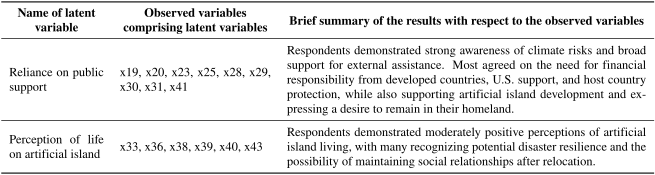
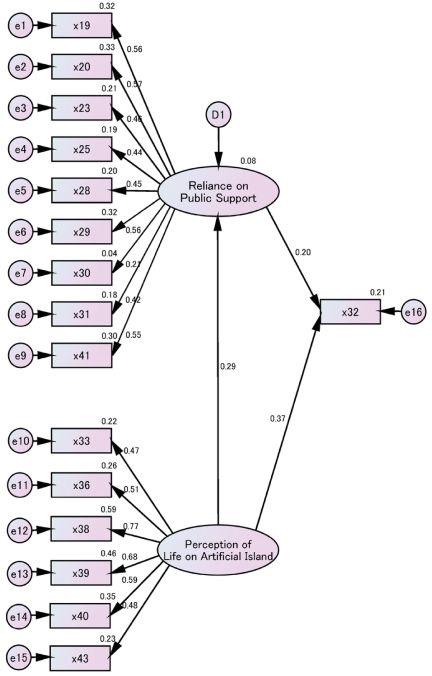
Fig. 1. SEM path diagram.
3.2. Analysis of SEM
Figure 1 presents a path diagram. All path coefficients and variances are statistically significant at the 5% level. We examined the major goodness-of-fit indices: the root mean square error of approximation (RMSEA) and comparative fit index (CFI). The values of these indices were 0.068 and 0.834, respectively. Thus, while the model can be considered acceptable, it cannot be deemed to fit very well when compared with the benchmark values for the fit indices, 0.90 for CFI, and 0.08 for RMSEA. The estimated path coefficients indicate that “Perception of life on artificial island” has a moderately positive effect on “Reliance on public support” (0.29), suggesting that more favorable evaluations of artificial island life are associated with stronger orientations toward institutional support. “Reliance on public support” has a positive, although smaller, effect on x32 (0.20), indicating that “Reliance on public support” modestly facilitates relocation intention. The direct effect of “Perception of life on artificial island” on x32 was comparatively stronger (0.37), highlighting the primary role of individual-level evaluations. Regarding effect decomposition, the indirect effect through “Reliance on public support” is 0.056; thus, the total effect of “Perception of life on artificial island” on x32 is 0.42, suggesting that while mediation exists, the relationship is predominantly driven by a direct effect. The coefficient of determination for x32 (0.21) indicated that approximately 21% of the variance in relocation willingness was explained by the model. This reflects a moderate level of explanatory power, implying that, while the included latent variables are substantively important, additional factors not captured in the model also contribute to relocation decisions.
The results of the SEM analysis suggest that both “Reliance on public support” and “Perception of life on artificial island” may influence the intention to migrate to artificial islands to a certain degree, while the impact of “Perception of life on artificial island” on x32, the intention to migrate to artificial islands, appears to be critical, considering the values of the path coefficients as well as the indirect effect of “Perception of life on artificial island” on x32 via “Reliance on public support.” Furthermore, it implies that the following citizens tend to move to artificial islands: those who believe artificial islands will improve jobs, income, and living conditions; those who are pessimistic about Majuro’s future under sea-level rise; those who support public assistance for relocation; and/or those who demand stakeholder consent before construction.
3.3. Comparison with the Survey Results in the Maldives
Sasaki et al. 9 conducted a questionnaire survey on Hulhumalé residents in the Maldives in August and September 2022. The results revealed that the residents generally valued the environment of Hulhumalé, specifically its natural beauty and air and water quality. Transportation was also highly valued, as well as sports facilities and parks, while the high costs of acquiring a residence and living in Hulhumalé were least appreciated by the residents, along with the lack of cultural activities, well-paying jobs, police protection, and public order. Moreover, they constructed a model of permutation feature importance, whose findings indicated that current inhabitants of Hulhumalé highly valued the following factors related to their living conditions: clean new homes, resilience to natural disasters, sports facilities and parks, lack of air and water pollution, and territorial integrity.
The results of the questionnaire survey in this study reveal that Majuro citizens have a clear preference for adaptation strategies that allow people to remain within the RMI, and perceive an artificial island to be built within the RMI in a relatively positive manner, although they highly demand democratic procedures for its construction. Thus, the results of surveys conducted in Majuro in the RMI and Malé in the Maldives indicate that the quality of the living environment and job opportunities are key factors in achieving smooth relocation to an artificial island.
4. Conclusion
This study clarified the following: a strong emotional and cultural attachment to one’s homeland, a clear preference for adaptation strategies that allow people to remain within the RMI, a limited interest in overseas migration, and a strong consensus that artificial islands should not be constructed without the agreement of all involved parties. Moreover, the results of the SEM analysis clarified that the impact of the perception of life on artificial islands on the intention to migrate to artificial islands may be critical. The findings of a previous study conducted in the Maldives indicated that factors related to living conditions on artificial islands were highly valued. Based on these results, we conclude that quality of living is one of the most influential factors in promoting smooth relocation to artificial islands.
The limitations of this study are as follows. First, the relatively small sample size of 150 participants (0.6% of Majuro’s estimated adult population) should be considered from the perspective of representativeness. Moreover, Cronbach’s alpha coefficient for “Reliance on public support” is relatively low, requiring careful attention in terms of internal consistency. Second, reverse causality is possible in the SEM model; individuals already willing to relocate may form more positive perceptions and express greater support for public intervention. Although the model is theoretically grounded, the causal direction should, therefore, be interpreted with caution. Third, the required quality level of the living environment on artificial islands remains unclear. It also varies depending on the nation. For example, the RMI and Maldives have different GDP per capita levels; thus, it may be difficult to provide a uniform standard for both nations. Furthermore, the costs required to construct artificial islands would amount to several hundred to several thousand times the national GDP, leaving the practical questions of who should bear these costs and through what mechanisms unresolved 14. Fourth, the nexus between public perceptions of artificial island development and administrative correspondence remains an open question. Moreover, in the RMI, land tenure is regulated by complex customary legal systems.
Currently, land ownership in the RMI is governed by customary laws. Land reclaimed by constructing artificial islands would legally belong to the owners of neighboring coastal lands rather than to the state. This finding suggests that the institutional design governing such ownership arrangements requires careful reexamination 15. This study clarified that respect for individual preferences regarding relocation to artificial islands was highly valued in Majuro, the RMI. However, it remains unclear what specific government involvement could be implemented. Future studies should clarify how governments should coordinate the relocation to artificial islands.
Appendix A. Question items used in the survey
Acknowledgments
This work was supported by JSPS KAKENHI (Grant Number 24K03174).
- [1] The International Court of Justice, “Advisory opinion of 23 July 2025 – Obligations of states in respect of climate change,” 2025. https://icj-web.leman.un-icc.cloud/sites/default/files/case-related/187/187-20250723-adv-01-00-en.pdf [Accessed December 29, 2025]
- [2] D. Sasaki, “Analysis of the attitude within Asia-Pacific countries towards disaster risk reduction: Text mining of the Official Statements of 2018 Asian Ministerial Conference on Disaster Risk Reduction,” J. Disaster Res., Vol.14, No.8, pp. 1024-1029, 2019. https://doi.org/10.20965/jdr.2019.p1024
- [3] R. Black, W. N. Adger, N. W. Arnell, S. Dercon, A. Geddes, and D. Thomas, “Migration and global environmental change,” Glob. Environ. Chang., Vol.21, Supplement 1, pp. S1-S2, 2011. https://doi.org/10.1016/j.gloenvcha.2011.10.005
- [4] E. Piguet, A. Pécoud, and P. de Guchteneire, “Migration and climate change: An overview,” Refug. Surv. Quart., Vol.30, Issue 3, pp. 1-23, 2011. https://doi.org/10.1093/rsq/hdr006
- [5] R. Obokata, L. Veronis, and R. McLeman, “Empirical research on international environmental migration: A systematic review,” Popul. Environ., Vol.36, pp. 111-135, 2014. https://doi.org/10.1007/s11111-014-0210-7
- [6] M. Nakayama, J. Seru, C. Vila, M. Bilimon, R. Fujikura, A. Sakamoto, and M. Sato, “Artificial island construction as an instrument for the right to stay: Case of the Marshall Islands,” J. Disaster Res., Vol.20, No.1, pp. 44-52, 2025. https://doi.org/10.20965/jdr.2025.p0044
- [7] Republic of the Marshall Islands, “National adaptation plan: Responding to the impact of climate change,” World Bank PREP II Project, 2023. https://rmigov.com/RMI-NAP-2023.pdf [Accessed December 18, 2025]
- [8] M. Nakayama, R. Fujikura, R. Okuda, M. Fujii, R. Takashima, T. Murakawa, E. Sakai, and H. Iwama, “Alternatives for the Marshall Islands to cope with the anticipated sea level rise by climate change,” J. Disaster Res., Vol.17, No.3, pp. 315-326, 2022. https://doi.org/10.20965/jdr.2022.p0315
- [9] D. Sasaki, A. Sakamoto, A. Laila, A. Aslam, S. Feng, T. Kaku, T. Sasaki, N. Shinomura, and M. Nakayama, “Facilitating the smooth migration of inhabitants of atoll countries to artificial islands: Case of the Maldives,” Sustainability, Vol.16, Issue 11, 2024. https://doi.org/10.3390/su16114582
- [10] J. Seru, M. Bilimon, and M. Nakayama, “Comparing perspectives on artificial island development: Analysis of surveys from Majuro general population and College of the Marshall Islands students,” J. Disaster Res., Vol.21, No.4, pp. 714-719, 2026. https://doi.org/10.20965/jdr.2026.p0714
- [11] D. Sasaki, Y. Jibiki, and T. Ohkura, “Tourists’ behavior for volcanic disaster risk reduction: A case study of Mount Aso in Japan,” Int. J. of Disaster Risk Reduction, Vol.78, Article No.103142, 2022. https://doi.org/10.1016/j.ijdrr.2022.103142
- [12] P. Tarka, “An overview of structural equation modeling: Its beginnings, historical development, usefulness and controversies in the social sciences,” Qual. Quant., Vol.52, pp. 313-354, 2017. https://doi.org/10.1007/s11135-017-0469-8
- [13] D. Sasaki, I. Taafaki, T. Uakeia, J. Seru, Y. McKay, and H. Lajar, “Influence of religion, culture and education on perception of climate change and its implications: Applying structural equation modeling (SEM),” J. Disaster Res., Vol.14, No.9, pp. 1303-1308, 2019. https://doi.org/10.20965/jdr.2019.p1303
- [14] M. Ishiwatari, M. Maekawa, and R. Fujikura, “Climate change adaptation strategies and economic challenges in atoll nations: A case study of the Republic of the Marshall Islands,” J. Disaster Res., Vol.20, No.1, pp. 53-60, 2024. https://doi.org/10.20965/jdr.2025.p0053
- [15] IMF, “Republic of the Marshall Islands: Staff Report for the 2023 Article IV consultation,” 2023.
This article is published under a Creative Commons Attribution-NoDerivatives 4.0 Internationa License.