
Research Paper:
A Corporate Financial Analysis Framework Based on RFECV-PRF Feature Selection and GA-LightGBM
Cui Hu†
Chongqing College of Finance and Economics
No.1888 Honghe South Road, Yongchuan District, Chongqing 402160, China
†Corresponding author

Financial fraud in listed companies has attracted increasing academic attention due to its severe implications for investors and market stability. Traditional methods for detecting fraudulent financial statements have proven insufficient in addressing the growing complexity and volume of financial data. This study proposes a novel hybrid model combining recursive feature elimination with cross-validation and parallel random forest (RFECV-PRF) for feature selection and a genetic algorithm-optimized LightGBM (GA-LightGBM) for financial fraud detection. The RFECV-PRF method effectively evaluates feature importance and selects the optimal subset of financial indicators, while the GA-LightGBM model enhances prediction accuracy and efficiency through global optimization of hyperparameters. Empirical tests using data from five industries—energy, materials, industrials, information technology, and healthcare—demonstrated significant improvements in classification accuracy, precision, recall, and F1 scores. The proposed framework outperforms traditional machine learning approaches such as random forest and XGBoost, achieving superior results in detecting fraudulent financial activities. This research highlights the potential of integrating advanced feature selection methods with optimized machine learning models to address the challenges of financial fraud detection and improve the reliability of corporate financial reporting.
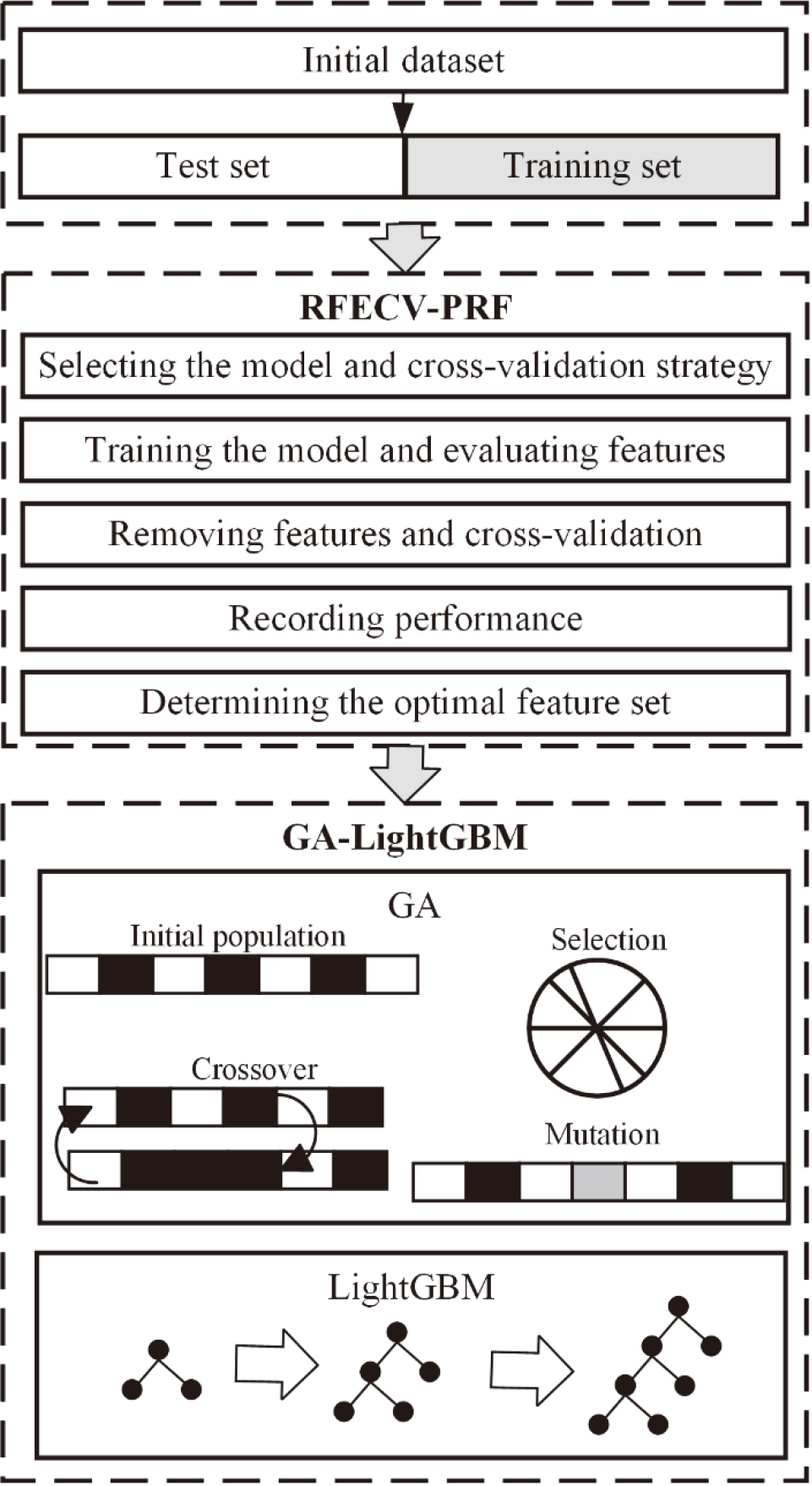
RFECV-PRF-GA-LightGBM model framework
- [1] S. Cai, “Explainable fraud detection of financial statement data driven by two-layer knowledge graph,” Expert Syst. Appl., Vol.246, Article No.123126, 2024. https://doi.org/10.1016/j.eswa.2023.123126
- [2] W. Zhou, “Detecting evolutionary financial statement fraud,” Decis. Support Syst., Vol.50, No.3, pp. 570-575, 2011. https://doi.org/10.1016/j.dss.2010.08.007
- [3] D. Kong, “Explain or conceal? Causal language intensity in annual report and stock price crash risk,” Econ. Model., Vol.94, pp. 715-725, 2021. https://doi.org/10.1016/j.econmod.2020.02.013
- [4] J. Li, “Textual analysis and detection of financial fraud: Evidence from Chinese manufacturing firms,” Econ. Model., Vol.126, Article No.106428, 2023. https://doi.org/10.1016/j.econmod.2023.106428
- [5] Y. Li, B. Fu, Y. Tong, Z. Tang, Z. Shang, and A. Li, “Abnormal detection of financial fraud in listed companies based on deep learning,” Procedia Comput. Sci., Vol.242, pp. 1402-1409, 2024. https://doi.org/10.1016/j.procs.2024.08.112
- [6] K. G. Al-Hashedi and P. Magalingam, “Financial fraud detection applying data mining techniques: A comprehensive review from 2009 to 2019,” Comput. Sci. Rev., Vol.40, Article No.100402, 2021. https://doi.org/10.1016/j.cosrev.2021.100402
- [7] J. West, “Intelligent financial fraud detection: A comprehensive review,” Computers & Security, Vol.57, pp. 47-66, 2016. https://doi.org/10.1016/j.cose.2015.09.005
- [8] T. Prabhavathy, V. K. Elumalai, and E. Balaji, “Hand gesture classification framework leveraging the entropy features from sEMG signals and VMD augmented multi-class SVM,” Expert Syst. Appl., Vol.238, Part D, Article No.121972, 2024. https://doi.org/10.1016/j.eswa.2023.121972
- [9] G. G. Sundarkumar, V. Ravi, and V. Siddeshwar, “One-class support vector machine based undersampling: Application to churn prediction and insurance fraud detection,” 2015 IEEE Int. Conf. on Computational Intelligence and Computing Research (ICCIC), 2015. https://doi.org/10.1109/ICCIC.2015.7435726
- [10] Q. Deng, “Application of support vector machine in the detection of fraudulent financial statements,” 2009 4th Int. Conf. on Computer Science & Education, pp. 1056-1059, 2009. https://doi.org/10.1109/ICCSE.2009.5228542
- [11] H. Pan, “Incremental model checking for fuzzy computation tree logic,” Fuzzy Sets Syst., Vol.500, Article No.109195, 2025. https://doi.org/10.1016/j.fss.2024.109195
- [12] K. Supraja and S. J. Saritha, “Robust fuzzy rule based technique to detect frauds in vehicle insurance,” 2017 Int. Conf. on Energy, Communication, Data Analytics and Soft Computing (ICECDS), pp. 3734-3739, 2017. https://doi.org/10.1109/ICECDS.2017.8390160
- [13] S. K. Saeed and H. Hagras, “Adaptive type-2 fuzzy logic based system for fraud detection in financial applications,” 2018 10th Computer Science and Electronic Engineering (CEEC), pp. 15-18, 2018. https://doi.org/10.1109/CEEC.2018.8674217
- [14] S. Z. Aftabi, A. Ahmadi, and S. Farzi, “Fraud detection in financial statements using data mining and GAN models,” Expert Syst. Appl., Vol.227, Article No.120144, 2023. https://doi.org/10.1016/j.eswa.2023.120144
- [15] I. Dutta, S. Dutta, and B. Raahemi, “Detecting financial restatements using data mining techniques,” Expert Syst. Appl., Vol.90, pp. 374-393, 2017. https://doi.org/10.1016/j.eswa.2017.08.030
- [16] P. Hajek, “Interpretable fuzzy rule-based systems for detecting financial statement fraud,” J. MacIntyre, I. Maglogiannis, L. Iliadis, and E. Pimenidis (Eds.), “Artificial intelligence applications and innovations,” Springer, pp. 425-436, 2019. https://doi.org/10.1007/978-3-030-19823-7_36
- [17] M. Lokanan, V. Tran, and N. H. Vuong, “Detecting anomalies in financial statements using machine learning algorithm: The case of Vietnamese listed firms,” Asian J. Account. Res., Vol.4, No.2, pp. 181-201, 2019. https://doi.org/10.1108/AJAR-09-2018-0032
- [18] Indrajani, Y. Heryadi, L. A. Wulandhari, and B. S. Abbas, “Recognizing debit card fraud transaction using CHAID and K-nearest neighbor: Indonesian Bank case,” 2016 11th Int. Conf. on Knowledge, Information and Creativity Support Systems (KICSS), 2016. https://doi.org/10.1109/KICSS.2016.7951441
- [19] V. R. Sonwane, S. Zanje, S. Yenpure, Y. Gunjal, Y. Kulkarni, and R. Yeole, “Advanced machine learning techniques for credit card fraud detection: A comprehensive study,” 2024 5th Int. Conf. on Smart Electronics and Communication (ICOSEC), pp. 1978-1981, 2024. https://doi.org/10.1109/ICOSEC61587.2024.10722667
- [20] U. Jabeen, K. Singh, and S. Vats, “Credit card fraud detection scheme using machine learning and synthetic minority oversampling technique (SMOTE),” 2023 5th Int. Conf. on Inventive Research in Computing Applications (ICIRCA), pp. 122-127, 2023. https://doi.org/10.1109/ICIRCA57980.2023.10220646
- [21] A. Singh, A. Singh, A. Aggarwal, and A. Chauhan, “Design and implementation of different machine learning algorithms for credit card fraud detection,” 2022 Int. Conf. on Electrical, Computer, Communications and Mechatronics Engineering (ICECCME), 2022. https://doi.org/10.1109/ICECCME55909.2022.9988588
- [22] P. Hajek and R. Henriques, “Mining corporate annual reports for intelligent detection of financial statement fraud – A comparative study of machine learning methods,” Knowl.-Based Syst., Vol.128, pp. 139-152, 2017. https://doi.org/10.1016/j.knosys.2017.05.001
- [23] T. Shahana, “State of the art in financial statement fraud detection: A systematic review,” Technol. Forecast., Vol.192, Article No.122527, 2023. https://doi.org/10.1016/j.techfore.2023.122527
- [24] Y. Zhang, A. Hu, J. Wang, and Y. Zhang, “Detection of fraud statement based on word vector: Evidence from financial companies in China,” Finance Res. Lett., Vol.46, Article No.102477, 2022. https://doi.org/10.1016/j.frl.2021.102477
- [25] S. A. Naghibi, H. Hashemi, R. Berndtsson, and S. Lee, “Application of extreme gradient boosting and parallel random forest algorithms for assessing groundwater spring potential using DEM-derived factors,” J. Hydrol., Vol.589, Article No.125197, 2020. https://doi.org/10.1016/j.jhydrol.2020.125197
- [26] A. Habibi, M. R. Delavar, M. S. Sadeghian, B. Nazari, and S. Pirasteh, “A hybrid of ensemble machine learning models with RFE and Boruta wrapper-based algorithms for flash flood susceptibility assessment,” Int. J. Appl. Earth Obs. Geoinformation, Vol.122, Article No.103401, 2023. https://doi.org/10.1016/j.jag.2023.103401
- [27] F. Li, “Network traffic prediction based on PSO-LightGBM-TM,” Comput. Netw., Vol.254, Article No.110810, 2024. https://doi.org/10.1016/j.comnet.2024.110810
- [28] F. Jiang et al., “Thermal performance prediction of radial-rotating oscillating heat pipe by a novel fusion model: A case study of application in grinding,” Case Stud. Therm. Eng., Vol.60, Article No.104731, 2024. https://doi.org/10.1016/j.csite.2024.104731
- [29] X. Yuan, Y. Zhou, C. Yan, Y. Wang, H. He, and Q. Zhang, “Extraction of features for financial fraud in companies using machine learning algorithms,” SmartTech Innov., Vol.1, No.1, pp. 28-38, 2025. https://doi.org/10.26917/j.cnki.issn.2097-597X.2025.01.003
This article is published under a Creative Commons Attribution-NoDerivatives 4.0 Internationa License.