
Paper:
Developing and Evaluating a Disaster Education Teaching Material Support System for Sharing Educational Knowledge
Keigo Kamida*,**,†
 , Masataka Kawasaki*,**
, and Yuichiro Usuda*,**
, Masataka Kawasaki*,**
, and Yuichiro Usuda*,**
*National Research Institute for Earth Science and Disaster Resilience
3-1 Tennodai, Tsukuba, Ibaraki 305-0006, Japan
**University of Tsukuba
Tsukuba, Japan
†Corresponding author

This study developed a system and teaching material creation support model by applying the instructional design (ID) framework to facilitate the development of disaster education teaching materials tailored to regional characteristics. First, a teaching material creation support model based on ID theory was proposed, demonstrating the model’s potential for standardizing the development of disaster education teaching materials and its applicability in practice. Second, a prototype system was developed to create lesson plans aligned with actual regional conditions by identifying regional characteristics and referencing past cases. Third, through presentation to schoolteachers and empirical evaluation, the usefulness of the search function and of the linkage between cases and lesson plans was confirmed, highlighting the effectiveness of sharing disaster education knowledge and supporting instruction. Future challenges include strengthening quality assurance for teaching materials, expanding reference cases through comprehensive data integration, and designing flexibility to preserve teachers’ discretion.
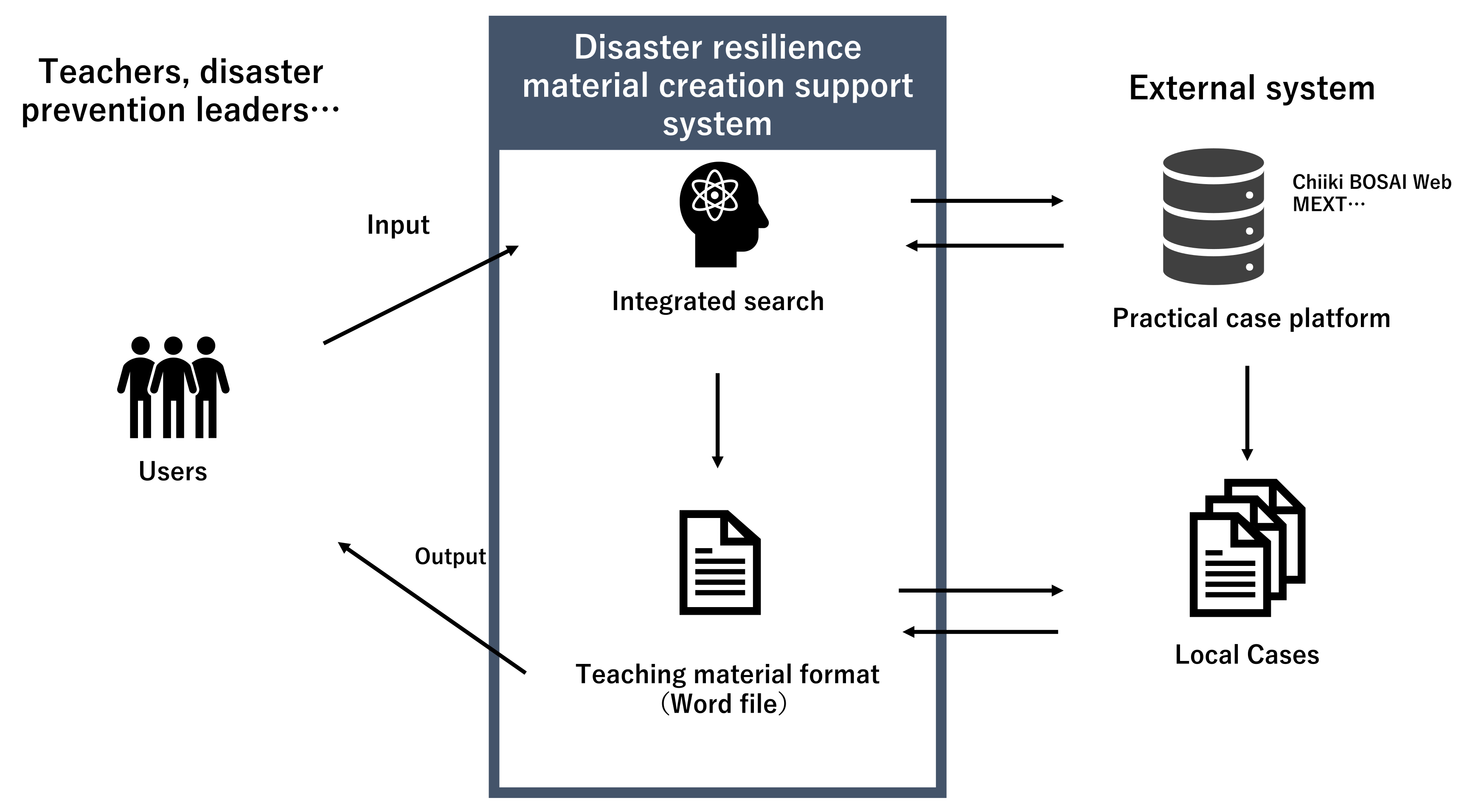
Disaster education support system
- [1] United Nations Office for Disaster Risk Reduction, “Sendai Framework for Disaster Risk Reduction 2015–2030,” 2015. https://www.undrr.org/publication/sendai-framework-disaster-risk-reduction-2015-2030 [Accessed July 20, 2025]
- [2] Ministry of Education, Culture, Sports, Science and Technology, “Third plan for promoting school safety,” 2022 (in Japanese). https://www.mext.go.jp/content/20220325_mxt_kyousei02_000021515_01.pdf [Accessed March 15, 2025]
- [3] Ministry of Education, Culture, Sports, Science and Technology, “Expert panel on disaster education and management in response to the Great East Japan Earthquake,” 2012 (in Japanese). https://www.mext.go.jp/b_menu/shingi/chousa/sports/012/toushin/__icsFiles/afieldfile/2012/07/31/1324017_01.pdf [Accessed March 15, 2025]
- [4] M. Ikeda, T. Nagata, R. Kimura, T.-Y. Yi, and S. Nagamatsu, “Analysis of current disaster prevention education materials developed in Japan—The future of disaster prevention education in relation to the courses of study,” J. of Social Safety Science, Vol.39, pp. 103-111, 2021 (in Japanese). https://doi.org/10.11314/jisss.39.103
- [5] A. Sakurai, “Sendai Framework for Disaster Risk Reduction and school disaster safety: Promoting international cooperation for mutual learning,” Quarterly J. of Geography, Vol.73, Issue 2, pp. 63-76, 2021 (in Japanese). https://doi.org/10.5190/tga.73.2_63
- [6] F. Miura, “Disaster prevention education support system using the internet,” J. of Japan Society for Natural Disaster Science, Vol.24, No.4, pp. 382-386, 2006 (in Japanese).
- [7] H. Hatakeyama, M. Nagai, and M. Murota, “Development and practice of a scenario-based learning support system for urging evacuation behavior based on subjective judgment in the field,” Trans. of Japanese Society for Information and Systems in Education, Vol.35, Issue 2, pp. 134-144, 2018 (in Japanese). https://doi.org/10.14926/jsise.35.134
- [8] Y. Ohta and M. Ushiyama, “A study of relationship between regional characteristics and disaster education at school,” J. of Japan Society for Natural Disaster Science, Vol.28, No.3, pp. 249-257, 2009 (in Japanese).
- [9] Ministry of Education, Culture, Sports, Science and Technology, “Survey on the implementation status of plans for the promotion of school safety (FY2023 Results),” 2024 (in Japanese). https://anzenkyouiku.mext.go.jp/report-gakkouanzen/data/r05/ope_dev05-3.pdf [Accessed August 20, 2025]
- [10] K. Kamida and Y. Usuda, “Supporting the development of disaster education materials reflecting regional characteristics: A nationwide survey of prefectural guidelines in Japan,” Proc. of the Annual Conf. of the Institute of Social Safety Science, Vol.56, pp. 216-217, 2025.
- [11] K. Suzuki, “Instructional design for e-Learning practices,” Japan J. of Educational Technology, Vol.29, Issue 3, pp. 197-205, 2005 (in Japanese). https://doi.org/10.15077/jjet.KJ00004286879
- [12] R. M. Gagné, W. W. Wager, K. C. Golas, and J. M. Keller, “Principles of instructional design (5th ed.),” Wadsworth Publishing, 2005.
- [13] R. Kimura, K. Tamura, M. Inoguchi, K. Horie, and H. Hayashi, “Method of designing training programs for disaster responders based on instructional design (ID) theory in the case of life reconstruction support for disaster victims of Tokyo Metropolitan Government,” J. of Social Safety Science, Vol.18, pp. 433-442, 2012 (in Japanese). https://doi.org/10.11314/jisss.18.433
- [14] T. Nagata and R. Kimura, “An attempt of developing the tornado disaster management education program based on the knowledge and lessons of the tornado-affected school and applying them to schools out of the affected area,” J. of Social Safety Science, Vol.28, pp. 117-126, 2016 (in Japanese). https://doi.org/10.11314/jisss.28.117
- [15] T. Nagata and R. Kimura, “Proposing a multi-hazard approach to disaster management education to enhance children’s ‘zest for life’: Development of disaster management education programs to be practiced by teachers,” J. Disaster Res., Vol.12, No.1, pp. 17-29, 2017. https://doi.org/10.20965/jdr.2017.p0017
- [16] T. Nagata and R. Kimura, “Developing a disaster management education and training program for children with intellectual disabilities to improve ‘zest for life’ in the event of a disaster—A case study on Tochigi Prefectural Imaichi Special School for the intellectually disabled—,” J. Disaster Res., Vol.15, No.1, pp. 20-40, 2020. https://doi.org/10.20965/jdr.2020.p0020
- [17] T. Nagata, M. Ikeda, R. Kimura, and T. Oda, “Development of tsunami disaster risk reduction education program for children with no experience of earthquake disaster—Practice and verification at Shichigahama Town, Miyagi Prefecture,” J. Disaster Res., Vol.17, No.6, pp. 1000-1014, 2022. https://doi.org/10.20965/jdr.2022.p1000
- [18] T. Nagata, T.-Y. Yi, R. Kimura, and M. Ikeda, “Development of the volcanic disaster risk reduction education program using the ICT tool ‘YOU@RISK Volcanic Disaster Edition’—Practical verification at a junior high school in the Mt. Nasu area—,” J. Disaster Res., Vol.19, No.5, pp. 793-807, 2024. https://doi.org/10.20965/jdr.2024.p0793
- [19] K. Iwaka, M. Matsushige, Y. Kozuki, and H. Yamanaka, “Learning effect of disaster prevention training targeting new employee in Tokushima Prefecture Government,” J. of the Center for Community Engagement and Lifelong Learning, Tokushima University, Vol.29, pp. 1-12, 2020 (in Japanese).
- [20] M. Matsushige, Y. Kozuki, A. Kono, R. Yamanaka, and Y. Nishiyama, “Discussion on designing and assessing disaster prevention education based on ID focusing on the leading evacuees drills using red/blue paperboard,” J. of Japan Society of Civil Engineers, Ser. B2 (Coastal Engineering), Vol.76, No.2, pp. I_1195-I_1200, 2020 (in Japanese). https://doi.org/10.2208/kaigan.76.2_i_1195
- [21] R. Fukumoto, “Instructional design for disaster prevention education under infectious disease epidemic: Case study of providing the opportunity to talk about disaster prevention through the generations with play cards,” Proc. of the 68th Annual Conf. of JSSD, pp. 122-123, 2021 (in Japanese). https://doi.org/10.11247/jssd.68.0_122
- [22] Juhadi, N. Hamid, E. Trihatmoko, M. Herlina, and E. N. Aroyandini, “Developing a model for disaster education to improve students’ disaster mitigation literacy,” J. Disaster Res., Vol.16, No.8, pp. 1243-1256, 2021. https://doi.org/10.20965/jdr.2021.p1243
- [23] M. Ikeda, T. Nagata, R. Kimura, T.-Y. Yi, S. Suzuki, S. Nagamatsu, T. Oda, S. Endo, M. Hatakeyama, S. Yoshikawa, S. Adachi, S. Miura, and J. Take, “Development of disaster management education program to enhance disaster response capabilities of schoolchildren during heavy rainfall—Implementation at elementary school in Nagaoka City, Niigata Prefecture, a disaster-stricken area,” J. Disaster Res., Vol.16, No.7, pp. 1121-1136, 2021. https://doi.org/10.20965/jdr.2021.p1121
- [24] R. Kimura and K. Aikawa, “Proposal for a disaster management drill program for high school students who have never experienced a disaster to foster a sense of ‘awareness that disaster affects everyone’,” J. Disaster Res., Vol.19, No.1, pp. 124-138, 2024. https://doi.org/10.20965/jdr.2024.p0124
- [25] H. Sano, S. Miura, N. Handa, T.-Y. Yi, H. Taguchi, and Y. Usuda, “Development of ‘regional characteristic information tool’ to provide information reflecting cross-regional evaluation of regional characteristics to practitioners,” J. of Disaster Information Studies, Vol.16, Issue 2, pp. 247-259, 2018 (in Japanese). https://doi.org/10.24709/jasdis.16.2_247
- [26] Ministry of Education, Culture, Sports, Science and Technology, “Instructional reference material: Practical guide to disaster prevention education (elementary school edition),” 2023 (in Japanese). https://anzenkyouiku.mext.go.jp/mextshiryou/data/jissenbousaisyougakukou.pdf [Accessed March 20, 2025]
- [27] I. Sato, “Qualitative data analysis: Principles, methods, and practice,” Shinyosha, 2008 (in Japanese).
This article is published under a Creative Commons Attribution-NoDerivatives 4.0 Internationa License.