
Paper:
Developing and Evaluating a Disaster Education Teaching Material Support System for Sharing Educational Knowledge
Keigo Kamida*,**,†
 , Masataka Kawasaki*,**
, and Yuichiro Usuda*,**
, Masataka Kawasaki*,**
, and Yuichiro Usuda*,**
*National Research Institute for Earth Science and Disaster Resilience
3-1 Tennodai, Tsukuba, Ibaraki 305-0006, Japan
**University of Tsukuba
Tsukuba, Japan
†Corresponding author

This study developed a system and teaching material creation support model by applying the instructional design (ID) framework to facilitate the development of disaster education teaching materials tailored to regional characteristics. First, a teaching material creation support model based on ID theory was proposed, demonstrating the model’s potential for standardizing the development of disaster education teaching materials and its applicability in practice. Second, a prototype system was developed to create lesson plans aligned with actual regional conditions by identifying regional characteristics and referencing past cases. Third, through presentation to schoolteachers and empirical evaluation, the usefulness of the search function and of the linkage between cases and lesson plans was confirmed, highlighting the effectiveness of sharing disaster education knowledge and supporting instruction. Future challenges include strengthening quality assurance for teaching materials, expanding reference cases through comprehensive data integration, and designing flexibility to preserve teachers’ discretion.
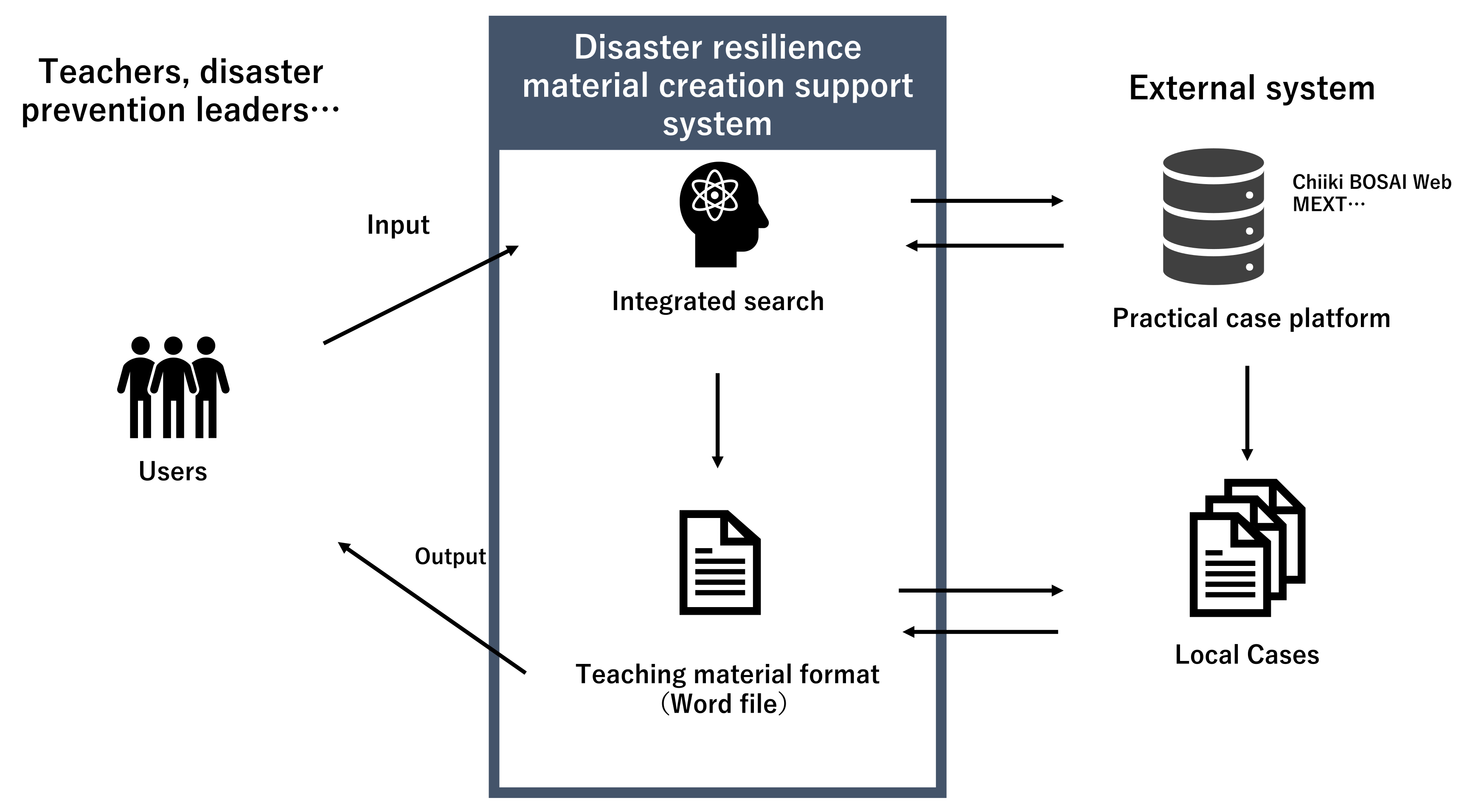
Disaster education support system
1. Introduction
The Sendai Framework for Disaster Risk Reduction, published by the United Nations International Strategy for Disaster Reduction (now the United Nations Office for Disaster Risk Reduction) in 2015 1, states that “Policies and practices for disaster risk management should be based on an understanding of disaster risk in all its dimensions of vulnerability, capacity, exposure of persons and assets, hazard characteristics and the environment.” This emphasizes the global need for practices grounded in comprehensive disaster risk awareness.
Japan is a disaster-prone country that has experienced numerous catastrophes throughout its history and faces various hazards, such as earthquakes and floods, almost every year. The Great Hanshin-Awaji Earthquake in 1995 highlighted the importance of disaster education in Japan. Following the Great East Japan Earthquake in 2011, there has been a growing demand for practical disaster education in schools nationwide that incorporates local disaster risks, along with the sharing and dissemination of knowledge through digital technology 2.
The final report of the Expert Panel on Disaster Education and Management in Response to the Great East Japan Earthquake, compiled by the Ministry of Education, Culture, Sports, Science and Technology (MEXT) in 2012 3, was issued in response to the Great East Japan Earthquake. It aimed to foster an “attitude of proactive action” and the spirit of “mutual aid and public assistance,” while also noting that insufficient time was being allocated to disaster education. Subsequently, MEXT developed nationwide guidelines for disaster education, providing directions for and promoting their implementation. Based on these efforts, prefectures have created their own guidelines, and disaster education is now being implemented nationwide.
Support programs for disaster education (e.g., the “Disaster Education Challenge Plan,” the “1.17 Disaster Prevention Future Award ‘Bousai Koshien’,” and the “Disaster Reduction Education Program”) have contributed to the development of over 2,000 disaster education teaching materials 4. However, challenges remain regarding the widespread adoption of these materials and methods and the establishment of effective support mechanisms 5.
One key reason is that knowledge of disaster education practices (hereinafter referred to as “disaster education knowledge”) remains scattered across multiple sources as unstructured data, including individual reports, organizational websites, and practitioners’ personal experiences. Although systems supporting disaster education activities have been developed (e.g., Miura 6 and Hatakeyama et al. 7), no systems have been identified that specifically support the creation of teaching materials.
Therefore, this study examines a system designed to facilitate the sharing of existing disaster education knowledge and support the creation of teaching materials. In addition to sharing disaster education knowledge, the system provides information on regional characteristics, including local disaster risks. It aims to promote practical disaster education tailored to regional characteristics by supporting the creation of teaching materials based on shared knowledge.
2. Challenges of Disaster Education
Although disaster education is progressing in various regions, a survey by Ohta and Ushiyama 8 revealed that education on landslides and mudslides was being implemented in schools without alignment with actual local risks. Subsequently, the aforementioned MEXT guidelines led to nationwide recognition of the necessity for school disaster preparedness accounting for regional characteristics, particularly local disaster risks. However, a 2024 MEXT survey of schools nationwide indicated that although over 90% of schools conduct earthquake evacuation drills, the rate of volcanic disaster drills in areas designated as volcanic hazard zones is below 20% for high schools 9. This suggests that disaster education has not been sufficiently tailored to regional hazards, highlighting the challenges of implementing locally appropriate disaster education.
Moreover, the burden on teachers is significant. Disaster education, which cannot be directly applied to other examples owing to regional differences, requires adaptation. The widespread dissemination of disaster education materials and teaching methods, along with the establishment of effective support mechanisms, remains a key challenge 5.
Kamida and Usuda 10 examined the disaster education guidelines issued by each prefecture, which served as reference for teachers implementing such education in schools. Their findings revealed that although 43 out of 47 prefectures have issued guidelines, 40% lack descriptions of regional characteristics and do not provide concrete methods for acquiring such local knowledge.
3. Study on a Support Model for Creating Disaster Teaching Materials
This study examines a support model for creating disaster education teaching materials and aims to develop a corresponding system. The support model incorporates essential elements while referencing existing guidelines. Its development is grounded in educational engineering theories, particularly instructional design (ID) and the analysis, design, development, implementation, and evaluation (ADDIE) model.
ID has been widely applied in Europe and the United States since the 1970s and is defined as “a model and field of study that synthesizes methods for enhancing the effectiveness, efficiency, and appeal of educational activities, or the process of applying these to realize learning support environments” 11. Although other theories and studies on teaching methods exist, ID is characterized by its focus on supporting learners through various activities rather than mere teaching and on learner outcomes 12. Its applications extend beyond schools to include the training of engineers and medical professionals as well as vocational education and training. As mentioned above, disaster education has shifted its emphasis from a “knowledge-imposing” approach to fostering an “attitude of proactive action” tailored to local contexts. Therefore, this study incorporates ID, a theory designed to maximize the effectiveness of educational activities aligned with objectives such as student motivation.
Kimura et al. 13 developed an educational and training program for disaster education incorporating ID. Subsequently, Nagata and Kimura 14,15,16, Nagata et al. 17,18, Iwaka et al. 19, Matsushige et al. 20, Fukumoto 21, Juhadi et al. 22, Ikeda et al. 23, and Kimura and Aikawa 24 developed disaster education materials using the ADDIE model. However, these studies focused solely on evaluating students and the materials, with little discussion of regional characteristics. Furthermore, they focused on developing individual materials, without incorporating ID into support systems for material creation. Therefore, this study aims to develop a new system using the ADDIE model.
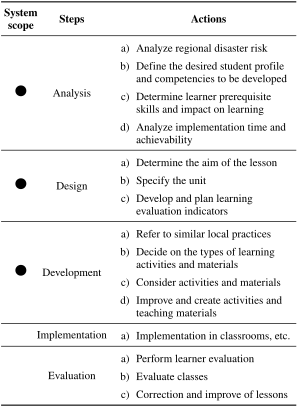
For system development, we employed the ADDIE model 12, a representative and comprehensive ID framework outlining the sequence of educational activities. The ADDIE model comprises five steps: “Analysis” examines the target audience and educational content; “Design” determines the programs and content to be prepared; “Development” reviews and creates instructional materials; “Implementation” entails actual practice in classrooms or similar settings; and “Evaluation” assesses lessons and materials to identify areas for improvement.
We constructed a modified ADDIE model tailored to disaster education (Table 1 and Fig. 1) by referencing guidelines from prefectures nationwide. We focused on the system’s scope from “Analysis” to “Development,” which are critical stages for instructional material creation.
4. Developing a Disaster Education Teaching Materials Creation Support System
Drawing on the above theories and understanding regional characteristics, we attempted to build an online support site that enables the efficient sharing and creation of disaster education materials. The details of the system are described below (Fig. 2).
4.1. System Design
This study implemented the following functions. The goal is to enable both widespread dissemination of teaching materials and flexible creation of materials tailored to regional characteristics.
-
(1)
The regional characteristics search function is provided by connecting to the “Regional Characteristic Information Tool” (Chiiki BOSAI Web) 25 operated by the National Research Institute for Earth Science and Disaster Resilience. This site provides relative evaluations of disaster risk in cities, wards, towns, and villages across Japan’s 1,718 municipalities.
-
(2)
The teaching material search function enables filtering by disaster type (earthquake, tsunami, heavy rain, etc.), target grade level, class period, and subject area.
-
(3)
The template creation function provides lesson plan templates, creating an environment where teachers can rapidly create and review teaching materials.
Table 1. Disaster teaching materials development support model.
4.2. System Operation
Figure 3 shows an operational overview of the system. Each operation is described in detail below.
4.2.1. Understanding Regional Characteristics
The “Chiiki BOSAI Web” system searches using the entered prefecture and municipality names, presents a relative evaluation of the search area’s characteristics across all 1,718 municipalities nationwide on a five-point scale, and narrows down similar municipalities. The regional hazard levels are assessed as follows: earthquakes are rated on a five-point scale based on the probability of a magnitude 6 or greater earthquake occurring within 30 years, using probabilistic seismic motion prediction. Tsunamis, liquefaction, and volcanic hazards are classified using microtopographic maps. Flooding and inland water inundation are rated based on the percentage of the area covered by floodwater using hazard maps. Heavy snowfall is rated on a five-point scale based on snow depth.
A summary of the regional assessment results is presented in narrative form to facilitate the understanding of regional characteristics. Moreover, a list of regions with similar characteristics is provided, enabling users to refer to practical examples implemented in comparable areas.
4.2.2. Determination of the Target
The school level and target grade level are entered to narrow down the search for past cases.
4.2.3. Subject Review
The subject for which a class is to be conducted is entered and the system narrows down the results based on past cases. Practices by regional disaster prevention leaders are registered and linked on the “Chiiki BOSAI Web,” filtered and presented from practice data supported by the National Research and Development Agency, Cabinet Office, and MEXT.
4.2.4. Nurturing Ability
MEXT 26 defines eight clusters for disaster education instruction: “Understanding natural phenomena (earthquakes, tsunamis, and volcanic disasters),” “Understanding local disaster history (weather-related disasters),” “Issues manifesting during disasters,” “Utilizing disaster lessons learned,” “Identifying local damage characteristics,” “Methods for damage mitigation,” “How to protect yourself during disasters,” and “Mutual aid and public assistance in damage mitigation.” In addition, it specifies three selectable items: “Know,” “Prepare,” and “Act.”
4.2.5. Recommended Teaching Materials and Past Examples
Past practice examples were extracted from the “Chiiki BOSAI Web” and the initiative/case collections of MEXT using the above filters. Based on the characteristics of the selected regions, examples of high-risk disasters and methodologies from similar regions were referenced. Lesson plans were constructed according to this format and displayed on the screen. Additionally, links to referenced past examples were provided, enabling users to trace the original cases. Furthermore, the system allows the lesson plan to be exported as a Word file, enabling teachers to immediately add notes, make corrections, and create lesson plans more efficiently (Fig. 4).
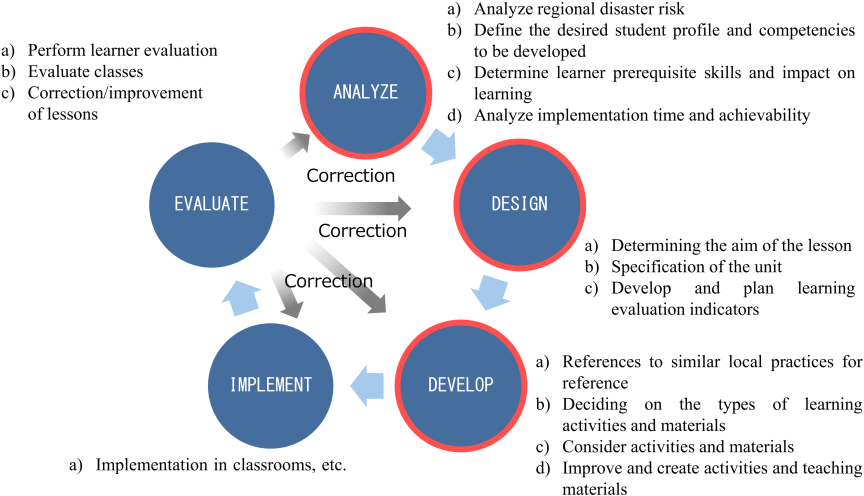
Fig. 1. Disaster teaching materials development support model.
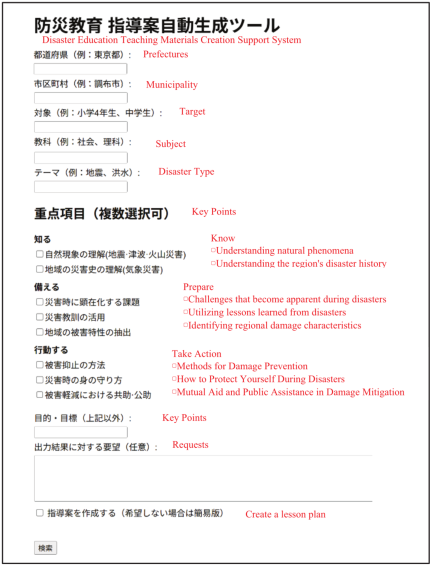
Fig. 2. Disaster education teaching materials creation support system.
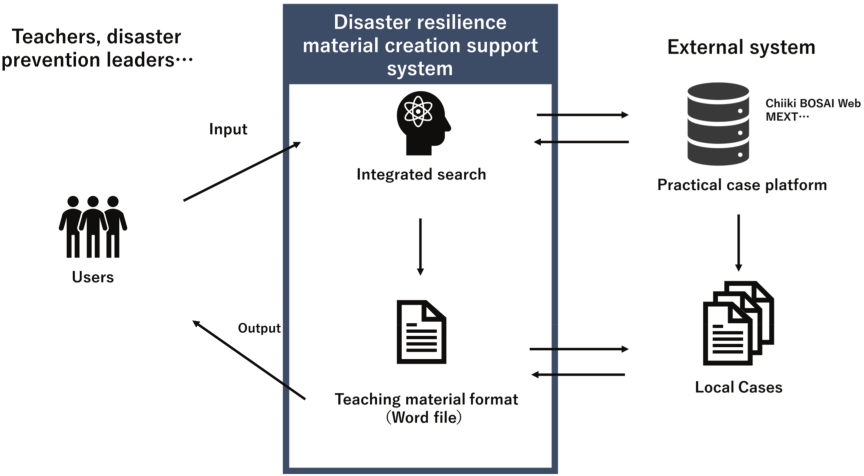
Fig. 3. Overview of the operation of the disaster education teaching materials creation support system.
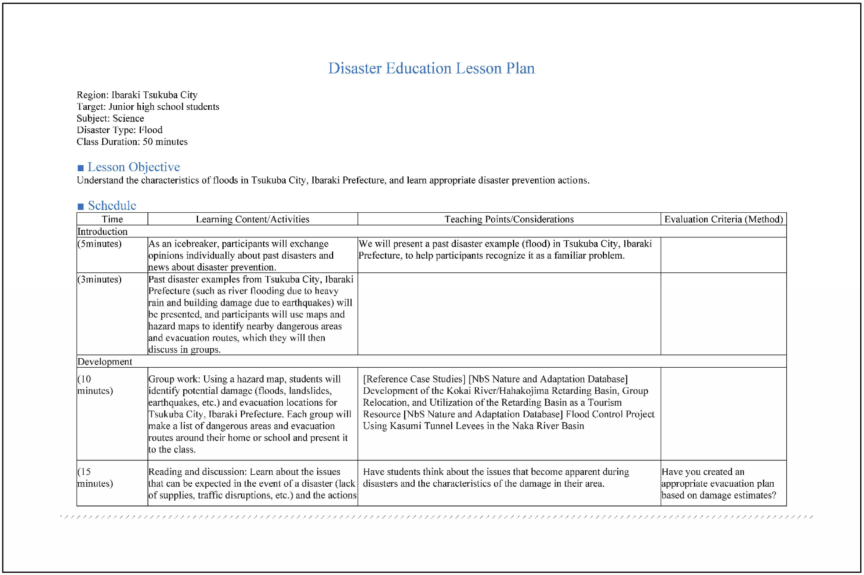
Fig. 4. Example of output instruction plan results.
5. System Evaluation
5.1. Survey Methodology
To evaluate the system, a survey was conducted with public elementary school teachers in Tokyo, public junior high school teachers in Kanagawa Prefecture, and public high school teachers in Shizuoka Prefecture to examine the system’s usefulness and the validity of the generated teaching materials (Table 2). The analysis of the survey data followed the evaluation process outlined in ID.
According to Gagné et al. 12, evaluation in ID encompasses five categories: “evaluation of instructional materials,” “quality review of the instructional system design (ISD) process,” “evaluation of learner response to ID,” “measurement of learner performance against learning objectives,” and “prediction of outcomes resulting from ID.” We conducted a quality review of the ISD process with a focus on system evaluation. Process evaluation comprises two aspects: “evaluation of the process itself” and “evaluation of the process outcomes,” organized under these categories in this study. When selecting interview subjects, we considered disaster types and regional characteristics. We targeted a school in Chofu City, Tokyo, designated as a municipal School Safety Promotion School and engaged in disaster prevention, considering the city’s flood risk; a school in Yokohama City, Kanagawa Prefecture, designated as a regional disaster prevention hub and engaged in disaster prevention projects, considering its vulnerability to a potential Tokyo inland earthquake; and a school in Shizuoka City, Shizuoka Prefecture, designated as a UNESCO School and engaged in advanced disaster prevention education, considering its vulnerability to the Nankai Trough Earthquake, a plate boundary earthquake. Survey items included “ease of finding teaching materials,” “efficiency in lesson preparation,” “suitability of teaching materials,” and “motivation for sharing teaching materials.”
5.2. Survey Results on Generated Teaching Materials
The teaching materials created during the survey period were examined for validity, specifically whether they considered disaster risks in the selected regions. Teachers generated 27 lesson plans during the survey period. All lesson plans reflected the disaster risks specific to their respective regions and incorporated regional characteristics. Representative activities included the following: “Using hazard maps, groups identified potential damage (flooding, landslides, earthquakes, etc.) and confirmed evacuation sites in Suruga Ward, Shizuoka City, Shizuoka Prefecture; each group then listed and presented hazardous locations and evacuation routes around their homes and schools.” and “Present past disaster cases in Minami Ward, Yokohama City, Kanagawa Prefecture (e.g., river flooding due to heavy rain, building damage due to earthquakes), then use maps and hazard maps to identify nearby hazardous locations and evacuation routes, and discuss them in groups.”
Table 2. Survey overview.
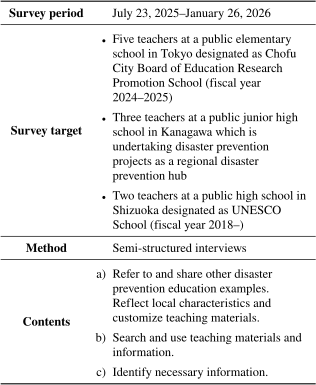
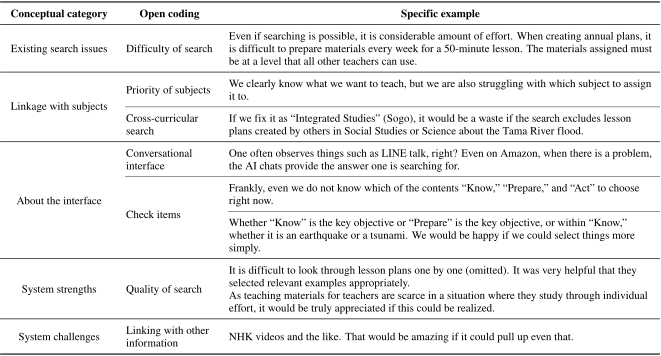
Table 3. Conceptual categories related to “Evaluation of the process itself” in teacher interviews.
5.3. Results of the Hearing Survey
To evaluate the system’s adaptability in real-world settings, we conducted interviews with 10 educators: five public elementary school teachers in Tokyo, three public junior high school teachers in Kanagawa Prefecture, and two public high school teachers in Shizuoka Prefecture. All interview content was transcribed verbatim and analyzed using MAXQDA (Ver. 24.10.0), based on Sato’s 27 qualitative methodology. To ensure reliability, the same analyst reanalyzed the data one week after the initial coding. The resulting Cohen’s kappa coefficient was 0.72, confirming consistency in the application of the criteria. Where discrepancies occurred, the items were re-examined, and after minor revisions to the analysis criteria, the final analysis for the entire dataset was completed.
In all, 66,187 characters were meticulously analyzed. Open codes were extracted from each sentence, and conceptual categories were derived from relevant open codes. These were further reclassified into ISD quality evaluation categories: “Evaluation of the process itself” and “Evaluation of the process outcomes.”
Consequently, for the “Evaluation of the process itself” category, five conceptual categories were obtained: “Existing search issues,” “Linkage with subjects,” “About the interface,” “System strengths,” and “System challenges.” For the “Evaluation of process outcomes” category, four conceptual categories were obtained: “About the objective,” “About the introduction,” “System strengths,” and “System challenges.”
Each conceptual category is detailed in the following sections.
5.3.1. Conceptual Categories Related to “Evaluation of the Process Itself”
The conceptual categories related to “Evaluation of the process itself” are described in Table 3.
Conceptual Category: “Existing Search Issues”
The conceptual category “Existing search issues” corresponds to “Difficulty of search.” Specifically, comments regarding challenges with searching previous materials were identified, such as “Ultimately, while this search is indeed possible, it is an enormous amount of effort.”
Conceptual Category: “Linkage with Subjects”
The conceptual category “Linkage with subjects” includes “Priority of subjects” and “Cross-curricular search.” Specifically, opinions were expressed regarding challenges in subject planning, such as “We have a clear idea of what we want to teach, but we are struggling with which subject to assign it to,” as well as the importance of subject-agnostic search functionality.
Conceptual Category: “About the Interface”
The conceptual category “About the interfaces” includes “Conversational interface” and “Check items.” Specifically, opinions were observed regarding interactive interfaces, such as “I want AI to converse like this and give me the answer I most need,” and regarding the complexity of the options: “Frankly, the contents of ‘Know,’ ‘Prepare,’ and ‘Act’ are unclear. Even we do not know which option to choose. Is ‘Know’ the primary goal, or is ‘Prepare’? Within ‘Know,’ is it about earthquakes or tsunamis? It would be beneficial if we could choose something simpler.”
Conceptual Category: “System Strengths”
The conceptual category “System strengths” includes “Quality of search.” Specifically, comments related to efficiency and optimization during selection were observed, such as “Going through each one individually to look at lesson plans is really tough. [...] I believed it was incredibly helpful that it selected things that seemed relevant, like this.” Comments regarding simplifying the instructional material search process were also noted, such as “In a situation where teachers are studying through personal effort, there are few teaching materials available for them. Therefore, if this could be realized, it would be truly appreciated.”
Conceptual Category: “System Challenges”
The conceptual category “System challenges” includes “Linking with other information.” Specifically, there were views regarding expanding the search scope through collaboration with other organizations, such as “NHK videos and the like. That would be amazing if it pulled up even that.”
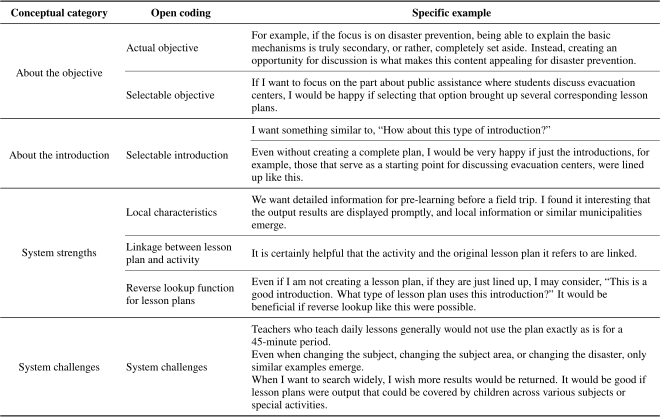
Table 4. Conceptual categories related to “Evaluation of process outcomes” in teacher interviews.
5.3.2. Conceptual Categories Related to “Evaluation of Process Outcomes”
The conceptual categories related to “Evaluation of process outcomes” are described in Table 4.
Conceptual Category: “About the Objective”
The conceptual category “About the objective” encompasses “Actual objective” and “Selectable objective.” Specifically, opinions indicated that linking objective selection with corresponding lesson plans was beneficial, as shown in comments such as “If I want to focus on the part about public assistance where students discuss evacuation centers, I would be happy if selecting that option brought up several corresponding lesson plans.” Linking the selection of target subjects with the corresponding lesson plans proved beneficial.
Conceptual Category: “About the Introduction”
The conceptual category “About the introduction” corresponds to “Selectable introduction.” Specifically, opinions were observed regarding the benefits of allowing optional introductions, such as “Even just an introduction—for example, an introduction that serves as a starting point for discussing this shelter—can be something like this. Therefore, having them laid out like this makes me happy.”
Conceptual Category: “System Strengths”
The conceptual category “System strengths” includes “Local characteristics,” “Linkage between lesson plans and activity,” and “Reverse lookup function for lesson plans.” Specifically, regarding the ease of grasping regional characteristics, it was noted that “We want detailed information for pre-learning before a field trip. I found it interesting that the output result is displayed quickly, and local information or similar municipalities emerged.” Opinions were also observed regarding the usefulness of the lesson plan output results, such as the ease of understanding regional characteristics and the benefit of linking activities with the original lesson plans.
Conceptual Category: “System Challenges”
The conceptual category “System challenges” corresponds to “System challenges.” Specifically, opinions were expressed regarding challenges in application when presenting completed lesson plans, such as “Teachers who teach daily lessons generally would not use the plan exactly as is for a 45-minute period.”
6. Results and Discussion
This study developed an ID-based support model and system to assist with the creation of disaster education teaching materials tailored to regional characteristics. The research outcomes are summarized as follows: First, we constructed a novel ID-based support model aimed at practitioners for developing disaster education materials. By applying educational technology theory, we sought to standardize the development of disaster education materials and demonstrate their potential application in disaster education. Second, we developed a prototype support system based on this model. The system enables users to understand the characteristics of their region, reference past practice examples online, and create lesson plans that align with their educational objectives. Third, when the system was presented to elementary, junior high, and high school teachers and evaluated empirically, they responded with positive feedback such as “It is difficult to look through lesson plans one by one (omitted). It was very helpful that they selected relevant examples appropriately,” and “Having links connecting that activity to the original lesson plan it referenced is definitely useful.” These positive opinions confirmed the effectiveness of the system in facilitating the sharing of disaster education knowledge and supporting teaching material creation. The ISD process itself and its outcomes also received positive feedback.
However, three challenges remain to be addressed. First, the system requires greater flexibility in instructional reviews. The survey results indicate that mandating strict adherence to a fixed lesson plan format may hinder teachers’ creativity, as exemplified by comments such as, “Teachers who teach daily lessons generally would not use the plan exactly as is for a 45-minute period.” Therefore, the system needs improvement to support disaster education practices while leaving room for teachers to adapt. Second, the pool of practical reference examples should be expanded to increase the variety and optimization of the generated lesson plans. Currently, the number of reference cases available is limited. As one comment noted, “Even when changing the subject, changing the subject area, or changing the disaster, only similar examples emerge,” indicating that in some regions, there are few precedents, leading to the frequent repetition of similar cases. Therefore, increasing the number of examples displayed is essential. This requires collaboration with various ministries, agencies, and organizations to make a wider range of disaster prevention teaching materials available for reference. Defining the necessary information and requirements for sharing disaster education materials is crucial. Mechanisms for automatically acquiring common items and user-friendly upload functions are required. Ensuring quality while increasing the number of materials is another challenge. Currently, the system primarily references past cases registered on the Chiiki BOSAI Web and MEXT. However, as the number of cases increases, developing methods to evaluate the quality of the cases will be required. Finally, evaluation and verification are required for all steps of the disaster teaching material development support model. This study evaluated the “Analysis,” “Design,” and “Development” phases of the five-step support model—the specific focus of the system—targeting teachers across various school types in earthquake- and flood-prone areas. We plan to continuously cycle through the “Implementation” and “Evaluation” phases in collaboration with schools, conducting long-term investigations into the effectiveness of this system for disaster prevention education within schools.
Acknowledgments
The authors are grateful to those who provided guidance, advice, and support during the preparation of this manuscript. In particular, we express our sincere appreciation to the teachers of public elementary schools in Tokyo, junior high schools in Yokohama, and high schools in Shizuoka, Japan, for their generous cooperation.
- [1] United Nations Office for Disaster Risk Reduction, “Sendai Framework for Disaster Risk Reduction 2015–2030,” 2015. https://www.undrr.org/publication/sendai-framework-disaster-risk-reduction-2015-2030 [Accessed July 20, 2025]
- [2] Ministry of Education, Culture, Sports, Science and Technology, “Third plan for promoting school safety,” 2022 (in Japanese). https://www.mext.go.jp/content/20220325_mxt_kyousei02_000021515_01.pdf [Accessed March 15, 2025]
- [3] Ministry of Education, Culture, Sports, Science and Technology, “Expert panel on disaster education and management in response to the Great East Japan Earthquake,” 2012 (in Japanese). https://www.mext.go.jp/b_menu/shingi/chousa/sports/012/toushin/__icsFiles/afieldfile/2012/07/31/1324017_01.pdf [Accessed March 15, 2025]
- [4] M. Ikeda, T. Nagata, R. Kimura, T.-Y. Yi, and S. Nagamatsu, “Analysis of current disaster prevention education materials developed in Japan—The future of disaster prevention education in relation to the courses of study,” J. of Social Safety Science, Vol.39, pp. 103-111, 2021 (in Japanese). https://doi.org/10.11314/jisss.39.103
- [5] A. Sakurai, “Sendai Framework for Disaster Risk Reduction and school disaster safety: Promoting international cooperation for mutual learning,” Quarterly J. of Geography, Vol.73, Issue 2, pp. 63-76, 2021 (in Japanese). https://doi.org/10.5190/tga.73.2_63
- [6] F. Miura, “Disaster prevention education support system using the internet,” J. of Japan Society for Natural Disaster Science, Vol.24, No.4, pp. 382-386, 2006 (in Japanese).
- [7] H. Hatakeyama, M. Nagai, and M. Murota, “Development and practice of a scenario-based learning support system for urging evacuation behavior based on subjective judgment in the field,” Trans. of Japanese Society for Information and Systems in Education, Vol.35, Issue 2, pp. 134-144, 2018 (in Japanese). https://doi.org/10.14926/jsise.35.134
- [8] Y. Ohta and M. Ushiyama, “A study of relationship between regional characteristics and disaster education at school,” J. of Japan Society for Natural Disaster Science, Vol.28, No.3, pp. 249-257, 2009 (in Japanese).
- [9] Ministry of Education, Culture, Sports, Science and Technology, “Survey on the implementation status of plans for the promotion of school safety (FY2023 Results),” 2024 (in Japanese). https://anzenkyouiku.mext.go.jp/report-gakkouanzen/data/r05/ope_dev05-3.pdf [Accessed August 20, 2025]
- [10] K. Kamida and Y. Usuda, “Supporting the development of disaster education materials reflecting regional characteristics: A nationwide survey of prefectural guidelines in Japan,” Proc. of the Annual Conf. of the Institute of Social Safety Science, Vol.56, pp. 216-217, 2025.
- [11] K. Suzuki, “Instructional design for e-Learning practices,” Japan J. of Educational Technology, Vol.29, Issue 3, pp. 197-205, 2005 (in Japanese). https://doi.org/10.15077/jjet.KJ00004286879
- [12] R. M. Gagné, W. W. Wager, K. C. Golas, and J. M. Keller, “Principles of instructional design (5th ed.),” Wadsworth Publishing, 2005.
- [13] R. Kimura, K. Tamura, M. Inoguchi, K. Horie, and H. Hayashi, “Method of designing training programs for disaster responders based on instructional design (ID) theory in the case of life reconstruction support for disaster victims of Tokyo Metropolitan Government,” J. of Social Safety Science, Vol.18, pp. 433-442, 2012 (in Japanese). https://doi.org/10.11314/jisss.18.433
- [14] T. Nagata and R. Kimura, “An attempt of developing the tornado disaster management education program based on the knowledge and lessons of the tornado-affected school and applying them to schools out of the affected area,” J. of Social Safety Science, Vol.28, pp. 117-126, 2016 (in Japanese). https://doi.org/10.11314/jisss.28.117
- [15] T. Nagata and R. Kimura, “Proposing a multi-hazard approach to disaster management education to enhance children’s ‘zest for life’: Development of disaster management education programs to be practiced by teachers,” J. Disaster Res., Vol.12, No.1, pp. 17-29, 2017. https://doi.org/10.20965/jdr.2017.p0017
- [16] T. Nagata and R. Kimura, “Developing a disaster management education and training program for children with intellectual disabilities to improve ‘zest for life’ in the event of a disaster—A case study on Tochigi Prefectural Imaichi Special School for the intellectually disabled—,” J. Disaster Res., Vol.15, No.1, pp. 20-40, 2020. https://doi.org/10.20965/jdr.2020.p0020
- [17] T. Nagata, M. Ikeda, R. Kimura, and T. Oda, “Development of tsunami disaster risk reduction education program for children with no experience of earthquake disaster—Practice and verification at Shichigahama Town, Miyagi Prefecture,” J. Disaster Res., Vol.17, No.6, pp. 1000-1014, 2022. https://doi.org/10.20965/jdr.2022.p1000
- [18] T. Nagata, T.-Y. Yi, R. Kimura, and M. Ikeda, “Development of the volcanic disaster risk reduction education program using the ICT tool ‘YOU@RISK Volcanic Disaster Edition’—Practical verification at a junior high school in the Mt. Nasu area—,” J. Disaster Res., Vol.19, No.5, pp. 793-807, 2024. https://doi.org/10.20965/jdr.2024.p0793
- [19] K. Iwaka, M. Matsushige, Y. Kozuki, and H. Yamanaka, “Learning effect of disaster prevention training targeting new employee in Tokushima Prefecture Government,” J. of the Center for Community Engagement and Lifelong Learning, Tokushima University, Vol.29, pp. 1-12, 2020 (in Japanese).
- [20] M. Matsushige, Y. Kozuki, A. Kono, R. Yamanaka, and Y. Nishiyama, “Discussion on designing and assessing disaster prevention education based on ID focusing on the leading evacuees drills using red/blue paperboard,” J. of Japan Society of Civil Engineers, Ser. B2 (Coastal Engineering), Vol.76, No.2, pp. I_1195-I_1200, 2020 (in Japanese). https://doi.org/10.2208/kaigan.76.2_i_1195
- [21] R. Fukumoto, “Instructional design for disaster prevention education under infectious disease epidemic: Case study of providing the opportunity to talk about disaster prevention through the generations with play cards,” Proc. of the 68th Annual Conf. of JSSD, pp. 122-123, 2021 (in Japanese). https://doi.org/10.11247/jssd.68.0_122
- [22] Juhadi, N. Hamid, E. Trihatmoko, M. Herlina, and E. N. Aroyandini, “Developing a model for disaster education to improve students’ disaster mitigation literacy,” J. Disaster Res., Vol.16, No.8, pp. 1243-1256, 2021. https://doi.org/10.20965/jdr.2021.p1243
- [23] M. Ikeda, T. Nagata, R. Kimura, T.-Y. Yi, S. Suzuki, S. Nagamatsu, T. Oda, S. Endo, M. Hatakeyama, S. Yoshikawa, S. Adachi, S. Miura, and J. Take, “Development of disaster management education program to enhance disaster response capabilities of schoolchildren during heavy rainfall—Implementation at elementary school in Nagaoka City, Niigata Prefecture, a disaster-stricken area,” J. Disaster Res., Vol.16, No.7, pp. 1121-1136, 2021. https://doi.org/10.20965/jdr.2021.p1121
- [24] R. Kimura and K. Aikawa, “Proposal for a disaster management drill program for high school students who have never experienced a disaster to foster a sense of ‘awareness that disaster affects everyone’,” J. Disaster Res., Vol.19, No.1, pp. 124-138, 2024. https://doi.org/10.20965/jdr.2024.p0124
- [25] H. Sano, S. Miura, N. Handa, T.-Y. Yi, H. Taguchi, and Y. Usuda, “Development of ‘regional characteristic information tool’ to provide information reflecting cross-regional evaluation of regional characteristics to practitioners,” J. of Disaster Information Studies, Vol.16, Issue 2, pp. 247-259, 2018 (in Japanese). https://doi.org/10.24709/jasdis.16.2_247
- [26] Ministry of Education, Culture, Sports, Science and Technology, “Instructional reference material: Practical guide to disaster prevention education (elementary school edition),” 2023 (in Japanese). https://anzenkyouiku.mext.go.jp/mextshiryou/data/jissenbousaisyougakukou.pdf [Accessed March 20, 2025]
- [27] I. Sato, “Qualitative data analysis: Principles, methods, and practice,” Shinyosha, 2008 (in Japanese).
This article is published under a Creative Commons Attribution-NoDerivatives 4.0 Internationa License.