
Research Paper:
Measuring and Characterizing Global Value Chain Resilience in Chinese Industries: Trend Analysis and Intelligent Clustering
Linhui Zhao*
 , Yanfang Lyu**,†, and Dong Wang***
*Institute of Quantitative Economics and Statistics, Huaqiao University
No.668 Jimei Avenue, Jimei District, Xiamen, Fujian 361021, China
**School of Economics, Guangdong University of Technology
No.161 Yinglong Road, Tianhe District, Guangzhou, Guangdong 510520, China
†Corresponding author
***School of Business, Minnan Normal University
No.36 Xianqianzhi Street, Xiangcheng District, Zhangzhou, Fujian 363000, China

Against rising global uncertainty, understanding the evolution and structural patterns of global value chain (GVC) resilience is crucial for sustaining stable international production networks. However, existing research often relies on single-indicator or linear measurement approaches that are insufficient to capture the multidimensional and heterogeneous nature of GVC resilience. To address this gap, this study develops a comprehensive GVC resilience framework encompassing resistance, adjustment, and transformative dimensions. Using the OECD inter-country input-output data, we measure the resilience levels of 42 Chinese industries. Feature vectors capturing each industry’s long-term resilience profile of each industry are constructed, and three intelligent clustering algorithms—K-means++, Gaussian mixture model, and spectral clustering—are applied to identify latent grouping structures. The empirical results showed that (1) the evolution of GVC resilience displayed substantial heterogeneity across industries; (2) China exhibited relatively strong resilience in 2000, 2001, 2009, and 2020, but weaker performance in 2004, 2012, and 2017; (3) the integrated clustering outcomes classified industries into three groups—high resilience and low volatility, low resilience and high volatility, and medium resilience and declining trend.
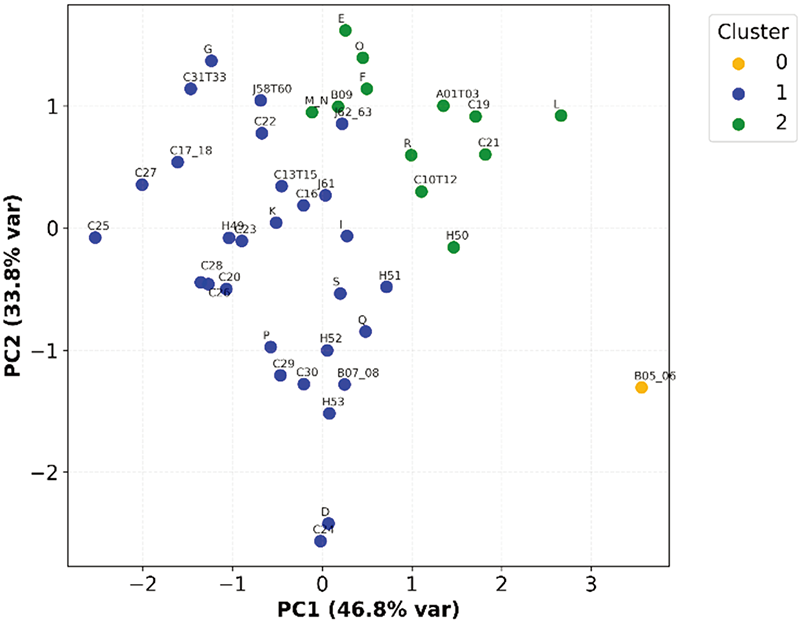
Clustering of GVC resilience in China
- [1] I. Ayadi and A. I. Hunjra, “Firms in times of economic uncertainty: Digital integration to counter information asymmetry and ESG controversies,” Business Ethics, the Environment & Responsibility, Vol.35, No.1, pp. 99-116, 2026. https://doi.org/10.1111/beer.12779
- [2] G. Gereffi, P. Pananond, F. Tell, and T. Fang, “Navigating industrial policy and global value chains in an era of disruptions,” J. of Int. Business Policy, Vol.8, No.3, pp. 207-223, 2025. https://doi.org/10.1057/s42214-025-00223-9
- [3] A. Berthou, A. Haramboure, and L. Samek, “Mapping and testing product-level vulnerabilities in granular production networks,” Organisation for Economic Cooperation and Development (OECD) Science, Technology and Industry Working Papers, No.2024/02, 2024. https://doi.org/10.1787/9bcde495-en
- [4] R. Koopman, Z. Wang, and S. Wei, “Tracing value-added and double counting in gross exports,” American Economic Review, Vol.104, No.2, pp. 459-494, 2014. https://doi.org/10.1257/aer.104.2.459
- [5] P. Antràs, “The uncharted waters of international trade,” National Bureau of Economic Research (NBER) Working Paper, No.33312, 2024. https://doi.org/10.3386/w33312
- [6] M. T. Islam and D. Chadee, “Adaptive governance and resilience of global value chains: A framework for sustaining the performance of developing-country suppliers during exogenous shocks,” Int. Business Review, Vol.33, No.2, Article No.102248, 2024. https://doi.org/10.1016/j.ibusrev.2023.102248
- [7] R. Martin, “Regional economic resilience, hysteresis and recessionary shocks,” J. of Economic Geography, Vol.12, No.1, pp. 1-32, 2012. https://doi.org/10.1093/jeg/lbr019
- [8] R. Baldwin, R. Freeman, and A. Theodorakopoulos, “Hidden exposure: Measuring US supply chain reliance,” National Bureau of Economic Research (NBER) Working Paper, No.31820, 2023. https://doi.org/10.3386/w31820
- [9] L. Statsenko, R. S. Jayasinghe, and C. Soosay, “Supply network resilience capabilities: A social-ecological perspective,” Supply Chain Management, Vol.29, No.1, pp. 1-26, 2024. https://doi.org/10.1108/SCM-11-2022-0438
- [10] M. Trippl, S. Fastenrath, and A. Isaksen, “Rethinking regional economic resilience: Preconditions and processes shaping transformative resilience,” European Urban and Regional Studies, Vol.31, No.2, pp. 101-115, 2024. https://doi.org/10.1177/09697764231172326
- [11] C. Schwellnus, A. Haramboure, and L. Samek, “Policies to strengthen the resilience of global value chains: Empirical evidence from the COVID-19 shock,” Organisation for Economic Cooperation and Development (OECD) Science, Technology and Industry Policy Papers, No.141, 2023. https://doi.org/10.1787/fd82abd4-en
- [12] R. Yang and Y. Zheng, “A study on the impact of digital economy development on the evolution of global value chain division of labor and resilience,” Quantitative Economics and Technological Economics Research, Vol.40, No.8, pp. 69-89, 2023 (in Chinese). https://doi.org/10.13653/j.cnki.jqte.20230706.001
- [13] B. Sheng and X. Hao, “Can digitalization of manufacturing enhance the resilience of enterprises’ global value chains? – From the perspective of ‘stabilizing, strengthening, and extending the chain’,” Finance and Trade Economics, Vol.46, No.6, pp. 1-17, 2025 (in Chinese). https://doi.org/10.19795/j.cnki.cn11-1166/f.20250611.006
- [14] R. C. Johnson and A. Moxnes, “GVCs and trade elasticities with multistage production,” J. of Int. Economics, Vol.145, Article No.103796, 2023. https://doi.org/10.1016/j.jinteco.2023.103796
- [15] Z. Wang, S. Wei, X. Yu, and K. Zhu, “Characterizing global value chains: Production length and upstreamness,” National Bureau of Economic Research (NBER) Working Paper No.23261, 2017. https://doi.org/10.3386/w23261
- [16] K. John, L. Litov, and B. Yeung, “Corporate governance and risk-taking,” The J. of Finance, Vol.63, No.4, pp. 1679-1728, 2008. https://doi.org/10.1111/j.1540-6261.2008.01372.x
- [17] S. Inomata and T. Hanaka, “Measuring exposure to network concentration risk in global supply chains: Volume versus frequency,” Structural Change and Economic Dynamics, Vol.68, pp. 177-193, 2024. https://doi.org/10.1016/j.strueco.2023.10.002
- [18] R. Baldwin, R. Freeman, and A. Theodorakopoulos, “Horses for courses: Measuring foreign supply chain exposure,” National Bureau of Economic Research (NBER) Working Paper, No.30525, 2022. https://doi.org/10.3386/w30525
- [19] F. Jiang, Z. Lei, and Z. Zhang, “Structural changes and efficiency evolution in manufacturing growth: A re-examination of the ‘geindustrialization’ issue,” China Industrial Economics, No.12, pp. 71-88, 2022 (in Chinese). https://doi.org/10.19581/j.cnki.ciejournal.2022.12.002
- [20] J. Ji, Y. Wang, and J. Yu, “Trade liberalization and distortions in labor allocation in the service sector,” Int. Trade Issues, No.7, pp. 105-122, 2023 (in Chinese). https://doi.org/10.13510/j.cnki.jit.2023.07.009
- [21] T. Liu and Q. Fu, “The structural ‘supporting effect’ in the dual circulation and the upward climbing of the manufacturing value chain: from the perspective of enhancing innovation capabilities,” China Industrial Economics, No.8, pp. 121-139, 2025 (in Chinese). https://doi.org/10.19581/j.cnki.ciejournal.2025.08.012
- [22] J. Yang, L. Hua, and H. Li, “U.S. export controls on China and the domestic value-added rate of Chinese firms’ exports,” World Economic Research, No.1, pp. 59-73, 2026 (in Chinese). https://doi.org/10.13516/j.cnki.wes.2026.01.004
- [23] C. Du and R. Zhang, “An exploration of the mechanisms and paths for artificial intelligence to promote the deep integration of advanced manufacturing and producer service industries,” The Economist, No.9, pp. 47-56, 2025 (in Chinese). https://doi.org/10.16158/j.cnki.51-1312/f.2025.09.014
- [24] A. Orankiewicz and M. Adamczak, “The emergence of new film distribution models as a result of streaming platforms’ impact on the contemporary film market,” Int. J. of Arts Management, Vol.27, No.2, pp. 51-66, 2025.
- [25] N. Shirahama, N. Nakaya, K. Moriya, K. Koshi, K. Matsumoto, and S. Watanabe, “An analysis of viewing intentions for promotional videos using fuzzy c c-means clustering: A comparative study between Japan and Singapore,” J. Adv. Comput. Intell. Intell. Inform., Vol.29, No.4, pp. 847-856, 2025. https://doi.org/10.20965/jaciii.2025.p0847
- [26] V. Kumar, A. Mohan, and G. Srivastava, “On machine learning assisted k k-means texttt{++} ++ clustering based phase quantization method for enhanced gain reflectarray design,” Int. J. of Electronics and Communications, Vol.204, Article No.156110, 2026. https://doi.org/10.1016/j.aeue.2025.156110
- [27] M. Wang, X. Li, L. Chen, H. Chen, C. Chen, and M. Liu, “A deep-based Gaussian mixture model algorithm for large-scale many objective optimization,” Applied Soft Computing, Vol.172, Article No.112874, 2025. https://doi.org/10.1016/j.asoc.2025.112874
- [28] Y. Zhao, Z. Bi, P. Zhu, A. Yuan, and X. Li, “Deep spectral clustering with projected adaptive feature selection,” IEEE Trans. on Geoscience and Remote Sensing, Vol.63, pp. 1-12, 2025. https://doi.org/10.1109/TGRS.2025.3530434
This article is published under a Creative Commons Attribution-NoDerivatives 4.0 Internationa License.