
Research Paper:
A Conjugate Gradient-Accelerated Constrained Multi-Objective Optimizer for High-Dimensional Problems with Application to Wellbore Trajectory Planning
Jiafeng Xu*1,*2,*3
 , Xin Chen*1,*2,*3,*4,†
, and Yang Zhou*1,*2,*3
, Xin Chen*1,*2,*3,*4,†
, and Yang Zhou*1,*2,*3
*1School of Automation, China University of Geosciences
No.388 Lumo Road, Hongshan District, Wuhan, Hubei 430074, China
*2Hubei Key Laboratory of Advanced Control and Intelligent Automation for Complex Systems
No.388 Lumo Road, Hongshan District, Wuhan, Hubei 430074, China
*3Engineering Research Center of Intelligent Technology for Geo-Exploration, Ministry of Education
No.388 Lumo Road, Hongshan District, Wuhan, Hubei 430074, China
*4School of Future Technology, China University of Geosciences
No.388 Lumo Road, Hongshan District, Wuhan, Hubei 430074, China
†Corresponding author

With declining hydrocarbon reserves, optimizing directional wellbore trajectory planning is crucial for accessing complex reservoirs while managing cost and risk. Multi-segment composite trajectories have been widely used in complex formations, but their high-dimensional nature challenges the efficiency of gradient-free multi-objective optimization methods. This paper proposes a conjugate gradient-assisted multi-objective algorithm to accelerate the optimization process. A dual-population update strategy integrates gradient-based search with constraint satisfaction, while adaptive step size and hybrid search mitigate multi-objective gradient conflicts. Gradients for formation-related objectives are approximated via finite differences. The algorithm is validated on a five-segment Bézier trajectory for an extended-reach horizontal wellbore, demonstrating superior normalized hypervolume, convergence, and diversity compared to gradient-based and evolutionary algorithms. Ablation studies verify the effectiveness of the hybrid strategy. The selected trajectory achieves an optimal balance among wellbore length, curvature, and stability under all constraints. To our knowledge, this is the first application of gradient-based multi-objective optimization to wellbore trajectory planning, offering a promising pathway toward real-time drilling trajectory design with enhanced efficiency and robustness.
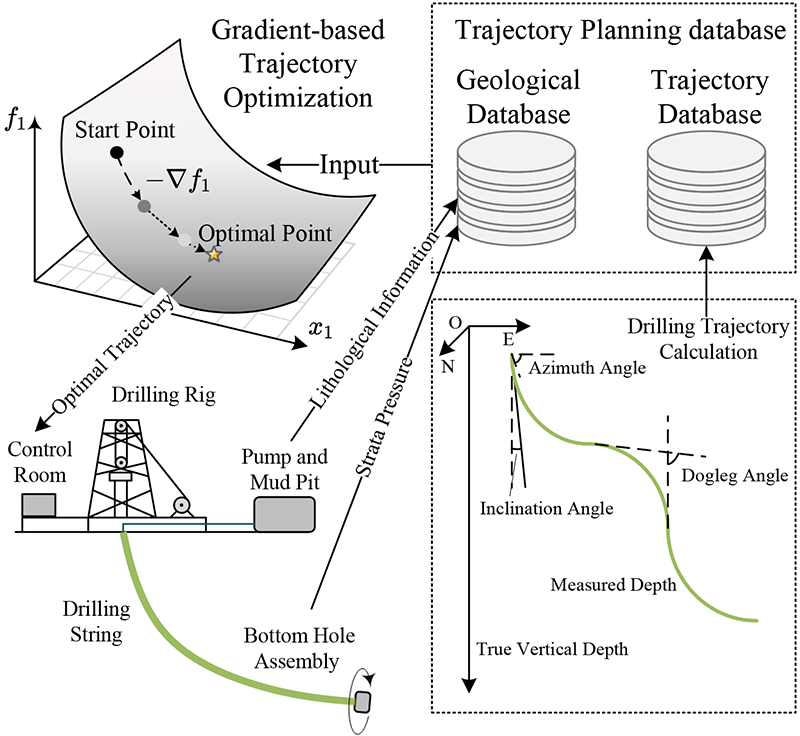
Multi-objective wellbore path planning
- [1] D. Zhang, M. Wu, C. Lu, L. Chen, W. Cao, and J. Hu, “Intelligent Compensating Method for MPC-Based Deviation Correction with Stratum Uncertainty in Vertical Drilling Process,” J. Adv. Comput. Intell. Inform., Vol.25, No.1, pp. 23-30, 2021. https://doi.org/10.20965/jaciii.2021.p0023
- [2] H. Wei, N. Yao, H. Tian, Y. Yao, J. Zhang, and H. Li, “A Predicting Model for Near-Horizontal Directional Drilling Path Based on BP Neural Network in Underground Coal Mine,” J. Adv. Comput. Intell. Inform., Vol.26, No.3, pp. 279-288, 2022. https://doi.org/10.20965/jaciii.2022.p0279
- [3] W. Li, M. Wu, S. Chen, L. Mu, C. Lu, and L. Chen, “Design of an Intelligent Control System for Compound Directional Drilling in Underground Coal Mines,” J. Adv. Comput. Intell. Inform., Vol.28, No.4, pp. 1052-1062, 2024. https://doi.org/10.20965/jaciii.2024.p1052
- [4] D. Chen, K. Mao, Z. Ye, W. Li, W. Yan, and H. Wang, “An artificial intelligent well trajectory design method combining both geological and engineering objectives,” Geoenergy Sci. Eng., Vol.236, Article No.212736, 2024. https://doi.org/10.1016/j.geoen.2024.212736
- [5] Z. Cai, X. Lai, M. Wu, C. Lu, and L. Chen, “Trajectory Azimuth Control Based on Equivalent Input Disturbance Approach for Directional Drilling Process,” J. Adv. Comput. Intell. Inform., Vol.25, No.1, pp. 31-39, 2021. https://doi.org/10.20965/jaciii.2021.p0031
- [6] Z. Cai and G. Hu, “Stability Analysis of Drilling Inclination System with Time-Varying Delay via Free-Matrix-Based Lyapunov–Krasovskii Functional,” J. Adv. Comput. Intell. Inform., Vol.25, No.6, pp. 1031-1038, 2021. https://doi.org/10.20965/jaciii.2021.p1031
- [7] S. Vlemmix, G. J. P. Joosten, D. R. Brouwer, and J. D. Jansen, “Adjoint-Based Well Trajectory Optimization in a Thin Oil Rim,” EUROPEC/EAGE Conf. and Exhib. (09EURO), Article No.SPE-121891-MS, 2009. https://doi.org/10.2118/121891-MS
- [8] R. G. Hanea, P. Casanova, F. H. Wilschut, and R. M. Fonseca, “Well Trajectory Optimization Constrained to Structural Uncertainties,” SPE Res. Simul. Conf., Article No.SPE-182680-MS, 2017. https://doi.org/10.2118/182680-MS
- [9] E. G. D. Barros, A. Chitu, and O. Leeuwenburgh, “Ensemble-based well trajectory and drilling schedule optimization-application to the Olympus benchmark model,” Comput. Geosci., Vol.24, No.6, pp. 2095-2109, 2020. https://doi.org/10.1007/s10596-020-09952-7
- [10] X. Wu and K. Zhang, “Three-dimensional trajectory design for horizontal well based on optimal switching algorithms,” ISA Trans., Vol.58, pp. 348-356, 2015. https://doi.org/10.1016/j.isatra.2015.04.002
- [11] Y. Guo and E. Feng, “Nonlinear dynamical systems of trajectory design for 3D horizontal well and their optimal controls,” J. Comput. Appl. Math., Vol.212, Issue 2, pp. 179-186, 2008. https://doi.org/10.1016/j.cam.2006.11.034
- [12] R. Lu and A. C. Reynolds, “Joint Optimization of Well Locations, Types, Drilling Order, and Controls Given a Set of Potential Drilling Paths,” SPE J., Vol.25, Issue 03, pp. 1285-1306, 2020. https://doi.org/10.2118/193885-PA
- [13] U. Singh, R. Pathan, A. D. Joshi, A. Cavé, C. Fouchard, and A. Baume, “Accelerated Design of Sidetrack and Deepening Well Trajectories,” SPE J., Vol.29, Issue 04, pp. 1862-1872, 2024. https://doi.org/10.2118/218395-PA
- [14] W. Li, X. Yang, C. Lu, Q. Li, P. Fang, X. Wu, H. Huang, H. Fan, N. Yao, H. Tian, and M. Wu, “Modeling and optimization of trajectory deviation for compound directional drilling in coal mines,” Neurocomputing, Vol.618, Article No.129029, 2025. https://doi.org/10.1016/j.neucom.2024.129029
- [15] J. Shu, G. Han, Z. Yue, L. Cheng, Y. Dong, and X. Liang, “Optimizing Well Trajectories for Enhanced Oil Production in Naturally Fractured Reservoirs: Integrating Particle Swarm Optimization with an Innovative Semi-Analytical Model Framework,” SPE J., Vol.30, Issue 02, pp. 957-975, 2025. https://doi.org/10.2118/223939-PA
- [16] Z. Wang, D. Gao, and J. Liu, “Multi-objective sidetracking horizontal well trajectory optimization in cluster wells based on DS algorithm,” J. Petrol. Sci. Eng., Vol.147, pp. 771-778, 2016. https://doi.org/10.1016/j.petrol.2016.09.046
- [17] R. Khosravanian, V. Mansouri, D. A. Wood, and M. R. Alipour, “A comparative study of several metaheuristic algorithms for optimizing complex 3-D well-path designs,” J. Pet. Explor. Prod. Technol., Vol.8, No.4, pp. 1487-1503, 2018. https://doi.org/10.1007/s13202-018-0447-2
- [18] J. Xu and X. Chen, “Bat Algorithm Optimizer for Drilling Trajectory Designing under Wellbore Stability Constraints,” 2018 37th Chinese Control Conf. (CCC), pp. 10276-10280, 2018. https://doi.org/10.23919/ChiCC.2018.8483403
- [19] K. Biswas, M. T. Rahman, A. H. Almulihi, F. Alassery, M. A. H. Al Askary, T. B. Hai, S. S. Kabir, A. I. Khan, and R. Ahmed, “Uncertainty handling in wellbore trajectory design: A modified cellular spotted hyena optimizer-based approach,” J. Pet. Explor. Prod. Technol., Vol.12, pp. 2643-2661, 2022. https://doi.org/10.1007/s13202-022-01458-5
- [20] S. Sun, Y. Gao, X. Sun, J. Wu, and H. Chang, “Intelligent optimization of horizontal wellbore trajectory based on reinforcement learning,” Geoenergy Sci. Eng., Vol.244, Article No.213479, 2025. https://doi.org/10.1016/j.geoen.2024.213479
- [21] W. Zhu, Y. Liu, L. Wang, J. Cao, Y. Li, and Y. Ma, “Deep Reinforcement Learning for Well Trajectory Design with Collision Avoidance,” SPE J., Vol.30, Issue 08, pp. 4545-4560, 2025. https://doi.org/10.2118/228295-PA
- [22] S. Ghadami, H. Biglarian, H. Beyrami, and M. Salimi, “Optimization of multilateral well trajectories using pattern search and genetic algorithms,” Results Eng., Vol.16, Article No.100722, 2022. https://doi.org/10.1016/j.rineng.2022.100722
- [23] A. Lamghari, “Mine Planning and Oil Field Development: A Survey and Research Potentials,” Math. Geosci., Vol.49, No.3, pp. 395-437, 2017. https://doi.org/10.1007/s11004-017-9676-z
- [24] W. Huang, M. Wu, L. Chen, X. Chen, and W. Cao, “Multi-objective drilling trajectory optimization using decomposition method with minimum fuzzy entropy-based comprehensive evaluation,” Appl. Soft Comput., Vol.107, Article No.107392, 2021. https://doi.org/10.1016/j.asoc.2021.107392
- [25] W. Huang, M. Wu, L. Chen, J. She, H. Hashimoto, and S. Kawata, “Multiobjective Drilling Trajectory Optimization Considering Parameter Uncertainties,” IEEE Trans. on Systems, Man, and Cybernetics: Systems, Vol.52, Issue 2, pp. 1224-1233, 2022. https://doi.org/10.1109/TSMC.2020.3019428
- [26] J. Xu, X. Chen, W. Cao, and M. Wu, “Multi-objective trajectory planning in the multiple strata drilling process: A bi-directional constrained co-evolutionary optimizer with Pareto front learning,” Expert Syst. Appl., Vol.238, Part F, Article No.122119, 2024. https://doi.org/10.1016/j.eswa.2023.122119
- [27] Z. Wang, S.-L. Shen, D. Chen, W. Li, W. Li, and Z. Fan, “Multi-objective optimization of the wellbore trajectory considering both geological and engineering factors,” Geoenergy Sci. Eng., Vol.246, Article No.213647, 2025. https://doi.org/10.1016/j.geoen.2025.213647
- [28] J. Xu, X. Chen, Y. Zhou, M. Zhang, W. Cao, and M. Wu, “Expensive deviation-correction drilling trajectory planning: A constrained multi-objective Bayesian optimization with feasibility-oriented bi-objective acquisition function,” Control Eng. Pract., Vol.156, Article No.106240, 2025. https://doi.org/10.1016/j.conengprac.2025.106240
- [29] H. Yavari, J. Qajar, B. S. Aadnoy, and R. Khosravanian, “Selection of Optimal Well Trajectory Using Multi-Objective Genetic Algorithm and TOPSIS Method,” Arab. J. Sci. Eng., Vol.48, No.12, pp. 16831-16855, 2023. https://doi.org/10.1007/s13369-023-08149-1
- [30] J. Kudela, “A critical problem in benchmarking and analysis of evolutionary computation methods,” Nat. Mach. Intell., Vol.4, No.12, pp. 1238-1245, 2022. https://doi.org/10.1038/s42256-022-00579-0
- [31] K.-Z. Liu and C. Gan, “Deterministic Gradient-Descent Learning of Linear Regressions: Adaptive Algorithms, Convergence Analysis and Noise Compensation,” IEEE Trans. Pattern Anal. Mach. Intell., Vol.46, Issue 12, pp. 7867-7877, 2024. https://doi.org/10.1109/TPAMI.2024.3399312
- [32] D. A. Wood, “Constrained optimization assists deviated wellbore trajectory selection from families of quadratic and cubic Bezier curves,” Gas Sci. Eng., Vol.110, Article No.204869, 2023. https://doi.org/10.1016/j.jgsce.2022.204869
- [33] E. M. E. M. Shokir, M. K. Emera, S. M. Eid, and A. W. Wally, “A New Optimization Model for 3D Well Design,” Oil and Gas Sci. Technol., Vol.59, No.3, pp. 255-266, 2004. https://doi.org/10.2516/ogst:2004018
- [34] J. Fliege and B. F. Svaiter, “Steepest descent methods for multicriteria optimization,” Math. Methods Oper. Res., Vol.51, No.3, pp. 479-494, 2000. https://doi.org/10.1007/s001860000043
- [35] X. Liu and A. C. Reynolds, “A multiobjective steepest descent method with applications to optimal well control,” Comput. Geosci., Vol.20, No.2, pp. 355-374, 2016. https://doi.org/10.1007/s10596-016-9562-7
- [36] K. Izui, T. Yamada, S. Nishiwaki, and K. Tanaka, “Multiobjective optimization using an aggregative gradient-based method,” Struct. Multidiscip. Optim., Vol.51, No.1, pp. 173-182, 2015. https://doi.org/10.1007/s00158-014-1125-8
- [37] C. K. Goh, Y. S. Ong, K. C. Tan, and E. J. Teoh, “An investigation on evolutionary gradient search for multi-objective optimization,” 2008 IEEE Congress on Evolutionary Computation (IEEE World Congress on Computational Intelligence), pp. 3741-3746, 2008. https://doi.org/10.1109/CEC.2008.4631304
- [38] K. Deb and H. Jain, “An Evolutionary Many-Objective Optimization Algorithm Using Reference-Point-Based Nondominated Sorting Approach, Part I: Solving Problems with Box Constraints,” IEEE Trans. Evol. Comput., Vol.18, Issue 4, pp. 577-601, 2014. https://doi.org/10.1109/TEVC.2013.2281535
- [39] Y. Tian, R. Cheng, X. Zhang, and Y. Jin, “PlatEMO: A MATLAB Platform for Evolutionary Multi-Objective Optimization,” IEEE Comput. Intell. Mag., Vol.12, Issue 4, pp. 73-87, 2017. https://doi.org/10.1109/MCI.2017.2742868
This article is published under a Creative Commons Attribution-NoDerivatives 4.0 Internationa License.