
Paper:
Quantitative Evaluation of Postural Recovery During Human Walking by System Identification
Yasushi Hiroyama*, Hiroto Mori*, Ayato Kanada**
 , Yasutaka Nakashima***
, and Motoji Yamamoto***
, Yasutaka Nakashima***
, and Motoji Yamamoto***
*Department of Mechanical Engineering, Graduate School of Engineering, Kyushu University
744 Motooka, Nishi-ku, Fukuoka, Fukuoka 819-0395, Japan
**Department of Mechanical and Intelligent Systems Engineering, The University of Electro-Communications
1-5-1 Chofugaoka, Chofu, Tokyo 182-8585, Japan
***Faculty of Engineering, Kyushu University
744 Motooka, Nishi-ku, Fukuoka, Fukuoka 819-0395, Japan

This paper proposes a method to quantitatively evaluate human posture recovery performance when mechanical disturbances are applied during walking, considering that human falls mainly occur while walking. During walking, the reaction force from the soles of the feet acts as a disturbance during normal walking, which makes it difficult to distinguish between postural responses due to intentional mechanical disturbances and those due to normal walking. Furthermore, it is not easy to reproducibly apply mechanical disturbances during walking. The study uses a treadmill with independent left and right belts. The speed difference between the left and right belts is used as the disturbance input, and the dynamics of human postural correction due to disturbances is identified using system identification with the response of the center of pressure as the output. A method to quantitatively evaluate the posture recovery ability is proposed using the pole distribution of the identified dynamics model. The effectiveness of the proposed method is shown by experimentally demonstrating that there is a quantitatively significant difference in posture recovery performance when posture recovery ability is artificially reduced compared to when it is not reduced.
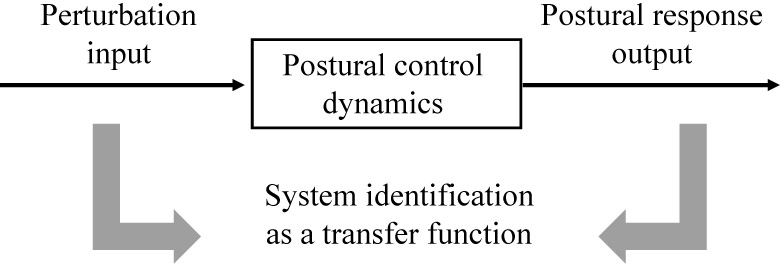
Input and output in system identification
- [1] S. M. Thomas, A. Parker, J. Fortune, G. Mitchell, A. Hezam, Y. Jiang, M. de Groh, K. Anderson, A. Gauthier-Beaupré, J. Barker, J. Watt, S. E. Straus, and A. C. Tricco, “Global evidence on falls and subsequent social isolation in older adults: A scoping review,” BMJ Open, Vol.12, No.9, Article No.e062124, 2022. https://doi.org/10.1136/bmjopen-2022-062124
- [2] A. Gabell, M. A. Simons, and U. S. Nayak, “Falls in the healthy elderly: Predisposing causes,” Ergonomics, Vol.28, No.7, pp. 965-975, 1985. https://doi.org/10.1080/00140138508963219
- [3] Y. Cai, S. G. Leveille, O. Andreeva, L. Shi, P. Chen, and T. You, “Characterizing fall circumstances in community-dwelling older adults: A mixed methods approach,” J. Gerontol. A Biol. Sci. Med. Sci., Vol.78, No.9, pp. 1683-1691, 2023. https://doi.org/10.1093/gerona/glad130
- [4] N. Niino, S. Tsuzuku, F. Ando, and H. Shimokata, “Frequencies and circumstances of falls in the national institute for longevity sciences, longitudinal study of aging (NILS-LSA),” J. of Epidemiology, Vol.10, No.1 Suppl, pp. S90-S94, 2000. https://doi.org/10.2188/jea.10.1sup_90
- [5] S. Mathias, U. Nayak, and B. Isaacs, “Balance in elderly patients: The “get-up and go” test,” Archives of Pysical Medicine and Rehabilitation, Vol.67, No.6, pp. 387-389, 1986.
- [6] D. Podsiadlo and S. Richardson, “The timed “up & go”: A test of basic functional mobility for frail elderly persons,” J. of the American Geriatrics Society, Vol.39, No.2, pp. 142-148, 1991. https://doi.org/10.1111/j.1532-5415.1991.tb01616.x
- [7] K. Berg, S. Wood-Daupinee, J. Williams, and D. Gayton, “Measuring balance in the elderly: Preliminary development of an instrument,” Physiotherapy Canada, Vol.41, No.6, pp. 304-311, 1989.
- [8] M. Tinetti, “Performance-oriented assessment of mobility problems in elderly patients,” J. of the American Geriatrics Society, Vol.34, No.2, pp. 119-126, 1986.
- [9] D. Martelli, F. Aprigliano, P. Tropea, G. Pasquini, S. Micera, and V. Monaco, “Stability against backward balance loss: Age-related modifications following slip-like perturbations of multiple amplitudes,” Gait & Posture, Vol.53, pp. 207-214, 2017. https://doi.org/10.1016/j.gaitpost.2017.02.002
- [10] L. Hak, H. Houdijk, F. Steenbrink, A. Mert, P. van der Wurff, P. J. Beek, and J. H. van Dieën, “Speeding up or slowing down?: Gait adaptations to preserve gait stability in response to balance perturbations,” Gait & Posture, Vol.36, No.2, pp. 260-264, 2012. https://doi.org/10.1016/j.gaitpost.2012.03.005
- [11] C. McCrum, G. Epro, K. Meijer, W. Zijlstra, G. P. Brüggemann, and K. Karamanidis, “Locomotor stability and adaptation during perturbed walking across the adult female lifespan,” J. of Biomechanics, Vol.49, No.7, pp. 1244-1247, 2016. https://doi.org/10.1016/j.jbiomech.2016.02.051
- [12] A. Hof, M. Gazendam, and W. Sinke, “The condition for dynamic stability,” J. of Biomechanics, Vol.38, No.1, pp. 1-8, 2005. https://doi.org/10.1016/j.jbiomech.2004.03.025
- [13] H. Watanabe, S. Okamoto, T. Kuroda, and Y. Akiyama, “Manipulability analysis of anterior and mediolateral dynamic gait stability of young and elderly individuals,” J. Robot. Mechatron., Vol.36, No.6, pp. 1568-1576, 2024. https://doi.org/10.20965/jrm.2024.p1568
- [14] T. Miyazaki, T. Aoki, J. Aizawa, T. Kawase, M. Sogabe, and K. Kawashima, “Adapting balance training by changing the direction of the tensile load on the lumbar region,” J. Robot. Mechatron., Vol.34, No.6, pp. 1361-1370, 2022. https://doi.org/10.20965/jrm.2022.p1361
- [15] T. Togoe, P. H. Tung, Y. Nakashima, and M. Yamamoto, “An evaluation method of human standing stability by applying the disturbance of swash plate fall,” Trans. of the JSME, Vol.87, No.896, Article No.20-00302, 2021 (in Japanese). https://doi.org/10.1299/transjsme.20-00302
- [16] M. Schimpl, C. Moore, C. Lederer, A. Neuhaus, J. Sambrook, J. Danesh, W. Ouwehand, and M. Daumer, “Association between walking speed and age in healthy, free-living individuals using mobile accelerometry—A cross-sectional study,” PLoS ONE, Vol.6, No.8, Article No.e23299, 2011. https://doi.org/10.1371/journal.pone.0023299
- [17] B. J. Loyd, J. Saviers-Steiger, A. Fangman, S. S. Paul, P. C. Fino, M. E. Lester, and L. E. Dibble, “Control of linear head and trunk acceleration during gait after unilateral vestibular deficits,” Archives of Physical Medicine and Rehabilitation, Vol.102, No.3, pp. 456-462, 2021. https://doi.org/10.1016/j.apmr.2020.08.005
- [18] T. Boerger, J. V. Dehy, T. Onushko, B. Schmit, and A. Hyngstrom, “Step length and width variability while walking on a motion simulator mounted treadmill,” Proc. of the 2016 38th Annual Int. Conf. of the IEEE Engineering in Medicine and Biology Society (EMBC), pp. 4577-4580, 2016. https://doi.org/10.1109/EMBC.2016.7591746
- [19] D. A. Winter, “Human balance and posture control during standing and walking,” Gait & Posture, Vol.3, No.4, pp. 193-214, 1995. https://doi.org/10.1016/0966-6362(96)82849-9
- [20] A. M. van Leeuwen, J. H. van Dieën, A. Daffertshofer, and S. M. Bruijn, “Ankle muscles drive mediolateral center of pressure control to ensure stable steady state gait,” Scientific Reports, Vol.11, No.1, Article No.21481, 2021. https://doi.org/10.1038/s41598-021-00463-8
- [21] World Health Organization, “Falls,” 2021. https://www.who.int/news-room/fact-sheets/detail/falls [Accessed November 19, 2025]
This article is published under a Creative Commons Attribution-NoDerivatives 4.0 Internationa License.