
Paper:
Social Problem-Solving Learning for University Students Using Robot Theater
Akihiro Yorita*,**
 and Naoyuki Kubota**
*Daiichi Institute of Technology
1-10-2 Kokubu-chuo, Kirishima, Kagoshima 899-4332, Japan
**Tokyo Metropolitan University
6-6 Asahigaoka, Hino, Tokyo 191-0065, Japan

In recent years, a variety of service robots have been developed using deep learning and other advanced technologies. However, traditional development processes often provide limited opportunities for developers to engage directly with customers or users, resulting in products that do not necessarily reflect actual needs. Furthermore, this challenge is compounded by the fact that customers and users are not always the same, and their goals may differ. This paper proposes an educational approach that emphasizes solving social issues through “communication” rather than system sophistication. The goal is to develop students’ problem-solving skills through the creation and performance of robot theater. By designing communication content for robots and enacting plays, students learn to consider the nature of human–robot interaction while applying design thinking and systems thinking. This paper presents the methodology and outcomes of a project-based learning course involving students from humanities, science, and design backgrounds. The results suggest that robot theater can be an effective tool for fostering empathy, creativity, and interdisciplinary collaboration.
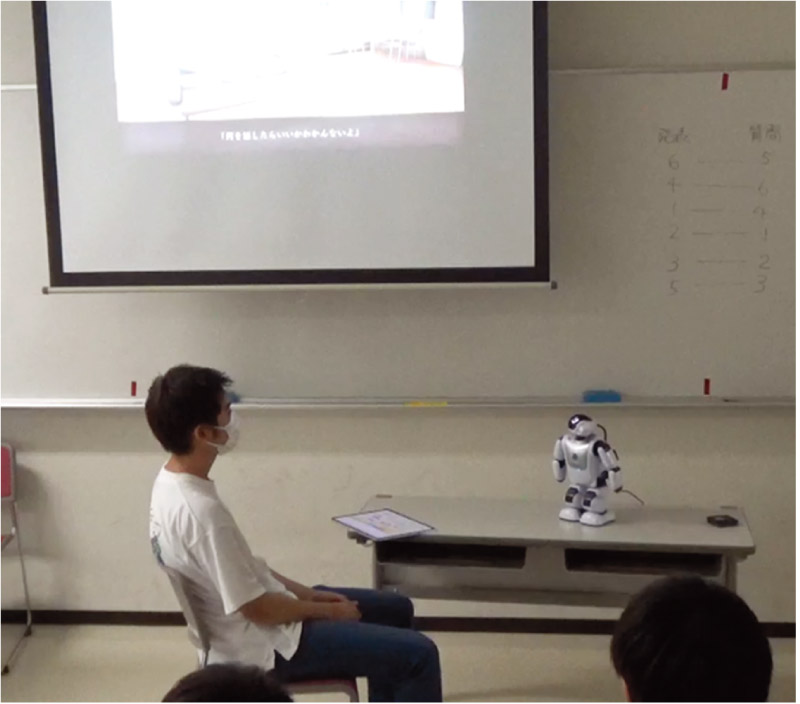
Robot theater scene
- [1] Y. Hirata, “AI robots pioneer the Smarter Inclusive Society,” Artif. Life Robotics, Vol.29, pp. 431-437, 2024. https://doi.org/10.1007/s10015-024-00975-2
- [2] N. Kubota, “From the design of communication towards the design for experience in human symbiotic systems,” J. of Japan Society for Fuzzy Theory and Intelligent Informatics, Vol.27, No.6, pp. 182-192, 2015 (in Japanese). https://doi.org/10.3156/jsoft.27.6_182
- [3] T. Yamaguchi, N. Kubota, and E. Sato-Shimokawara, “Community-centric approach for social robots,” J. of the Robotics Society of Japan, Vol.34, No.5, pp. 292-298, 2016 (in Japanese). https://doi.org/10.7210/jrsj.34.292
- [4] N. Kubota, “Communities and systems,” J. of Japan Society for Fuzzy Theory and Intelligent Informatics, Vol.29, No.4, pp. 120-127, 2017 (in Japanese). https://doi.org/10.3156/jsoft.29.4_120
- [5] H. Ishiguro and O. Hirata, “Robot theater,” J. of the Robotics Society of Japan, Vol.29, No.1, pp. 35-38, 2011 (in Japanese). https://doi.org/10.7210/jrsj.29.35
- [6] A. Yorita and N. Kubota, “Robot assisted instruction in elementary school based on robot theater,” J. Robot. Mechatron., Vol.23, No.5, pp. 893-901, 2011. https://doi.org/10.20965/jrm.2011.p0893
- [7] J. Barnes, M. S. FakhrHosseini, E. Vasey, Z. Duford, and M. Jeon, “Robot theater with children for STEAM education,” Proc. of the Human Factors and Ergonomics Society Annual Meeting, Vol.61, No.1, pp. 875-879, 2017. https://doi.org/10.1177/1541931213601511
- [8] J. Dong, S. Yu, K. Choi, and M. Jeon, “A child-robot theater afterschool program can promote children’s conceptualization of social robots’ mental capacities and engagement in learning,” Front. Robot. AI, Vol.12, Article No.1529421, 2025. https://doi.org/10.3389/frobt.2025.1529421
- [9] S. Sajadieh and H. Wolfe, “Designing interrogative robot theater: A robot who won’t take no for an answer,” A. L. Brooks (Ed.), “Creating Digitally. Intelligent Systems Reference Library,” Vol.241, pp. 183-211, 2023. https://doi.org/10.1007/978-3-031-31360-8_7
- [10] M. Fukunaga and N. Kubota, “Design and system thinking in education: Endurance of person and society to enhance human abilities for opening the future,” Proc. of the Japan Society of Simulation and Gaming, pp. 8-11, 2010 (in Japanese).
- [11] K. Higuchi, “A two-step approach to quantitative content analysis: KH coder tutorial using Anne of Green Gables (Part I),” Ritsumeikan Social Science Review, Vol.52, No.3, pp. 77-91, 2016.
- [12] Y. M. Reddy and H. Andrade, “A review of rubric use in higher education,” Assessment & Evaluation in Higher Education, Vol.35, No.4, pp. 435-448, 2010. https://doi.org/10.1080/02602930902862859
This article is published under a Creative Commons Attribution-NoDerivatives 4.0 Internationa License.