
Paper:
Omnidirectional Locomotion of 4-DOF Mobile Robots Connecting Two Differential Drive Wheel Modules with Serial Link Mechanisms
Hiroyasu Sato, Toshifumi Kawaguchi, and Kenji Inoue†
Yamagata University
4-3-16 Jonan, Yonezawa, Yamagata 992-8510, Japan
†Corresponding author

An omnidirectional mobile robot that consists of two differential drive wheel modules and two links is proposed. Free-rotating joints are used to connect the links with each other and the wheel modules with both ends of the connected links. A caster is attached to the bottom side of the joint that connects the links. A ball caster is also attached to the bottom side of the steering axis of each wheel module. The robot has four driving wheels, two for each module. The robot utilizes the four degrees of freedom (DOFs) of these wheels to control three DOFs for omnidirectional locomotion and one DOF for the angle between the two links. The robot can change its form by changing this angle; this modifies the stable region of the robot. The robot prevents itself from falling down a slope by extending the stable region downward on the slope. As the robot uses regular rubber tire wheels, it has a large load capacity and high stability on irregular road surfaces. A robot with a depth camera is developed. The movement of the robot toward a goal detected using this camera is controlled. Experimental results show that the robot can move in any direction on a horizontal plane.
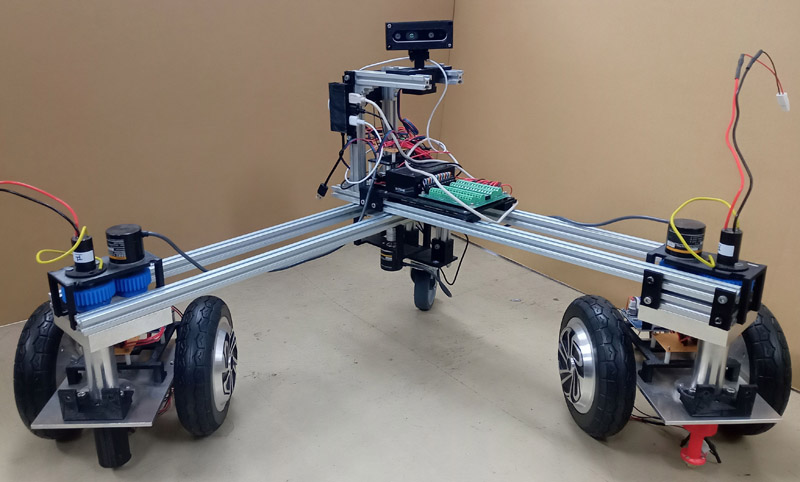
Wheeled mobile robot with serial links
- [1] K. Tadakuma, “Omnidirectional mobile and driving mechanism,” J. Robot. Soc. Jpn., Vol.29, No.6, pp. 516-519, 2011 (in Japanese). https://doi.org/10.7210/jrsj.29.516
- [2] H. Asama et al., “Development of an omni-directional mobile robot with 3 DoF decoupling drive mechanism,” J. Robot. Soc. Jpn., Vol.14, No.2, pp. 249-254, 1996 (in Japanese). https://doi.org/10.7210/jrsj.14.249
- [3] N. Ushimi, M. Yamamoto, and A. Mohri, “Tracking control of omni-directional vehicles using two wheels caster type odometer,” J. Robot. Mechatron., Vol.16, No.4, pp. 404-410, 2004. https://doi.org/10.20965/jrm.2004.p0404
- [4] T. Maeda and H. Ando, “Omnidirectional mobility following through trochoidal trajectory,” J. Robot. Mechatron., Vol.31, No.4, pp. 567-582, 2019. https://doi.org/10.20965/jrm.2019.p0567
- [5] G. Ishigami, J. Overholt, and K. Iagnemma, “Multi-material anisotropic friction wheels for omnidirectional ground vehicles,” J. Robot. Mechatron., Vol.24, No.1, pp. 261-267, 2012. https://doi.org/10.20965/jrm.2012.p0261
- [6] K. Tadakuma, R. Tadakuma, and J. Berengueres, “Tetrahedral mobile robot with spherical omnidirectional wheel,” J. Robot. Mechatron., Vol.20, No.1, pp. 125-134, 2008. https://doi.org/10.20965/jrm.2008.p0125
- [7] K. Nishizawa, T. Tsumugiwa, and R. Yokogawa, “Gait rehabilitation and locomotion support system using a distributed controlled robot system,” J. Robot. Mechatron., Vol.34, No.1, pp. 72-85, 2022. https://doi.org/10.20965/jrm.2022.p0072
- [8] T. Nakayama and M. Wada, “Study on an add-on type electric wheelchair using active caster with the differential mechanism,” J. Robot. Mechatron., Vol.35, No.1, pp. 99-112, 2023. https://doi.org/10.20965/jrm.2023.p0099
- [9] K. Kato and M. Wada, “Modeling and mechanical design of an active-caster omnidirectional mechanism with a ball transmission,” J. Robot. Mechatron., Vol.30, No.6, pp. 910-919, 2018. https://doi.org/10.20965/jrm.2018.p0910
- [10] H. Miura et al., “Field experiment report for verification of abandoned lignite mines by robotic exploration system,” J. Robot. Mechatron., Vol.30, No.6, pp. 1004-1013, 2018. https://doi.org/10.20965/jrm.2018.p1004
- [11] J. Hirasawa, S. Isobe, Y. Kuramochi, M. Nishino, and Y. Nihei, “Development of multi-articulated tracked vehicle with a sensorless salvaging bucket for decommissioning,” J. Robot. Mechatron., Vol.34, No.3, pp. 551-558, 2022. https://doi.org/10.20965/jrm.2022.p0551
- [12] H. Okada, T. Iwamoto, and K. Shibuya, “Water-rescue robot vehicle with variably configured segmented wheels,” J. Robot. Mechatron., Vol.18, No.3, pp. 278-285, 2006. https://doi.org/10.20965/jrm.2006.p0278
- [13] R. Miura et al., “Development of a decommissioning robot with a simple structure capable of traversing steps using two different drive systems,” J. Robot. Mechatron., Vol.36, No.1, pp. 95-106, 2024. https://doi.org/10.20965/jrm.2024.p0095
- [14] K. Tadakuma, R. Tadakuma, and S. Hirose, “Mechanical design of VmaxCarrier2: Omnidirectional mobile robot with function of step-climbing,” J. Robot. Mechatron., Vol.17, No.2, pp. 198-207, 2005. https://doi.org/10.20965/jrm.2005.p0198
- [15] D. Chugo, K. Kawabata, H. Kaetsu, H. Asama, and T. Mishima, “Configuration-based wheel control for step-climbing vehicle,” J. Robot. Mechatron., Vol.19, No.1, pp. 52-59, 2007. https://doi.org/10.20965/jrm.2007.p0052
- [16] M. Wada, “A 4WD omnidirectional wheelchair with enhanced step climbing capability,” J. Robot. Mechatron., Vol.20, No.6, pp. 846-853, 2008. https://doi.org/10.20965/jrm.2008.p0846
- [17] E. Ickowzcy, T. Aoki, and S. Hirose, “Predictive dynamics-based motion control for the rough-terrain locomotion of the personal vehicle Falcon-III,” J. Robot. Mechatron., Vol.23, No.4, pp. 545-556, 2011. https://doi.org/10.20965/jrm.2011.p0545
- [18] M. Wada and H. H. Asada, “Design and control of a variable footprint mechanism for holonomic omnidirectional vehicles and its application to wheelchairs,” IEEE Trans. Robot. Autom., Vol.15, No.6, pp. 978-989, 1999. https://doi.org/10.1109/70.817663
- [19] M. J. A. Safar, K. Watanabe, S. Maeyama, and I. Nagai, “Tip-over stability control for a holonomic omnidirectional mobile robot with active dual-wheel caster assemblies using SGCMG,” 2013 IEEE/RSJ Int. Conf. Intell. Robots Syst., pp. 4866-4871, 2013. https://doi.org/10.1109/IROS.2013.6697058
- [20] H. Sato, T. Kawaguchi, and K. Inoue, “Development of omnidirectional mobile robot connecting two differential drive wheel modules with link mechanism,” 2024 JSME Conf. Robot. Mechatron. (ROBOMECH2024), Session No.1A1-I02, 2024 (in Japanese).
- [21] Y. Onoue, T. Ishizawa, T. Danjo, and T. Fukuzono, “Proposing a method to analyze slope displacement using the distance image data of depth camera,” J. Disaster Res., Vol.16, No.7, pp. 1086-1095, 2021. https://doi.org/10.20965/jdr.2021.p1086
- [22] R. Iinuma, Y. Hori, H. Onoyama, Y. Kubo, and T. Fukao, “Robotic forklift for stacking multiple pallets with RGB-D cameras,” J. Robot. Mechatron., Vol.33, No.6, pp. 1265-1273, 2021. https://doi.org/10.20965/jrm.2021.p1265
- [23] H. Kurita, M. Oku, T. Nakamura, T. Yoshida, and T. Fukao, “Localization method using camera and LiDAR and its application to autonomous mowing in orchards,” J. Robot. Mechatron., Vol.34, No.4, pp. 877-886, 2022. https://doi.org/10.20965/jrm.2022.p0877
- [24] S. Hara, T. Shimizu, M. Konishi, R. Yamamura, and S. Ikemoto, “Autonomous mobile robot for outdoor slope using 2D LiDAR with uniaxial gimbal mechanism,” J. Robot. Mechatron., Vol.32, No.6, pp. 1173-1182, 2020. https://doi.org/10.20965/jrm.2020.p1173
This article is published under a Creative Commons Attribution-NoDerivatives 4.0 Internationa License.