
Paper:
Switching Control of Pedestrian Flows Using Discrete Hughes Models
Akihiro Morita
 , Koichi Kobayashi
, and Yuh Yamashita
, Koichi Kobayashi
, and Yuh Yamashita
Hokkaido University
Kita 14, Nishi 9, Kita-ku, Sapporo, Hokkaido 060-0814, Japan

Control of pedestrian flows has various applications such as fire evacuation. Mobile robots play an important role in control of pedestrian flows. In this paper, a switching control method of pedestrian flows is proposed toward using of mobile robots in future. As a mathematical model for pedestrian flows, we adopt the discrete Hughes model, which is a kind of meso-scale models. In the discrete Hughes model, the space is represented as an undirected graph, and pedestrian flows are characterized by changes in density at each vertex. In the proposed method, pedestrian flows are controlled by dynamically switching the graph structure. For each graph structure, a safety penalty is assigned. The optimal switching times that minimize the penalty are determined under a constraint on the exit rate defined in this paper. Through a numerical example, we demonstrate the effectiveness of the proposed method in evacuation guidance.
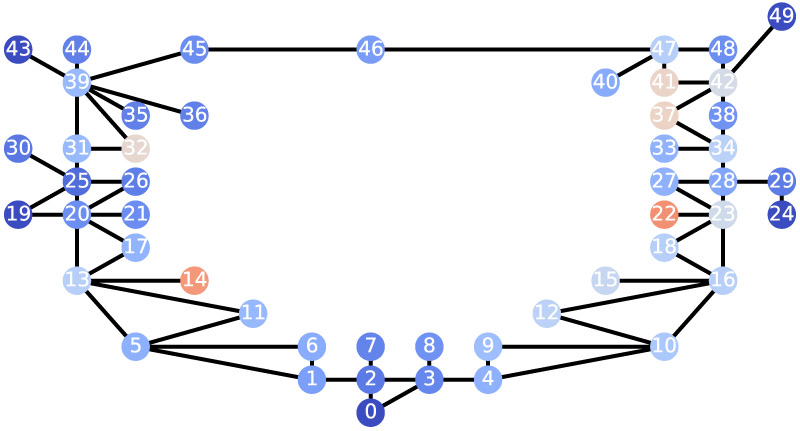
Evacuation status of the target area
- [1] I. Sakour and H. Hu, “Robot-assisted crowd evacuation under emergency situations: A survey,” Robotics, Vol.6, No.2, Article No.8, 2017. https://doi.org/10.3390/robotics6020008
- [2] A. Bahamid, A. M. Ibrahim, A. Ibrahim, I. Z. Zahurin, and A. N. Wahid, “Intelligent robot-assisted evacuation: A review,” J. of Physics: Conf. Series, Vol.1706, No.1, 2020. https://doi.org/10.1088/1742-6596/1706/1/012159
- [3] K. Ishikawa, K. Otomo, H. Osaki, and T. Odaka, “Path planning using a flow of pedestrian traffic in an unknown environment,” J. Robot. Mechatron., Vol.35, No.6, pp. 1460-1468, 2023. https://doi.org/10.20965/jrm.2023.p1460
- [4] N. Matsunaga, I. Yamamoto, and H. Okajima, “Navigation system for personal mobility vehicles following a cluster of pedestrians in a corridor using median of candidate vectors observer,” J. Robot. Mechatron., Vol.35, No.6, pp. 1562-1572, 2023. https://doi.org/10.20965/jrm.2023.p1562
- [5] V. Sharma, D. Nagpal, S. Monga, A. Almogren, D. Srivastava, A. Altameem, and J. Choi, “Enhanced forest fire evacuation planning using real-time sensor and GPS algorithm,” Scientific Reports, Vol.14, No.1, Article No.20091, 2024. https://doi.org/10.1038/s41598-024-71052-8
- [6] K. Akiyoshi, D. Chugo, S. Muramatsu, S. Yokota, and H. Hashimoto, “Autonomous mobile robot navigation considering the pedestrian flow intersections,” 2020 IEEE/SICE Int. Symp. on System Integration (SII), pp. 428-433, 2020. https://doi.org/10.1109/SII46433.2020.9026277
- [7] K. Sriniketh, A. V. Le, R. E. Mohan, B. J. Sheu, V. D. Tung, P. Van Duc, and M. B. Vu, “Robot-aided human evacuation optimal path planning for fire drill in buildings,” J. of Building Engineering, Vol.72, Article No.106512, 2023. https://doi.org/10.1016/j.jobe.2023.106512
- [8] W. Zeng, P. Chen, G. Yu, and Y. Wang, “Specification and calibration of a microscopic model for pedestrian dynamic simulation at signalized intersections: A hybrid approach,” Transportation Research Part C: Emerging Technologies, Vol.80, pp. 37-70, 2017. https://doi.org/10.1016/j.trc.2017.04.009
- [9] R. Lohner, M. Baqui, E. Haug et al., “Real-time micro-modelling of a million pedestrians,” Engineering Computations, pp. 217-237, 2016. https://doi.org/10.1108/EC-02-2015-0036
- [10] C. Burstedde, K. Klauck, A. Schadschneider, and J. Zittartz, “Simulation of pedestrian dynamics using a two-dimensional cellular automaton,” Physica A: Statistical Mechanics and its Applications, Vol.295, Nos.3-4, pp. 507-525, 2001. https://doi.org/10.1016/S0378-4371(01)00141-8
- [11] S. Wei-Guo, Y. Yan-Fei, W. Bing-Hong, and F. Wei-Cheng, “Evacuation behaviors at exit in ca model with force essentials: A comparison with social force model,” Physica A: Statistical Mechanics and its Applications, Vol.371, No.2, pp. 658-666, 2006. https://doi.org/10.1016/j.physa.2006.03.027
- [12] R.-Y. Guo, S. Wong, H.-J. Huang, P. Zhang, and W. H. Lam, “A microscopic pedestrian-simulation model and its application to intersecting flows,” Physica A: Statistical Mechanics and its Applications, Vol.389, No.3, pp. 515-526, 2010. https://doi.org/10.1016/j.physa.2009.10.008
- [13] V. J. Blue and J. L. Adler, “Cellular automata microsimulation for modeling bi-directional pedestrian walkways,” Transportation Research Part B: Methodological, Vol.35, No.3, pp. 293-312, 2001. https://doi.org/10.1016/S0191-2615(99)00052-1
- [14] A. Kirchner, K. Nishinari, and A. Schadschneider, “Friction effects and clogging in a cellular automaton model for pedestrian dynamics,” Physical Review E, Vol.67, No.5, Article No.056122, 2003. https://doi.org/10.1103/PhysRevE.67.056122
- [15] D. Helbing and P. Molnar, “Social force model for pedestrian dynamics,” Physical Review E, Vol.51, No.5, Article No.4282, 1995. https://doi.org/10.1103/PhysRevE.51.4282
- [16] M. Twarogowska, P. Goatin, and R. Duvigneau, “Macroscopic modeling and simulations of room evacuation,” Applied Mathematical Modelling, Vol.38, No.24, pp. 5781-5795, 2014. https://doi.org/10.1016/j.apm.2014.03.027
- [17] E. Carlini, A. Festa, and F. J. Silva, “The hughes model for pedestrian dynamics and congestion modelling,” IFAC-PapersOnLine, Vol.50, No.1, pp. 1655-1660, 2017. https://doi.org/10.1016/j.ifacol.2017.08.333
- [18] D. S. Vale, “Transit-oriented development, integration of land use and transport, and pedestrian accessibility: Combining node-place model with pedestrian shed ratio to evaluate and classify station areas in lisbon,” J. of Transport Geography, Vol.45, pp. 70-80, 2015. https://doi.org/10.1016/j.jtrangeo.2015.04.009
- [19] X. Yang, H. Sun, Y. Huang, and K. Fang, “A framework of community pedestrian network design based on urban network analysis,” Buildings, Vol.12, No.6, Article No.819, 2022. https://doi.org/10.3390/buildings12060819
- [20] F. Camilli, A. Festa, and S. Tozza, “A discrete hughes model for pedestrian flow on graphs,” Networks and Heterogeneous Media, Vol.12, No.1, pp. 93-112, 2017. https://doi.org/10.3934/nhm.2017004
- [21] N. Katsuhiro, F. Claudio, S. Kenichiro, and M. Hisashi, “Introduction to Crowd Management,” University of Tokyo Press, Vol.180, 2020.
This article is published under a Creative Commons Attribution-NoDerivatives 4.0 Internationa License.