
Paper:
Global and Local Localizations Using an Environmental Magnetic Field and a Scan Matching Method
Sam Ann Rahok*,†, Ryosuke Onozuka*, Hirohisa Oneda*, Kazumichi Inoue**, Yoshinori Tokoi*, Akio Tanaka*, and Koichi Ozaki***
*National Institute of Technology, Oyama College
7-7-1 Nakakuki, Oyama, Tochigi 323-0806, Japan
†Corresponding author
**Saitama University
2-5-5 Shimo-Okubo, Sakura-ku, Saitama, Saitama 338-8570, Japan
***Utsunomiya University
7-1-2 Yoto, Utsunomiya, Tochigi 321-8585, Japan

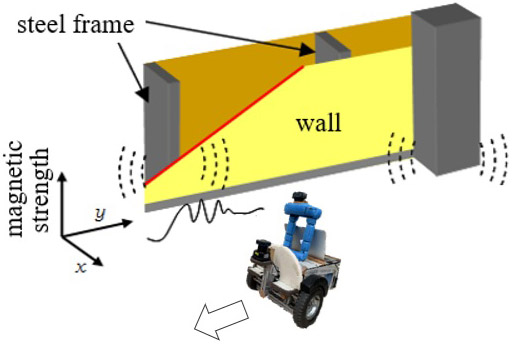
Global and local localizations are critical for mobile robots to perform tasks without human support. In this study, we proposed a new method for global and local localizations that combines an environmental magnetic field with a scan matching method. In this method, we record the environmental magnetic field at each waypoint during the map-building process. To perform global localization, we rotate the mobile robot’s magnetic sensor-detected heading direction (current magnetic heading direction) to approximate the heading direction of the environmental magnetic field stored on the map. Subsequently, we use the scan matching method at positions around each waypoint. The mobile robot is currently in the position with the highest matching rate. The experimental results show that the mobile robot can successfully localize almost anywhere in the indoor environment, with the exception of a position where the magnetic sensor is affected by electric boards, and has a high success rate in an outdoor environment. For the local localization, we calculate the deviation between the mobile robot’s current magnetic heading direction and the one stored on the map, and then use this deviation to improve the localization using the scan matching method. The experimental results show that the mobile robot can perform much stronger localization during autonomous navigation.
Localization using magnetic field
- [1] A. Takanose, K. Kondo, Y. Hoda, J. Meguro, and K. Takeda, “Localization system for vehicle navigation based on GNSS/IMU using time-series optimization with road gradient constrain,” J. Robot. Mechatron., Vol.35, No.2, pp. 387-397, 2023. http://doi.org/10.20965/jrm.2023.p0387
- [2] T. Tominaga and N. Kubo, “Performance assessment of adaptive Kalman fuilter-based GNSS PVT and integrity in dense urban environment,” Trans. of Navigation, Vol.4, No.2, pp. 49-58, 2019. https://doi.org/10.18949/jintransnavi.4.2_49
- [3] M. Agrawal and K. Konolige, “Real-time localization in outdoor environments using stereo vision and inexpensive GPS,” Proc. 18th of ICPR, pp. 1063-1068, 2006. http://doi.org/10.1109/ICPR.2006.962
- [4] I. P. Alonso, D. F. Llorca, and M. A. Sotelo, “Accurate global localization using visual odometry and digital maps on urban environments,” IEEE Tran. on Intelligent Transportation Systems, Vol.13, No.4, pp. 1535-1545, 2012. http://doi.org/10.1109/TITS.2012.2193569
- [5] S. Se, D. Lowe, and J. Little, “Global localization using distinctive visual features,” Proc. IROS, pp. 226-231, 2002. http://doi.org/10.1109/IRDS.2002.1041393
- [6] Y. Liu, Y. Petillot, D. Lane, and S. Wang, “Global localization with object-level semantics and topology,” Proc. of ICRA, pp. 4909-4915, 2019. http://doi.org/10.1109/ICRA.2019.8794475
- [7] S. Toshifumi, “An investigation on a magnetic field environment measuring technics (part 3),” Summaries of Technical Papers of Annual Meeting Architectural of Japan, pp. 181-182, 2000 (in Japanese).
- [8] I. Nagai, J. Sakai, and K. Watanabe, “Indoor self-localization using multiple magnetic sensors,” J. Robot. Mechatron., Vol.31, No.2, pp. 203-211, 2019. http://doi.org/10.20965/jrm.2019.p0203
- [9] J. Havrinen and A. Kemppainen, “Global indoor self-localization based on the ambient magnetic field,” Robotics and Autonomous Systems, Vol.57, No.10, pp. 1028-1035, 2009. https://doi.org/10.1016/j.robot.2009.07.018
- [10] Z. Wu, W. Wang, J. Zhang, Y. Wang, G. Peng, and D. Wang, “MGLT: Magnetic-lead global localization and tracking in degenerated repetitive environments,” IEEE/ASME Trans. on Mechatronics, Vol.29, No.6, pp. 4687-4698, 2024. https://doi.org/10.1109/TMECH.2024.3381177
- [11] S. A. Rahok, Y. Shikanai, and K. Ozaki, “Navigation using an environmental magnetic field for outdoor autonomous mobile robots,” Advanced Robotics, Vol.25, Nos.13-14, pp. 1751-1777, 2011. https://doi.org/10.1163/016918611X584677
- [12] S. A. Rahok, H. Oneda, A. Tanaka, and K. Ozaki, “A robust navigation method for mobile robots in real-world environment,” J. Robot. Mechatron., Vol.26, No.2, pp. 177-184, 2014. https://doi.org/10.20965/jrm.2014.p0177
- [13] S. A. Rahok, H. Oneda, T. Nakayama, K. Inoue, S. Osawa, A. Tanaka, and K. Ozaki, “Enhancement of scan matching using an environmental magnetic field,” J. Robot. Mechatron., Vol.30, No.4, pp. 532-539, 2018. https://doi.org/10.20965/jrm.2018.p0532
- [14] T. Higuchi, “Particle filter,” J. of The Institute of Electronics, Information and Communication Engineers, Vol.88, No.12, pp. 989-994, 2005.
- [15] M. Yokozuka, Y. Suzuki, T. Takei, N. Hashimoto, and O. Matsumoto, “Auxiliary particle filter localization for intelligent wheelchair systems in urban environments,” J. of Robot. Mechatron., Vol.22, No.6, pp. 758-766, 2010. https://doi.org/10.20965/jrm.2010.p0758
- [16] J. Eguchi and K. Ozaki, “Development of method using a combination of DGPS and scan matching for the making of occupancy grid maps for localization,” J. of Robot. Mechatron., Vol.25, No.3, pp. 506-514, 2013. https://doi.org/10.20965/jrm.2013.p0506
This article is published under a Creative Commons Attribution-NoDerivatives 4.0 Internationa License.