
Paper:
Digital Transformation of Disaster Response in Wajima City Following the 2024 Noto Peninsula Earthquake: Implementation Process and Operational Conditions —A Comparative Case Analysis of Five Operations—
Yuki Orihashi*,†, Shingo Suzuki*, Hiroyuki Kuramoto*, Yoshihiro Ura**, and Go Urakawa***
*Research Division for Social Resilience, National Research Institute for Earth Science and Disaster Resilience (NIED)
3-1 Tennodai, Tsukuba, Ibaraki 305-0006, Japan
†Corresponding author
**City of Wajima
Wajima, Japan
***Graduate School of Disaster Resilience and Governance, University of Hyogo
Kobe, Japan

This study examines the implementation process and operational conditions determining the success or failure of the digital transformation of disaster response in Wajima City, Ishikawa Prefecture, following the 2024 Noto Peninsula Earthquake. The study is based on a single-case comparative analysis of five operations—post-earthquake building safety assessment, shelter management, temporary housing, facility management, and publicly funded demolition—using operational records, products, meeting materials, and development logs. These operations were compared using five dimensions: digitalization of information collection, accumulation of shareable data, situational awareness through visualization, connection to decision support, and cross-departmental coordination. Among the five operations, post-earthquake building safety assessment and temporary housing advanced most continuously, while shelter management and facility management tended to remain at the stage of visualization, and publicly funded demolition remained fragmented. The results reveal that the digital transformation of disaster response progressed step by step from data input to accumulation, visualization, and decision support, rather than emerging all at once. Self-contained operations tended to advance more smoothly, whereas cross-departmental operations required clearer coordination and decision-making mechanisms. Thus, success depended less on technology itself than on operational conditions, implying that effective implementation depends on the peacetime preparation of data items, identifiers, update responsibilities, and decision-making arrangements.
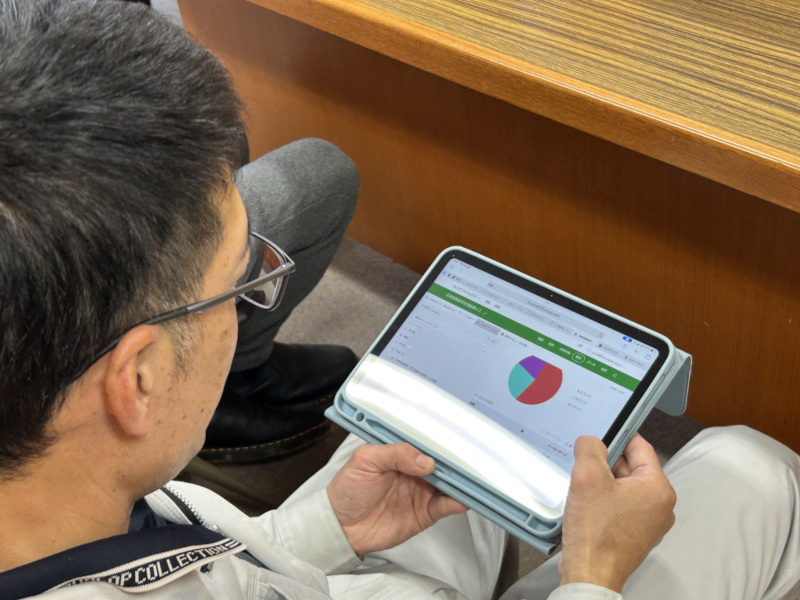
Reviewing disaster data on a tablet
- [1] Cabinet Office, “Overview of the 2024 Noto Peninsula Earthquake and the status of local government support,” 2024 (in Japanese). https://www.bousai.go.jp/updates/r60101notojishin/pdf/kensho_team2_shiryo01.pdf [Accessed March 29, 2026]
- [2] Y. Orihashi, S. Suzuki, H. Kuramoto, Y. Ura, and G. Urakawa, “The actual state of data utilization in disaster response in municipalities: Collaborative practice in Wajima City, following the 2024 Noto Peninsula Earthquake,” J. Jpn. Soc. Nat. Disaster Sci., Vol.43, No.3, pp. 619-630, 2024 (in Japanese).
- [3] M. Inoguchi, H. Hayashi, N. Yoshitomi, G. Urakawa, and K. Fujiharu, “Coaching effective operation procedures using GEOINT Database for local disaster responders based on short-term education model,” J. Soc. Saf. Sci., Vol.9, pp. 177-187, 2007 (in Japanese).
- [4] H. Taguchi, M. Hanashima, Y. Mizui, R. Sato, and Y. Usuda, “Information support activities in the Osaka prefecture on the earthquake in Osaka-Fu Hokubu – The first-time dispatch by Information Support Team (ISUT) –,” Report on Major Disasters, Vol.54, pp. 7-15, 2020 (in Japanese).
- [5] R. Sato, K. Yoshimori, S. Yusa, and Y. Usuda, “ISUT’s information support activities in the heavy rain since July 1, 2021,” J. Disaster Res., Vol.19, No.5, pp. 726-732, 2024. https://doi.org/10.20965/jdr.2024.p0726
- [6] Y. Usuda, M. Hanashima, R. Sato, and H. Sano, “Effects and issues of information sharing system for disaster response,” J. Disaster Res., Vol.12, No.5, pp. 1002-1014, 2017. https://doi.org/10.20965/jdr.2017.p1002
- [7] M. Hanashima, R. Sato, and Y. Usuda, “The standardized disaster-information products for disaster management: Concept and formulation,” J. Disaster Res., Vol.12, No.5, pp. 1015-1027, 2017. https://doi.org/10.20965/jdr.2017.p1015
- [8] Y. Usuda, T. Matsui, H. Deguchi, T. Hori, and S. Suzuki, “The shared information platform for disaster management – The research and development regarding technologies for utilization of disaster information –,” J. Disaster Res., Vol.14, No.2, pp. 279-291, 2019. https://doi.org/10.20965/jdr.2019.p0279
- [9] M. Hanashima and Y. Usuda, “Disaster information sharing technology among heterogeneous information systems through SIP4D-ZIP framework,” J. Disaster Res., Vol.18, No.7, pp. 763-769, 2023. https://doi.org/10.20965/jdr.2023.p0763
- [10] J. Wolbers and K. Boersma, “The common operational picture as collective sensemaking,” J. Contingencies Crisis Manag., Vol.21, Issue 4, pp. 186-199, 2013. https://doi.org/10.1111/1468-5973.12027
- [11] K. Kurata, N. Arai, Y. Chiba, T. Uezono, and N. Fukuwa, “The development and practice of a local information sharing system that can be utilized in normal and disaster,” J. Disaster Inf. Stud., Vol.15, No.2, pp. 187-195, 2017 (in Japanese). https://doi.org/10.24709/jasdis.15.2_187
- [12] R. Hamamoto and G. Urakawa, “Development of cloud based GIS to provide information of estimated damaged buildings at early stage in disaster response process,” J. Soc. Saf. Sci., Vol.34, pp. 85-93, 2019 (in Japanese). https://doi.org/10.11314/jisss.34.85
- [13] G. Urakawa, H. Hayashi, and K. Omura, “Development of support tool for creating map to share situational awareness at EOC,” J. Soc. Saf. Sci., Vol.14, pp. 99-109, 2011 (in Japanese). https://doi.org/10.11314/jisss.14.99
- [14] D. Fischer-Preßler, D. Bonaretti, and D. Bunker, “Digital transformation in disaster management: A literature review,” J. Strateg. Inf. Syst., Vol.33, Issue 4, Article No.101865, 2024. https://doi.org/10.1016/j.jsis.2024.101865
- [15] A. David, T. Yigitcanlar, R. Y. M. Li, J. M. Corchado, P. H. Cheong, K. Mossberger, and R. Mehmood, “Understanding local government digital technology adoption strategies: A PRISMA review,” Sustainability, Vol.15, Issue 12, Article No.9645, 2023. https://doi.org/10.3390/su15129645
- [16] V. Jayawardene, T. J. Huggins, R. Prasanna, and B. Fakhruddin, “The role of data and information quality during disaster response decision-making,” Prog. Disaster Sci., Vol.12, Article No.100202, 2021. https://doi.org/10.1016/j.pdisas.2021.100202
This article is published under a Creative Commons Attribution-NoDerivatives 4.0 Internationa License.