
Paper:
Three-Dimensional Heterogeneous Structures of Newly Formed Wind Slabs and its Implications for Avalanche Release
Satoru Yamaguchi*1,†, Kouichi Nishimura*2, Takahiro Tanabe*3, Satoru Adachi*3, Sojiro Sunako*1, Yoichi Ito*1, Taiki Nunokawa*2, Yoshihiko Saito*2, Tsubasa Okaze*4, Hirofumi Niiya*5, and Akio Shinya*6
*1Snow and Ice Research Center, National Research Institute for Earth Science and Disaster Resilience (NIED)
187-16 Maeyama, Suyoshi, Nagaoka, Niigata 940-0821, Japan
†Corresponding author
*2Yukiken Snow Eaters
Sapporo, Japan
*3Shinjo Cryospheric Environment Laboratory, Snow and Ice Research Center, National Research Institute for Earth Science and Disaster Resilience (NIED)
Shinjo, Japan
*4Institute of Science Tokyo
Tokyo, Japan
*5Niigata University
Niigata, Japan
*6Niseko Avalanche Institute
Niseko, Japan

Wind slabs, a major cause of dry slab avalanches, frequently develop during drifting-snow events in mountainous terrain. However, their three-dimensional internal structure remains poorly understood because of limited observations and is often assumed to be relatively homogeneous. This study examined recently deposited wind slabs using samples collected from Mt. Niseko Annupuri, Japan, in Februray and March 2024 and March 2025. High-resolution X-ray micro-computed tomography (µCT) was used to quantify three-dimensional snow-density distributions and spatial heterogeneity. Two avalanches associated with consecutive blizzard events were also examined to assess the potential implications of the observed structures for avalanche release. The µCT observations revealed pronounced three-dimensional heterogeneity, including band-like structures with distinct density contrasts. Similar features occurred in samples from both years despite differing deposition conditions. This heterogeneity likely results from interactions between drifting-snow deposition and locally variable airflow over irregular snow surfaces. The results demonstrate that newly formed wind slabs develop as three-dimensionally heterogeneous depositional bodies rather than homogeneous layers. Such structures may affect fracture initiation and crack propagation and contribute to avalanche release, particularly where no distinct weak layer is evident. These findings highlight the importance of three-dimensional observations for understanding wind-slab formation and avalanche processes.
Fragile 3D structure of wind slabs
1. Introduction
Dry-snow slab avalanches are among the most destructive natural hazards in snow-covered mountainous regions worldwide 1,2. One of the principal causes of these avalanches is the formation of wind slabs during blizzards, which can rapidly create unstable snowpack conditions over large areas, making them a major challenge in operational avalanche forecasting 3. Therefore, understanding the three-dimensional structure of newly formed wind slabs is fundamental for improving the physical understanding of avalanche release.
Snow is an inherently heterogeneous natural material whose three-dimensional internal structure governs its mechanical behavior over multiple spatial scales 1,4. Variations in snow density, grain morphology, bonding characteristics, and layering influence stress transmission through seasonal snowpacks, ultimately affecting their stability 1,5. However, despite the advance in characterizing snow properties and their evolution, the three-dimensional structural organization of newly deposited wind slabs and its role in avalanche release remain poorly understood.
The prevailing conceptual framework for dry-snow slab avalanche release is the weak-layer paradigm, in which failure initiates within a mechanically weak layer beneath a cohesive slab and propagates along a relatively continuous interface 1,5,6. This framework is supported by extensive field observations, laboratory experiments, and numerical modeling, providing a critical scientific basis for modern avalanche forecasting. Consequently, snowpack stability is conventionally assessed using snow pit stratigraphic observations and stability tests, which characterize the vertical layering, snow properties, and mechanical contrasts within snowpacks. However, such observations represent only a limited vertical section and cannot entirely resolve the lateral variability or three-dimensional organization of snow structures, particularly for newly deposited wind-affected snow, whose structure may vary substantially over short distances because of spatially variable deposition during blizzards.
Wind transport during blizzards is a primary driver of unstable wind-slab formation and rapidly increasing avalanche hazard 2,3. During these events, snow is continuously eroded, transported, and deposited under highly variable atmospheric conditions, with wind speed, wind direction, snowfall intensity, and topographic effects interacting to produce spatially heterogeneous snow-deposition patterns 7,8,9. Although studies have demonstrated the spatial heterogeneity of snow deposition during blizzards, how such heterogeneity is expressed in the three-dimensional internal structure of deposited snowpacks remains poorly understood. Newly deposited wind slabs are believed to exhibit substantial three-dimensional variability in density, grain characteristics, and depositional geometry; however, these heterogeneous internal structures have rarely been directly observed or quantified.
2. Study Area
The study area is located within a national park on Mt. Niseko Annupuri (42.88°N, 140.66°E; elevation: 1308 m) in the Niseko region of western Hokkaido, Japan (Fig. 1). This region spans the towns of Niseko and Kutchan and is one of the most popular mountainous tourist destinations in Japan, hosting several large ski resorts.
Mt. Niseko Annupuri is frequently exposed to strong northwesterly winds during winter storms, resulting in active drifting snow and repeated wind-deposited snow formation on lee slopes. The complex mountain topography produces a spatially variable airflow, leading to substantial variations in snow transport and deposition over short distances. Consequently, recently deposited wind slabs in this area exhibit considerable spatial variability. This combination of active snow transport and complex terrain provides an ideal natural laboratory for investigating how drifting-snow deposition influences the formation and three-dimensional internal structure of wind slabs, and ultimately avalanche release.
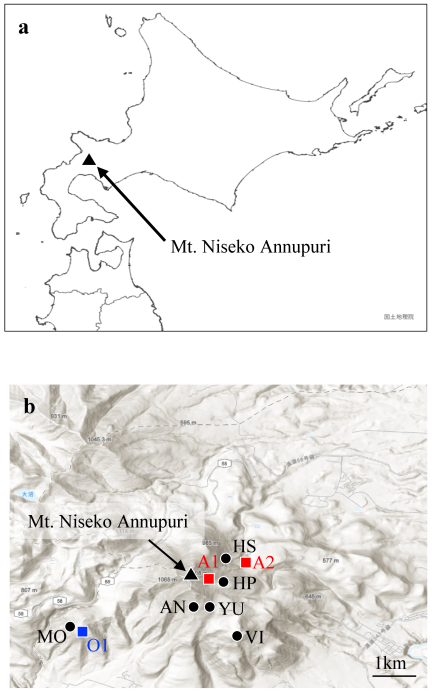
Fig. 1. Location of the study area. (a) Map of the survey area situated on Mt. Niseko Annupuri in the Niseko region, Hokkaido. (b) Map of the Niseko region. MO, AN, YU, VI, HP, and HS indicate the weather observation sites; A1 and A2 denote the avalanche occurrence sites on January 20 and 21, 2026, respectively; and O1 indicates the site of the special observation campaign. Modified based on the maps produced by the Geospatial Information Authority of Japan.
Since the early 2000s, continuous research on avalanche forecasting has been conducted in the Niseko region, establishing a collaborative framework among research institutions, local governments, and ski resorts. This has led to the accumulation of knowledge on snowpack structures and the relationship between meteorological conditions and avalanche occurrence 10,11,12. In recent years, meteorological observation networks have been developed to support operational decisions regarding gate openings and closings at ski resorts. These networks measure wind direction, wind speed, and air temperature across the Mt. Niseko Annupuri area (Fig. 1(b)). Numerical models have also been used to estimate the spatial distribution of wind fields and the associated snowdrift development; the results are shared among ski resort operators as part of an operational decision support system 13.
3. Results
3.1. Avalanche Occurrence During Sustained Drifting-Snow Conditions
Two dry slab avalanches were observed on January 20 and 21, 2026 at locations A1 and A2 (Fig. 1(b)), respectively (Figs. 2 and 3). Both avalanches occurred immediately after periods of sustained drifting-snow conditions and were intentionally triggered by ski patrol members during avalanche control operations. The first avalanche was released at 08:15 on January 20, and the second occurred at 07:47 on January 21. In both cases, the released slabs propagated rapidly downslope, immediately after triggering.
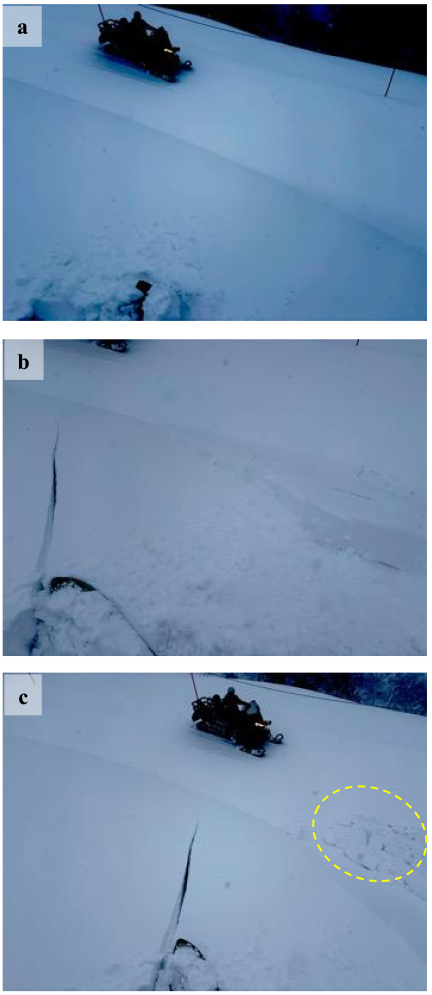
Fig. 2. Dry slab avalanche observed on January 20, 2026 (Location A1). The avalanche occurred immediately after a period of intense drifting-snow conditions and was triggered by a ski patrol at 08:15. A series of photographs taken by a ski patrol member at Niseko Hanazono Resort was captured from a vantage point overlooking the cat track (where the snowmobile is stationary) from the upper part of the slope. The sequence is (a), (b), and (c), and the three photographs were taken at intervals of \({<}1\) min. The yellow square in (c) shows the avalanche debris deposited on the cat track.
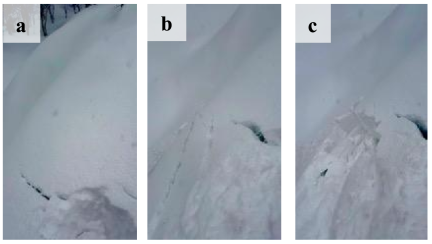
Fig. 3. Dry slab avalanche observed on January 21, 2026 (Location A2). The avalanche occurred immediately after a period of intense drifting-snow conditions and was triggered by a ski patrol at 07:47. Images extracted from a video recorded by ski patrol members of Niseko Hanazono Resort. The sequence is (a), (b), and (c), and each interval is 1 s.
Meteorological observations showed that both avalanche events occurred over prolonged periods of strong northwesterly winds (Fig. 4). At all observation sites, elevated wind speeds persisted for many hours before avalanche release, with the maximum 10-min wind speeds frequently exceeding 15–20 m s\(^{-1}\). The two avalanche events occurred under remarkably similar meteorological conditions and were characterized by sustained strong winds across the study area.
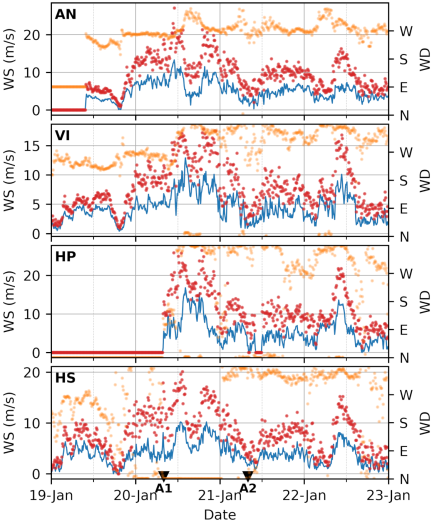
Fig. 4. Meteorological conditions at the observation sites from January 19 to 22, 2026. Orange dots indicate the wind direction, blue lines the 10-min averaged wind speed, and red dots the maximum wind speed within each 10-min interval. Black triangles denote avalanche occurrences (A1: January 20, 2026; A2: January 21, 2026). Both avalanches occurred during periods of strong sustained winds. The abbreviations for location names are the same as in Fig. 1(b).
3.2. Meteorological Conditions During the Special Observation Period
A special observation campaign (O1 in Fig. 1(b)) was conducted during a blizzard event between February 29 and March 4, 2024 (Fig. 5). During the special observation period, strong northwesterly winds accompanied by snowfall persisted for approximately one day. Snow samples for X-ray micro-computed tomography (μCT) analysis were collected at times S1 and S2 during this period.
At S2, the snow surface exhibited irregularly cracked wind-compacted slabs (Fig. 6). The cracks were confined to the upper few centimeters of the snowpack and formed an irregular polygonal pattern across the snow surface.
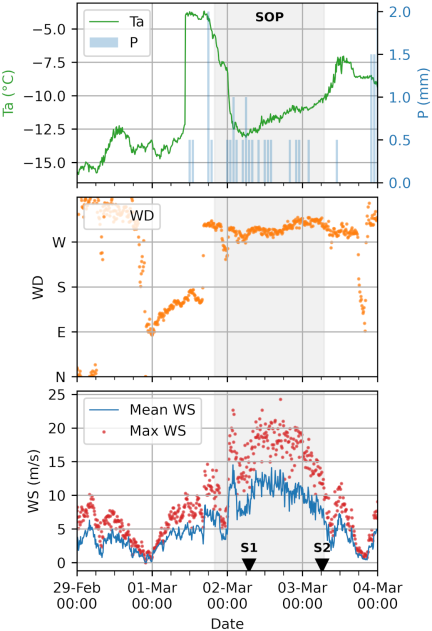
Fig. 5. Meteorological conditions from February 29 to March 4, 2024 at MO. The periods shaded in gray indicate the special observation period. Air temperature (Ta), wind direction (WD), mean wind speed (Mean WS), and maximum wind speed (Max WS) are measured at 10-min intervals. Precipitation (P) is measured at 1-h intervals at the Kutchan AMeDAS station. Black triangles (S1 and S2) indicate the times at which snow samples were collected for the X-ray μCT analysis.
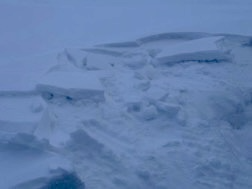
Fig. 6. Photograph of the snow surface taken when a snow sample was collected at time S2. The upper few centimeters feature irregularly cracked wind-compacted snow slabs.
3.3. Heterogeneous Three-Dimensional Wind Slab Structure
The X-ray μCT observations revealed pronounced heterogeneous structures within the near-surface wind slab sample at S2 (Fig. 7). These heterogeneous structures appeared as inclined bands comprising alternating high- and low-density regions extending throughout the analyzed volume. In contrast, the sample collected at S1 exhibited a relatively homogeneous internal structure.
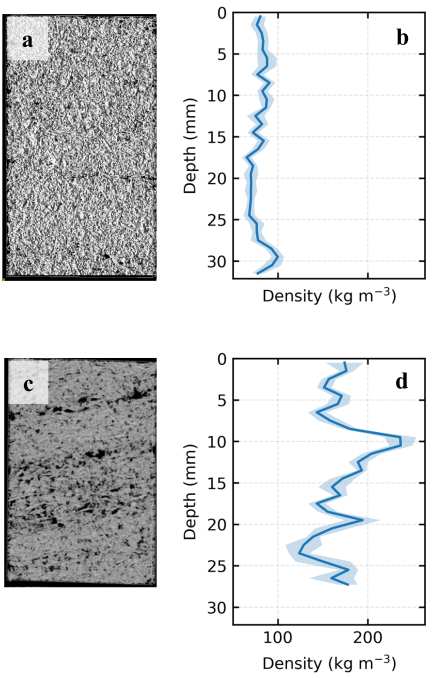
Fig. 7. X-ray μCT analysis of snow samples at S1 and S2. X-ray μCT images of (a) S1 and (c) S2 (resolution of 20 μm). White indicates ice and black indicates air. Density profiles of (b) S1 and (d) S2. The density profile of S2 exhibits pronounced vertical variability within the top 30 mm. The blue band indicates the standard deviation.
The density profiles reflected these structural differences (Figs. 7(b) and (d)). The S1 sample exhibited only small vertical density variations, whereas S2 exhibited pronounced density fluctuations within the upper 30 mm. High-density layers alternated with lower-density layers over short vertical distances, producing a markedly heterogeneous density profile compared with S1.
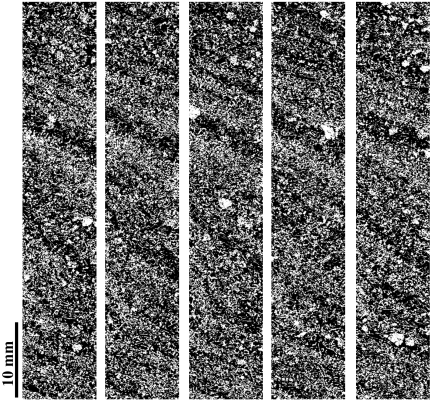
Fig. 8. X-ray μCT image of a surface sample collected immediately following the March 14, 2025 blizzard. Consecutive X-ray μCT sections acquired at 2-mm intervals demonstrate pronounced lateral heterogeneity in the near-surface snow structure following a blizzard. White indicates ice and black indicates air.
3.4. Reproducibility of Heterogeneous Structures
Similar heterogeneous structures were observed in an independent snow sample collected immediately after a blizzard on March 14, 2025 (Fig. 8). Consecutive X-ray μCT sections acquired at 2-mm intervals consistently exhibited laterally heterogeneous snow structures rather than laterally uniform layering. Heterogeneous band-like structures were identified across successive sections, indicating that the observed heterogeneity was not confined to a single cross-section but extended laterally throughout the sampled snow volume. Although the detailed geometry varied among the individual sections, inclined band-like features comparable to those in S2 were observed throughout the analyzed volume. Thus, despite differences in the observation year and individual storm conditions, similar heterogeneous structures were observed in the two independent blizzard events. Overall, the X-ray μCT observations consistently revealed heterogeneous internal structures within near-surface wind slabs formed during blizzard events.
4. Discussion
4.1. Heterogeneous Near-Surface Snow Structure Formation During Drifting-Snow Events
During drifting-snow events, strong winds transport and redistribute snow particles, leading to the development of wind-compacted surface layers 7,8,9. The field observations conducted during and immediately after drifting-snow conditions revealed irregularly cracked wind slabs on the snow surface (Fig. 6). X-ray μCT images further showed pronounced millimeter-scale heterogeneity in density and pore structure within the upper part of the snowpack (Fig. 7). These observations collectively suggest that recently formed wind slabs exhibit considerably more three-dimensional structural heterogeneity than is generally recognized. Such heterogeneity is likely associated with the highly variable depositional processes occurring during drifting-snow events. Under strong winds, the simultaneous occurrence of erosion, saltation, suspension, and deposition over short spatiotemporal scales results in repeated local snow redistribution 7,8,9. These processes produce spatially variable packing density and pore geometry, rather than laterally and vertically uniform snow layers. Therefore, the heterogeneous structures observed in this study are consistent with the dynamic nature of drifting-snow deposition.
Previous studies have generally characterized wind slabs using bulk properties such as density, hardness, and grain type. In contrast, the present X-ray μCT observations demonstrate that substantial structural variability exists within newly formed wind slabs at the millimeter scale. Therefore, rather than comprising homogeneous surface layers, wind slabs represent structurally heterogeneous deposits whose three-dimensional internal architecture reflects complex depositional processes associated with drifting snow.
4.2. Short-Term Persistence After Drifting-Snow Events
The two avalanche events occurred at different stages relative to the drifting-snow conditions. The A1 event occurred during a period of strong winds and active snow transport, whereas the A2 event occurred after the strong winds had subsided. This contrast suggests that the conditions favorable for dry slab avalanche release are not limited to the period of active drifting snow, persisting for some time even after the wind speeds decreased.
Surface and X-ray μCT observations provide a possible structural explanation for this delayed instability. At S2, which was after the strongest drifting snow subsided, irregularly cracked wind-compacted slabs remained at the surface, and the μCT sample exhibited pronounced vertical variations in density within the upper 30 mm of the snowpack (Figs. 6 and 7). These observations indicate that the heterogeneous structures formed during drifting-snow conditions can persist even after wind weakening, with parts of the structural heterogeneity retained post-event. Although the exact duration of this persistence cannot be determined from the present observations, the timing of A2 suggests that structurally heterogeneous and potentially unstable near-surface snow may remain for at least several hours after the active drifting snow weakens. Therefore, the cessation of strong winds does not imply the immediate disappearance of snow structures generated during the event. A short post-event period may exist during which recently deposited wind slabs retain the structural characteristics acquired during drifting-snow deposition.
This short-term persistence is critical because drifting-snow conditions and snowpack instability do not necessarily evolve synchronously. Wind speed and snow transport may decrease rapidly, whereas the internal structure of newly deposited snow may adjust more slowly through settling, sintering, metamorphism, or other mechanical disturbances. Therefore, the meteorological end of a drifting-snow event may precede the structural stabilization of the near-surface snowpack.
4.3. Implications for Dry Slab Avalanche Release
The present observations suggest that recently deposited wind slabs may remain structurally heterogeneous even after drifting-snow conditions weaken. This finding has important implications for understanding dry slab avalanche release. While conventional interpretations often regard wind slabs as relatively homogeneous layers overlying weak snow, the X-ray μCT observations reveal that the newly formed wind slabs may contain substantial internal heterogeneity at the millimeter scale. Such structural heterogeneity may influence the stress distribution within the near-surface snowpack. Variations in density, bonding, and pore geometry are likely to produce locally different mechanical responses, potentially leading to spatially heterogeneous stress concentrations. Instead of behaving as mechanically uniform slabs, recently deposited wind slabs may exhibit more complex responses to external loading.
Although the present observations do not directly demonstrate fracture initiation or propagation, they suggest that three-dimensional structural heterogeneity of wind slabs may contribute to the complex fracture behavior frequently observed in dry slab avalanches. In particular, local variations in mechanical properties may promote multiple fracture initiation sites or spatially variable crack propagation pathways rather than a single planar failure surface. These interpretations are consistent with the established importance of stress redistribution, failure initiation, and crack propagation in dry-snow slab avalanche release 1,5,6, but they remain speculative and require verification through future mechanical experiments and numerical modeling.
Therefore, the findings presented here complement, rather than replace, the conventional weak-layer framework for dry slab avalanche release 1,5,6. Although weak layers remain fundamental components of many avalanche release mechanisms, the present observations suggest that the structural complexity of the overlying wind slabs may also influence mechanical behavior immediately following drifting-snow events. Accordingly, considering both weak layer properties and slab heterogeneity may provide a more comprehensive physical framework for understanding dry slab avalanche release.
These findings may explain the long-standing field observation of ski patrols and avalanche forecasters that dry slab avalanches frequently occur during or shortly after drifting-snow events, even after the strongest winds have subsided. Although further mechanical verification is required, the observed three-dimensional structural heterogeneity may represent an unrecognized physical link between drifting-snow deposition and snowpack condition development conducive to dry slab avalanche release during and shortly after these events.
4.4. Heterogeneous Wind Slab Structure Formation Mechanism and Generality
To examine whether the three-dimensional structural heterogeneity observed in the February and March 2024 samples was specific to that event, an additional surface snow sample collected immediately after an independent blizzard in March 2025 was analyzed. Although no avalanche occurred during this event, consecutive X-ray μCT sections revealed pronounced spatial variability within the near-surface snow. Several inclined band-like structures visible throughout the sample exhibited markedly different positions, orientations, and internal configurations between sections, with separations of only 2 mm. These observations demonstrate that near-surface snow structures cannot be adequately represented as laterally uniform horizontal layers.
We hypothesized that these inclined and non-parallel structures record the progressive development of a snowdrift during the blizzards. As wind-transported snow accumulates on the slope, the depositional surface geometry and inclination continuously change. Such evolving surface conditions may, in turn, modify local airflow and snow transport pathways, causing successive depositional layers to form with different orientations and spatial configurations. Therefore, repeated feedback between snow deposition, changing surface topography, and the near-surface wind field may have generated the complex three-dimensional structures observed in the X-ray μCT images. This is consistent with previous modeling studies showing strong coupling between terrain-modified airflow and heterogeneous snow deposition 8,9.
Although the March 2025 observations represent only a single additional case, this provides independent evidence that complex three-dimensional heterogeneous structures can develop within recently deposited wind slabs. Together with the February and March 2024 observations, these findings suggest that such heterogeneity reflects the depositional process associated with drifting snow, rather than a feature unique to avalanche occurrence. In the future, observations under a wider range of meteorological and topographic conditions are required to determine the prevalence, persistence, and mechanical significance of these heterogeneous structures.
4.5. Limitations and Future Perspectives
The present study has several limitations. First, the observations were based on only two drifting-snow events at a single mountain site, and the spatiotemporal evolution of the observed heterogeneous structures could not be monitored continuously. Consequently, the prevalence, persistence, and variability of these structures under various meteorological and topographic conditions remain unclear.
Second, although the X-ray μCT observations clearly identified three-dimensional structural heterogeneity, the present study did not directly investigate its mechanical consequences. Future studies should combine high-resolution structural observations with laboratory mechanical testing and numerical simulations to quantify the effect of three-dimensional heterogeneity on stress redistribution, crack initiation, and fracture propagation in recently deposited wind slabs.
Furthermore, the coupled evolution of snow deposition, surface topography, and local airflow during drifting-snow events must be investigated. The present observations suggest that a three-dimensional snow structure may develop through repeated interactions between snow accumulation and an evolving wind field. Testing this hypothesis requires integrated field observations and numerical simulations of snow transport and deposition.
Despite these limitations, the present study demonstrated that recently deposited wind slabs possess previously unrecognized three-dimensional structural heterogeneity that may persist even after drifting-snow conditions weaken. These findings extend the conventional view of wind slabs as laterally uniform surface layers, revealing their complex three-dimensional depositional architecture.
5. Conclusion
This study investigated the three-dimensional internal structure of newly formed wind slabs using high-resolution X-ray μCT observations of snow collected immediately after blizzard events in the Niseko region, Japan. X-ray μCT analysis revealed that recently deposited wind slabs exhibited pronounced three-dimensional heterogeneous structures comprising inclined bands with alternating high- and low-density regions. Similar structural characteristics were observed across two independent blizzard events, suggesting that such heterogeneity is a reproducible feature of wind-slab formation rather than an event-specific phenomenon. The observed heterogeneous structures reflect complex depositional processes associated with drifting snow under spatially variable airflow. These observations indicate that newly formed wind slabs should be regarded as three-dimensional heterogeneous depositional bodies, rather than as laterally uniform snow layers.
Although the present study does not directly evaluate the mechanical behavior of these structures, the observed heterogeneity may influence fracture initiation and crack propagation within wind slabs and may therefore contribute to dry slab avalanche release during and shortly after drifting-snow events. More broadly, this study establishes an observational framework linking drifting-snow deposition, three-dimensional snow structure, and avalanche release mechanisms. Integrating these high-resolution structural observations with mechanical experiments and numerical simulations will improve the physical understanding and prediction of wind slab avalanches.
Acknowledgments
The authors gratefully thank the ski patrol members of Niseko Hanazono Resort for their assistance in field observations. We further appreciate the support provided by Niseko Moiwa Ski Resort during the special observation period. We greatly appreciate the helpful comments and suggestions from two anonymous reviewers. This work was conducted as part of the project “Enhancing Societal Resilience to Snow-Related Hazards through Advances in Observation and Prediction Technologies.” This study was supported by JSPS KAKENHI (Grant Numbers JP21H04601 [HaMaNAS PJ] and JP22K03747) and by a donation from the Niseko Annupuri District Avalanche Prevention Council.
- [1] J. Schweizer, J. B. Jamieson, and M. Schneebeli, “Snow avalanche formation,” Rev. Geophys., Vol.41, No.4, Article No.1016, 2003. https://doi.org/10.1029/2002RG000123
- [2] D. McClung and P. Schaerer, “The avalanche handbook (3rd edition),” The Mountaineers Books, 2006.
- [3] G. Statham et al., “A conceptual model of avalanche hazard,” Nat. Hazards, Vol.90, No.2, pp. 663-691, 2018. https://doi.org/10.1007/s11069-017-3070-5
- [4] M. Schneebeli, “Numerical simulation of elastic stress in the microstructure of snow,” Ann. Glaciol., Vol.38, pp. 339-342, 2004. https://doi.org/10.3189/172756404781815284
- [5] B. Reuter, J. Schweizer, and A. van Herwijnen, “A process-based approach to estimate point snow instability,” Cryosphere, Vol.9, No.3, pp. 837-847, 2015. https://doi.org/10.5194/tc-9-837-2015
- [6] J. Gaume, A. van Herwijnen, G. Chambon, N. Wever, and J. Schweizer, “Snow fracture in relation to slab avalanche release: Critical state for the onset of crack propagation,” Cryosphere, Vol.11, pp. 217-228, 2017. https://doi.org/10.5194/tc-11-217-2017
- [7] J. W. Pomeroy and D. M. Gray, “Snowcover: Accumulation, relocation and Management,” National Hydrology Research Institute (NHRI) Science Report No.7, 1995.
- [8] G. E. Liston and M. Sturm, “A snow-transport model for complex terrain,” J. Glaciol., Vol.44, No.148, pp. 498-516, 1998. https://doi.org/10.3189/S0022143000002021
- [9] M. Lehning, H. Löwe, M. Ryser, and N. Raderschall, “Inhomogeneous precipitation distribution and snow transport in steep terrain,” Water Resour. Res., Vol.44, No.7, Article No.W07404, 2008. https://doi.org/10.1029/2007WR006545
- [10] H. Hirashima, K. Nishimura, E. Baba, A. Hachikubo, and M. Lehning, “SNOWPACK model simulations for snow in Hokkaido, Japan,” Ann. Glaciol., Vol.38, pp. 123-129, 2004. https://doi.org/10.3189/172756404781815121
- [11] K. Nishimura, E. Baba, H. Hirashima, and M. Lehning, “Application of the snow cover model SNOWPACK to snow avalanche warning in Niseko, Japan,” Cold Reg. Sci. Technol., Vol.43, Nos.1-2, pp. 62-70, 2005. https://doi.org/10.1016/j.coldregions.2005.05.007
- [12] A. Komatsu and K. Nishimura, “Calculation of snowdrift distribution over complex topography to improve the accuracy of snow avalanche warning systems,” SOLA, Vol.18, pp. 71-75, 2022. https://doi.org/10.2151/sola.2022-012
- [13] S. Yamaguchi et al., “Co-creation with local governments and ski resorts to generate scientific information that contributes to ski resort avalanche safety management,” Bull. Glaciol. Res., Vol.42, pp. 9-17, 2024. https://doi.org/10.5331/bgr.23R02
This article is published under a Creative Commons Attribution-NoDerivatives 4.0 Internationa License.