
Survey Report:
Evacuation Behavior in the Absence of Ground Shaking: A Survey Report on the 2025 Kamchatka Far-Field Tsunami in Shingu City, Japan
Nanami Hasegawa†
 and Tomoyuki Takabatake
Kindai University
3-4-1 Kowakae, Higashiosaka, Osaka 577-8502, Japan
†Corresponding author

This study investigated residents’ evacuation behavior in Shingu City, Wakayama Prefecture, following the far-field tsunami generated by the 2025 Kamchatka Peninsula earthquake. Using a web-based questionnaire survey (N=283), the relationship between residents’ spatial risk perception and evacuation actions in the absence of ground motion was analyzed. The results revealed that official information, specifically Tsunami Advisories, Warnings, and Evacuation Orders, served as the primary trigger for 81% of evacuees, confirming that information interpretation dictates behavior during far-field tsunamis. The evacuation rates of residents who perceived themselves to be inside the estimated inundation zone were significantly higher than those for residents outside the zone. However, spatial perception did not significantly affect evacuation timing or methods. Notably, the phased issuance of warnings contributed to a wide dispersion of departure times, effectively preventing traffic congestion despite high private car usage. Conversely, the decision to return home heavily depended on subjective judgment and social cues rather than official clearance, contrasting with near-field events, where physical cues are clearer. These findings underscore the importance of risk communication strategies that not only initiate evacuation but also sustain protective behavior, preventing premature returns driven by an overestimation of safety in the absence of visible physical cues.
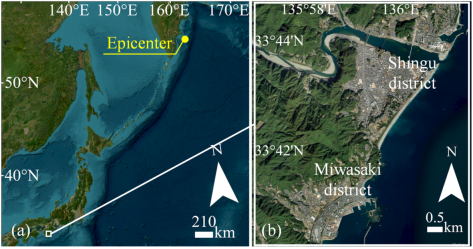
Study area and earthquake epicenter
- [1] Japan Meteorological Agency, “Monthly report on earthquakes and volcanoes in Japan, July 2025,” 2025 (in Japanese). https://www.data.jma.go.jp/eqev/data/gaikyo/monthly/202507/202507monthly.pdf [Accessed December 16, 2025]
- [2] Cabinet Office of Japan, “Questionnaire survey on evacuation behavior of residents during the 2011 Great East Japan Earthquake (main results),” 2012 (in Japanese). https://www.bousai.go.jp/jishin/tsunami/hinan/pdf/20121221_chousa1_1.pdf [Accessed January 21, 2026]
- [3] M. K. Lindell et al., “Households’ immediate responses to the 2009 American Samoa earthquake and tsunami,” Int. J. Disaster Risk Reduct., Vol.12, pp. 328-340, 2015. https://doi.org/10.1016/j.ijdrr.2015.03.003
- [4] A. S. Harnantyari et al., “Tsunami awareness and evacuation behaviour during the 2018 Sulawesi earthquake tsunami,” Int. J. Disaster Risk Reduct., Vol.43, Article No.101389, 2020. https://doi.org/10.1016/j.ijdrr.2019.101389
- [5] N. Hasegawa et al., “Tsunami awareness, preparedness, and evacuation behaviors during the 2024 Noto Peninsula Earthquake tsunami,” Saf. Sci., Vol.189, Article No.106885, 2025. https://doi.org/10.1016/j.ssci.2025.106885
- [6] T. Takabatake and N. Hasegawa, “Tsunami evacuation behavior: A systematic review and proposal for a standardized research framework,” Nat. Hazards, Vol.122, Article No.280, 2026. https://doi.org/10.1007/s11069-026-08035-7
- [7] L. Dengler, S. Araya, N. Graehl, F. Luna, and T. Nicolini, “Factors that exacerbated or reduced impacts of the 27 February 2010 Chile tsunami,” Earthq. Spectra, Vol.28, No.1S1, pp. 199-213, 2012. https://doi.org/10.1193/1.4000033
- [8] T. Takabatake et al., “Field survey and evacuation behaviour during the 2018 Sunda Strait tsunami,” Coast. Eng. J., Vol.61, No.4, pp. 423-443, 2019. https://doi.org/10.1080/21664250.2019.1647963
- [9] F. Imamura et al., “Preliminary observations and impact in Japan of the tsunami caused by the Tonga volcanic eruption on January 15, 2022,” Pure Appl. Geophys., Vol.179, No.5, pp. 1549-1560, 2022. https://doi.org/10.1007/s00024-022-03058-0
- [10] A. Moore et al., “Coastal emergency managers’ risk perception and decision making for the Tonga distant tsunami,” Int. J. Disaster Risk Reduct., Vol.108, Article No.104560, 2024. https://doi.org/10.1016/j.ijdrr.2024.104560
- [11] California Coastal Commission, “The Tohoku tsunami of March 11, 2011: A preliminary report on effects to the California Coast and planning implications,” 2011. https://www.coastal.ca.gov/energy/tsunami/CCC_Tohoku_Tsunami_Report.pdf [Accessed February 5, 2026]
- [12] Shingu City, “Tsunami hazard map,” 2025 (in Japanese). https://www.city.shingu.lg.jp/div/bousai/pdf/hazard/32-33_hm_r7.pdf [Accessed December 16, 2025]
- [13] N. Hasegawa et al., “Analysis of tsunami response and evacuation behaviors in northern Hyogo: Insights from the 2024 Noto Peninsula earthquake tsunami,” Int. J. Disaster Risk Reduct., Vol.115, Article No.104993, 2024. https://doi.org/10.1016/j.ijdrr.2024.104993
- [14] Portal Site of Official Statistics of Japan (e-Stat), “Resident demographic data for each region,” 2020. https://www.e-stat.go.jp/en [Accessed December 16, 2025]
- [15] Cabinet Office of Japan, “Resident survey on tsunami associated with the earthquake near the Kamchatka Peninsula: Survey report,” Government of Japan, 2025 (in Japanese). https://www.e-stat.go.jp/statistics/00100307 [Accessed December 16, 2025]
This article is published under a Creative Commons Attribution-NoDerivatives 4.0 Internationa License.