
Paper:
Disaster Ethnography as a Research Infrastructure: From Fundamental Studies to Social Implementation
Satoshi Tanaka†
Tokoha University
6-1 Yayoi-cho, Suruga-ku, Shizuoka, Shizuoka 422-8581, Japan
†Corresponding author

Large-scale natural disasters are complex social phenomena in which damage patterns and response processes vary depending on social, institutional, and temporal contexts. Conventional disaster research has primarily relied on quantitative approaches that capture conditions at specific points in time, making it difficult to understand the dynamic and procedural nature of disasters. Despite increasing attention to qualitative approaches, a systematic framework for accumulating and using primary experiential data remains underdeveloped. In response to this gap, disaster ethnography has emerged as a methodological approach that documents the experiences, perceptions, and actions of disaster victims and responders through detailed chronological narratives. This study reviews the definition, objectives, and methodological foundations of disaster ethnography and examines its contributions to disaster studies. It highlights key findings from previous studies, including the identification of temporal phases in disaster response and standardization of analytical procedures. Furthermore, the study conceptualizes disaster ethnography not only as a qualitative method, but also as a research infrastructure for preserving and sharing primary data. Moreover, it demonstrates its practical value as a training resource that facilitates the externalization of tacit knowledge and enhances situational awareness and decision-making in disaster risk management. These findings suggest that disaster ethnography provides an integrative framework linking research, practice, and education.
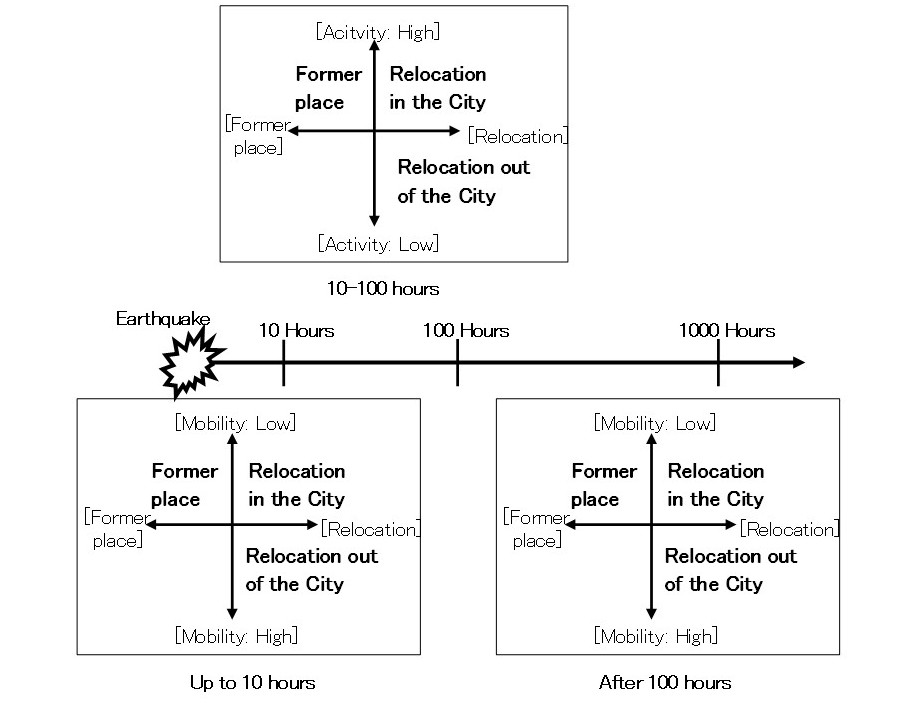
Response phases of victims’ behavior
- [1] H. Rodríguez, W. Donner, and J. E. Trainor (Eds.), “Handbook of Disaster Research,” 2nd ed., Springer, 2017. https://doi.org/10.1007/978-3-319-63254-4
- [2] S. M. Hoffman and A. Oliver-Smith (Eds.), “Catastrophe and Culture: The Anthropology of Disaster,” School of American Research Press, 2002.
- [3] R. Bolin and L. Stanford, “The Northridge Earthquake: Vulnerability and Disaster,” Routledge, 1998. https://doi.org/10.4324/9780203028070
- [4] K. J. Tierney, “From the Margins to the Mainstream? Disaster Research at the Crossroads,” Annu. Rev. Sociol., Vol.33, pp. 503-525, 2007. https://doi.org/10.1146/annurev.soc.33.040406.131743
- [5] T. Mikuriya (Ed.), “C.O.E. Oral History and Policy Research Project: ‘Hanshin-Awaji Earthquake Reconstruction Committee’ (1995–1996), Chair: Atsushi Shimokobe, ‘Simultaneous Progress’: Oral History,” Vols.1 and 2, National Graduate Institute for Policy Studies, 2002.
- [6] Reconstruction Agency, “Oral History,” Website for Passing on the Lessons Learned from the Great East Japan Earthquake. https://www.reconstruction.go.jp/311kyoukun/oral-history/ (in Japanese) [Accessed May 20, 2026]
- [7] Human Relations Area Files. https://hraf.yale.edu/ [Accessed May 20, 2026]
- [8] S. Tanaka and Y. Kuriyama, “Development of a Disaster Ethnography Database Featuring Digital and Analog Methods,” Proc. ISSS, 2017 (in Japanese).
- [9] Human Relations Area Files, “Outline of Cultural Materials.” https://hraf.yale.edu/resources/reference/outline-of-cultural-materials/ [Accessed May 20, 2026]
- [10] “Disaster Ethnography Series,” Nos.1-33, Social Disaster Research Center, Tokoha University, 2016-2025 (in Japanese).
- [11] H. Hayashi and K. Shigekawa, “Producing Disaster Ethnography for the Development of Disaster Ethnology,” Papers of the Annual Conf. of ISSS, No.7, pp. 376-379, 1997 (in Japanese).
- [12] S. Tanaka and H. Hayashi, “Development of Disaster Ethnography for Establishing Disaster Ethnology,” Papers of the Annual Conf. of ISSS, No.8, pp. 14-19, 1998 (in Japanese).
- [13] I. Hayashi, “Disaster Ethnography and Interviews,” J. Japan Soc. Nat. Disaster Sci., Vol.27, No.3, pp. 236-241, 2008 (in Japanese).
- [14] A. Oliver-Smith, “The Martyred City: Death and Rebirth in the Peruvian Andes,” University of New Mexico Press, 1986.
- [15] H. Murakami, “Underground,” Kodansha, 1997 (in Japanese).
- [16] R. Yanagiya et al., “Establishment of Disaster Ethnography Research, Editing, and Utilization Process,” Papers of the Workshop on the Great East Japan Earthquake, ISSS, No.9, pp. 31-34, 2020 (in Japanese).
- [17] S. Tanaka et al., “A Study on the Chronological Development of Disaster Processes,” J. Japan Soc. Nat. Disaster Sci., Vol.18, No.1, pp. 21-30, 1999 (in Japanese).
- [18] S. Tanaka et al., “Development of a Standardized Procedure for Disaster Ethnography,” J. ISSS, No.3, pp. 181-199, 2000 (in Japanese).
- [19] S. Tanaka et al., “Operational Issues for the Housing Damage Evaluation Process in the 2004 Mid-Niigata Earthquake Disaster: Lessons Learned from the Ojiya City Experience,” J. ISSS, No.8, pp. 51-61, 2006 (in Japanese).
- [20] K. Shigekawa et al., “Some Regulatory Issues in Building Damage Assessment: A Case Study of the Niigata-ken Chuetsu Earthquake,” J. ISSS, No.7, pp. 133-140, 2005 (in Japanese).
- [21] S. Tanaka, “Building Damage Inspection Analysis in the 2007 Niigata Chuetsu-Oki Earthquake, Kashiwazaki: Self-Inspection Analysis for Damage Evaluation,” J. Disaster Res., Vol.3, No.6, pp. 372-380, 2008. https://doi.org/10.20965/jdr.2008.p0372
- [22] S. Tanaka and K. Shigekawa, “Building Damage Evaluation Analysis of Tsunami Damage in the 2011 Great East Japan Earthquake,” J. ISSS, No.18, pp. 269-275, 2012 (in Japanese).
- [23] K. Shigekawa et al., “Analysis of the Correlation Between Public Assistance Systems for the Restoration of Damaged Dwellings: A Case Study of Ojiya City After the 2004 Mid-Niigata Earthquake,” J. ISSS, No.8, pp. 71-80, 2006 (in Japanese).
- [24] M. Takashima, S. Tanaka, and K. Shigekawa, “Household Recovery Consulting Using Household Recovery Support Chart in Anamizu Town After the March 2007 Noto Peninsula Earthquake,” J. Disaster Res., Vol.3, No.6, pp. 381-389, 2008. https://doi.org/10.20965/jdr.2008.p0381
- [25] T. Sugano, “Significance and Future Issues Concerning the Provision of Temporary Housing, Mainly Through Private Rental Houses, and Disaster Case Management: An Action Research Study in Kumamoto City Applying Research Results from the Great East Japan Earthquake,” J. ISSS, No.31, pp. 177-186, 2017 (in Japanese).
- [26] Cabinet Office, “Standard Textbook on Disaster Prevention,” 2007 (in Japanese).
- [27] K. Ota, “A Case Study Utilizing Disaster Ethnography for Emergency Responder Training,” J. ISSS, No.12, pp. 93-99, 2010 (in Japanese).
- [28] H. Kagiya et al., “Approaches to the Identification of Issues Regarding Disaster Management in Welfare Facilities for Persons with Disabilities and the Formulation of a Business Continuity Plan (BCP),” J. ISSS, No.27, pp. 113-120, 2015 (in Japanese).
- [29] Y. Shiga et al., “Development of Training Materials for Human Resource Development Utilizing Disaster Ethnography Research from the Great East Japan Earthquake,” Proc. Japan Water Works Association 2019, Session ID 9-50, 2019 (in Japanese).
- [30] Y. Noguchi and S. Kikuchi, “Discussion on an Ethnographic Approach to Post-Disaster Settings in Architectural Planning Studies,” J. Architecture and Urban Design, Kyushu University, No.39, pp. 7-14, 2021 (in Japanese).
This article is published under a Creative Commons Attribution-NoDerivatives 4.0 Internationa License.