
Note:
Risk Governance and the Prevention of Sediment Disasters After the 2024 Mw 7.3 Hualien Earthquake in Eastern Taiwan —A Transdisciplinary Approach Case Study
Ting-Chi Tsao*,†, Jung-Hsing Chien*, Chen-Yu Chen**, and Hsiao-Yu Huang**
*Sinotech Engineering Consultants, Inc.
No.280 Xinhu 2nd Road, Neihu District, Taipei 114065, Taiwan
†Corresponding author
**Agency of Rural Development and Soil and Water Conservation, Ministry of Agriculture
Nantou, Taiwan

Following a major earthquake, the frequency of debris flows and landslides increases. To effectively mitigate the impact of these disasters and strengthen collaboration and information exchange among the central government, local authorities, and the public, adopting a transdisciplinary approach to disaster risk governance in earthquake-affected areas is crucial. On April 3, 2024, a magnitude 7.3 earthquake struck Hualien, triggering over 1,900 new landslides in eastern Taiwan. The resulting landslide debris poses a significant risk, potentially serving as a source for future debris flows. With the rainy season approaching in May, relevant government agencies responsible for debris flow disaster management have developed comprehensive strategies and actions for prevention, preparedness, response, and recovery phases to address these anticipated hazards.
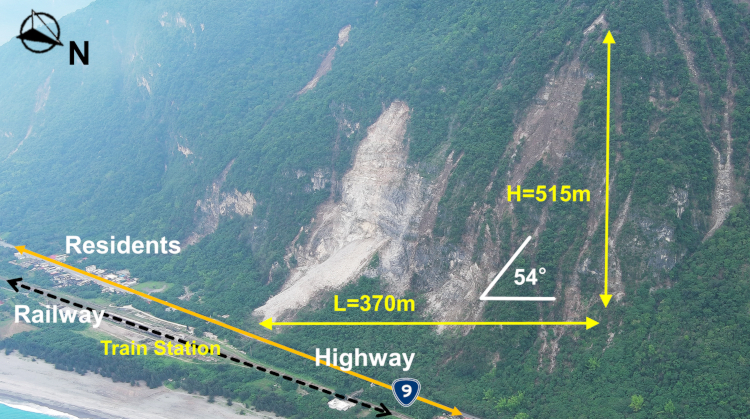
An earthquake-triggered landslide
- [1] S.-C. Chen and C.-Y. Wu, “Debris flow disaster prevention and mitigation of non-structural strategies in Taiwan,” J. Mt. Sci., Vol.11, No.2, pp. 308-322, 2014. https://doi.org/10.1007/s11629-014-2987-3
- [2] L.-C. Chen, J.-Y. Wu, and M.-J. Lai, “The evolution of the natural disaster management system in Taiwan,” J. Chin. Inst. Eng., Vol.29, No.4, pp. 633-638, 2006. https://doi.org/10.1080/02533839.2006.9671159
- [3] Y.-H. Lin and Y.-M. Wu, “Magnitude determination for earthquake early warning using P P-alert low-cost sensors during 2024 Mw7.4 Hualien, Taiwan earthquake,” Sci. Rep., Vol.15, Article No.12538, 2025. https://doi.org/10.1038/s41598-025-97748-z
- [4] W. Peng, K. H. Chen, R. Bürgmann, Y.-J. Hsu, and Y.-H. Chen, “Aseismic slip and seismic swarms leading up to the 2024 M7.3 Hualien earthquake,” Nat. Commun., Vol.16, Article No.9066, 2025. https://doi.org/10.1038/s41467-025-64117-3
- [5] R. Enokida et al., “Earthquake disaster resilience in Taiwan observed from the April 2024 mathrm{M}_{mathrm{L}} ML 7.1 Hualien earthquake,” Front. Built Environ., Vol.11, Article No.1593942, 2025. https://doi.org/10.3389/fbuil.2025.1593942
- [6] J.-M. Chang, W.-A. Chao, C.-M. Yang, and M.-W. Huang, “Coseismic and subsequent landslides of the 2024 Hualien earthquake (M7.2) on April 3 in Taiwan,” Landslides, Vol.21, No.10, pp. 2591-2595, 2024. https://doi.org/10.1007/s10346-024-02312-x
- [7] M. Chen, C. Tang, J. Xiong, M. Chang, and N. Li, “Spatio-temporal mapping and long-term evolution of debris flow activity after a high magnitude earthquake,” CATENA, Vol.236, Article No.107716, 2024. https://doi.org/10.1016/j.catena.2023.107716
- [8] T. Görüm et al., “The 2023 Türkiye-Syria earthquake disaster was exacerbated by an atmospheric river,” Commun. Earth Environ., Vol.6, Article No.151, 2025. https://doi.org/10.1038/s43247-025-02111-9
- [9] X. Fan et al., “Earthquake-induced chains of geologic hazards: Patterns, mechanisms, and impacts,” Rev. Geophys., Vol.57, No.2, pp. 421-503, 2019. https://doi.org/10.1029/2018RG000626
- [10] C.-W. Lin et al., “Impact of Chi-Chi earthquake on the occurrence of landslides and debris flows: Example from the Chenyulan River watershed, Nantou, Taiwan,” Eng. Geol., Vol.71, Nos.1-2, pp. 49-61, 2004. https://doi.org/10.1016/S0013-7952(03)00125-X
- [11] J. C. Chen, C. D. Jan, and W. S. Huang, “Characteristics of rainfall triggering of debris flows in the Chenyulan watershed, Taiwan,” Nat. Hazards Earth Syst. Sci., Vol.13, No.4, pp. 1015-1023, 2013. https://doi.org/10.5194/nhess-13-1015-2013
- [12] C. Tang, J. Zhu, W. L. Li, and J. T. Liang, “Rainfall-triggered debris flows following the Wenchuan earthquake,” Bull. Eng. Geol. Environ., Vol.68, No.2, pp. 187-194, 2009. https://doi.org/10.1007/s10064-009-0201-6
- [13] C. Li, M. Wang, and K. Liu, “A decadal evolution of landslides and debris flows after the Wenchuan earthquake,” Geomorphology, Vol.323, pp. 1-12, 2018. https://doi.org/10.1016/j.geomorph.2018.09.010
- [14] H. Tanyaş et al., “A closer look at factors governing landslide recovery time in post-seismic periods,” Geomorphology, Vol.391, Article No.107912, 2021. https://doi.org/10.1016/j.geomorph.2021.107912
- [15] L. Dai et al., “Coseismic debris remains in the orogen despite a decade of enhanced landsliding,” Geophys. Res. Lett., Vol.48, No.19, Article No.e2021GL095850, 2021. https://doi.org/10.1029/2021GL095850
- [16] Y.-H. Hsiao et al., “Analysis of the impact of flood disasters on aquaculture in a warming scenario – With aquaculture in Pingtung County as an example,” J. Water Clim. Change, Vol.16, No.11, pp. 3416-3427, 2025. https://doi.org/10.2166/wcc.2025.110
- [17] S.-H. Su, H.-C. Kuo, L.-H. Hsu, and Y.-T. Yang, “Temporal and spatial characteristics of typhoon extreme rainfall in Taiwan,” J. Meteorol. Soc. Jpn. II, Vol.90, No.5, pp. 721-736, 2012. https://doi.org/10.2151/jmsj.2012-510
- [18] Y.-H. Chen, H.-C. Kuo, C.-C. Wang, and Y.-T. Yang, “Influence of southwest monsoon flow and typhoon track on Taiwan rainfall during the exit phase: Modelling study of typhoon Morakot (2009),” Q. J. R. Meteorol. Soc., Vol.143, No.709, pp. 3014-3024, 2017. https://doi.org/10.1002/qj.3156
- [19] T.-C. Tsao and C.-Y. Chen, “Transdisciplinary approach toward preparedness in a mountainous community in central Taiwan and its impact on disaster evacuation: A case study,” J. Disaster Res., Vol.18, No.5, pp. 456-461, 2023. https://doi.org/10.20965/jdr.2023.p0456
- [20] E. Alam and N. S. Ray-Bennett, “Disaster risk governance for district-level landslide risk management in Bangladesh,” Int. J. Disaster Risk Reduct., Vol.59, Article No.102220, 2021. https://doi.org/10.1016/j.ijdrr.2021.102220
- [21] V. Capobianco et al., “Effective landslide risk management in era of climate change, demographic change, and evolving societal priorities,” Landslides, Vol.22, No.9, pp. 2915-2933, 2025. https://doi.org/10.1007/s10346-024-02418-2
- [22] V. Braun et al., “Tackling inter- and transdisciplinary challenges: A new research approach for the Institute for Interdisciplinary Mountain Research,” Mt. Res. Dev., Vol.44, No.4, pp. P1-P2, 2024. https://doi.org/10.1659/mrd.2024.00029
- [23] S. Lenzi, J. Sádaba, and A. Retegi, “Climate adaptation in urban space: The need for a transdisciplinary approach,” Front. Sustain. Cities, Vol.7, Article No.1562066, 2025. https://doi.org/10.3389/frsc.2025.1562066
- [24] S. Pedde et al., “Leveraging climate resilience capacities by (un)learning from transdisciplinary research projects,” Clim. Risk Manag., Vol.47, Article No.100675, 2025. https://doi.org/10.1016/j.crm.2024.100675
- [25] K. Tsukahara, “The transdisciplinary approach to developing an integrated water-related disaster information system for municipalities,” J. Disaster Res., Vol.18, No.5, pp. 462-466, 2023. https://doi.org/10.20965/jdr.2023.p0462
- [26] I. Alcántara-Ayala, “Landslides in a changing world,” Landslides, Vol.22, No.9, pp. 2851-2865, 2025. https://doi.org/10.1007/s10346-024-02451-1
- [27] I. Dallo et al., “The need for open, transdisciplinary, and ethical science in seismology,” Seismica, Vol.2, No.2, 2023. https://doi.org/10.26443/seismica.v2i2.470
- [28] M. Inoue et al., “Building disaster resilience amid the COVID-19 pandemic: A transdisciplinary approach for decision making,” J. Disaster Res., Vol.17, No.1, pp. 144-151, 2022. https://doi.org/10.20965/jdr.2022.p0144
- [29] K. Takeuchi et al., “Challenges of transdisciplinary approach in disaster recovery management,” Nat. Hazards, Vol.120, No.13, pp. 12471-12489, 2024. https://doi.org/10.1007/s11069-024-06693-z
- [30] M. Ishiwatari et al., “Transdisciplinary approach: Toward innovative recovery and disaster risk reduction,” J. Disaster Res., Vol.19, No.3, pp. 534-538, 2024. https://doi.org/10.20965/jdr.2024.p0534
- [31] M. Micu and I. Roznovietchi, “Building landslide risk culture in Romania: The role of geomorphology within a transdisciplinary approach,” Landslides, Vol.22, No.9, pp. 3133-3147, 2025. https://doi.org/10.1007/s10346-025-02529-4
- [32] J. Parviainen et al., “The Risk-Tandem Framework: An iterative framework for combining risk governance and knowledge co-production toward integrated disaster risk management and climate change adaptation,” Int. J. Disaster Risk Reduct., Vol.116, Article No.105070, 2025. https://doi.org/10.1016/j.ijdrr.2024.105070
- [33] International Organization for Standardization (ISO), “ISO 31000:2018: Risk management—Guidelines,” 2018.
- [34] W.-C. Lo, T.-C. Tsao, and C.-H. Hsu, “Building vulnerability to debris flows in Taiwan: A preliminary study,” Nat. Hazards, Vol.64, No.3, pp. 2107-2128, 2012. https://doi.org/10.1007/s11069-012-0124-6
- [35] L. Tchankova, “Risk identification – Basic stage in risk management,” Environ. Manag. Health, Vol.13, No.3, pp. 290-297, 2002. https://doi.org/10.1108/09566160210431088
- [36] I. Alcántara-Ayala and A. R. Moreno, “Landslide risk perception and communication for disaster risk management in mountain areas of developing countries: A Mexican foretaste,” J. Mt. Sci., Vol.13, No.12, pp. 2079-2093, 2016. https://doi.org/10.1007/s11629-015-3823-0
- [37] C. Bhandari, A. Scolobig, J. Abderhalden, P. Weyrich, and M. Stoffel, “Risk communication policies and strategies in Nepal and Switzerland: A comparative study,” Int. J. Disaster Risk Reduct., Vol.129, Article No.105773, 2025. https://doi.org/10.1016/j.ijdrr.2025.105773
- [38] Agency of Rural Development and Soil and Water Conservation, MOA (in Chinese). https://246.ardswc.gov.tw/DisasterApplication/ImportantEvent [Accessed November 1, 2025].
- [39] K. Durham, “Treating the risks in Cairns,” Nat. Hazards, Vol.30, No.2, pp. 251-261, 2003. https://doi.org/10.1023/A:1026174602731
- [40] National Science and Technology Center for Disaster Reduction (NCDR), “Summary report on the disaster of 2024 Typhoon Gaemi,” 2024 (in Chinese).
- [41] Eastern Region Branch Office, Highway Bureau, MOTC (in Chinese). https://thbu4.thb.gov.tw/ [Accessed November 1, 2025]
- [42] C.-H. Li, “Typhoon Gaemi damages the Taiwan Railway’s Hualien-Taitung Line, with the Xiaoqingshui Creek Bridge washed away,” EBC News Channel, July 25, 2024. https://news.ebc.net.tw/news/living/433433 [Accessed November 1, 2025]
This article is published under a Creative Commons Attribution-NoDerivatives 4.0 Internationa License.