
Survey Report:
Clinical Rural Planning Approach to Recovery from the 2024 Noto Peninsula Earthquake
Ryohei Yamashita*1,†
 , Yu Shibata*2, Junichi Hirota*3, Yoshiyuki Uchikawa*4, Takao Suzuki*5, Misato Uehara*4
, Naoko Saio*6
, Miki Yamamichi*2, Mamiko Yamazaki*6, Kazuki Isomura*7, Tomohiro Ichinose*8
, and Juichi Yamazaki*9
, Yu Shibata*2, Junichi Hirota*3, Yoshiyuki Uchikawa*4, Takao Suzuki*5, Misato Uehara*4
, Naoko Saio*6
, Miki Yamamichi*2, Mamiko Yamazaki*6, Kazuki Isomura*7, Tomohiro Ichinose*8
, and Juichi Yamazaki*9
*1Ishikawa Prefectural University
1-308 Suematsu, Nonoichi, Ishikawa 921-8836, Japan
†Corresponding author
*2Prefectural University of Kumamoto
Kumamoto, Japan
*3NPO IWATE Community Development Support Center
Shiwa, Japan
*4Shinshu University
Kamiina, Japan
*5Niigata Agro-Food University
Niigata, Japan
*6Institute of Science Tokyo
Tokyo, Japan
*7National Institute of Technology, Akita College
Akita, Japan
*8Keio University
Fujisawa, Japan
*9Kobe University
Kobe, Japan

This paper reports the application of a “Clinical Rural Planning (CRP)” approach in the Najimi District of Wajima City, Ishikawa Prefecture, which suffered extensive damage in the 2024 Noto Peninsula Earthquake (NE2024). The Najimi District comprises 11 hamlets, including Shiroyone Senmaida, a terraced rice field recognized as a Globally Important Agricultural Heritage System. The earthquake devastated homes, farmland, and essential community infrastructure. During the recovery, a gap emerged between government-led plans that prioritized urban-centered reconstruction and the strong desire of residents to remain in their home communities. In response, the authors employed insights from rural planning and clinical sociology to attentively listen to the thoughts and needs of the affected residents and assist in articulating their recovery priorities. Through local workshops and structured dialogues with government officials, they helped build a process that conveyed the voices of residents to administrative bodies. In this approach, researchers did not act as conventional investigators but as partners—emphasizing trust-building and empathetic dialogue. The CRP was operationalized through informal group dialogues and hamlet-level participatory workshops that produced written request lists that were subsequently used to structure a public meeting with the Mayor. The process demonstrated the effectiveness of CRP in converting situated community needs into actionable administrative agendas while maintaining ethical engagement and avoiding research fatigue.
1. Introduction
The 2024 Noto Peninsula Earthquake (hereafter referred to as NE2024) was a major seismic event that struck at 16:10 JST on January 1, 2024, with its epicenter located in the Noto region of Ishikawa Prefecture, Japan (37.5°N, 137.3°E). The earthquake registered a magnitude of 7.6 and had a focal depth of 16 km. According to official records released in May 2025, the death toll in Ishikawa Prefecture, where the earthquake’s epicenter was located, reached 581 and 116,069 houses were damaged 1.
The damage caused by NE2024 was severe. In the immediate aftermath of the earthquake, many settlements became isolated due to the destruction of general roads and forest/agricultural access roads. Additionally, water outages and power failures persisted for an extended period 2. Delays in the emergency recovery process have accelerated the outflow of the population in many parts of the Noto region. Within one year of the disaster, an official decline of approximately 10% in the population was recorded 3. However, estimates based on GPS tracking data suggest that an even greater number of residents have evacuated the region and have not returned 4.
As illustrated above, the Noto region—already facing long-standing challenges of depopulation—was brought to a critical state by NE2024, making it extremely difficult to maintain pre-existing community structures. In 2011, the Food and Agriculture Organization designated the Noto region as a Globally Important Agricultural Heritage System (GIAHS) in recognition of its rich cultural landscape, including traditional agriculture and forestry, coastal livelihoods such as salt production and rock seaweed harvesting, historical festivals, and traditional crafts. In the wake of the disaster, efforts are underway to restore these traditional ways of life and preserve the region’s valuable cultural heritage while simultaneously exploring future-oriented reconstruction strategies that can adapt to the realities of a declining population.
A major issue became evident during the recovery and reconstruction process. In the Noto region, where a significant population decline is expected to continue, future tax revenue reductions and a shortage of successors for local communities are unavoidable. Based on this premise, the initial reconstruction plans of municipal governments prioritized the concentration of residential areas in central urban zones.
In contrast, many small hamlets affected by the disaster had little to no prior experience in developing future community-led plans. As a result, consensus-building among residents—particularly those wishing to preserve local communities sustained by agriculture, forestry, and fisheries—remained underdeveloped.
As specialists in rural planning, the authors engaged closely with disaster-affected residents who had missed opportunities for collective decision-making, helping them articulate their individual challenges and needs in written form. These efforts enabled meaningful dialogue between residents and local authorities. This study highlights a new and significant contribution of rural planning in the recovery phase following a major disaster by defining the concept of “clinical rural planning (hereafter referred to as CRP)” and explaining its core principles and practices.
The Human Rights and Ethics Committee of Ishikawa Prefectural University approved all activities in this study (Approval Nos.559 and 583). The authors have no conflicts of interest to declare.
2. Conceptual Definition of Clinical Rural Planning
2.1. Definition and Scope of “Rural Planning”
Rural planning is defined as follows on the website of the Association of Rural Planning 5, the principal academic organization representing the field of rural planning in contemporary Japan:
“The Association of Rural Planning aims to foster interdisciplinary collaboration and dialogue among experts and local stakeholders to promote the development of attractive rural communities. Its activities encompass not only academic research but also field investigations, seminars, and policy-oriented initiatives.”
Rural planning encompasses various disciplines, including natural sciences, social sciences, and humanities. Disaster science is also applied to rural, mountainous, and coastal communities. The field includes researchers—such as the authors of this paper—who have been directly involved in community care and recovery efforts during past large-scale disasters. Although the Science Council of Japan acknowledges that few equivalent academic disciplines exist internationally 6, rural planning is recognized as a core field within the broader study of rural, mountainous, and fishing communities in Japan.
Interdisciplinarity is both effective and necessary in disaster research 7,8.
2.2. Theoretical Foundations of the Clinical Approach to Community Development
Clinical sociology is one of the key theoretical foundations for clinically approaching issues in local communities. Originally a medical concept, clinical procedures focus on specific cases, such as individuals facing problems, and involve collaborative efforts among professionals from multiple disciplines 9. When combined with sociology, this approach forms the basis of clinical sociology: a theoretical framework that emphasizes the connection between individual human experiences and social processes, unlike large-scale structural or quantitative analyses. Clinical sociology is emerging as a promising new intervention strategy for community development 10.
2.3. CRP in Post-Disaster Recovery Contexts
Practices based on the discipline may appear like the concept of action research. However, in post-disaster recovery contexts, particularly following large-scale disasters, affected populations are often severely impacted both physically and psychologically, as previously noted. Therefore, unlike action research 11, which primarily aims to collect data, this study focuses on accompaniment and support. From this perspective, the distinction between subject and object becomes more pronounced.
For example, in the Philippines, a country frequently affected by natural disasters, the integration of clinical sociology and action research has already given rise to cases in which researchers have engaged in negotiations with local government authorities regarding recovery strategies on behalf of disaster-affected residents 12. Similarly, interdisciplinary knowledge from the field of rural planning is expected to be mobilized in Japan, one of the countries most frequently affected by natural disasters, to support consensus-building among disaster-affected residents and to represent their voices in interactions with public authorities when necessary.
In response to this social need, empirical practice has identified key elements such as procedures for collaboration with disaster-affected communities, ethical considerations, professional diversity, appropriate allocation of authority, and methods of dissemination of information 13,14. Building upon these elements, this study proposes a theory of CRP originating from Japan, which encompasses recovery and reconstruction plan formulation and community engagement.
3. Study Area
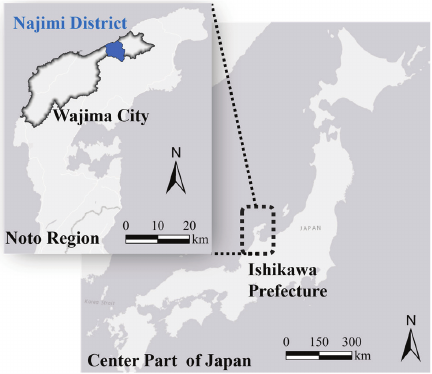
Fig. 1. Study area.
Source: Photograph by the author (July 1, 2024)
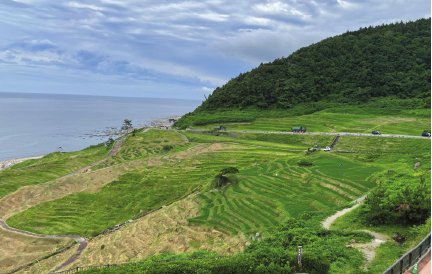
Fig. 2. “Shiroyone Senmaida” terraced rice fields in the Najimi District (37°25\('\)27\(''\)N, 136°59\('\)52\(''\)E).
The study area is the Najimi District in Wajima City, located in the northern part of the Noto Peninsula in Ishikawa Prefecture, which was severely affected by NE2024 (Fig. 1). “Shiroyone Senmaida,” a terraced rice field known for its spectacular landscape, is one of Japan’s most prominent tourist destinations. Before NE2024, it attracted many visitors annually (Fig. 2). This terraced field covers approximately 4 ha and comprises over 1,000 small rice paddies. It is a symbolic site associated with the Noto region’s GIAHS designation. Since NE2024, it has also served as a focal point in media coverage related to disaster impacts and recovery progress.
The Najimi District comprises 11 hamlets. Although the region had experienced ongoing depopulation, small-scale agriculture, forestry, and fisheries were still being practiced in each hamlet, adapted to the local topography.
These terraced rice fields are no longer owned or operated by individual farmers, as all the former landowners have retired from farming. Instead of relying on private land lease arrangements, the local government has systematically entrusted the management of the fields to a collective of motivated farmers. Most members of this farming collective live in the 11 hamlets of the Najimi District. These hamlets all suffered extensive damage in NE2024, resulting in many farmers losing their homes. In other words, the reconstruction of the terraced rice fields, which are a symbol of the Noto region’s recovery, involves restoring the agricultural land and rebuilding the local communities in the Najimi District, where many farmers lived 15.
According to the authors’ original field investigations, a divergence in perspectives emerged in the immediate aftermath of NE2024 between local authorities, who prioritized rapid emergency restoration using heavy machinery as a symbol of recovery, and local residents, who had traditionally reconstructed the terraced fields by hand and accepted natural landslides. Furthermore, many displaced farmers had not yet found new places to live, creating uncertainty about their ability to continue managing the terraced fields.
The authors recognized the confusion and hesitation among disaster-affected residents who were faced with multiple complex challenges and were uncertain about how to proceed with the recovery process. This marked the beginning of the study, with the authors deciding to collaborate with the affected communities.
4. The Process of Clinical Support
4.1. Methodological Framework and Procedures
Authors adopted a qualitative, participatory, and step-wise design to implement the principles of accompaniment, trust-building, and avoid research fatigue. Instead of administering questionnaires in the early stages, authors prioritized informal conversations, careful selection of face-to-face settings that did not impose burdens on the affected community, and participant observation.
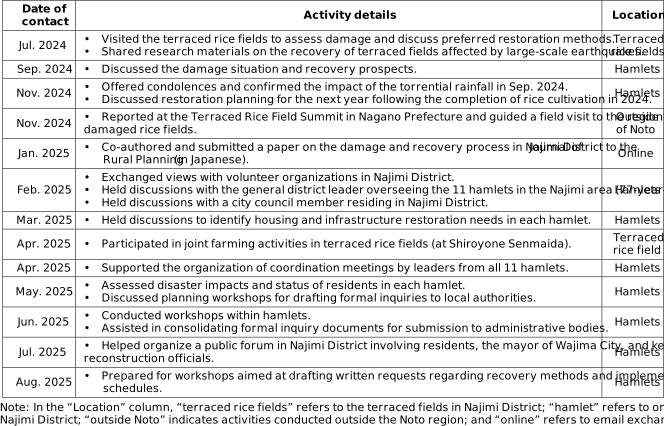
Between July 2024 and July 2025, the authors conducted at least 13 organized visits to the Najimi District. These dialogues revolved around themes such as “housing issues,” “continuity of agriculture,” and “expectations toward local government.” Detailed field notes were taken during each round of discussion with residents and subsequently shared in online meetings within the research team.
Table 1. Ongoing engagement between the disaster-affected community in the Najimi District and the authors.
Workshops were facilitated in three stages in eight hamlets that voluntarily participated: (i) free listing of damage situations, (ii) clustering of needs through methods such as the KJ technique and mind-mapping, and (iii) joint drafting of formal question and request documents addressed to the municipality. Facilitation placed particular emphasis on active listening, reflective paraphrasing, and language clarification to ensure that residents’ own words—rather than researchers’ intentions—were reflected in the outputs. The resulting documents were consolidated at the district level and submitted in advance of public dialogue with the Mayor of Wajima City.
This procedural design maintained our role as “companions” while generating a systematic set of steps—repeated visits, trust-building dialogues, hamlet-level workshops, and structured transmission of requests—that can inform future CRP applications in disaster-affected rural areas. This constitutes a generalizable approach developed under strong contextual constraints of local specificity.
This sequence is summarized in Table 1. The subsequent sections subdivide and elaborate on the series of CRP practices that authors conducted.
4.2. Ethical Considerations in the Approach
In previous large-scale disasters, researchers have documented instances of research fatigue caused by the excessive demands placed on disaster-affected individuals by researchers 16. From the outset of NE2024, the authors adopted a sensitive approach to support procedures that considered the needs and circumstances of the affected communities 17. Rather than initiating contact by requesting quantitative surveys or offering assistance, the authors first demonstrated their sincere commitment to understanding the damage to Najimi District. They sought to help disaster-affected residents cultivate a constructive and forward-looking mindset by presenting them with prior research materials.
They regularly visited the hamlets, prioritizing informal conversations over formal surveys to alleviate psychological stress and establish trust as researchers engaged in supportive collaboration.
In November 2024, the authors organized a visit to an area affected by similar challenges for residents impacted by NE2024. The aim of this visit was to encourage a more positive and proactive approach to recovery.
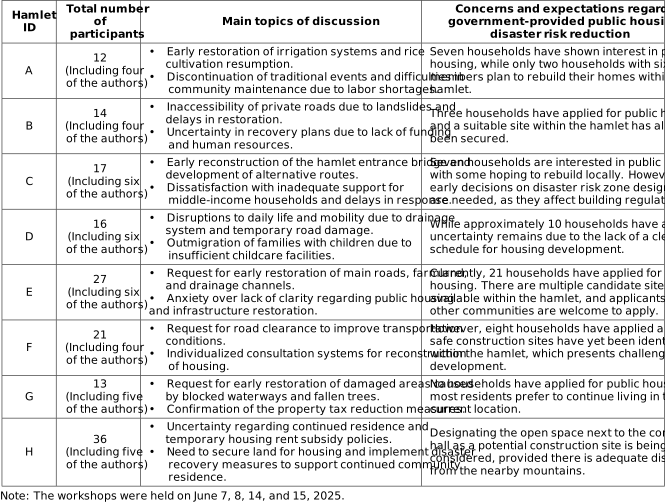
Table 2. Record of discussions in each hamlet.
4.3. Organization of Interdisciplinary Researchers
Initially, some of our authors collaborated voluntarily, making repeated visits to the disaster-affected area either individually or in groups. Through these visits, the participants gradually established mutual trust with the local community. As a result, community members began to share the various issues they were facing with the authors.
These issues were diverse and complex, requiring an interdisciplinary approach. Recognizing this, the authors formed an interdisciplinary research group.
While the authors are collectively engaged in rural planning, each member has foundational expertise in a different academic discipline, including agricultural economics, regional planning, agricultural engineering, disaster recovery policy, landscape ecology, architecture, environmental studies and education 18. The authors engaged in ongoing dialogue and collaboration with disaster-affected residents by leveraging their organizational capacity to identify more detailed and context-specific needs. The outcomes of these efforts were later introduced in a newsletter created by the residents themselves and distributed within disaster-affected communities living in temporary housing and related accommodations.
4.4. Support for the Preparation of Inquiry and Request Documents to Local Authorities
It became clear that there was a discrepancy between the housing reconstruction plans developed by local authorities, which were based on the principle of managing public assets over the long term under fiscal constraints, and the needs of residents in some of the 11 hamlets who wished to rebuild homes that would allow them to continue agricultural livelihoods. Moreover, discussions regarding residents’ preferences for housing reconstruction have not yet been initiated in many of the remaining hamlets.
Previous major disasters have shown that patterns of damage differ across hamlets. These cases demonstrate that appropriate approaches to housing reconstruction must be designed to suit the specific conditions of each community to avoid unresolved dissatisfaction or inconvenience 19.
The authors respected the governance structure established in Najimi District, whereby each hamlet is represented by a local leader who reports to a district-wide leader. Under this structure, local leaders convey the collective opinions of their hamlets to the general leader, who engages in dialogue with the administrative authorities. Rather than interfering with this existing decision-making mechanism, the authors adopted a supportive approach to assist the local leaders within each hamlet.
As shown in Table 2, opportunities for consensus-building were supported and facilitated in all eight hamlets willing to hold internal discussions by June 2025. In each hamlet, efforts were made to build consensus among disaster-affected residents regarding their recovery and reconstruction needs, and to articulate these in the form of questions and requests to local authorities. As a result, the total number of questions was 38.
Alongside this process, the authors engaged in discussions with administrative authorities as necessary, consistently clarifying that their aim was not to provoke confrontation between the government and the disaster-affected communities. Instead, the authors emphasized the importance of facilitating mutual understanding, avoiding conflict and finding reasonable, constructive solutions.
5. Preliminary Results
On July 12, 2025, the Mayor of Wajima City held a meeting with disaster-affected residents. The Mayor explained the municipality’s recovery and reconstruction policy and answered questions from the community (Fig. 3). A total of 120 residents participated in the meeting. The mayor personally responded to a list of questions and requests that had been compiled in advance by the authors based on input from the residents. In addition to the 38 pre-submitted questions, all 52 questions were answered, including the 14 raised by participants on the day.
At the beginning of the meeting, the leader of the Najimi District expressed gratitude to the research group for their work. This may be interpreted as an indication of the community’s recognition of the CRP applied in this case.
Given the incomplete mutual understanding previously observed between local authorities and the disaster-affected community through CRP, the mayor would not have been able to fully grasp the specific and nuanced concerns of the different hamlets without a concrete list of questions. The CRP’s behind-the-scenes approach can be considered to have made the public briefing more effective.
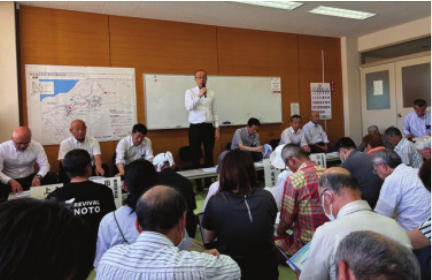
Source: Author’s own photograph (July 12, 2025)
Fig. 3. Public briefing by the Mayor of Wajima.
Although the details of the responses cannot be disclosed because the session was not public, several examples illustrate how the CRP outcomes were reflected in the discussion:
-
Some residents had misunderstood the prefectural notification regarding the duration of temporary housing occupancy; this was clarified and corrected.
-
The city presented new restrictions based on age, income, and family structure that had not been explained in detail in the earlier questionnaire survey on residential reconstruction (covering location, building type, and loan conditions).
-
It was explained that the restoration of public roads, rivers, and farmland would require enormous budgets and the mobilization of a large workforce, and completion could not be achieved within only a few years.
For example, the third point conveyed indispensable information for the livelihood recovery of affected residents, but it was not necessarily welcome news for them. Thus, although the authorities never intended to conceal such information, no concrete schedule would have been presented in an official forum without directly questioning the specific locations and repair targets. CRP-facilitated issue framing enabled concrete responses to be elicited during the time and opportunity constraints inherent in recovery project briefing sessions.
The next phase of support will involve clarifying residents’ requests more specifically based on the mayor’s responses to the previously submitted questions. The community alone is considered unable to undertake this task. Further engagement through the approach based on the CRP is anticipated.
6. Conclusion
Small hamlets with limited local governance experience are found throughout Japan. Therefore, the recovery process in the small communities of the Noto region offers valuable insights into disaster risk reduction in a country at high risk of large-scale disasters, including the anticipated Nankai Trough megathrust earthquake. The contributions of CRP to the recovery of the severely damaged Najimi District following NE2024 can be summarized as follows:
-
Encouraging disaster-affected residents to come together by hamlet and recognizing the need for discussions on recovery and facilitating such opportunities.
-
Supporting the articulation of recovery needs that the affected communities had previously been unable to express clearly.
-
Creating opportunities for shared dialogue between administrative authorities and disaster-affected communities.
As the residential status of individuals affected by the disaster in the Najimi District is gradually finalized, an increasing number of residents are expected to settle outside the district. It will therefore be necessary to develop and implement mechanisms that enable these individuals to sustainably manage farmland, community facilities and religious sites, such as shrines, in their original place of residence, even if they are living outside the district.
To achieve this, the restoration of infrastructure is essential, which necessitates negotiations with administrative authorities. In such negotiations, tensions may arise between government officials and the disaster-affected community. Researchers must also have a proper understanding of the policies for disaster victims and fiscal constraints of the government.
In recovery processes following large-scale disasters such as NE2024, the expertise required for CRP is highly diverse, and the authors acknowledge that current team composition requires further expansion. Therefore, further integration of new areas of expertise is assumed to be essential for establishing CRP’s academic identity.
Additionally, it is important to present disaster-affected communities with multiple scenarios regarding the content and timeline of recovery and reconstruction. Given the high degree of uncertainty in recovery efforts, not all residents’ expectations will be met. Supporting residents in making the best possible decisions under uncertain conditions, sustained involvement by researchers, and assistance with decision-making processes are essential.
In methodological terms, this study demonstrates that CRP is not a rigid protocol but a flexible, step-wise process adaptable to diverse rural contexts. These methods form a systematic framework for post-disaster recovery planning. While CRP emphasizes qualitative depth and local specificity, its structured process offers valuable guidance for future researchers and practitioners working in disaster-affected rural communities.
Acknowledgments
This study was supported by Ishikawa Prefecture, Ishikawa Prefectural University, the Hokuriku Regional Development Association, and The Association of Rural Planning (ARP). The authors would like to express their gratitude to Dr. Yoshihiro Kikuchi (Sendai National College of Technology), and Dr. Hideharu Kurita (NARO) for their valuable cooperation. Special thanks are also extended to Mr. Yuichi and Mrs. Makiko Shirao for their support in engaging with the affected community.
- [1] https://www.bousai.go.jp/updates/r60101notojishin/r60101notojishin/index.html [Accessed July 17, 2025]
- [2] https://www.pref.ishikawa.lg.jp/saigai/202401jishin-taisakuhonbu.html#kaiken [Accessed July 17, 2025]
- [3] R. Yamashita, “Current status and challenges in the recovery and revitalization of rural communities and agricultural management,” J. of Japanese Society Irrigation, Drainage and Rural Engineering, Vol.93, No.3, pp. 179-182, 2025 (in Japanese).
- [4] https://www.bosai.yomiuri.co.jp/biz-article/16014 [Accessed July 19, 2025]
- [5] https://rural-planning.jp/ [Accessed July 20, 2025]
- [6] Science Council of Japan, “New settlement areas and rural planning research,” Report of the Liaison Committee on Rural Planning Studies, 1997 (in Japanese). https://www.scj.go.jp/ja/info/kohyo/14/16-31.pdf
- [7] J. Diehl, K. Asahiro, Y. Hwang, T. Hirashima, L. Kong, Z. Wang, H. Yao, and P. Tan, “A CHANS approach to investigating post-disaster recovery potential in rural Japan,” J. Disaster Res., Vol.17, No.3, pp. 453-463, 2022. https://doi.org/10.20965/jdr.2022.p0453
- [8] M. Ishiwatari, M. Ohara, K. Razak, M. Inoue, X. Zheng, and R. Shaw, “Transdisciplinary approach: Toward innovative recovery and disaster risk reduction,” J. Disaster Res., Vol.19, No.3, pp. 534-538, 2024. https://doi.org/10.20965/jdr.2024.p0534
- [9] L. Wirth, “Clinical sociology,” Clinical Sociology Review, Vol.1, pp. 7-22, 1982.
- [10] J. A. Freedman, “Clinical sociology: What it is and what it isn’t – A perspective,” Clinical Sociology Review, Vol.1, pp. 34-49, 1982.
- [11] O. Sukmana, “The role of community social worker in participatory action research-based community empowerment process in Indonesia,” Int. J. of Social Sciences and Management Review, Vol.6, No.1, pp.259-275, 2023. https://doi.org/10.37602/IJSSMR.2022.6118
- [12] E. Porio, “Climate resilience initiative in Metro Manila: Participatory community risk assessment and power in community interventions,” J. M. Fritz (Eds.), “International Clinical Sociology,” pp. 257-276, Springer, 2020. https://doi.org/10.1007/978-3-030-54584-0_14
- [13] E. Porio, “Essentials of community intervention,” J. M. Fritz and J. Rhéaume (Eds.), “Community Intervention: Clinical Sociology Perspectives,” pp. 17-34, Springer, 2022. https://doi.org/10.1007/978-3-030-93695-2_2
- [14] J. Rhéaume, “Research for the community,” J. M. Fritz and J. Rhéaume (Eds.), “Community Intervention: Clinical Sociology Perspectives,” pp. 35-48, Springer, 2022. https://doi.org/10.1007/978-3-030-93695-2_3
- [15] Y. Uchikawa, “Characteristics of agricultural land and livelihood structure in the Noto region and direction of development toward reconstruction from the earthquake,” J. of Rural Planning, Vol.43, No.4, pp. 170-173, 2025 (in Japanese).
- [16] K. Honda, S. Abeysinghe, C. Leppold, A. L. Williams, A. Ozaki, and A. Goto, “Ethically researching health and disaster: Lessons from over a decade of research since the 3.11 disaster in Fukushima,” JMA J., Vol.7, No.2, pp. 279-281, 2024. https://doi.org/10.31662/jmaj.2023-0145
- [17] Y. Hara, K. Takeda, R. Yamashita, R. Saito, D. Sasaki, K. Hayashi, and T. Aoki, “The ‘fallacy of composition’ as an ethical challenge facing scientific research in disaster-affected areas: The 2024 Noto Peninsula Earthquake and Tsunami,” Int. J. of Disaster Risk Reduction, Vol.119, Article No.105359, 2025. https://doi.org/10.1016/j.ijdrr.2025.105359
- [18] https://sites.google.com/view/najilab/ [Accessed July 26, 2025]
- [19] J. Hirota, “Damage and reconstruction of village communities in the Great East Japan Earthquake and tsunami: Focusing the sustainability,” J. of Rural Planning, Vol.39, No.4, pp. 350-357, 2021 (in Japanese). https://doi.org/10.2750/arp.39.350
This article is published under a Creative Commons Attribution-NoDerivatives 4.0 Internationa License.