
Paper:
Depopulated Fishing Village Under the Prediction of a Nankai Trough Earthquake: Social Vulnerability and High Ground Relocation Planning in Taiki-cho, Mie Prefecture
Kenji Muroi†, Makoto Takahashi
 , and Keiichi Tadokoro
Nagoya University
Furo-cho, Chikusa-ku, Nagoya, Aichi 464-8601, Japan
†Corresponding author

Japan’s disaster prevention law focuses on hazard countermeasures, but not on vulnerability. However, fishing villages expected to suffer damage from a Nankai Trough earthquake have a markedly declining and aging population, and earthquake countermeasures must be considered from a sustainability perspective. Based on this idea, this study presents an interdisciplinary analysis of the current state of disaster risk reduction (DRR) in a depopulated fishing village, using the Nishiki district of Taiki-cho, Mie Prefecture as a case study. The chief findings are as follows. First, we verified that the advanced tsunami evacuation measures promoted by the town authorities in Taiki-cho since the 1990s would be effective even in the event of a “maximum-class” Nankai Trough earthquake. Second, a disconnect exists between such tsunami countermeasures and conventional community-based DRR. We revealed that the former DRR in Nishiki used to be linked to the livelihoods of the local community; however, external development dismantled this system, leading to a transition toward tsunami-specific measures led by the town authorities. Third, considering the background of extreme depopulation and aging in Nishiki in recent years, a plan was formulated to relocate elderly people to higher ground in advance. Based on an analysis of residents’ opinions of this plan, we examined the relationship between future DRR and the sustainability of local communities in depopulated fishing villages.
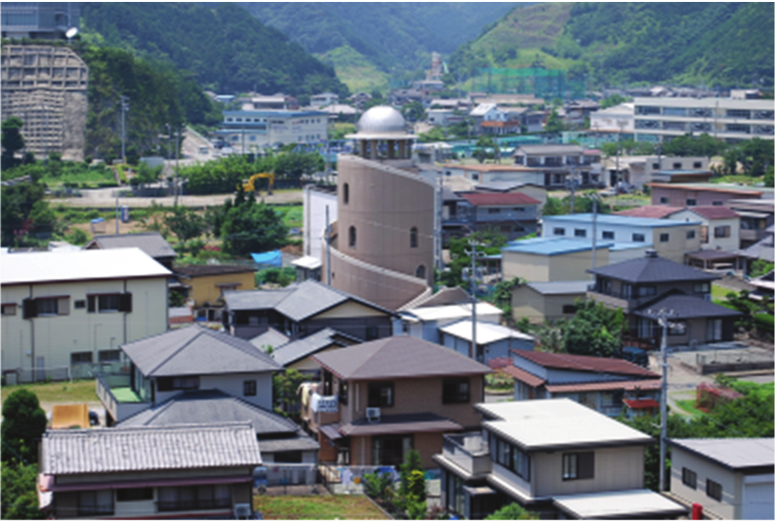
Nishiki Tower in Taiki-cho
- [1] O. Ikuta, “Disaster prevention law,” Shinzansha Publishing Co., Ltd., 2013 (in Japanese).
- [2] S. Sasaki, “Latest disaster prevention and recovery legislation,” Dai-Ichi Hoki Co., Ltd., 2017 (in Japanese).
- [3] D. Shiozaki and Y. Hashimoto, “System development for tsunami evacuation drill using ICT and tsunami inundation simulation data,” J. Disaster Res., Vol.19, No.1, pp. 72-80, 2024. https://doi.org/10.20965/jdr.2024.p0072
- [4] K. Yamori, “Open science for fostering seismologic science literacy,” J. Disaster Res., Vol.19, No.1, pp. 139-146, 2024. https://doi.org/10.20965/jdr.2024.p0139
- [5] H. Nakamichi, “Open-door events of the Sakurajima volcano observatory,” J. Disaster Res., Vol.19, No.1, pp. 147-153, 2024. https://doi.org/10.20965/jdr.2024.p0147
- [6] M. Takubo, M. Sugiura, R. Ishibashi, N. Miura, and A. Tanabe-Ishibashi, “How disaster prevention videos contribute to tsunami evacuation: Subjective motivation and risk-sensitive attitude in a simulation experiment,” J. Disaster Res., Vol.19, No.1, pp. 94-104, 2024. https://doi.org/10.20965/jdr.2024.p0094
- [7] M. Sawada and T. Sato, “The possibility of wide area evacuation in the event of natural disasters: A survey in Amagasaki City, Hyogo Prefecture,” J. Disaster Res., Vol.19, No.1, pp. 105-112, 2024. https://doi.org/10.20965/jdr.2024.p0105
- [8] W. Kurata, “Disaster resilient and welfare community,” Minerva Shobo Co., Ltd., 1999 (in Japanese).
- [9] E. L. Quarantelli, “Disasters theory and research,” SAGE Publications Ltd., 1978.
- [10] A. H. Barton, “Communities in disaster,” Doubleday and Company Inc., 1969.
- [11] K. Hewitt (Ed.), “Interpretations of calamity,” Allen and Unwin, 1983.
- [12] A. Oliver-Smith, “The martyred city,” University of New Mexico Press, 1986.
- [13] B. Wisner, P. Blaikie, T. Cannon, and I. Davis, “At risk: Natural hazards, people’s vulnerability and disasters,” Routledge, 2003.
- [14] A. Oliver-Smith, “Theorizing vulnerability in a globalized world: A political ecological perspective,” A. Oliver-Smith and S. M. Hoffmann (Eds.), “Catastrophe and culture: The anthropology of disaster,” School of American Research Press, 2002.
- [15] I. Burton, R. W. Kates, and G. F. White, “The environment as hazard (2nd edition),” Guilford Press, 1993.
- [16] S. Yoshihara, “Land problems in an era of declining population,” Chuokoron-Shinsha Inc., 2017 (in Japanese).
- [17] K. Igarashi, “Who owns the land?,” Iwanami Shoten, 2022 (in Japanese).
- [18] H. Masuda, “Disappearance of countryside,” Iwanami Shoten, 2014 (in Japanese).
- [19] Headquarters for Earthquake Research Promotion, “Long-term assessment of Nankai Trough seismic activity (Version 2),” 2013 (in Japanese).
- [20] S. Nakata, “Research on the history of disasters in fishing villages in Mie Prefecture, part 2: Ansei no Tsunami 2,” Umi to Ningen, Vol.19, pp. 1-127, 1991 (in Japanese).
- [21] S. Sekiguchi, “Big tsunami in Kumano: Tonankai earthquake just before the defeat of the war,” 1990 (in Japanese).
- [22] H. Sakaguchi, “Nishiki-cho journal: Re-issued,” Nishiki-cho Tourist Association, 1955 (in Japanese).
- [23] S. Nakata, “Research on the history of disasters in fishing villages in Mie Prefecture, part 1: Hoei no Tsunami,” Umi to Ningen, Vol.16, pp. 1-54, 1989 (in Japanese).
- [24] Mie Prefecture, “Mie Prefecture Earthquake Damage Assumption Survey in 2013,” 2014 (in Japanese).
- [25] T. Nakaseko, F. Kimata, S. Tanaka, and M. Takahashi, “Tsunami warning evacuation system in Nishiki of central Japan,” Proc. of Int. Conf. on Tsunami Warning, 2008.
- [26] F. Kimata and T. Nakaseko, “Onsite tsunami warning system in Nishiki, central Japan: Seismological background,” Proc. of Int. Conf. on Tsunami Warning, 2008.
- [27] M. Takahashi, S. Tanaka, F. Kimata, T. Nakaseko, and Suhirman, “Proposing the community-based tsunami warning system,” Proc. of Int. Conf. on Tsunami Warning, 2008.
- [28] Kisei-cho, “History of Kisei-cho: Record edition,” 2001 (in Japanese).
- [29] H. Kitamura, “Ashihama nuclear power plant now: 20 years history of Ashihama Nuclear Power Plant,” Gendai Shokan Co., Ltd., 1986 (in Japanese).
- [30] H. Kitamura, “The town that stopped the nuclear power plant: 37-year battle for the Ashihama Nuclear Power Plant in Mie,” Gendai Shokan Co., Ltd., 2011 (in Japanese).
- [31] Asahi Shimbun Tsu Branch, “The sea! 30 Years of Ashihama Nuclear Power Plant,” Fubaisha, Inc., 1994 (in Japanese).
- [32] T. Sato, “Development and application of pneumatic flow mixing method to reclamation for offshore airport,” Technical Note of the Port and Airport Research Institute, No.1076, pp. 1-81, 2004 (in Japanese).
- [33] Green Infrastructure Study Group (Ed.), “Green infrastructure: Implementation version,” Nikkei Business Publications, Inc., 2020 (in Japanese).
This article is published under a Creative Commons Attribution-NoDerivatives 4.0 Internationa License.