
Paper:
Neural Evaluation of Educational Videos: Potential Disadvantage of Combining Hazard-Mechanism Explanation and Evacuation Instruction Messages
Yuang Chen*1,*2, Kei Takahashi*1,*2, Azumi Tanabe-Ishibashi*2,*3, Naoki Miura*4
 , and Motoaki Sugiura*2,*5,†
*1School of Medicine, Tohoku University
2-1 Seiryo-machi, Aoba-ku, Sendai, Miyagi 980-0875, Japan
*2Institute of Development, Aging and Cancer, Tohoku University
Sendai, Japan
*3Faculty of Psychology, Shujitsu University
Okayama, Japan
*4Faculty of Engineering, Tohoku Institute of Technology
Sendai, Japan
*5International Research Institute of Disaster Science
Tohoku University, Sendai, Japan
†Corresponding author

This study examined the educational effectiveness of combining hazard-mechanism explanations and evacuation instructions in tsunami-related video messages, using both behavioral and neural measures. University students were assigned to one of four groups (mechanism, evacuation, combination, or control) and exposed to video materials while undergoing fMRI. The educational effect was assessed by changes in evacuation intent in a scenario-based decision-making task before and after video exposure. Results showed that all tsunami-related video groups had higher increases in evacuation intent than the control group, confirming that both mechanism and evacuation content were effective. However, the combined condition did not produce additional behavioral benefits. Neuroimaging analysis revealed diminished activation in five cortical regions related to self-referential processing (posterior cingulate cortex (PCC)), visual processing (lingual gyrus and inferior occipital gyrus), and auditory processing (bilateral superior temporal gurus) in the combination group compared to the evacuation-only group. Importantly, PCC activity was positively correlated with increased evacuation intent, suggesting its role as a neural index of educational effectiveness. These findings indicate that although hazard-mechanism and evacuation-instruction videos are individually effective, their combination may impose cognitive load that undermines self-referential processing and reduces neural engagement. Implications for the design of disaster education materials highlight the importance of balancing informational richness with cognitive processing demands to optimize preparedness outcomes.
1. Introduction
Explanations of the hazard mechanism and behavioral recommendations are often included in public disaster prevention communications to create an educational effect for disaster risk reduction. The educational effect of disaster educational materials has been demonstrated to enhance the theoretical disaster knowledge, which may extend to later practical skills 1. Regarding mechanism content, earthquake education research found that understanding the underlying science reduces emotional fear and supports emotionally detached reasoning about seismic events 2. Another study showed that deep comprehension of natural-phenomenon mechanisms enhances long-term conceptual risk models and facilitates schema activation during decision making 3. In the context of tsunami preparedness, mechanistic explanations have been shown to improve the accuracy of risk perception by reducing uncertainty 4. By contrast, behavioral recommendation content directly targets action by laying out step-by-step procedures. According to the COM-B behavior change framework—which identifies capability, opportunity, and motivation as prerequisites for any behavior—such recommendations increase self-efficacy by clarifying what people can do and what opportunities the environment affords 5. In crisis settings, precise behavioral instructions have been empirically linked to greater intention to evacuate after receiving a tsunami warning 6.
However, the effect of combining these two types of information on enhancing disaster preparedness remains unclear. The effect of combining different types of information to increase decision-making accuracy could be controversial. Previous research on information diversity indicated that higher diversity of information would result in lower accuracy and longer decision-making time, causing information overload 7, a mental state characterized by limited information search and retrieval strategies as well as suboptimal decisions 8.
The effect of combining different types of messages has been demonstrated in the field of health promotion. A previous study found that with the combination of behavioral recommendation and mechanism, additional concreteness of behavioral recommendation could further improve one’s self-efficacy 9, which is concerned with judgments of how well one can execute courses of action required to deal with prospective situations 10. Another study found that hybrid messages including both statistical and narrative descriptions of HPV (human papillomavirus) resulted in greater perceived risk than either one of them alone 11.
Health-promotion research has also examined the understanding of the neural process underlying the effect of advertisements and persuasive messages. Existing studies have commonly suggested the involvement of cortical midline structures (CMS), such as medial prefrontal cortex (mPFC) and PCC implicated in self-referential processing. For example, antidrug advertising research showed that the mPFC and amygdala were elicited when participants were exposed to strong anti-drug ads compared to ads unrelated to drugs, which represented a correlation between persuasive effect and emotional arousal as well as executive control 12. Another functional magnetic resonance imaging (fMRI) study found that tailored nutritional messages, compared to untailored ones, activate self-referential CmS regions, hippocampus, and angular gyrus, where activity predicts subsequent reductions in unhealthy eating behavior 13. A study on tobacco prevention messages concluded that activation in self-referential CmS and social processing regions during announcement exposure is associated with perceived effectiveness 14.
For natural disasters, however, the effect of combining hazard-mechanism explanations and response instructions has been poorly understood at both the behavioral or neural levels. A previous experimental study has demonstrated the effect of a set of videos combining these information types for earthquakes and tsunamis, but the effect of combination has not been examined 15. Eye-tracking research showed that 3D visual effects in disaster risk communication increase cognitive load, as indicated by more fixations and shorter fixation durations, which are linked to reduced knowledge retention 16. Yet, there is no existing study that directly investigates the neural mechanisms underlying the disaster communication’s educational effect.
In this paper, we aimed to understand the effects of combining hazard-mechanism explanations and response instructions on preparedness for natural disasters by testing behavioral changes after video viewing and exploring neural correlates during viewing. We presented university students with videos conveying one of these two types of messages in the context of earthquake–tsunami disaster-risk reduction. We compared the educational effect of the videos between the group who saw either type of video alone and those who saw both types of videos. The educational effect was evaluated at the behavioral level using a scenario-based evacuation decision-making task and at the neural level using fMRI. Our analysis was non-directional with respect to the relative effectiveness of the two video types, while at the neural level we expected higher involvement of self-referential CmS for a more effective condition.
In addition to examining the behavioral and neural effects of combining mechanism explanations and evacuation instructions, it is also important to consider the cognitive characteristics of each message type. Understanding an earthquake-induced tsunami mechanism requires spatial reasoning and the integration of geographical structural knowledge. Prior research indicates that such spatial-geophysical comprehension relies on medial temporal and posterior parietal systems, including the parahippocampal region, posterior cingulate cortex (PCC), and superior parietal lobule (SPL) 17,18. In contrast, interpreting the necessity of evacuation behavior involves crisis-management reasoning in ambiguous social contexts, drawing on CmS associated with evaluative decision making as well as temporal-parietal regions essential for social cognition 19,20,21. Considering these theoretically grounded differences, the present study additionally analyzed neural responses to mechanism-only and evacuation-only tsunami videos using standard whole-brain voxel-wise analysis. These analyses provide a reference framework for interpreting the neural processes engaged by each message type and for understanding how combining them may alter the processing patterns elicited by single-message content. We expected that the neural pattern between the two types of videos would show share areas, like the CmS, while each type would also present unique brain regions, aligning with previous research.
2. Methods
2.1. Participants
62 undergraduate and graduate students (25 female, 37 male, mean age SD = \(20.9 \pm 2.0\)years) were recruited via email and pseudo-randomly assigned into four groups. (See Sections 2.3 and 3.1 for details). None of the participants had any history of mental disorders. Written informed consent was obtained from all participants prior to their participation. This study was approved by the ethics committee of the Smart Aging Research Center, Tohoku University, Japan (approval number: 2407-01).
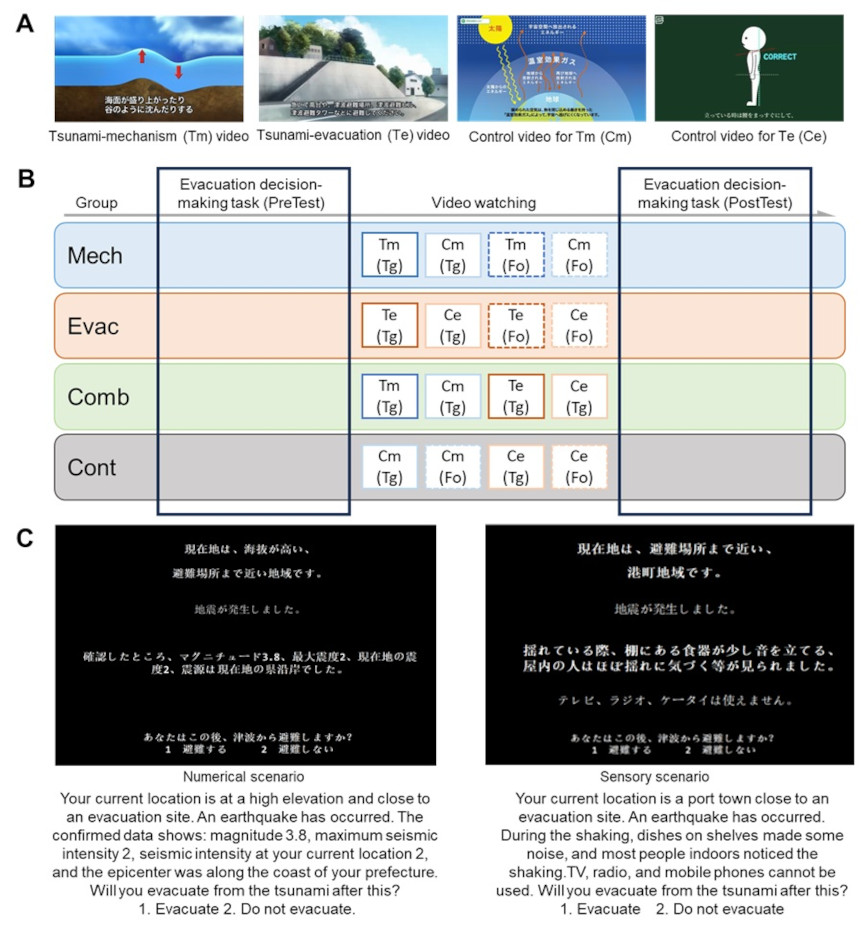
Fig. 1. Experimental design. (A) Video types: example of each video type. (B) Groups and procedures: mechanism group (Mech) viewed 8 Tm and 8 Cm videos; evacuation group (Evac) viewed 8 Te and 8 Ce videos; combination group (Comb) viewed 4 Tm, 4Te, 4 Cm, and 4 Ce videos; and control group (Cont) viewed 8 Cm and 8 Ce videos during the fMRI scanning. Each video set for Mech, Evac, and Cont groups composed of 4 shared videos with that for Comb group (i.e., for the target of comparison (Tg)) and 4 as foils (Fo; to control the number of videos across groups). Each participant conducted the earthquake–tsunami evacuation decision-making task twice, once before (PreTest) and again after (PostTest) watching the video. (C) Earthquake-tsunami evacuation decision-making task. Example scenarios (one on the left for “numerical” and another on the right for “sensory” scenario) are given. Each participant made evacuate-or-no decision on each of 40 scenarios (20 sensory and 20 numerical) at each session of PreTest and PostTest. The increased number of choosing to evacuate from PreTest to the PostTest was used as an index of Increased Evacuation Intent. See all the scenarios (in English) in Table 4 of ref 22.
2.2. Videos
Four types of videos (Fig. 1(A)) were prepared by extracting relevant parts of publicly available (i.e., YouTube) videos with a length of 25–62 s. We prepared two types of tsunami-related videos tsunami-mechanism videos (Tm), such as explaining how a tsunami occurs, tsunami speed, and tsunami height, as well as tsunami-evacuation videos (Te), such as explaining where to evacuate when a tsunami occurs, how to use a hazard map, and the meanings of evacuation signs. The former were dedicated to hazard-mechanism explanation, and the latter to response instruction. We also prepared corresponding tsunami-unrelated videos controlling for the perceptual characteristics and message types: control-mechanism videos (Cm) included explanations about global warming, mechanism of vision, causes of low back pain, etc., as well as control-evacuation videos (Ce) including instructions on how to reduce global warming, myopia recovery training, how to stretch the body, etc.
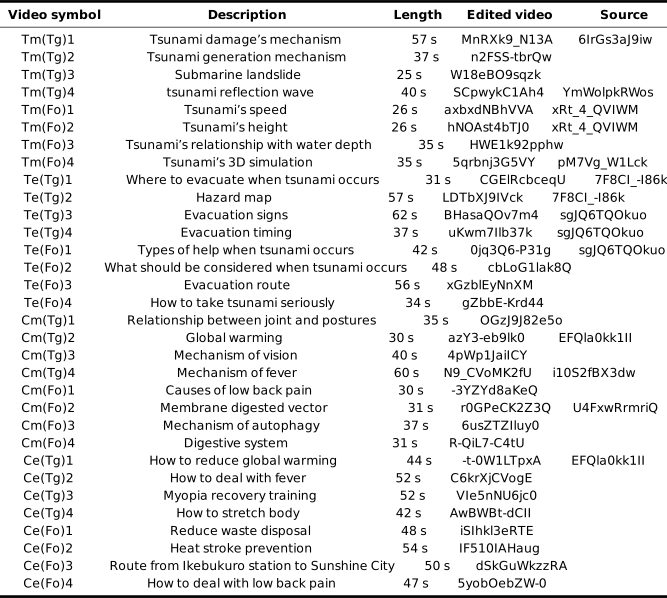
For each video type, 8 videos were prepared (Table 3 in the Appendix); 4 videos were used as targets (Tg) for the comparison of neural activity between groups, and another 4 were as foils (Fo) to control the number of videos across groups.
2.3. Groups and Procedures
Participants were pseudo-randomly assigned to four groups (Fig. 1(B)). 16 participants were assigned to the Mech group, who viewed 8 Tm and 8 Cm (i.e., 4 Tm(Tg), 4 Tm(Fo), 4 Cm(Tg), 4 Cm(Fo)) videos, 15 to the Evac group, who viewed 8 Te and 8 Ce (i.e., 4 Te(Tg), 4 Te(Fo), 4 Ce(Tg), 4 Ce(Fo)) videos, 16 to the Comb group, who viewed 4 Tm(Tg), 4 Te(Tg), 4 Cm(Tg), and 4 Ce(Tg) videos, and 15 to the Cont group, who viewed 8 Cm and 8 Ce (i.e., 4 Cm(Tg), 4 Cm(Fo), 4 Ce(Tg), 4 Ce(Fo)) videos. For the Mech, Evac, and Comb groups, tsunami videos and control videos were presented alternately with a 23–28 s interstimulus interval featuring a black screen with a Central white fixation cross between each video. The orders of the tsunami video sequence and the control video sequence were random. For the Cont group, Cm and Ce videos were presented alternately. The orders of the Cm video sequence and the Ce video sequence were also random.
During video watching, each participant was lying supine on the bed of the MRI scanner and stimuli were presented though a liquid-crystal display monitor via a mirror attached to a head coil. Each participant performed the decision-making task by pressing one of two buttons (Evacuate / Do not evacuate) of an MRI-compatible response device (Current Designs, Philadelphia, PA, United States) with the first and second fingers of their right hand. The assignment of the fingers to the buttons was counterbalanced across participants. The participant’s head was supported bilaterally by a cushion to reduce head movement, and instructed not to move their body throughout the experiment, except for the assigned finger. All trials were created, controlled, and recorded using the E-Prime 3.0 software (Psychology Software Tools, Inc., Pittsburgh, PA, United States).
2.4. Evacuation Decision-Making Task
The educational effects of the videos were evaluated using an earthquake–tsunami scenario-based evacuation decision-making task. Each participant conducted the task twice, once before (PreTest), and again after (PostTest) watching the video. The decision-making task consisted of 40 tsunami scenario lasting 7 seconds each. Scenarios described a situation in which the particscenario-basedipant, traveling to an unfamiliar place alone experienced the earthquake with various intensities, at locations with various vulnerabilities to tsunamis. Half of the earthquake intensity of the scenarios was given as a description of sensory experiences (sensory scenario) and scientific data (numerical scenario) in the other half (Fig. 1(C)). Scenarios were presented in the same pseudo-random order both in the PreTest and PostTest. Each participant made an evacuate-or-no decision on each scenario, and the number of evacuations was separately calculated for PreTest and PostTest. The increase in the evacuation rate was used as an index of educational effect. Additionally, 20 control scenarios were included for participants to press a predetermined button (e.g., “Please press ‘Yes’”) for an attention check. All the scenarios were prepared and validated previously 15.
2.5. fMRI Measurement
All MRI data were collected using a 3-T MRI scanner (Achieva dStream 3.0T, Philips Medical Systems, Best, Netherlands). To obtain functional images of blood oxygenation level-dependent T2*-weighted MR signals, 40 trans axial images covering the entire brain were obtained using a gradient echo-planar imaging (EPI) sequence [repetition time (TR) = 2500 ms; echo time (TE) = 30 ms; slice thickness= 3 mm; gap = 0 mm; flip angle (FA) = 85°; field of view (FOV) = 192 mm\(^{2}\); and scan matrix = \(64 \times 64\)]. High-resolution T1-weighted structural MR images were also obtained from each participant.
2.6. Analysis
2.6.1. Educational Effects
To compare the educational effects of the videos across four groups, one-way analysis of variance (ANOVA) was conducted on the Pre-Post increase of the evacuation rate in the earthquake–tsunami evacuation decision-making task. We expected to see a significant positive effect of tsunami-related videos (i.e., Mech, Evac, Comb \(>\) Cont) as well as significant positive or negative effect of combination (i.e., Mech vs. Comb, Evac vs. Comb). Tukey’s HSD was used for the post-hoc comparisons.
2.6.2. fMRI: Preprocessing
All functional images were analyzed using the Statistical Parametric Mapping software (SPM 12; Wellcome Department of Cognitive Neurology, London, UK) implemented in the MATLAB R2024b environment (MathWorks Inc., Natick, MA, United States). All analyses were performed using the Montréal Neurological Institute (MNI) space. For pre-processing, head motion along the time-series EPI images was estimated and all images were realigned. Scanning time lags across the slices were corrected using a time series interpolation. The EPI images were spatially normalized to the MNI space using parameters estimated using the MNI-T1 template and structural T1 image of each participant, which were co-registered to the EPI image beforehand; a segmentation procedure was adopted to normalize the T1 image. Finally, all normalized EPI images were smoothed using a Gaussian kernel with a full width at half maximum of 8 mm.
2.6.3. fMRI: Estimation of Condition-Specific Activation
A conventional two-level approach was applied to the multi-subject fMRI dataset for statistical analysis. At the first level, condition-specific hemodynamic responses were estimated at each voxel for each participant in a general linear model (GLM) framework. For each group, the responses during the video watching were separately modeled for four video types. The six estimated head motion parameters were included to remove any artifacts caused by head motion. A high-pass filter (128 s cut-off) was adopted to remove low-frequency noise.
2.6.4. fMRI: Effect of Single Video-Type and Comparison Between Mech and Evac
To characterize the neural responses elicited by mechanism-only and evacuation-only tsunami videos, second-level whole-brain analyses were conducted. First, one-sample \(t\)-tests were performed separately for the Mech (\(\mathrm{Tm}(\mathrm{Tg}+\mathrm{Fo}) - \mathrm{Cm}(\mathrm{Tg}+\mathrm{Fo})\)) and Evac groups (\(\mathrm{Te}(\mathrm{Tg}+\mathrm{Fo}) - \mathrm{Ce}(\mathrm{Tg}+\mathrm{Fo})\)) to identify brain regions activated by each single video-type condition relative to its corresponding control videos. Next, to directly compare the neural processing of mechanism and evacuation videos, two-sample \(t\)-tests were conducted, testing Mech \(>\) Evac (\(\mathrm{Tm}(\mathrm{Tg}+\mathrm{Fo}) - \mathrm{Cm}(\mathrm{Tg}+\mathrm{Fo}) > \mathrm{Te}(\mathrm{Tg}+\mathrm{Fo}) - \mathrm{Ce}(\mathrm{Tg}+\mathrm{Fo})\)) and Evac \(>\) Mech (\(\mathrm{Te}(\mathrm{Tg}+\mathrm{Fo}) - \mathrm{Ce}(\mathrm{Tg}+\mathrm{Fo}) > \mathrm{Tm}(\mathrm{Tg}+\mathrm{Fo}) - \mathrm{Cm}(\mathrm{Tg}+\mathrm{Fo})\)). The statistical threshold for the voxel-wise analysis was \(p < 0.001\) (uncorrected) for the cluster formation, and corrected to \(p < 0.05\) (family-wise error) using cluster size assuming the entire brain as the search volume.
2.6.5. fMRI: Effect of Video-Type Combination
At the second level, between-subject statistical inferences were made for the contrasts of estimated condition-specific hemodynamic responses. To examine the effect of combining two video types on neural response to specific video type, relevant group comparisons (two-sample \(t\)-test) of differential activation (tsunami video–control video) were performed. That is, to test the positive effect of combination on Tm videos, group comparison of Comb \(>\) Mech on the contrast \(\mathrm{Tm}(\mathrm{Tg}) - \mathrm{Cm}(\mathrm{Tg})\) was made based on identical mechanism and control videos between Mech and Comb groups; a reverse group comparison was made for the negative effect. Similar comparisons were made between Comb and Evac on the contrast \(\mathrm{Te}(\mathrm{Tg}) - \mathrm{Ce}(\mathrm{Tg})\) based on identical evacuation and control videos between Evac and Comb groups. The statistical threshold for the voxel-wise analysis was \(p < 0.001\) (uncorrected) for the cluster formation, and corrected to \(p < 0.05\) (family-wise error) using cluster size assuming the entire brain as the search volume.
2.6.6. fMRI: Correlation with the Educational Effect
When significant effect of video-type combination on neural response was identified, we examined if it is related to the educational effect, as a post-hoc region of interest (ROI) analysis. To this end, we constructed the multiple regression model including the individual educational effect as the explanatory variable, and contrasted activation for specific video type as the dependent variable. The data from the two relevant groups were pooled, and the group effect was entered as a dummy variable. Each peak voxel of the cluster was used as a ROI and \(p < 0.05\) (uncorrected) was applied.
3. Result
3.1. Sample Selection
For educational effect analysis, 17 (Mech = 4; Evac = 4; Comb = 6; Cont = 3) participants were excluded due to poor performance (accuracy \(<\) 70%) 23,24 in the control scenarios of the decision-making task. Thus, the final sample used for the decision-making analysis comprised of 45 participants (16 female, 29 male, \(20.9 \pm 2.0\) years): 12 in the Mech group (4 female, 8 male, \(20.4 \pm 1.8\) years), 11 in the Evac group (5 female, 6 male, \(21.3 \pm 2.6\) years), 10 in the Comb group (3 female, 7 male, \(21.5 \pm 2.0\) years), and 12 in the Cont group (4 female, 8 male, \(20.9 \pm 2.1\) years). For the fMRI analysis (except the correlation analysis), one participant was excluded because of failure to obtain T1 image, and another was excluded because of a scanning length error during fMRI scanning. The final sample used for fMRI analysis comprised 60 participants (24 female, 36 male, \(21.0 \pm 2.0\) years): 16 in the Mech group (6 female, 10 male, \(20.4 \pm 1.7\) years), 14 in the Evac group (8 female, 6 male, \(20.9 \pm 2.4\) years), 15 in the Comb (6 female, 9 male, \(21.6 \pm 1.9\) years), and 15 in the Cont group (4 female, 11 male, \(21.0 \pm 2.1\) years). For the correlation analysis, the samples eligible for the educational-effect analysis were used; the loss of T1 image of one participant made the sample size of Evac group 10 (5 female, 5 males, \(21.7 \pm 2.5\) years).
3.2. Educational Effect
Figure 2 shows the increased evacuation rate in four groups. The one-way ANOVA revealed a significant main effect of group on increased evacuation intention (\(F(3, 41) = 3.21\), \(p = 0.033\), \(\eta^2 = 0.19\)). Tukey’s HSD post-hoc tests indicated that the Evac group showed a greater increase than the Cont group (\(p = 0.030\)), whereas all other contrasts were non-significant (\(p\)s \(\ge 0.13\)).
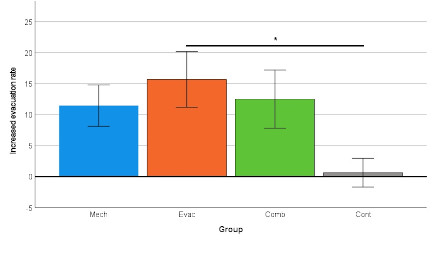
Fig. 2. Educational effect between four groups. The average increase (i.e., from PreTest to PostTest) in evacuation rate [%] is given for each group. Error bars indicate the standard error (\(^*\): \(p < 0.05\), \(^{**}\): \(p < 0.01\))
3.3. Effect of Single Video-Type
In the one-sample \(t\)-test analysis of brain activity during Tm videos, significant activation was observed in the left and right superior parietal lobules (LSPL and RSPL), parahippocampal gyrus (PHG) and PCC (Table 1, Fig. 3(A)). In contrast, the one-sample \(t\)-test for Te videos revealed robust activation in the left and right lingual gyrus (LLG and RLG), left and right superior temporal gyrus (LSTG and RSTG), and PCC (Table 1, Fig. 3(C)). In the two-sample \(t\)-test, the Mech \(>\) Evac contrast showed significantly greater activation in regions including the SPL and inferior temporal gyrus (ITG) (Table 1, Fig. 3(B)). The Evac \(>\) Mech contrast showed significantly greater activation in regions including PCC, LSTG and RSTG (Table 1, Fig. 3(D)).
Table 1. Neural response to tsunami-evacuation videos of Mech and Evac groups.
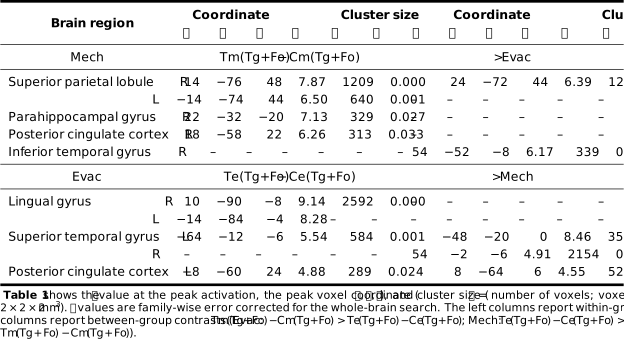
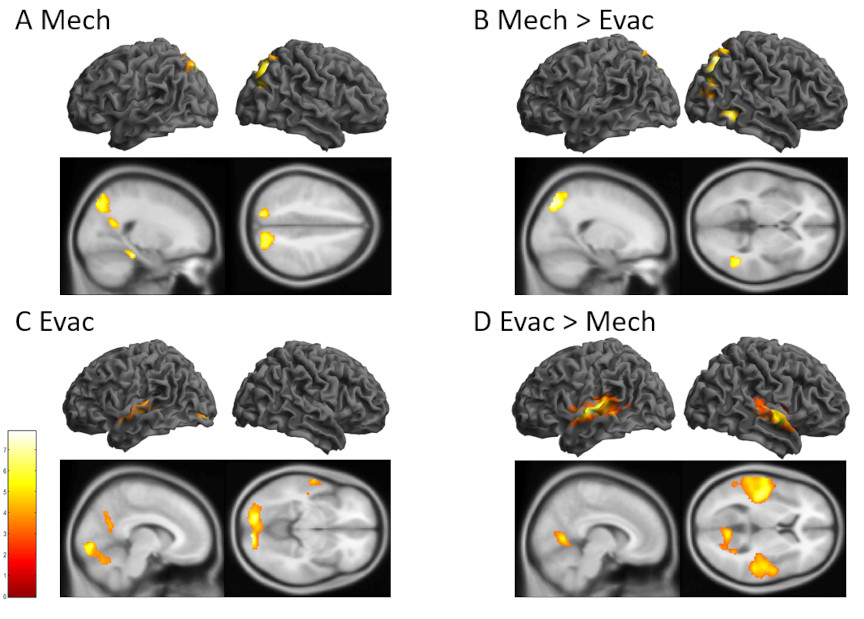
Fig. 3. Neural response to tsunami-evacuation videos of Mech and Evac groups. Differential activations \(\mathrm{Tm}(\mathrm{Tg}+\mathrm{Fo}) - \mathrm{Cm}(\mathrm{Tg}+\mathrm{Fo})\), \(\mathrm{Te}(\mathrm{Tg}+\mathrm{Fo}) - \mathrm{Ce}(\mathrm{Tg}+\mathrm{Fo})\) and their comparison are shown. Activated areas are given in a yellow-red color scale superimposed on a standard T1 anatomical section or rendering image provided by SPM12. (A) Activated brain regions of Mech group (\(\mathrm{Tm}(\mathrm{Tg}+\mathrm{Fo}) - \mathrm{Cm}(\mathrm{Tg}+\mathrm{Fo})\)). (B) Activated brain regions for comparison Mech \(>\) Evac (\(\mathrm{Tm}(\mathrm{Tg}+\mathrm{Fo}) - \mathrm{Cm}(\mathrm{Tg}+\mathrm{Fo}) > \mathrm{Te}(\mathrm{Tg}+\mathrm{Fo}) - \mathrm{Ce}(\mathrm{Tg}+\mathrm{Fo})\)). (C) Activated brain regions of Evac group (\(\mathrm{Te}(\mathrm{Tg}+\mathrm{Fo}) - \mathrm{Ce}(\mathrm{Tg}+\mathrm{Fo})\)). (D) Activated brain regions for comparison Evac \(>\) Mech (\(\mathrm{Te}(\mathrm{Tg}+\mathrm{Fo}) - \mathrm{Ce}(\mathrm{Tg}+\mathrm{Fo}) > \mathrm{Tm}(\mathrm{Tg}+\mathrm{Fo}) - \mathrm{Cm}(\mathrm{Tg}+\mathrm{Fo})\)).
3.4. Effect of Video-Type Combination
In the two-sample \(t\)-test analysis of brain activity during the video-watching. A negative effect of the combination on Te videos (group comparison of Evac \(>\) Comb on the contrast \(\mathrm{Te}(\mathrm{Tg}) - \mathrm{Ce}(\mathrm{Tg})\)) was significant in LSTG and RSTG, RLG, PCC, and inferior occipital gyrus (IOG). No significant positive or negative effect of combination on Tm movies (group comparison between Mech and Comb on the contrast \(\mathrm{Tm}(\mathrm{Tg}) - \mathrm{Cm}(\mathrm{Tg})\)) were obtained (Table 2, Fig. 4).
3.5. Correlation with the Educational Effect
Since a significant negative effect of video-type combination on neural response was identified for the Te movies, we examined if this is related to the educational effect, as a pot-hoc ROI analysis, pooling the data from Evac and Comb groups. Significant positive effect of the educational effect was identified for the PCC (standardized \(\beta = 0.20\), \(t(17) = 2.52\), \(p = 0.01\); Fig. 5). The effect was not significant for the other four regions: LSTG (\(\beta = 0.23\), \(t(17) = 0.25\), \(p = 0.40\)), RSTG (\(\beta = 0.20\), \(t(17) = 0.21\), \(p = 0.40\)), RLG (\(\beta = 37\), \(t(17) = 0.82\), \(p = 0.21\)), and IOG (\(\beta = 0.58\), \(t(17) = 0.28\), \(p = 0.39\)).
Table 2. Diminished neural response to tsunami-evacuation videos by combined presentation.
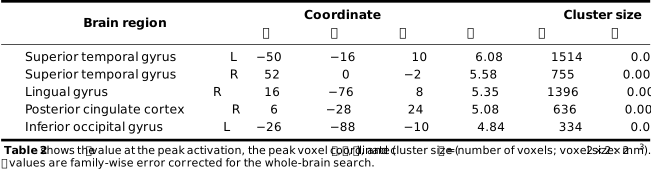
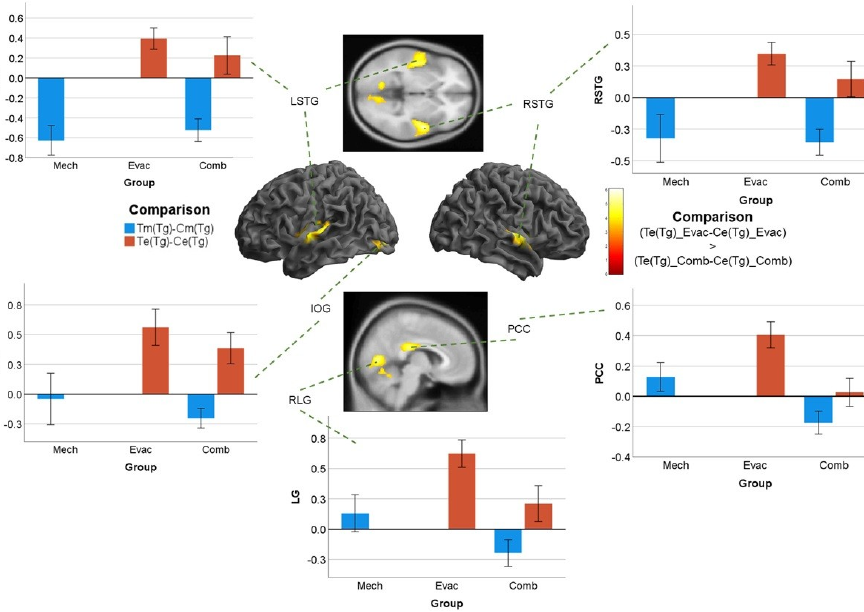
Fig. 4. Diminished neural response to tsunami-evacuation videos by combined presentation. Differential activation (\(\left(\mathrm{Te}(\mathrm{Tg})_{\mathrm{Evac}} - \mathrm{Ce}(\mathrm{Tg})_{\mathrm{Evac}}\right) > \left(\mathrm{Te}(\mathrm{Tg})_{\mathrm{Comb}} - \mathrm{Ce}(\mathrm{Tg})_{\mathrm{Comb}}\right)\)) is shown. Activated areas are given in a yellow-red color scale superimposed on a standard T1 anatomical section or rendering image provided by SPM12. Activation profile shows the estimated activation \(\mathrm{Tm}(\mathrm{Tg}) - \mathrm{Cm}(\mathrm{Tg})\) and \(\mathrm{Te}(\mathrm{Tg}) - \mathrm{Ce}(\mathrm{Tg})\) at each peak voxel for Mech, Evac, and Comb groups (LSTG: left-superior temporal gyrus, RSTG: right-superior temporal gyrus, RLG: lingual gyrus, PCC: posterior cingulate cortex, IOG: inferior occipital gyrus). Error bars indicate the standard error.
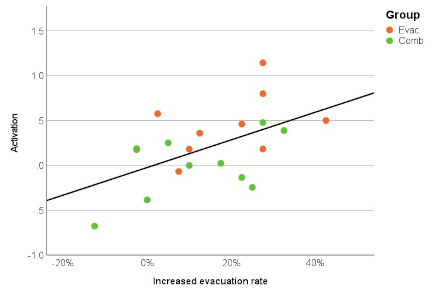
Fig. 5. Correlation with the educational effect. Scatter plot showing the relationship between increased evacuation rate and neural activation at PCC. Each point represents one participant, color-coded by group: Evac (orange) and Comb (green). The black line represents the overall linear fit across all participants.
4. Discussion
The present study investigated the educational effectiveness of combining hazard-mechanism explanations and evacuation instructions in tsunami-related video messages, evaluating both behavioral outcomes and neural correlates. In educational effect analysis, the increases in evacuation rate showed an overall group difference, with a significant difference between the Evac and Cont groups, confirming that the tsunami evacuation instruction videos have an educational effect. However, this effect was not significantly different across other comparisons. The neuroimaging analyses revealed reduced neural activity in five cortical regions, including the PCC, which is part of the self-referential CmS, during tsunami-evacuation video watching in the combination group compared to the evacuation-only group. Furthermore, PCC activity was positively correlated with the increase in evacuation intent, suggesting its relevance to the processing of effective disaster communication. In addition to these findings, supplementary analyses of single-message videos demonstrated that mechanism-only (Tm) and evacuation-only (Te) content elicited partially overlapping but distinguishable neural patterns. The mechanism videos recruited LSPL, RSPL, PHG, and PCC, whereas the evacuation videos produced robust activation in the LLG, RLG, LSTG, RSTG, and PCC. Direct comparison between the two message types showed that the Mech \(>\) Evac contrast yielded stronger activation in parietal and inferior temporal regions, while the Evac \(>\) Mech contrast exhibited stronger activation in PCC and bilateral superior temporal regions.
Previous neuroimaging studies on persuasive communication, decision making, and memory have consistently highlighted the role of the PCC as part of the CmS involved in self-referential, value-based processing, and episodic memory 25,26. For example, research on smoking Cessation demonstrated a greater engage of PCC in high-tailored smoking Cessation messages 27. In line with these findings, the present study also found that PCC activation was positively correlated with increases in evacuation intent, suggesting that PCC activity may serve as a neural index of the educational effect in disaster communication.
However, the combination of disaster mechanism and evacuation information led to reduced PCC activation compared with evacuation-only messages. This diminished response implies that presenting both content types together may have diluted the self-referential processing supported by the PCC, thereby undermining the educational effect at the neural level. This contrasts with prior findings in health promotion, where hybrid messages enhanced perceived risk 11. One plausible explanation for this disruption is that mechanism and evacuation messages place demands on partially different cognitive operations–conceptual spatial reasoning versus procedural action planning. When presented simultaneously, these heterogeneous information types may require parallel allocation of attentional and interpretive resources, thereby reducing the depth of self-referential processing normally associated with evacuation content. Importantly, this interpretation should not be understood as evidence of cognitive overload in a strict sense, but rather as a hypothesis consistent with longstanding findings in educational communication research, which note that mixing heterogeneous forms of information can sometimes diminish the effectiveness of each component 28,29.
In addition to PCC, diminished neural responses were observed in regions such as the bilateral superior temporal gyrus (STG), right lingual gyrus (RLG), and inferior occipital gyrus (IOG). The STG is implicated in auditory comprehension 30 and insight-based problem solving 31. One previous study found that the STG is sensitive to surprisal during story comprehension 32. The LG is related to visual processing 33 and non-moral emotional arousal 34. Similarly, the IOG is also correlated with emotion regulation 35 and visual recognition 36. Taken together, one possible interpretation is that the combined presentation may have overloaded or fragmented participants’ cognitive and emotional engagement, weakening the clarity or salience of evacuation-related cues. Like these results, additional fMRI results under the Evac \(>\) Mech comparison also showed greater activity in the PCC and bilateral STG, which align with theoretical accounts suggesting that understanding the need for evacuation involves evaluative decision-making processes supported by cortical midline structures as well as temporal–parietal regions involved in the social-contextual interpretation of risk. The presence of PCC and superior temporal activation during evacuation videos therefore reflects the cognitive demands of understanding evacuation necessity 19,20,21.
The mechanism-only videos elicited activation in regions linked to spatial reasoning and geophysical understanding, including the SPL, PHG, and PCC, consistent with prior research showing that comprehension of natural-hazard mechanisms relies on medial temporal–parietal systems 17,18. However, the ITG, as an unanticipated region, appeared in the results and retained activity in the Mech \(>\) Evac contrast, in contrast to the LSPL, PHG, and PCC, which lost activity. This could be because the stimulus material for this experiment was not fully controlled; thus, these results should be treated with caution.
From a practical perspective, the findings caution against the assumption that more information necessarily improves preparedness outcomes. While combining content types may seem beneficial, it may inadvertently attenuate the neural and psychological mechanisms that promote behavior change 7,8. Disaster educators and communicators should consider message specificity and cognitive load when designing instructional materials, especially under time-constrained or emotionally charged scenarios.
Although the omnibus ANOVA indicated a significant overall group effect, the limited sample size substantially reduces statistical sensitivity, and only the contrast between the Evac and Cont groups reached significance under Tukey correction. The absence of significance for other comparisons—particularly the Mech and Comb groups—should therefore be interpreted as a possible consequence of insufficient power rather than evidence of no educational effect. Given these considerations, the behavioral findings should be treated with caution.
Regarding the neural results, it is important to clarify that behavioral measures index the educational effect, whereas the fMRI contrasts capture neural responses to different types of video content. A positive association between PCC activation and evacuation intention specifically in the conditions that contained evacuation-instruction content was observed, suggesting that PCC engagement may serve as a neural marker of educational processing. The Evac condition produced relatively stronger PCC responses, whereas the Comb condition showed weaker responses, even though both conditions contributed to the correlation pattern. This difference does not imply separate analyses or isolated mechanisms across subgroups. Instead, it indicates that variations in message composition may influence the degree of self-referential engagement during learning, which in turn relates to subsequent preparedness behavior. Also, this differentiation highlights the potential advantage of incorporating neuroimaging measures to evaluate the effectiveness of disaster education materials, especially when behavioral outcomes alone may not fully capture underlying cognitive processing differences 37,38.
Nonetheless, several limitations should be noted. Most importantly, the final sample size after applying the attention-task exclusion criterion remains modest for a between-group behavioral and fMRI design. The reduced sample size inevitably limits statistical power and increases the risk of Type II errors. Consequently, the absence of significant differences between some conditions—particularly the Mech and Comb groups—should be interpreted with caution. Moreover, the small sample may restrict the generalizability and stability of both behavioral effects and neural activation patterns. The simulation nature of the decision-making task may also limit the generalizability of results to real-world evacuation behavior. Additionally, although our factorial design allows comparisons across message types, the number of mechanism and evacuation instruction videos shown in the Comb group differed from those of the other groups, which may have confounded interpretation. Furthermore, differences in video length, informational density, and visual complexity between each group may cause a stimulation intensity discrepancy, thus reflecting general processing demands rather than message-type effects alone. Control video content could also affect participants’ performance, as it contains information to be understood, thus covering up some cognitive activities in the results. In addition, choosing university students as participants has its limitations. While university students provided a methodologically advantageous sample for an fMRI-based educational experiment—given their generally high task compliance, stable attentional performance, and suitability for laboratory-based cognitive tasks 39—their use also introduces limitations in terms of external validity. Young adults differ from coastal residents, older adults, disaster-experienced individuals, or tourists in risk perception, emotional reactivity, and real-world decision-making under stress. Although students in Sendai often visit nearby coastal destinations, which gives some contextual relevance to tsunami-related preparedness, this does not make them representative of populations who routinely live with tsunami risk. Therefore, the present study should be viewed as a controlled preliminary investigation of educational mechanisms. It is also worth mentioning that the present study cannot precisely determine how neural variations map onto levels of conscious intention, because fMRI activity was measured during video viewing rather than during the decision-making phase. Future studies should consider balancing video quantity and quality or using regression models that incorporate exposure duration or intensity as a covariate, and offering control videos that cost equivalent sensory resources but less cognitive demands, examining whether the observed behavioral and neural patterns extend to populations with different age ranges, disaster experiences, and geographic contexts.
5. Conclusion
This study explored how different types of tsunami educational videos influence both evacuation intention and neural processing. In the conditions that produced measurable increases in evacuation intention–namely those including evacuation-instruction content–activation in the posterior cingulate cortex (PCC) showed a positive association with behavioral improvement. This pattern aligns with findings from health-communication research, suggesting that PCC engagement may also serve as a neural marker of educational processing in the context of disaster-risk communication. Building on this observation, our results further suggest that combining mechanism explanations with evacuation instructions may reduce the educational effectiveness of evacuation-focused messages. In the combined condition, PCC engagement was weaker than in the evacuation-only condition, indicating that merging conceptually distinct information types may dilute self-referential processing that supports preparedness. Future research with larger samples is needed to confirm these possibilities and to inform the design of disaster-education materials that optimize both cognitive processing and behavioral outcomes.
Appendix A. Hazard Mechanism Videos
Table 3 shows the description, length, and the link of each video. Add “https://youtu.be/” before links to edited videos and sources. Videos without a source link mean we lost access to the original video from August 2025.
Table 3. Hazard mechanism videos and corresponding control videos.
Acknowledgments
This study was supported by the Ministry of Education, Culture, Sports, Science and Technology (MEXT) of Japan under the Second Earthquake and Volcano Hazards Observation and Research Program (Earthquake and Volcano Hazard Reduction Research) and the Disaster Resilience Co-creation Center, IRIDeS, Tohoku University. We also thank Masato Takubo for providing the materials used in his experiments.
- [1] T. A. Codreanu, A. Celenza, and I. Jacobs, “Does disaster education of teenagers translate into better survival knowledge, knowledge of skills, and adaptive behavioral change? A systematic literature review,” Prehosp. Disaster Med., Vol.29, No.6, pp. 629-642, 2014. https://doi.org/10.1017/S1049023X14001083
- [2] S. Custodio, G. Silveira, L. Matias, I. Mata, C. Matos, J. M. Palma-Oliveira, F. Rocha, and F. C. Lopes, “Educating for earthquake science and risk in a tectonically slowly deforming region,” Seismol. Res. Lett., Vol.87, No.3, pp. 773-782, 2016. https://doi.org/10.1785/0220150239
- [3] National Research Council “How People Learn: Brain, Mind, Experience, and School: Expanded Edition,” The National Academies Press, 2000. https://doi.org/10.17226/9853
- [4] M. K. Lindell and R. W. Perry, “The protective action decision model: Theoretical modifications and additional evidence,” Risk Anal., Vol.32, No.4, pp. 616-632, 2012. https://doi.org/10.1111/j.1539-6924.2011.01647.x
- [5] S. Michie, M. M. van Stralen, and R. West, “The behaviour change wheel: A new method for characterising and designing behaviour change interventions,” Implement. Sci., Vol.6, 2011. https://doi.org/10.1186/1748-5908-6-42
- [6] J. Sutton and C. Woods, “Tsunami warning message interpretation and sense making: Focus group insights,” Weather Clim. Soc., Vol.8, No.4, pp. 389-398, 2016. https://doi.org/10.1175/WCAS-D-15-0067.1
- [7] E. Iselin, “The effects of information load and information diversity on decision quality in a structured decision task,” Account. Organ. Soc., Vol.13, No.2, pp. 147-164, 1988. https://doi.org/10.1016/0361-3682(88)90041-4
- [8] M. Eppler and J. Mengis, “The concept of information overload: A review of literature from organization science, accounting, marketing, MIS, and related disciplines,” Inf. Soc., Vol.20, No.5, pp. 325-344, 2004. https://doi.org/10.1080/01972240490507974
- [9] C. Chang, “Behavioral recommendations in health research news as cues to action: Self-relevancy and self-efficacy processes,” J. Health Commun., Vol.21, No.8, pp. 954-968, 2016. https://doi.org/10.1080/10810730.2016.1204377
- [10] A. Bandura, “Self-efficacy mechanism in human agency,” Am. Psychol., Vol.37, No.2, pp. 122-147, 1982. https://doi.org/10.1037/0003-066X.37.2.122
- [11] X. Nan, M. F. Dahlstrom, A. Richards, and S. Rangarajan, “Influence of evidence type and narrative type on HPV risk perception and intention to obtain the HPV vaccine,” Health Commun., Vol.30, No.3, pp. 301-308, 2015. https://doi.org/10.1080/10410236.2014.888629
- [12] I. S. Ramsay, M. C. Yzer, M. Luciana, K. D. Vohs, and A. W. MacDonald, III, “Affective and executive network processing associated with persuasive antidrug messages,” J. Cogn. Neurosci., Vol.25, No.7, pp. 1136-1147, 2013. https://doi.org/10.1162/jocn_a_00391
- [13] L.-A. Casado-Aranda, N. van der Laan, and J. Sanchez-Fernandez, “Neural activity in self-related brain regions in response to tailored nutritional messages predicts dietary change,” Appetite, Vol.170, 2022. https://doi.org/10.1016/j.appet.2021.105861
- [14] E. C. Kranzler, R. Schmaelzle, M. B. O’Donnell, R. Pei, and E. B. Falk, “Adolescent neural responses to antismoking messages, perceived effectiveness, and sharing intention,” Media Psychol., Vol.22, No.2, pp. 323-349, 2019. https://doi.org/10.1080/15213269.2018.1476158
- [15] M. Takubo, M. Sugiura, R. Ishibashi, N. Miura, and A. Tanabe-Ishibashi, “How disaster prevention videos contribute to tsunami evacuation: Subjective motivation and risk-sensitive attitude in a simulation experiment,” J. Disaster Res., Vol.19, No.1, pp. 94-104, 2024. https://doi.org/10.20965/jdr.2024.p0094
- [16] A. Kopacz, G. Banerski, and C. Biele, “Cognitive and visual processing of 3D enhanced disaster risk communication video,” Int. J. Disaster Risk Reduct., Vol.75, Article No.102971, 2022. https://doi.org/10.1016/j.ijdrr.2022.102971
- [17] P. Gersmehl, “Brain science and geographic thinking: A review and research agenda for K-3 geography,” Educ. Sci., Vol.13, No.12, Article No.1199, 2023. https://doi.org/10.3390/educsci13121199
- [18] N. A. Herweg and M. J. Kahana, “Spatial representations in the human brain,” Front. Hum. Neurosci., Vol.12, Article No.297, 2018. https://doi.org/10.3389/fnhum.2018.00297
- [19] J. K. Rilling and A. G. Sanfey, “The neuroscience of social decision-making,” Annu. Rev. Psychol., Vol.62, No.1, pp. 23-48, 2011. https://doi.org/10.1146/annurev.psych.121208.131647
- [20] Y. Ni and J. Li, “Neural mechanisms of social learning and decision-making,” Sci. China Life Sci., Vol.64, No.6, pp. 897-910, 2021. https://doi.org/10.1007/s11427-020-1833-8
- [21] N. Labutina, S. Polyakov, L. Nemtyreva, A. Shuldishova, and O. Gizatullina, “Neural correlates of social decision-making,” Iran. J. Psychiatry, Vol.19, No.1, Article No.148, 2024. https://doi.org/10.18502/ijps.v19i1.14350
- [22] M. Takubo, M. Sugiura, R. Ishibashi, N. Miura, and A. Tanabe-Ishibashi, “A risk-scrutinizing attitude is independent of risk-sensitive attitude and may hamper a proper protective response: A tsunami simulation experiment,” J. Disaster Res., Vol.19, No.1, pp. 81-93, 2024. https://doi.org/10.20965/jdr.2024.p0081
- [23] X. Schmalz, G. Schulte-Krne, E. D. Simone, and K. Moll, “What do artificial orthography learning tasks actually measure? Correlations within and across tasks,” J. of Cognition, Vol.4, No.1, Article No.7, 2021. https://doi.org/10.5334/joc.144
- [24] J. R. Matthews, N. Sugihara, S. Nagisa, H. Ohashi, and K. Shibata, “The order of task decisions and confidence ratings has little effect on metacognition,” Commun. Psychol., Vol.3, No.1, Article No.140, 2025. https://doi.org/10.1038/s44271-025-00321-7
- [25] B. L. L. Foster, S. R. R. Koslov, L. Aponik-Gremillion, M. E. E. Monko, B. Y. Y. Hayden, and S. R. R. Heilbronner, “A tripartite view of the posterior cingulate cortex,” Nat. Rev. Neurosci., Vol.24, No.3, pp. 173-189, 2023. https://doi.org/10.1038/s41583-022-00661-x
- [26] R. Leech and D. J. Sharp, “The role of the posterior cingulate cortex in cognition and disease,” Brain, Vol.137, No.1, pp. 12-32, 2014. https://doi.org/10.1093/brain/awt162
- [27] H. F. Chua, I. Liberzon, R. C. Welsh, and V. J. Strecher, “Neural correlates of message tailoring and self-relatedness in smoking cessation programming,” Biol. Psychiatry, Vol.65, No.2, pp. 165-168, 2009. https://doi.org/10.1016/j.biopsych.2008.08.030
- [28] J. Sweller, “Cognitive load theory,” J. P. Mestre and B. H. Ross (Eds.), “Psychology of Learning and Motivation,” pp. 37-76, Elsevier, 2011. https://doi.org/10.1016/B978-0-12-387691-1.00002-8
- [29] P. Ayres and J. Sweller, “The Cambridge Handbook of Multimedia Learning: The split-attention principle in multimedia learning,” R. E. Mayer (Ed.), “The Cambridge handbook of multimedia learning,” Cambridge University Press, 2005. https://doi.org/10.1017/CBO9780511816819.009
- [30] V. Schmithorst, S. Holland, and E. Plante, “Cognitive modules utilized for narrative comprehension in children: A functional magnetic resonance imaging study,” Neuroimage, Vol.29, No.1, pp. 254-266, 2006. https://doi.org/10.1016/j.neuroimage.2005.07.020
- [31] M. Jung-Beeman, E. Bowden, J. Haberman, J. Frymiare, S. Arambel-Liu, R. Greenblatt, P. Reber, and J. Kounios, “Neural activity when people solve verbal problems with insight,” PLoS Biol., Vol.2, No.4, pp. 500-510, 2004. https://doi.org/10.1371/journal.pbio.0020097
- [32] R. M. Willems, S. L. Frank, A. D. Nijhof, P. Hagoort, and A. van den Bosch, “Prediction during natural language comprehension,” Cereb. Cortex, Vol.26, No.6, pp. 2506-2516, 2016. https://doi.org/10.1093/cercor/bhv075
- [33] J. Bogousslavsky, J. Miklossy, J. Deruaz, G. Assal, and F. Regli, “Lingual and fusiform gyri in visual processing: A clinicopathological study of superior altitudinal hemianopia,” J. Neurol. Neurosurg. Psychiatry, Vol.50, No.5, pp. 607-614, 1987. https://doi.org/10.1136/jnnp.50.5.607
- [34] J. Moll, R. de Oliveira-Souza, I. Bramati, and J. Grafman, “Functional networks in emotional moral and nonmoral social judgments,” Neuroimage, Vol.16, No.3, pp. 696-703, 2002. https://doi.org/10.1006/nimg.2002.1118
- [35] M. Pico-Perez, J. Radua, T. Steward, J. M. Menchon, and C. Soriano-Mas, “Emotion regulation in mood and anxiety disorders: A meta-analysis of fMRI cognitive reappraisal studies,” Prog. Neuro-Psychopharmacol. Biol. Psychiatry, Vol.79, No.B, pp. 96-104, 2017. https://doi.org/10.1016/j.pnpbp.2017.06.001
- [36] C. Gerlach, C. Aaside, G. Humphreys, A. Gade, O. Paulson, and I. Law, “Brain activity related to integrative processes in visual object recognition: Bottom-up integration and the modulatory influence of stored knowledge,” Neuropsychologia, Vol.40, No.8, pp. 1254-1267, 2002. https://doi.org/10.1016/S0028-3932(01)00222-6
- [37] K. Motoki, S. Suzuki, R. Kawashima, and M. Sugiura, “A combination of self-reported data and social-related neural measures forecasts viral marketing success on social media,” J. Interact. Mark., Vol.52, pp. 99-117, 2020. https://doi.org/10.1016/j.intmar.2020.06.003
- [38] E. B. Falk, E. T. Berkman, and M. D. Lieberman, “From neural responses to population behavior: Neural focus group predicts population-level media effects,” Psychol. Sci., Vol.23, No.5, pp. 439-445, 2012. https://doi.org/10.1177/0956797611434964
- [39] R. A. Peterson, “On the use of college students in social science research: Insights from a second-order meta-analysis,” J. Consum. Res., Vol.28, No.3, pp. 450-461, 2001. https://doi.org/10.1086/323732
This article is published under a Creative Commons Attribution-NoDerivatives 4.0 Internationa License.