
Survey Report:
Relationship Between Disaster Prevention Weather Information and Residents’ Awareness: A Case Study of the 2014 Hiroshima Heavy Rain Disaster
Masahiro Sawada*1,†
 , Toshihiko Kobayashi*2, Hiroto Minamide*3, Yuri Okada*3, Akiko Yamaguchi*3, Yuhito Hakozaki*3, Satoshi Ishii*3, Yoshiaki Akiyama*4, Haruna Ichida*4, Yutaro Takemoto*5, and Hiroshi Taniguchi*1
*1Graduate School of Disaster Resilience and Governance, University of Hyogo
1-5-2 Wakinohama Kaigan-dori, Chuo-ku, Kobe, Hyogo 651-0073, Japan
†Corresponding author
*2Hikone Local Meteorological Observatory
Shiga, Japan
*3Osaka District Meteorological Observatory
Osaka, Japan
*4Kobe Local Meteorological Observatory
Hyogo, Japan
*5Hiroshima Local Meteorological Observatory
Hiroshima, Japan

This survey report investigates the gap between disaster prevention weather information and residents’ evacuation behavior during the August 2014 Hiroshima Heavy Rain Disaster. Although meteorological forecasting technology has improved, it does not always lead to effective resident action. To understand this discrepancy, we conducted semi-structured interviews with five residents in the affected Asaminami Ward and analyzed 88 narratives from published experience records. We mapped residents’ subjective “moments of anxiety” and “evacuation decisions” against objective meteorological data (precipitation and warnings). The survey results reveal that residents’ sense of crisis often lagged significantly behind the issuance of warnings and was instead triggered by direct sensory perceptions of danger (e.g., sounds of rain and debris flow). This report provides qualitative data highlighting the specific cognitive barriers to using weather information in rapid-onset disasters.
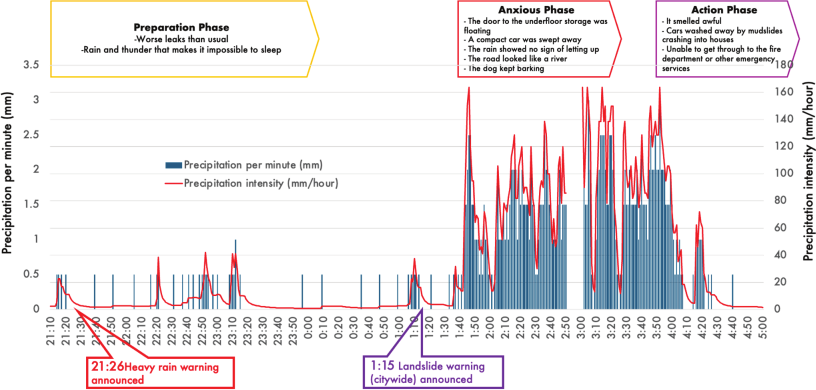
Comparison of residents" awareness phases and meteorological data timeline
- [1] Cabinet Office, Government of Japan, “White paper on disaster management 2015,” 2015 (in Japanese).
- [2] K. Yamori, “Disaster psychology,” Kyoto University Press, 2004 (in Japanese).
- [3] K. Takenouchi and K. Yamori, “Synergistic integration of detailed meteorological and community information for evacuation from weather-related disasters: Proposal of a ‘disaster response switch’,” Int. J. of Disaster Risk Science, Vol.11, No.6, pp. 762-774, 2020. https://doi.org/10.1007/s13753-020-00317-3
- [4] Y. Takemoto, S. Ishii, H. Ichida, Y. Akiyama, M. Hakozaki, Y. Okada, S. Yamaguchi, H. Minamide, T. Kobayashi, M. Sawada, and H. Taniguchi, “Research on understanding the relationship between disaster prevention weather information and disaster perception among local residents,” J. of the Osaka District Meteorological Research Association, 2024 (in Japanese).
- [5] August 2014 Hiroshima Large-Scale Sediment Disaster Emergency Survey Team and Hiroshima City Disaster Prevention Specialist Network, “Collection of experiences from the August 20, 2014 Hiroshima Heavy Rain Disaster,” Japan Society of Erosion Control Engineering (JSECE), 2015 (in Japanese).
- [6] M. Ushiyama, M. Honma, S. Yokomaku, and K. Sugimura, “Characteristics of victims caused by heavy rainfall disaster caused by typhoon No.1919,” J. of Japan Society for Natural Disaster Science, Vol.40, No.1, pp. 81-102, 2021 (in Japanese).
- [7] M. Honma and T. Katada, “Study on the relationship between disaster advance information and resident evacuation in tsunami disaster prevention,” J. of Disaster Information Studies, Vol.6, pp. 61-72, 2008 (in Japanese). https://doi.org/10.24709/jasdis.6.0_61
This article is published under a Creative Commons Attribution-NoDerivatives 4.0 Internationa License.