
Paper:
Update of the Seismic Microzonation Map of Lima and Callao, Peru
Diana Calderon
 , Fernando Lázares†
, Carlos Gonzales
, Gerson Carrasco
, Zenon Aguilar
, and Silvia Alarcon
, Fernando Lázares†
, Carlos Gonzales
, Gerson Carrasco
, Zenon Aguilar
, and Silvia Alarcon
Centro Peruano Japonés de Investigaciones Sísmicas y Mitigación de Desastres, Facultad de Ingeniería Civil, Universidad Nacional de Ingeniería
1150 Av. Tupac Amaru, Rimac, Lima 15333, Peru
†Corresponding author

Lima City and Callao Province are located in the Pacific Ring of Fire and have experienced major earthquakes over the years. To understand the seismic response of the soil, a seismic microzonation study was developed, taking into account the results of geological, geotechnical, and geophysical surveys. The geological study identified areas with potential for rockfall on the existing hills in Lima. The geotechnical exploration included survey drilling, soil sampling for analysis, and standard penetration test. The results defined the mechanical characteristics of the soils and identified their strength and behavior as foundation materials. The geophysical exploration consisted of single-point microtremor measurements, microtremor arrays, MASW (multichannel analysis of surface waves), and refraction tests. The results provided the natural period of vibration and the velocity profiles of the P and S waves, allowing the dynamic characteristics of the soils to be identified. The results of the geological, geotechnical, and geophysical surveys were superimposed to develop the geotechnical microzonation map, the isoperiod map, and the seismic microzonation map for Lima City and the Callao Province. The latter identifies five zones, where the area with the best mechanical and dynamic soil characteristics covers most of the study area.
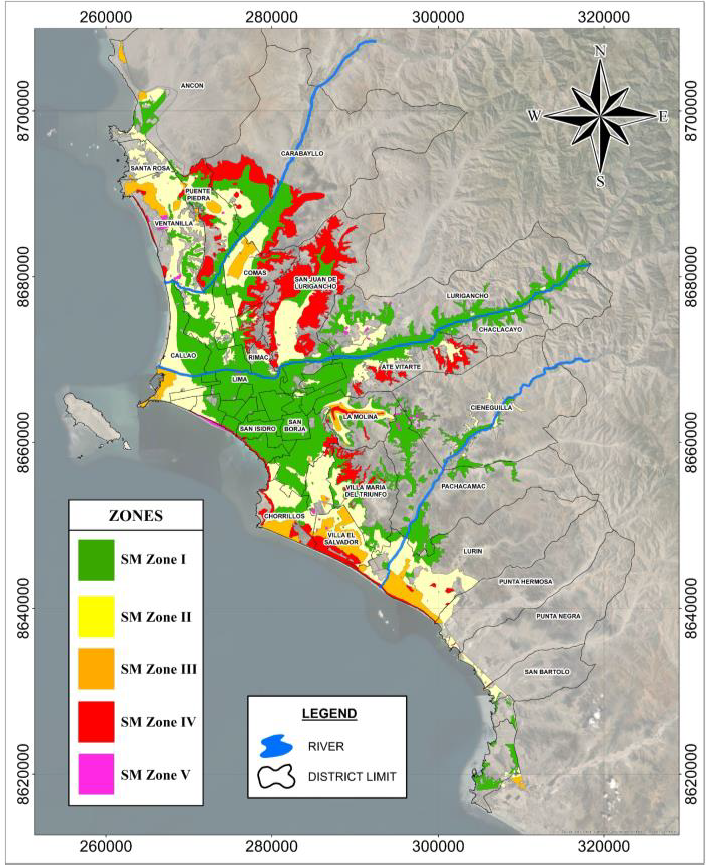
Microzonation map in Lima and Callao
- [1] A. Ansal, “Seismic microzonation; past, present and future,” Bulletin of Earthquake Engineering, Vol.23, No.9, pp. 3483-3506, 2025. https://doi.org/10.1007/s10518-025-02182-1
- [2] S. Yasuda, H. Nagase, and Y. Tanoue, “Microzonation for seismic geotechnical hazards and actual damage during the 2005 Fukuoka-ken Seiho-oki Earthquake,” Soil and Foundations, Vol.51, No.2, pp. 215-226, 2011. https://doi.org/10.3208/sandf.51.215
- [3] O. Uyanık, Z. Öncü, N. A. Uyanık, and N. Ekin, “Seismic microzonation and geotechnical modeling studies considering local site effects for İnegöl Plain (Bursa-Turkey),” Earth and Space Science, Vol.11, No.11, Article No.e2023EA003460, 2024. https://doi.org/10.1029/2023EA003460
- [4] R. Rauld, F. Medina, F. Leyton, and S. Ruiz, “Mapa de microzonificación sismo-geológica para Chile,” XIV Congreso Geológico Chileno, 2015 (in Spanish).
- [5] Instituto de Ingeniería, Universidad Autónoma de México, “Actualización de la zonificación sísmica de la ciudad de México y Áreas Aledañas-Parte Norte,” 2020 (in Spanish).
- [6] R. Aguiar Falconí, “Microzonificación sísmica de quito, 2nd Edición” Instituto Panamericano de Geografía e Historia, 2017 (in Spanish).
- [7] N. Pulido et al., “Scenario source models and strong ground motion for future mega-earthquakes: Application to Lima, Central Peru,” Bulletin of the Seismological Society of America, Vol.105, No.1, pp. 368-386, 2015. https://doi.org/10.1785/0120140098
- [8] N. E. Pulido and J. C. Villegas-Lanza, “Megathrust earthquake potential of Peruvian subduction zone based on slab-interface mechanical coupling and the earthquake energy budget,” American Geophysical Union Fall Meeting 2023 (AGU23), Session No.T42A-03, 2023.
- [9] D. Calderon, Z. Aguilar, F. Lazares, S. Alarcon, and S. Quispe, “Development of a seismic microzoning map for Lima city and Callao, Peru,” J. Disaster Res., Vol.9, No.6, pp. 939-945, 2014. https://doi.org/10.20965/jdr.2014.p0939
- [10] Instituto Geofísico del Perú, “Zonifica Perú.” https://zonificaperu.igp.gob.pe/visor/zonificacion/ [Accessed September 30, 2025]
- [11] E. Silgado Ferro, “Historia de los sismos más notables ocurridos en el Perú (1513–1974),” Instituto de Geología y Minería, 1978 (in Spanish).
- [12] Ministerio de Vivienda, Construcción y Saneamiento, “Informe de microzonificación sísmica del distrito del Cercado de Lima,” Programa Nuestras Ciudades, Ministerio de Vivienda, Construcción y Saneamiento, 2012 (in Spanish). https://sigrid.cenepred.gob.pe/sigridv3/documento/197 [Accessed February 3, 2025]
- [13] Ministerio de Vivienda, Construcción y Saneamiento, “Informe de microzonificación sísmica del distrito de Puente Piedra,” Programa Nuestras Ciudades, Ministerio de Vivienda, Construcción y Saneamiento, 2011 (in Spanish). https://sigrid.cenepred.gob.pe/sigridv3/documento/480 [Accessed February 3, 2025]
- [14] Ministerio de Vivienda, Construcción y Saneamiento, “Informe de microzonificación sísmica del distrito de San Juan de Lurigancho,” Programa Nuestras Ciudades, Ministerio de Vivienda, Construcción y Saneamiento, 2011 (in Spanish). https://sigrid.cenepred.gob.pe/sigridv3/documento/333 [Accessed February 3, 2025]
- [15] Centro Peruano Japonés de Investigaciones Sísmicas y Mitigación de Desastres (CISMID), “Estudio de microzonificación sísmica del distrito de San Borja,” Informe, 2019 (in Spanish).
- [16] CISMID, “Estudio de microzonificación sísmica del distrito de San Miguel,” Informe, 2015 (in Spanish).
- [17] CISMID, “Estudio de microzonificación sísmica del distrito del Callao,” Informe, 2021 (in Spanish).
- [18] CISMID, “Estudio de microzonificación sísmica del distrito de La Molina,” Informe, 2010 (in Spanish).
- [19] CISMID, “Estudio de microzonificación sísmica del distrito de Ventanilla,” Informe, 2012 (in Spanish).
- [20] K. Terzaghi, “Theoretical soil mechanics,” John Wiley & Sons, 1943. https://doi.org/10.1002/9780470172766
- [21] G. G. Meyerhof, “Some recent research on the bearing capacity of foundations,” Canadian Geotechnical J., Vol.1, No.1, pp. 16-26, 1963. https://doi.org/10.1139/t63-003
- [22] Servicio Nacional de Capacitación para la Industria de la Construcción, “Norma técnica E.050 suelos y Cimentaciones,” Reglamento Nacional de Edificaciones, Ministerio de Vivienda, Construcción y Saneamiento, 2018.
- [23] C. B. Park, R. D. Miller, and J. Xia, “Multichannel analysis of surface waves,” Geophysics, Vol.64, No.3, pp. 800-808, 1999. https://doi.org/10.1190/1.1444590
- [24] J. Capon, “High-resolution frequency-wavenumber spectrum analysis,” Proc. of the IEEE, Vol.57, No.8, pp. 1408-1418, 1969. https://doi.org/10.1109/PROC.1969.7278
- [25] K. Aki, “Space and time spectra of stationary stochastic waves, with special reference to microtremors,” Bulletin of the Earthquake Research Institute, The University of Tokyo, Vol.35, No.3, pp. 415-456, 1957. https://doi.org/10.15083/0000033938
- [26] I. Cho, T. Tada, and Y. Shinozaki, “A new method to determine phase velocities of Rayleigh waves from microseisms,” Geophysics, Vol.69, No.6, pp. 1535-1551, 2004. https://doi.org/10.1190/1.1836827
- [27] T. Tada, I. Cho, and Y. Shinozaki, “Beyond the SPAC method: Exploiting the wealth of circular-array methods for microtremor exploration,” Bulletin of the Seismological Society of America, Vol.97, No.6, pp. 2080-2095, 2007. https://doi.org/10.1785/0120070058
- [28] Z. Aguilar, J. Tarazona, L. Vergaray, and J. Barrantes, “Site response analysis and its comparison with the Peruvian seismic design spectrum,” Tecnia, Vol.29, No.2, pp. 91-97, 2019. https://doi.org/10.21754/tecnia.v29i2.700
- [29] Y. Nakamura, “A method for dynamic characteristics estimation of subsurface using microtremor on the ground surface,” Quarterly Report of RTRI, Vol.30, No.1, pp. 25-33, 1989.
- [30] S. Molnar et al., “A review of the microtremor horizontal-to-vertical spectral ratio (MHVSR) method,” J. of Seismology, Vol.26, No.4, pp. 653-685, 2022. https://doi.org/10.1007/s10950-021-10062-9
- [31] Instituto Geofísico del Perú, “Sismo de Mala del 22 de junio 2021 (M6.0) y niveles de sacudimiento del suelo,” Informe Técnico No.013-2021/IGP Ciencias de la Tierra Sólida, Instituto Geofísico del Perú, 2021 (in Spanish). http://hdl.handle.net/20.500.12816/4958 [Accessed February 5, 2025]
- [32] CISMID, “Acelerogramas del sismo de Mala-Lima del 22 de junio de 2021,” Informe, Centro de Observación para la Ingeniería Sísmica (CEOIS), Red Nacional de Acelerógrafos del CISMID-FIC-UNI (REDACIS), 2021 (in Spanish). https://www.cismid.uni.edu.pe/category/informes-tecnicos/ [Accessed February 5, 2025]
- [33] CISMID, “Acelerogramas del Sismo de Callao del 28 de noviembre de 2021,” Informe, Centro de Observación para la Ingeniería Sísmica (CEOIS), Red Nacional de Acelerógrafos del CISMID-FIC-UNI (REDACIS), 2021 (in Spanish). https://www.cismid.uni.edu.pe/category/informes-tecnicos/ [Accessed February 5, 2025]
- [34] C. Gonzales et al., “Preliminary system for the estimation of peak ground acceleration distribution in Metropolitan Lima and Callao: Application in recent seismic events,” J. Disaster Res., Vol.18, No.4, pp. 319-328, 2023. https://doi.org/10.20965/jdr.2023.p0319
- [35] P. Mendoza, “Effect of the attenuation pattern in the interpolation of the peak ground acceleration in Lima and Callao,” Undergraduate thesis, Universidad Nacional de Ingeniería, 2025 (unpublished) (in Spanish).
This article is published under a Creative Commons Attribution-NoDerivatives 4.0 Internationa License.