
Development Report:
Feasibility Study of a Generative-AI-Based Privacy-Preserving Video Archiving Framework for Pedestrian Traffic Monitoring
Masaya Nakahara*,†
 , Shosuke Okamura*, and Yuya Matsui**
*Faculty of Information Science and Arts, Osaka Electro-Communication University
1130-70 Kiyotaki, Shijonawate, Osaka 575-0063, Japan
†Corresponding author
**Graduate School of Information Science and Arts, Osaka Electro-Communication University
1130-70 Kiyotaki, Shijonawate, Osaka 575-0063, Japan

In Japan, continuous monitoring of pedestrian traffic volume is considered crucial for measuring the effectiveness of sustainable urban development and revitalization efforts. However, storage periods of camera footage are limited due to privacy protection concerns, making long-term time-series analysis and detailed post-event analysis (such as movement path analysis) difficult. Existing masking techniques, such as mosaic blurring, protect privacy but result in the loss of human features, leading to reduced accuracy in artificial intelligence (AI)-based tracking and counting. This study proposes a privacy-preserving video archiving framework that enables long-term storage and post-hoc analysis by regenerating pedestrian images using generative AI. We developed a prototype system and conducted a pilot study to verify its feasibility. In a pilot experiment using a 15-minute pedestrian video, the proposed method achieved a counting accuracy of 99.07% relative to the manual reference count, suggesting that generative masking can preserve counting utility in the tested setting. However, the attribute-estimation results were affected by seasonal domain shifts, and the IoU-based evaluation revealed other issues in spatial consistency and masking omissions. These findings indicate the feasibility of the proposed framework and provide technical requirements for future privacy-preserving video archiving systems.
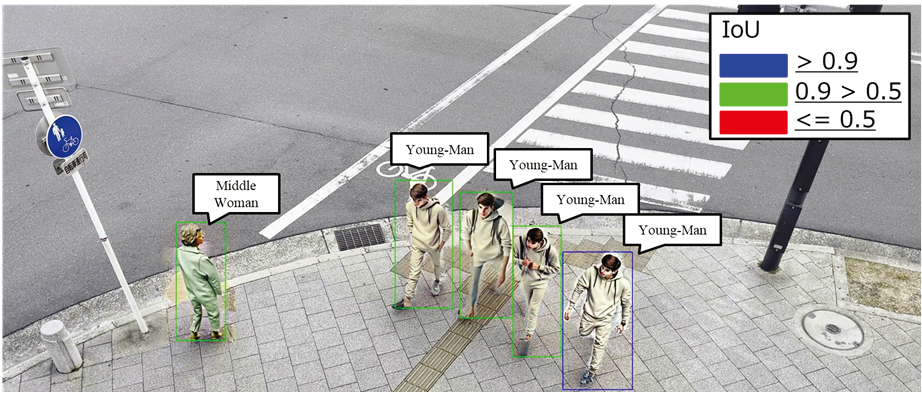
Generative masking with IoU evaluation
- [1] M. Shamroukh, A. Natapov, and T. Larimian, “Reliability and scalability of pedestrian monitoring practices: A systematic review,” IEEE Access, Vol.13, pp. 147679-147689, 2025. https://doi.org/10.1109/ACCESS.2025.3599283
- [2] E. S. Bibri, “Data-driven smart sustainable cities of the future: New conceptions of and approaches to the spatial scaling of urban form,” Future Cities and Environment, Vol.7, No.1, pp. 1-15, 2021. https://doi.org/10.5334/fce.120
- [3] P. Voigt and A. von dem Bussche, “The EU General Data Protection Regulation (GDPR): A Practical Guide,” Springer Nature, 2017. https://doi.org/10.1007/978-3-031-62328-8
- [4] R. J. Padilla-López, A. A. Chaaraoui and F. Flórez-Revuelta, “Visual privacy protection methods: A survey,” Expert Systems with Applications, Vol.42, No.9, pp. 4177-4195, 2015. https://doi.org/10.1016/j.eswa.2015.01.041
- [5] NEC Solution Innovators, Ltd., “Field Analyst.” https://www.nec-solutioninnovators.co.jp/en/sl/fieldanalyst/index.html [Accessed January 1, 2026]
- [6] S. Okamura, M. Nakahara, and Y. Matsui, “A Study on video image generation method for measuring town vitality considering age groups and gender,” Proc. 87th National Convention of IPSJ, Vol.87, No.2, pp. 867-868, 2025 (in Japanese).
- [7] N. Carion, F. Massa, G. Synnaeve, N. Usunier, A. Kirillov, and S. Zagoruyko, “End-to-end object detection with transformers,” Proc. European Conf. on Computer Vision (ECCV), 2020.
- [8] H. Jiang and E. Learned-Miller, “Face detection with the faster R-CNN,” Proc. 2017 12th IEEE Int. Conf. on Automatic Face and Gesture Recognition (FG 2017), pp. 650-657, 2017. https://doi.org/10.1109/FG.2017.82
- [9] E. K. Tokuda, Y. Lockerman, G. B. Ferreira, E. Sorrelgreen, D. Boyle, R. M. Cesar-Jr, and C. T. Silva, “A new approach for pedestrian density estimation using moving sensors and computer vision,” ACM Trans. on Spatial Algorithms and Systems (TSAS), Vol.6, No.4, pp. 1-20, 2020. https://doi.org/10.1145/3397575
- [10] W. Liu, D. Anguelov, D. Erhan, C. Szegedy, S. Reed, C. Y. Fu, and A. C. Berg, “SSD: Single shot multibox detector,” Proc. ECCV, pp. 21-37, 2016. https://doi.org/10.1007/978-3-319-46448-0_2
- [11] J. Redmon, S. Divvala, R. Girshick, and A. Farhadi, “You only look once: Unified, real-time object detection,” Proc. IEEE Conf. on Computer Vision and Pattern Recognition, pp. 779-788, 2016. https://doi.org/10.1109/CVPR.2016.91
- [12] Fannovel 16, “ComfyUI-video-matting.” https://github.com/Fannovel16/ComfyUI-Video-Matting [Accessed January 1, 2026]
- [13] IDEA-Research, “DWPose.” https://github.com/IDEA-Research/DWPose [Accessed January 1, 2026]
- [14] N. Wojke, A. Bewley, and D. Paulus, “Simple online and realtime tracking with a deep association metric,” Proc. Int. Conf. on Image Processing (ICIP), pp. 3645-3649, 2017. https://doi.org/10.1109/ICIP.2017.8296962
- [15] J. Cao, J. Pang, X. Weng, R. Khirodkar, and K. Kitani, “Observation-centric sort: Rethinking sort for robust multi-object tracking,” Proc. IEEE/CVF Conf. on Computer Vision and Pattern Recognition, pp. 9686-9696, 2023. https://doi.org/10.1109/CVPR52729.2023.00934
- [16] G. Maggiolino, A. Ahmad, J. Cao, and K. Kitani, “Deep OC-SORT: Multi-pedestrian tracking by adaptive re-identification,” Proc. IEEE Int. Conf. on Image Processing (ICIP), pp. 3025-3029, 2023. https://doi.org/10.1109/ICIP49359.2023.10222576
- [17] M. Kamijo, “Gait-based age estimation using spatial fluctuating image sequences during the gait cycle,” Bulletin of Graduate Studies, Computer and Information Sciences, Vol.19, pp. 1-6, 2024 (in Japanese).
- [18] Q. Qin, and J. Vychodil, “Pedestrian detection algorithm based on improved convolutional neural network,” J. Adv. Comput. Intell. Intell. Inform., Vol.21, No.5, pp. 834-839, 2017. https://doi.org/10.20965/jaciii.2017.p0834
- [19] H. Chao, Y. He, J. Zhang, and J. Feng, “GaitSet: Regarding gait as a set for cross-view gait recognition,” Proc. AAAI Conf. on Artificial Intelligence, pp. 8126-8133, 2019. https://doi.org/10.1609/aaai.v33i01.33018126
- [20] A. Frühstück, K. K. Singh, E. Shechtman, N. J. Mitra, P. Wonka, and J. Lu, “InsetGAN for full-body image generation,” Proc. IEEE/CVF Conf. on Computer Vision and Pattern Recognition, pp. 7723-7732, 2022. https://doi.org/10.1109/CVPR52688.2022.00757
- [21] I. J. Goodfellow, J. Pouget-Abadie, M. Mirza, B. Xu, D. Warde-Farley, S. Ozair, A. Courville, and Y. Bengio, “Generative adversarial nets,” Advances in Neural Information Processing Systems, Vol.27, 2014.
- [22] H. Hukkelås and F. Lindseth, “Deepprivacy2: Towards realistic full-body anonymization,” Proc. IEEE/CVF Winter Conf. on Applications of Computer Vision (WACV 2023), pp. 1329-1338, 2023. https://doi.org/10.1109/WACV56688.2023.00138
- [23] L. Ma, X. Jia, Q. Sun, B. Schiele, T. Tuytelaars, and L. Van Gool, “Pose guided person image generation,” Advances in Neural Information Processing Systems, Vol.30, 2017.
- [24] M. Mirza and S. Osindero, “Conditional generative adversarial nets,” arXiv:1411.1784, 2014. https://doi.org/10.48550/arXiv.1411.1784
- [25] Viggle Inc., “ViggleAI.” https://viggle.ai/home [Accessed January 1, 2026]
- [26] R. Güler, N. Neverova, and I. Kokkinos, “DensePose: Dense human pose estimation in the wild,” Proc. IEEE Conf. on Computer Vision and Pattern Recognition, pp. 7297-7306, 2018. https://doi.org/10.1109/CVPR.2018.00762
- [27] S. Fu, D. Wei and L. Zhou, “Improved YOLOv8-based algorithm for detecting helmets of electric moped drivers and passengers,” J. Adv. Comput. Intell. Intell. Inform., Vol.29, No.2, pp. 349-357, 2025. https://doi.org/10.20965/jaciii.2025.p0349
- [28] L. Zhang, A. Rao, and M. Agrawala, “Adding conditional control to text-to-image diffusion models,” Proc. IEEE/CVF Int. Conf. on Computer Vision, pp. 3836-3847, 2023.
- [29] Tencent AI Lab, “IP-adapter.” https://github.com/tencent-ailab/IP-Adapter [Accessed January 1, 2026]
- [30] C. Wan, L. Wang, V. V. Phoha, “A survey on gait recognition,” ACM Computing Surveys, Vol.51, No.5, pp. 1-35, 2018. https://doi.org/10.1145/3230633
This article is published under a Creative Commons Attribution-NoDerivatives 4.0 Internationa License.