
Research Paper:
A Continual Self-Supervised Learning Framework Using a Decoder and a Clustering-Based Data Selection Method
Ryosuke Fujii*
 , Naoki Masuyama*,†
, Yusuke Nojima*
, Chu Kiong Loo**
, and Liew Wei Shiung**
*Osaka Metropolitan University
1-1 Gakuen-cho, Sakai, Osaka 599-8531, Japan
†Corresponding author
**University of Malaya
Kuala Lumpur 50603, Malaysia

Continual learning aims to learn a sequence of tasks without forgetting the previously learned tasks. Promising methods for achieving continual learning include applying a replay buffer that stores previously learned samples in existing learning frameworks. Among these methods, lifelong unsupervised mixup (LUMP) interpolates the current task samples and samples from the replay buffer to prevent forgetting. LUMP randomly selects data for the replay buffer. This random selection is likely to have a negative effect on learning performance. In this study, we propose a clustering-based data selection method for the replay buffer. In addition, we introduce a denoising autoencoder to the self-supervised methods to improve the performance of the learning representations. We compare the clustering algorithms used in our framework and demonstrate the effectiveness of the proposed framework through computational experiments. Experimental results on CIFAR-100 and Tiny-ImageNet demonstrate that the proposed framework improves the average accuracy compared with LUMP while reducing forgetting. In particular, the CA+-based selection approach enhances the learning performance. The source code is available at https://github.com/Masuyama-lab/LUMP_SidAE_Clustering
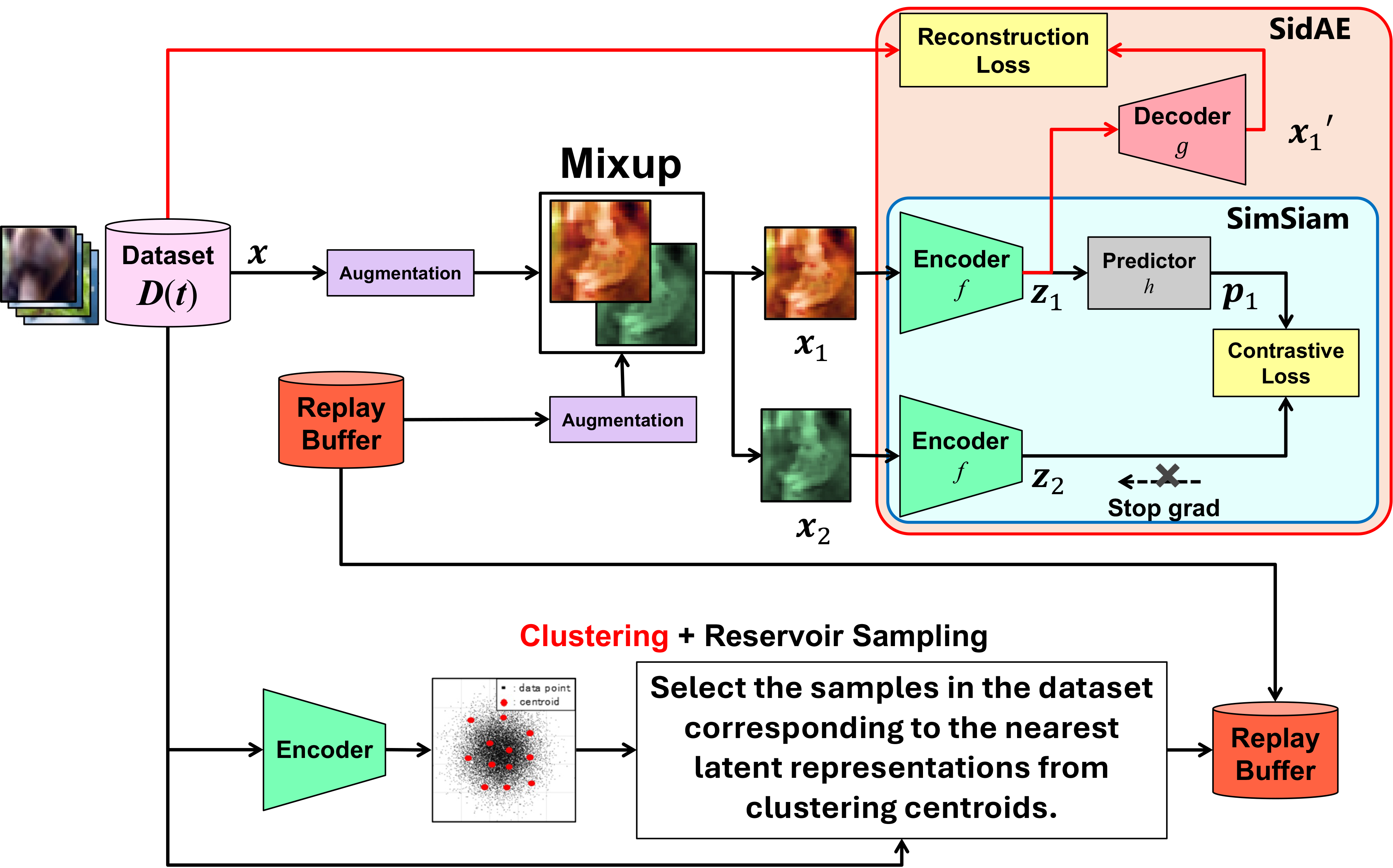
Proposed continual SSL framework
1. Introduction
In recent years, various large-scale data have become available. However, annotating such data is time-consuming, costly, and often requires specialized expertise, resulting in datasets that may lack in quantity and quality 1. Furthermore, retraining models each time new data arrives is impractical from both cost and data retention perspectives. Consequently, there is a pressing need for learning methods that can operate without labeled data and handle continuously growing datasets.
Self-supervised learning (SSL) 2 is a promising approach to label-free learning. In SSL, a model is pretrained on unlabeled data to learn an encoder that extracts latent representations from a pretext task. The pretrained encoder is then fine-tuned on a small amount of labeled data to solve a downstream task.
A key challenge in continual learning is to avoid catastrophic forgetting, whereby adjustments to the encoder parameters prioritize new data over previously learned data, and the representation learning performance declines. Lifelong unsupervised mixup (LUMP) 3 is a continual learning method that mitigates catastrophic forgetting by storing a subset of past data in a replay buffer and mixing it with new task data. LUMP can be applied to various SSL methods to preserve historical knowledge. LUMP updates the replay buffer using random sampling. However, this strategy does not guarantee that representative samples of the data distribution are preserved in the buffer. Consequently, the stored samples may not sufficiently represent the latent feature distribution, which can negatively affect representation learning performance. To address this limitation, we introduce a clustering-based data selection strategy that preserves representative samples in the latent space.
In this study, we aim to enhance the learning performance of LUMP by proposing two extensions. First, we introduce a clustering-based selection method for the replay buffer, thereby ensuring that representative samples of each task are retained to improve the continual learning performance. As the continual learning performance may vary depending on the clustering algorithm used, we apply and compare multiple clustering algorithms. Second, we employ Siam denoising autoencoder (SidAE) 4 that combines SimSiam with an autoencoder to enhance representation learning.
The contributions of this paper are summarized as follows:
-
1.
We propose a continual learning framework using an architecture that combines an SSL method with an autoencoder.
-
2.
We propose a replay buffer updating method using clustering-based sample selection for continual learning performance.
-
3.
We apply several clustering algorithms and compare the continual learning performance to investigate which clustering algorithm is appropriate for replay buffer sampling.
-
4.
Computational experiments show that the method applying the proposed architecture and the clustering-based sample selection method improves the continual learning performance.
This paper is organized as follows. Section 2 presents a literature review on SSL and continual learning. Section 3 presents some preliminary knowledge. Section 4 describes the proposed framework. Section 5 presents the experimental setup, results, and discussion. Finally, Section 6 concludes the paper and outlines future research directions.
2. Literature Review
2.1. SSL
SSL algorithms aim to learn latent features from unlabeled instances without relying on human annotations 5. In the SSL model, an encoder is trained to extract latent representations from unlabeled data in the pretext task. Then, in the downstream task, the pretrained encoder is fine-tuned on a small amount of labeled data.
SSL can be broadly grouped according to the composition of the training dataset (i.e., anchor, positive, and negative samples) and network architecture into three families: contrastive learning 6,7, non-contrastive learning 8,9,10,11, and masked modeling 12,13. Contrastive learning generally demands large batch sizes and an enormous number of positive-negative pairs, adversely affecting scalability. Masked image modeling approaches typically require large models and prolonged training to achieve competitive representation performance. In contrast, non-contrastive learning methods such as SimSiam 10 and Barlow Twins 11 obviate the need for negative samples and very large batches. SidAE 4 is an extension of SimSiam that includes an autoencoder. It reconstructs an original image from a latent representation using a decoder to improve the representation learning performance.
In this study, we use SimSiam and SidAE in our framework owing to their combination of high representation learning performance and architectural simplicity.
2.2. Continual Learning
Several methods have been proposed to enhance continual learning, and can be grouped into three broad classes: regularization-based 14,15, architecture-based 16,17, and replay-based approaches 3,18. Regularization-based methods modify the objective function to discourage large alterations in the network weights. Architecture-based strategies allocate distinct parameter subsets to different tasks, typically at the expense of increased memory requirement. Replay-based techniques mitigate catastrophic forgetting by retaining a subset of previously seen training examples in a replay buffer and consulting these examples during subsequent training. Their ease of implementation and applicability to many network architectures make them particularly attractive. For instance, gradient episodic memory 19 leverages stored examples to impose optimization constraints during current training. dark experience replay 18 integrates replay with knowledge distillation and regularization by matching network logits across task sequences. Among replay-based methods for self-supervised continual learning, LUMP 3 provides a simple yet effective mechanism inspired by image-mixing approaches that interpolate current training samples with past samples preserved in a buffer 20,21.
In this study, we use LUMP as part of the proposed framework because of its simple yet effective mechanism for continual SSL.
2.3. Clustering
Classical clustering methods, such as Gaussian mixture model (GMM) 22 and k-means 23, have proven useful across many domains, but share the well-known limitation that the number of clusters must be specified a priori.
To address this problem, a range of growing self-organizing clustering algorithms have been developed, primarily building on growing neural gas (GNG) 24, and adaptive resonance theory (ART)-based clustering algorithms 25. GNG-based approaches tend to approximate the overall data topology with a network of nodes and edges during the early stages of training 26,27,28, whereas ART-based methods initially form many small networks and subsequently merge them to recover a topological representation of the data distribution 29,30,31,32. A notable advantage of ART variants is their ability to adaptively and continuously create nodes to track evolving data distributions, while avoiding catastrophic forgetting. Specifically, ART algorithms that use the correntropy-induced metric (CIM) 33 as a similarity measure have demonstrated superior clustering performance compared to other methods 34,35,36,37. A practical drawback of ART approaches is their sensitivity to data-dependent parameters such as the vigilance (similarity) threshold; therefore, several studies have proposed remedies to reduce this dependency 38,39,40. Among these, CIM-based ART (CA+) 40 achieves strong clustering performance across diverse datasets without requiring manual parameter tuning.
In this study, we incorporate several clustering algorithms into our proposed buffer updating method to compare their effects on continual representation learning performance.
3. Preliminary Knowledge
3.1. Problem Setup
We consider a task-incremental scenario that provides datasets consisting of \(T\) tasks. Each task consists of a dataset \(\mathcal{U}_\tau=\{(x_{i,\tau})_{i=1}^{n_\tau}\}( \tau\in\{1,2, \ldots,T\})\), where \(x_{i,\tau}\) and \(n_\tau\) denote a training sample and number of training samples, respectively. Let us consider a network \(f_\Theta : \mathcal{X}_\tau \xrightarrow{} \mathcal{R}^D\) parameterized by \(\Theta=\{w_l\}_{l=1}^{L}\), where \(\mathcal{R}^D\) and \(L\) denote \(D\)-dimensional latent space and number of layers, respectively. The objective of the network \(f_\Theta\) is to learn latent representations of task \(\tau+1\) while preserving the knowledge until task \(\tau\).
3.2. SimSiam
SimSiam 10 is an SSL method that can learn data representations without label information. It does not require negative samples and adds a Multi-Layer Perceptron (MLP) to one side of the path. In addition, SimSiam uses a stop-gradient operation to avoid the collapse of representations. SimSiam consists of an encoder network \(f(\cdot)\) and a predictor MLP \(h(\cdot)\). The inputs are two randomly augmented views \(\pmb{x}_1\) and \(\pmb{x}_2\) from image \(\pmb{x}\). The loss function \(L_{\mathrm{Con}}\) minimizes the negative cosine similarity between the outputs of the encoder network and the predictor MLP.
3.3. SidAE
SidAE 4 is an SSL method that combines SimSiam with a denoising autoencoder. Two augmented views are used as inputs in SimSiam, and the original image is not used. However, SidAE aims to reconstruct the original image from the representation to improve the performance of the representation learning. SidAE consists of SimSiam and a decoder \(g(\cdot)\) that reconstructs the original input \(\pmb{x}\) from the representation \(z_i\), i.e., \(\pmb{x}_i'=g(\pmb{z}_i)\). The loss function \(L\) is defined as follows:
3.4. LUMP
LUMP 3 is a replay buffer-based continual learning method. The basic concept is inspired by mixup 20. The mixup generates an interpolated sample from two different samples. Although mixup has been proposed for supervised learning, LUMP has shown that it can be effectively adapted to continual unsupervised learning by incorporating a replay buffer that preserves and reuses past examples. LUMP interpolates between samples from the current task and those from the replay buffer. The mixup is defined as follows:
4. Proposed Framework
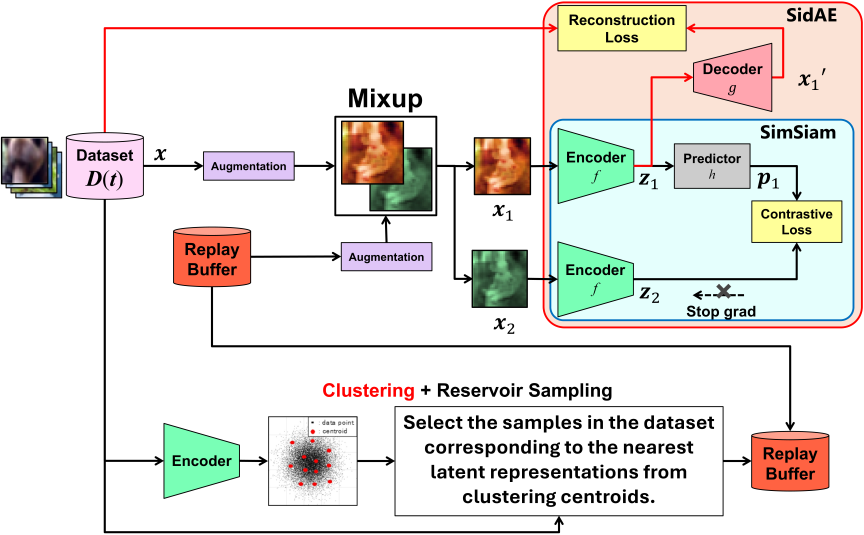
Fig. 1. Proposed framework.
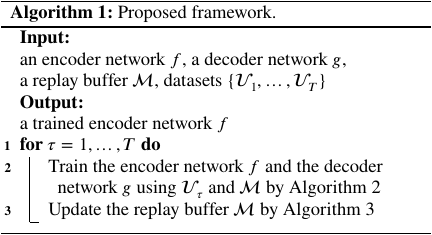
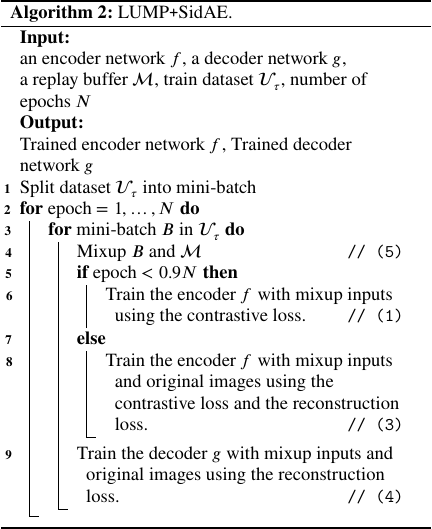
Figure 1 shows an overview of the proposed framework. Algorithm 1 outlines the proposed framework. SimSiam can be replaced by other SSL methods. We introduce LUMP into an SSL method to improve the continual learning performance. Algorithm 2 summarizes the learning process using a decoder network and reconstruction loss to improve the representation learning performance. Algorithm 3 summarizes the clustering-based sample selection for the replay buffer to improve the continual learning performance.
4.1. LUMP+SidAE
In a previous research 3, LUMP is applied to SimSiam. We propose the application of LUMP to SidAE to improve the representation learning performance. The decoder reconstructs the original images before mixup. Algorithm 2 describes the learning process.
After 90% of the training epochs have been completed, we add the reconstruction loss \(L_{\mathrm{Rec}}\), as defined in Eq. (3), so that the encoder uses the reconstruction loss obtained from a sufficiently trained decoder. This implies that the encoder learns using only the contrastive loss, and the reconstruction loss is used to train the decoder for 90% of the epochs.
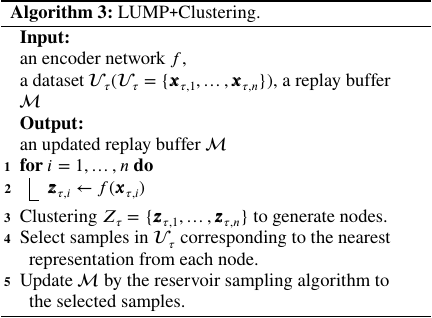
4.2. LUMP+Clustering
In LUMP, randomly selected samples are used to update the replay buffer. However, we propose a clustering-based data selection method for the replay buffer. Algorithm 3 summarizes the replay buffer update method.
During the replay buffer updating process, we first extract latent representations of a dataset \(\mathcal{U}_\tau\) by the encoder \(f\) after learning task \(\tau\). A clustering algorithm is then applied to these latent representations to obtain the cluster centroids. The replay buffer is updated using the data corresponding to the nearest latent representations from the cluster centroids.
Clustering-based sample selection can be applied to any continual learning method that uses a replay buffer.
5. Computational Experiments
5.1. Experimental Settings
ResNet18 41 is used as the backbone of the encoder. We set the hyperparameters as follows: batch size 256; replay buffer size 256; the number of training epochs 100; the number of trials 3. We use Split CIFAR-100 42 and Split Tiny-ImageNet as the training datasets. Split CIFAR-100 is arranged into 20 tasks, each containing five random classes. Split Tiny-ImageNet is a variant of the Tiny-ImageNet 43 dataset arranged into 20 tasks, with each task containing five random classes. The data-splitting method used in this study follows the task-incremental learning scenario, which is a typical continual learning setting defined in the literature 44.
| Dataset | #Samples | #Classes | #Tasks | Image size |
| CIFAR-100 | 50000 | 100 | 20 | \(32\times32\) |
| Tiny-ImageNet | 50000 | 100 | 20 | \(64\times64\) |
| Dataset | #Samples | #Classes | #Tasks | Image size |
| CIFAR-10 | 10000 | 10 | 5 | \(32\times32\) |
| CIFAR-100 | 5000 | 100 | 20 | \(32\times32\) |
| Tiny-ImageNet | 5000 | 100 | 20 | \(64\times64\) |
| SVHN | 26320 | 10 | 5 | \(32\times32\) |
| MNIST | 10000 | 10 | 5 | \(28\times28\) |
We evaluate training encoder \(f\) under in-distribution (ID) and out-of-distribution (OOD) conditions. For the OOD condition, we use Tiny-ImageNet as the training dataset, whereas CIFAR-10, CIFAR-100, SVHN, and MNIST are used as the test datasets. Although CIFAR-10, CIFAR-100, and Tiny-ImageNet share some semantically similar categories, the datasets have been collected independently and contain different image distributions. Therefore, the OOD evaluation mainly measures the generalization ability of the learned representations to different datasets.
Table 1 presents the details of the training datasets, and Table 2 presents the details of the test datasets, including the ID and the OOD settings.
5.2. Compared Algorithms
We evaluate our approach against two baselines: fine-tuned SimSiam (Finetune) and SimSiam employing LUMP procedure (LUMP). Finetune does not apply a continual learning approach. LUMP uses a replay buffer but selects samples randomly from the dataset using the reservoir sampling algorithm. We use the following clustering algorithms for LUMP+Clustering:
-
1.
k-means 23: An iterative algorithm that updates the cluster centroids to minimize the sum of distances between each datum and the centroid of its assigned cluster. Initialization was performed using k-means
++with 10 random restarts and \(k=256\). -
2.
k-medoids 45: A variant of k-means in which each cluster center is restricted to an actual data point (the medoid) rather than the arithmetic mean. Initialization used k-medoids
++, and the number of clusters was set to \(k=256\). -
3.
GMM 22: This algorithm assumes that the data are generated from a mixture of Gaussian distributions and estimates each component’s parameters from the dataset via the expectation–maximization algorithm. We ran 10 initializations and set the number of mixture components to 256.
-
4.
Spectral clustering (SC) 46: A graph-based clustering technique that constructs an affinity graph from the dataset and performs clustering in a low-dimensional embedding obtained from the graph Laplacian. SC can capture nonlinear structures in data. We used 10 initializations and specified 256 clusters.
-
5.
Self-organizing map (SOM) 47: A topology-preserving algorithm that represents data distribution using a set of prototype nodes connected by edges. During training, the node that is most similar to each input (the best matching unit) and its neighborhoods are updated to better represent the input distribution. We used a \(16 \times 16\) map (256 nodes) for initialization.
-
6.
CA
+40: A clustering algorithm based on ART that supports continual learning. Nodes are created and updated adaptively according to the similarity between the incoming data and existing nodes. The maximum number of nodes was set to 256.
The source code of LUMP+SidAE+Clustering is available on GitHub.(1)
5.3. Evaluation Metrics
We use average accuracy and average forgetting to evaluate the continual learning performance. The average accuracy is defined as follows:
The average forgetting is defined as follows:
Here, \(a_{\tau,i}\) is the test accuracy of k-NN for task \(i\) after learning task \(\tau\), and \(T\) is the number of tasks. Lower forgetting implies that the machine can continually learn the representations.
| Methods | Clustering | CIFAR-100 | Tiny-ImageNet | ||
| Accuracy | Forgetting | Accuracy | Forgetting | ||
| Finetune | N/A | 77.470 (1.016) | 4.054 (0.427) | 74.280 (0.251) | 2.892 (1.750) |
| LUMP | N/A | 79.453 (0.633) | 1.525 (0.074) | 76.067 (2.281) | 1.633 (0.813) |
| Ours | k-means | 78.650 (2.576) | 1.416 (0.547) | 77.420 (0.560) | 1.370 (0.363) |
| k-medoids | 78.550 (1.396) | 2.745 (0.551) | 76.587 (0.050) | 1.500 (0.261) | |
| GMM | 78.003 (1.381) | 1.630 (0.180) | 75.867 (0.480) | 1.352 (0.057) | |
| SC | 79.850 (0.938) | 2.549 (0.370) | 75.293 (1.171) | 1.753 (0.252) | |
| SOM | 81.137 (1.637) | 2.613 (0.155) | 76.507 (0.539) | 1.612 (0.179) | |
CA+
|
80.873 (0.447) | 0.926 (0.111) | 77.087 (0.918) | 1.205 (0.105) | |
The best value in each metric is indicated in bold.
A darker tone in a cell corresponds to a higher accuracy or lower forgetting.
5.4. Results with In-Distribution Condition
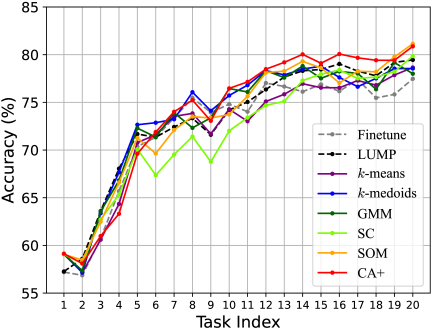
Fig. 2. History of accuracy on CIFAR-100.
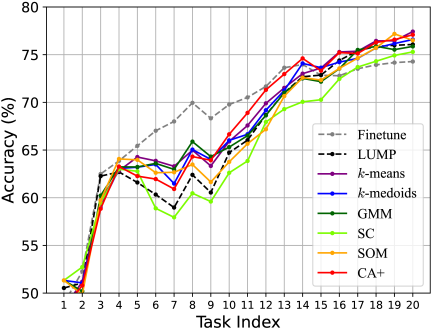
Fig. 3. History of accuracy on Tiny-ImageNet.
Table 3 presents the classification accuracy and forgetting after learning 20 tasks, which are presented as the mean and standard deviation over three runs. Fig. 2 and 3 depict the accuracy histories of CIFAR-100 and Tiny-ImageNet, respectively. Finetune and LUMP denote the baseline methods, whereas the remaining entries correspond to our proposed methods, which combine LUMP+SidAE+Clustering with various clustering methods. As shown in Table 3, the proposed methods outperform the baselines (Finetune and LUMP) on both datasets. For CIFAR-100, the proposed method using SOM achieved the highest accuracy, whereas for Tiny-ImageNet, the best performance was obtained using k-means. For forgetting, the variant employing CA+ produced the best results on both datasets. All methods incorporating LUMP outperform the plain Finetune, indicating that LUMP substantially mitigates catastrophic forgetting. Moreover, from Figs. 2 and 3, we observe that the CA+ variant attained superior accuracy, particularly in the latter half of the task sequence, suggesting that the CA+-based selection of replay data benefitted the learning of later tasks.
Our methods, using k-medoids, GMM, SC, and SOM as clustering algorithms, exhibited higher forgetting than LUMP. However, because forgetting metric is defined based on the difference between the maximum accuracy achieved for each task during training and the final accuracy, forgetting may be greater if the model achieves a higher accuracy in the early stages of training.
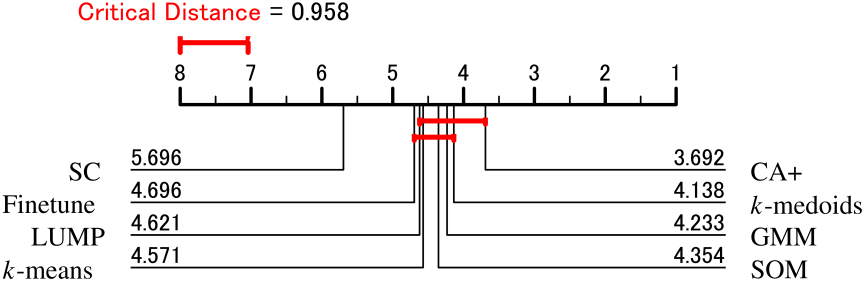
Fig. 4. CD diagram of the accuracy on ID condition.
| Method | Clustering | CIFAR-10 | CIFAR-100 | SVHN | MNIST |
| Finetune | N/A | 86.573 (0.252) | 73.500 (0.441) | 39.330 (0.600) | 94.530 (0.249) |
| LUMP | N/A | 87.267 (0.866) | 74.770 (1.818) | 40.741 (1.122) | 93.953 (0.542) |
| Ours | k-means | 87.717 (0.562) | 76.507 (0.670) | 42.230 (0.926) | 94.770 (0.169) |
| k-medoids | 87.573 (0.202) | 75.290 (0.093) | 41.477 (0.722) | 94.630 (0.265) | |
| GMM | 87.297 (0.107) | 75.487 (0.318) | 40.028 (0.426) | 93.687 (0.222) | |
| SC | 87.147 (1.087) | 74.230 (1.257) | 40.491 (3.861) | 93.843 (0.174) | |
| SOM | 87.600 (0.271) | 76.303 (0.987) | 42.321 (1.002) | 94.517 (0.480) | |
CA+
|
87.853 (0.387) | 75.920 (0.551) | 38.897 (0.941) | 94.180 (0.499) |
The best value in each metric is indicated in bold.
A darker tone in a cell corresponds to a higher accuracy.
| Architecture | Clustering | CIFAR-100 | Tiny-ImageNet |
| SimSiam | N/A | 79.453 (0.633) | 76.067 (2.281) |
| SimSiam | CA+
|
80.647 (1.787) | 76.960 (1.242) |
| SidAE | N/A | 80.537 (0.917) | 77.327 (1.363) |
| SidAE | CA+
|
80.873 (0.447) | 77.087 (0.918) |
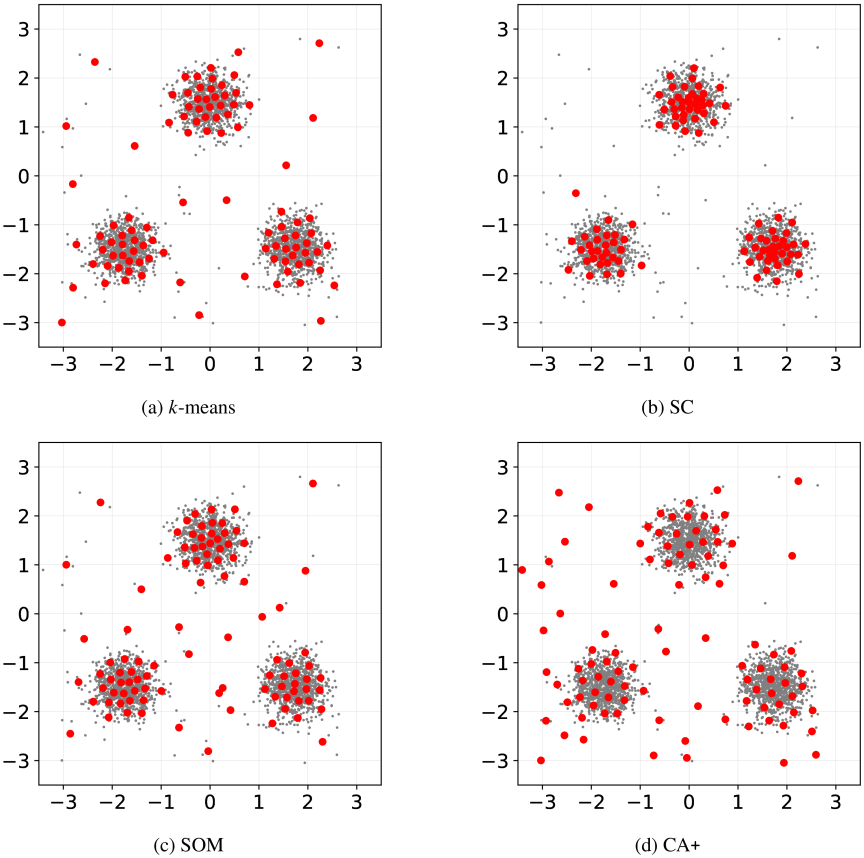
Fig. 5. Comparison of clustering algorithms. Black points denote data samples and red points denote clustering centroids.
We performed a statistical comparison of accuracy across all 20 tasks for both datasets using the Friedman test, followed by the Nemenyi post-hoc analysis. The Friedman test assesses the null hypothesis that all algorithms exhibit equivalent performance. When this null hypothesis is rejected, the Nemenyi post-hoc analysis is used for pairwise comparisons based on the per-task ranks of accuracy. The performance difference between the two algorithms is deemed statistically significant if the \(p\)-value from the Nemenyi post-hoc analysis is below the chosen significance level. In this study, we set the significance level at 5% for both the Friedman test and the Nemenyi post-hoc tests. Fig. 4 shows the critical-distance (CD) diagram produced by the Nemenyi test for the 20-task accuracy on each dataset. The numerical values indicate the average ranks of each method (lower ranks are better); the methods connected within the CD are not statistically different. Except for the variant using SC, the proposed clustering-based methods achieved higher ranks than the Finetune and LUMP baselines, with CA+ obtaining the best overall rank.
5.5. Results with Out-of-Distribution Condition
Table 4 presents classification accuracy on OOD conditions, reported as the mean and standard deviation over three runs. For both CIFAR-100 and MNIST, the proposed method employing k-means clustering achieved the best performance. This superior OOD performance is likely attributable to the fact that the k-means variant also attained the highest accuracy on the ID condition on Tiny-ImageNet.
In the OOD setting, our evaluation focuses on measuring the generalization ability of learned representations across different datasets rather than explicitly evaluating the OOD detection capability. In particular, the relatively lower accuracy observed for SVHN can be attributed to the significant distribution gap between the training dataset (Tiny-ImageNet) and the SVHN dataset, which contains images of digits that differ substantially from natural images.
5.6. Ablation Study
To evaluate the individual contributions of our two proposed components, we conducted an ablation study in which LUMP was augmented with either CA+-based data selection only or with the decoder only. Table 5 shows the classification accuracy after the completion of the 20 tasks. For CIFAR-100, the variant combining clustering (CA+) and the decoder achieved the highest accuracy. For Tiny-ImageNet, the combined variant does not achieve the best performance. However, both single-component variants, namely, LUMP with CA+ data selection only and LUMP with the decoder (reconstruction loss) added only, yielded improvements over the baseline LUMP.
5.7. Consideration of Clustering Algorithms
To investigate the effects of different clustering algorithms, we compared their characteristic behaviors, as illustrated in Fig. 5. In the figure, the black points denote data samples and the red points denote clustering centroids. The results for k-medoids and GMM closely resemble those for k-means. In contrast, k-means, SOM, and CA+ place centroids even in low-density regions, resulting in a broadly distributed set of centroids across the space. SC, however, concentrates centroids only in high-density regions. A clustering algorithm that yields widely distributed centroids can select samples that are far apart in the latent space and therefore maintain greater diversity in the replay buffer. Among the evaluated methods, CA+ is particularly promising because it determines centroids by updating nodes directly with incoming data rather than by computing centroids, which likely enables it to preserve a more representative and diverse set of replay samples.
6. Conclusion
We improved the learning performance of continual SSL by integrating a replay-buffer data selection strategy with an autoencoder architecture within the LUMP self-supervised continual learning framework. We also evaluated several clustering algorithms and investigated those that were appropriate for replay buffer sampling. Computational experiments showed that the proposed approach enhanced the learning performance, with CA+ yielding the best overall results.
Although our experiments were centered on LUMP, the proposed components are not inherently tied to LUMP itself. Clustering-based data selection targets the replay buffer construction process, and the decoder targets the representation learning quality. Therefore, both components can potentially be applied to other replay-based unsupervised continual learning frameworks. Recent studies have shown that replay-based methods, such as Osiris 48, achieve superior performance compared to other approaches in unsupervised continual learning. Because Osiris also relies on a replay buffer updated via reservoir sampling, using our framework can further improve its performance.
In future work, we will consider a framework that stores previously learned data in the latent space rather than the replay buffer samples and extend the proposed approach to class-incremental learning scenarios.
Acknowledgments
This research was supported in part by the 2025 Osaka Metropolitan University (OMU) Strategic Research Promotion Project (Young Researcher), Grant Number OMU-SRPP2025_YR07, and in part by the Japan Society for the Promotion of Science (JSPS), KAKENHI Grant Number JP25K03187.
Footnotes
- [1] Q. Sang, Z. Shu, L. Liu, C. Hu, and Q. Wu, “Image quality assessment based on self-supervised learning and knowledge distillation,” J. of Visual Communication and Image Representation, Vol.90, Article No.103708, 2023. https://doi.org/10.1016/j.jvcir.2022.103708
- [2] V. Rani, S. T. Nabi, M. Kumar, A. Mittal, and K. Kumar, “Self-supervised learning: A succinct review,” Archives of Computational Methods in Engineering, Vol.30, No.4, pp. 2761-2775, 2023. https://doi.org/10.1007/s11831-023-09884-2
- [3] D. Madaan, J. Yoon, Y. Li, Y. Liu, and S. J. Hwang, “Representational continuity for unsupervised continual learning,” Proc. of Int. Conf. on Learning Representations, 2022.
- [4] F. Baier, S. Mair, and S. G. Fadel, “Self-supervised siamese autoencoders,” I. Miliou, N. Piatkowski, and P. Papapetrou (Eds.), “Lecture Notes in Computer Science,” pp. 117-128, 2024. https://doi.org/10.1007/978-3-031-58547-0_10
- [5] J. Gui, T. Chen, J. Zhang, Q. Cao, Z. Sun, H. Luo, and D. Tao, “A survey on self-supervised learning: Algorithms, applications, and future trends,” IEEE Trans. on Pattern Analysis and Machine Intelligence, Vol.46, No.12, pp. 9052-9071, 2024. https://doi.org/10.1109/tpami.2024.3415112
- [6] T. Chen, S. Kornblith, M. Norouzi, and G. Hinton, “A simple framework for contrastive learning of visual representations,” Proc. of the 37th Int. Conf. on Machine Learning, Vol.119, pp. 1597-1607, 2020.
- [7] K. He, H. Fan, Y. Wu, S. Xie, and R. Girshick, “Momentum contrast for unsupervised visual representation learning,” 2020 IEEE/CVF Conf. on Computer Vision and Pattern Recognition (CVPR), pp. 9726-9735, 2020. https://doi.org/10.1109/cvpr42600.2020.00975
- [8] M. Caron, I. Misra, J. Mairal, P. Goyal, P. Bojanowski, and A. Joulin, “Unsupervised learning of visual features by contrasting cluster assignments,” Proc. of Advances in Neural Information Processing Systems, pp. 9912-9924, 2020.
- [9] J.-B. Grill, F. Strub, F. Altché, C. Tallec, P. Richemond, E. Buchatskaya, C. Doersch, B. Avila Pires, Z. Guo, M. Gheshlaghi Azar, B. Piot, K. Kavukcuoglu, R. Munos, and M. Valko, “Bootstrap your own latent: A new approach to self-supervised learning,” Proc. of Advances in Neural Information Processing Systems, pp. 21271-21284, 2020.
- [10] X. Chen and K. He, “Exploring simple siamese representation learning,” 2021 IEEE/CVF Conf. on Computer Vision and Pattern Recognition (CVPR), pp. 15745-15753, 2021. https://doi.org/10.1109/cvpr46437.2021.01549
- [11] J. Zbontar, L. Jing, I. Misra, Y. LeCun, and S. Deny, “Barlow twins: Self-supervised learning via redundancy reduction,” Proc. of Int. Conf. on Machine Learning, pp. 12310-12320, 2021.
- [12] K. He, X. Chen, S. Xie, Y. Li, P. Dollar, and R. Girshick, “Masked autoencoders are scalable vision learners,” 2022 IEEE/CVF Conf. on Computer Vision and Pattern Recognition (CVPR), pp. 15979-15988, 2022. https://doi.org/10.1109/cvpr52688.2022.01553
- [13] Z. Xie, Z. Zhang, Y. Cao, Y. Lin, J. Bao, Z. Yao, Q. Dai, and H. Hu, “SimMIM: a simple framework for masked image modeling,” 2022 IEEE/CVF Conf. on Computer Vision and Pattern Recognition (CVPR), pp. 9643-9653, 2022. https://doi.org/10.1109/cvpr52688.2022.00943
- [14] J. Kirkpatrick, R. Pascanu, N. Rabinowitz, J. Veness, G. Desjardins, A. A. Rusu, K. Milan, J. Quan, T. Ramalho, A. Grabska-Barwinska, D. Hassabis, C. Clopath, D. Kumaran, and R. Hadsell, “Overcoming catastrophic forgetting in neural networks,” Proc. of the National Academy of Sciences, Vol.114, No.13, pp. 3521-3526, 2017. https://doi.org/10.1073/pnas.1611835114
- [15] F. Zenke, B. Poole, and S. Ganguli, “Continual learning through synaptic intelligence,” Proc. of the 34th Int. Conf. on Machine Learning, pp. 3987-3995, 2017.
- [16] A. A. Rusu, N. C. Rabinowitz, G. Desjardins, H. Soyer, J. Kirkpatrick, K. Kavukcuoglu, R. Pascanu, and R. Hadsell, “Progressive neural networks,” arXiv:1606.04671, 2016. https://doi.org/10.48550/arXiv.1606.04671
- [17] A. Mallya and S. Lazebnik, “PackNET: Adding multiple tasks to a single network by iterative pruning,” 2018 IEEE/CVF Conf. on Computer Vision and Pattern Recognition (CVPR), pp. 7765-7773, 2018. https://doi.org/10.1109/cvpr.2018.00810
- [18] P. Buzzega, M. Boschini, A. Porrello, D. Abati, and S. Calderara, “Dark experience for general continual learning: A strong, simple baseline,” Proc. of Advances in Neural Information Processing Systems, pp. 15920-15930, 2020.
- [19] D. Lopez-Paz and M. A. Ranzato, “Gradient episodic memory for continual learning,” Proc. of Advances in Neural Information Processing Systems, 2017.
- [20] H. Zhang, M. Cisse, Y. N. Dauphin, and D. Lopez-Paz, “mixup: Beyond empirical risk minimization,” Proc. of Int. Conf. on Learning Representations, 2018.
- [21] Z. Shen, Z. Liu, Z. Liu, M. Savvides, T. Darrell, and E. Xing, “Un-mix: Rethinking image mixtures for unsupervised visual representation learning,” Proc. of the AAAI Conf. on Artificial Intelligence, Vol.36, No.2, pp. 2216-2224, 2022. https://doi.org/10.1609/aaai.v36i2.20119
- [22] D. Reynolds, “Gaussian mixture models,” S. Z. Li and A. K. Jain (Eds.), “Encyclopedia of Biometrics,” Springer, pp. 827-832, 2015. https://doi.org/10.1007/978-1-4899-7488-4_196
- [23] S. Lloyd, “Least squares quantization in PCM,” IEEE Trans. on Information Theory, Vol.28, No.2, pp. 129-137, 1982. https://doi.org/10.1109/tit.1982.1056489
- [24] B. Fritzke, “A growing neural gas network learns topologies,” Proc. of Advances in Neural Information Processing Systems, 1994.
- [25] G. Carpenter and S. Grossberg, “The art of adaptive pattern recognition by a self-organizing neural network,” Computer, Vol.21, No.3, pp. 77-88, 1988. https://doi.org/10.1109/2.33
- [26] F. Shen and O. Hasegawa, “A fast nearest neighbor classifier based on self-organizing incremental neural network,” Neural Networks, Vol.21, No.10, pp. 1537-1547, 2008. https://doi.org/10.1016/j.neunet.2008.07.001
- [27] C. Wiwatcharakoses and D. Berrar, “SOINN+, a self-organizing incremental neural network for unsupervised learning from noisy data streams,” Expert Systems with Applications, Vol.143, Article No.113069, 2020. https://doi.org/10.1016/j.eswa.2019.113069
- [28] S. Marsland, J. Shapiro, and U. Nehmzow, “A self-organising network that grows when required,” Neural Networks, Vol.15, No. 8-9, pp. 1041-1058, 2002. https://doi.org/10.1016/s0893-6080(02)00078-3
- [29] G. A. Carpenter, S. Grossberg, and D. B. Rosen, “Fuzzy ART: Fast stable learning and categorization of analog patterns by an adaptive resonance system,” Neural Networks, Vol.4, No.6, pp. 759-771, 1991. https://doi.org/10.1016/0893-6080(91)90056-b
- [30] B. Vigdor and B. Lerner, “The Bayesian ARTMAP,” IEEE Trans. on Neural Networks, Vol.18, No.6, pp. 1628-1644, 2007. https://doi.org/10.1109/tnn.2007.900234
- [31] L. Wang, H. Zhu, J. Meng, and W. He, “Incremental local distribution-based clustering using Bayesian adaptive resonance theory,” IEEE Trans. on Neural Networks and Learning Systems, Vol.30, No.11, pp. 3496-3504, 2019. https://doi.org/10.1109/tnnls.2019.2919723
- [32] L. E. B. da Silva, I. Elnabarawy, and D. C. Wunsch, “Distributed dual vigilance fuzzy adaptive resonance theory learns online, retrieves arbitrarily-shaped clusters, and mitigates order dependence,” Neural Networks, Vol.121, pp. 208-228, 2020. https://doi.org/10.1016/j.neunet.2019.08.033
- [33] W. Liu, P. P. Pokharel, and J. C. Principe, “Correntropy: Properties and applications in non-gaussian signal processing,” IEEE Trans. on Signal Processing, Vol.55, No.11, pp. 5286-5298, 2007. https://doi.org/10.1109/tsp.2007.896065
- [34] N. Masuyama, C. K. Loo, and F. Dawood, “Kernel Bayesian ART and ARTMAP,” Neural Networks, Vol.98, pp. 76-86, 2018. https://doi.org/10.1016/j.neunet.2017.11.003
- [35] N. Masuyama, C. K. Loo, and S. Wermter, “A Kernel Bayesian adaptive resonance theory with a topological structure,” Int. J. of Neural Systems, Vol.29, No.5, Article No.1850052, 2019, pMID: 30764724. https://doi.org/10.1142/s0129065718500521
- [36] N. Masuyama, C. K. Loo, H. Ishibuchi, N. Kubota, Y. Nojima, and Y. Liu, “Topological clustering via adaptive resonance theory with information theoretic learning,” IEEE Access, Vol.7, pp. 76920-76936, 2019. https://doi.org/10.1109/access.2019.2921832
- [37] N. Masuyama, N. Amako, Y. Nojima, Y. Liu, C. K. Loo, and H. Ishibuchi, “Fast topological adaptive resonance theory based on correntropy induced metric,” 2019 IEEE Symp. Series on Computational Intelligence (SSCI), pp. 2215-2221, 2019. https://doi.org/10.1109/ssci44817.2019.9003098
- [38] L. E. B. da Silva, I. Elnabarawy, and D. C. Wunsch, “Dual vigilance fuzzy adaptive resonance theory,” Neural Networks, Vol.109, pp. 1-5, 2019. https://doi.org/10.1016/j.neunet.2018.09.015
- [39] L. Meng, A.-H. Tan, and D. C. Wunsch, “Adaptive scaling of cluster boundaries for large-scale social media data clustering,” IEEE Trans. on Neural Networks and Learning Systems, Vol.27, No.12, pp. 2656-2669, 2016. https://doi.org/10.1109/tnnls.2015.2498625
- [40] N. Masuyama, Y. Nojima, Y. Toda, C. K. Loo, H. Ishibuchi, and N. Kubota, “Privacy-preserving continual federated clustering via adaptive resonance theory,” IEEE Access, Vol.12, pp. 139692-139710, 2024. https://doi.org/10.1109/access.2024.3467114
- [41] K. He, X. Zhang, S. Ren, and J. Sun, “Deep residual learning for image recognition,” 2016 IEEE Conf. on Computer Vision and Pattern Recognition (CVPR), pp. 770-778, 2016. https://doi.org/10.1109/cvpr.2016.90
- [42] A. Krizhevsky, “Learning Multiple Layers of Features From Tiny Images,” University of Toronto, 2012.
- [43] J. Deng, W. Dong, R. Socher, L.-J. Li, K. Li, and L. Fei-Fei, “ImageNet: A large-scale hierarchical image database,” 2009 IEEE Computer Society Conf. on Computer Vision and Pattern Recognition Workshops (CVPR Workshops), pp. 248-255, 2009. https://doi.org/10.1109/cvpr.2009.5206848
- [44] L. Wang, X. Zhang, H. Su, and J. Zhu, “A comprehensive survey of continual learning: Theory, method and application,” IEEE Trans. on Pattern Analysis and Machine Intelligence, Vol.46, No.8, pp. 5362-5383, 2024. https://doi.org/10.1109/tpami.2024.3367329
- [45] L. Kaufman and P. J. Rousseeuw, “Partitioning around medoids (program PAM),” L. Kaufman and P. J. Rousseeuw, “Finding Groups in Data: An Introduction to Cluster Analysis,” John Wiley & Sons, Inc., pp. 68-125, 1990.
- [46] A. Y. Ng, M. I. Jordan, and Y. Weiss, “On spectral clustering: Analysis and an algorithm,” Proc. of the 15th Int. Conf. on Neural Information Processing Systems: Natural and Synthetic, pp. 849-856, 2001.
- [47] T. Kohonen, “The self-organizing map,” Proc. of the IEEE, Vol.78, No.9, pp. 1464-1480, 1990. https://doi.org/10.1109/5.58325
- [48] Y. Zhang, L. Charlin, R. Zemel, and M. Ren, “Integrating present and past in unsupervised continual learning,” arXiv:2404.19132, 2024. https://doi.org/10.48550/arXiv.2404.19132
This article is published under a Creative Commons Attribution-NoDerivatives 4.0 Internationa License.