
Research Paper:
YOLO-CG: A Lightweight and High-Precision Obstacle-Detection Model for Intelligent Wheelchairs
Yan Yu*1,†, Jie Lin*2, Li Liu*3, and Jingjing Ma*4
*1Community Education College, Luzhou Open University
No.1, Section 3 of Jiusi Road Longtan District, Luzhou, Sichuan 646000, China
†Corresponding author
*2School of Finance and Trade, Chengdu Vocational Technical College of Industry and Trade
No.188 Gangtong North Third Road, Pidu District, Chengdu, Sichuan 611741, China
*3School of Artificial Intelligence and Big Data, Luzhou Vocational and Technical College
No.2 Changqiao Road, Longmatan District, Luzhou, Sichuan 646000, China
*4College of Information Technology, Sichuan Vocational College of Finance and Economics
No.4111 Yidu West Road, Longquanyi District, Chengdu 610101, China

Against the backdrop of aging populations, research and development of intelligent wheelchairs in the field of smart eldercare are important. However, when applied in eldercare communities, blind-spot obstacle detection for intelligent wheelchairs faces challenges such as target cross-occlusion, complex features, and difficulties in embedding existing algorithms into low-efficiency resource-constrained devices. Therefore, we propose a lightweight YOLO-CG network. First, we constructed an intelligent wheelchair blind-spot obstacle-detection dataset that categorizes hazardous obstacle targets into seven classes using data collected from field research. Second, a coordinate attention (CA) mechanism and Ghost module were fused to propose the CA-Ghost module. Finally, a C3 module in the neck part of the original model was replaced with the Ghost-SE module. Experimental results demonstrate a 14% improvement in the harmonic mean F1-score of the improved model, with a reduction of 18.27% and 30.5% in total parameter count and GFLOPs, respectively, showing performance enhancements on both public and self-made datasets.
1. Introduction
With the increasing global population aging, the proportion of older adults continues to rise worldwide, profoundly impacting socioeconomic structures and posing unprecedented challenges to eldercare service systems. According to the Seventh National Population Census conducted by the National Bureau of Statistics of China, the population aged 60 and above has exceeded 260 million, accounting for 18.7% of the total population, while those aged 65 and above make up 13.5%, reflecting a rapidly aging population in China. In this context, smart eldercare has emerged as a crucial strategic approach to addressing the needs of the aging society. It encompasses not only the daily care and health management of older adults but also the safety and convenience of their mobility, serving as a key factor in enhancing their quality of life and promoting social harmony and stability. The intelligent wheelchair is a pivotal product in smart eldercare that significantly supports the mobility experience and safety of older adults through its intelligence. However, in specific settings of eldercare environments, blind-spot obstacle detection for intelligent wheelchairs has become a bottleneck hindering further development.
Due to the gradual decline in sensory functions in older adults, their ability to perceive the surrounding environment is significantly reduced, especially during wheelchair use, where they often struggle to accurately detect and avoid obstacles in blind spots, increasing the risk of accidents 1. Although existing technologies such as radar, ultrasonic sensors, and traditional image processing methods have achieved good results in obstacle detection, these approaches generally suffer from limitations that include susceptibility to environmental interference, high computational complexity, and poor adaptability to complex dynamic scenarios. As a result, they fail to meet the dual requirements of high precision and real-time performance for intelligent wheelchair obstacle detection in eldercare communities.
Whereas deep-learning-based object detection algorithms have achieved remarkable success in image recognition with high accuracy and robustness, their substantial computational costs and complex model structures pose significant challenges for deployment on resource-constrained embedded devices such as intelligent wheelchairs. Balancing detection accuracy with model complexity to achieve lightweight models has thus become a critical research issue in blind-spot obstacle detection for intelligent wheelchairs. Therefore, developing a lightweight blind-spot obstacle-detection algorithm suitable for intelligent wheelchairs for eldercare is important for improving mobility safety and reducing accidents among older adults. It also addresses the need to advance the smart eldercare industry and deeply integrate artificial intelligence with eldercare services.
We developed an improved lightweight wheelchair model based on YOLOv5. The main contributions of our work are as follows:
-
(1)
We constructed a coordinate attention (CA)-Ghost module to replace the original C3 module, enhancing the deep feature-extraction capability of the backbone network. The CA-Ghost module integrates the Ghost module with the CA mechanism, significantly improving the ability of the model to extract deep features.
-
(2)
We introduced a Ghost-SE module to replace the C3 module in the neck part of the original model, enabling the network to better adapt to resource-constrained devices and achieve a balance between model lightweightness and feature-extraction performance.
-
(3)
To address the challenges of blind-spot obstacle detection for intelligent wheelchairs in eldercare communities, we conducted systematic field surveys and data collection, adopting a simulated blind-spot perspective capture method to construct a dedicated dataset for model training and evaluation.
Through these improvements, this study aimed to achieve breakthroughs in blind-spot obstacle detection for intelligent wheelchairs, providing reliable technical support for safe and reliable mobility in eldercare communities and promoting the sustained and healthy development of the smart eldercare industry.
2. Related Work
Research on blind spot obstacle detection for intelligent wheelchairs in eldercare communities focuses on enhancing the safety of the elderly while using wheelchairs, particularly for those with diminished visual and auditory abilities, preventing accidents that may occur due to unnoticed or ignored obstacles in blind spots. Applying deep-learning algorithms from the field of artificial intelligence to upgrade wheelchairs enables accurate obstacle recognition and improves operational efficiency by embedding lightweight algorithms.
2.1. Traditional Sensor-Based Methods
In the field of object detection, scholars have extensively explored sensor-based approaches to obstacle detection. One common strategy employs hardware sensors such as radar and ultrasonic devices. For instance, Pellichero et al. compared the accuracy of rear obstacle detection in wheelchairs with and without sensor systems 2. Zhao et al. 3 adopted a multi-sensor fusion approach, combining ultrasonic and visual sensors for road-sign recognition to support route planning and robot obstacle avoidance. Beyond ultrasonic and radar sensors, laser and infrared sensors are also widely used in road-obstacle detection 4. Specifically, 2D LiDAR systems provide only distance information about obstacles 5, whereas 3D LiDAR systems scan in horizontal and vertical directions, offering richer spatial data including obstacle height 6. These sensor-based methods offer reliable performance under controlled conditions but often incur high hardware costs and limited adaptability in complex or dynamic environments.
2.2. Traditional Image-Processing Methods
Complementing sensor-based approaches, traditional computer-vision techniques have long been applied to obstacle detection. The Hough transform is a representative method that enables precise recognition based on linear features 7,8. It roughly determines object shapes by voting in parameter space and can effectively locate roadsides and segment potential obstacles when combined with morphological processing 9. Another prominent technique is optical flow (OF), which leverages motion cues between consecutive image frames. López et al. 10 segmented and processed optical flow generated by relative motion to extract visual features for character navigation. Similarly, Choi et al. 11 proposed an OF-based obstacle-detection method that adaptively separates scene backgrounds from foreground objects. The two classical OF algorithms—Lucas–Kanade and Horn–Schunck—are both difference-based and particularly effective in structured environments 12. During flow computation, \(k\)-means clustering is often employed to reconstruct obstacle shapes and detect road hazards. OF methods, broadly categorized into correlation-, difference-, and block-based types, encode relative motion between the camera and target objects, making them valuable for dynamic scene analysis.
2.3. Deep Learning-Based Methods
With the rise of convolutional neural networks (CNNs) 13, deep learning has revolutionized object detection, including obstacle detection in assistive robotics 14. Early efforts include the work of Xian et al. 15, who proposed a visual image obstacle type recognition model based on a computer-extended CNN. To address the limitations of most visual-recognition algorithms in complex scenarios and the high cost of detection equipment that is unsuitable for resource-constrained devices, they employed dilated convolutions to enhance model adaptability. Subsequent landmark architectures such as VGGNet 16, AlexNet 17, GoogleNet 18, and ResNet 19—along with their variants incorporating attention mechanisms 20—have demonstrated strong performance in visual recognition. More recently, transformer-based models have further advanced the field: Han et al. 21 introduced TNT, a high-performance visual transformer that leverages attention mechanisms, while Liu et al. 22 developed the Swin Transformer with a sliding window design based on the ViT framework, successfully applying visual attention to improve road obstacle-detection efficiency.
Obstacle detection, as a specialized form of object detection 23, encompasses two-stage and one-stage paradigms. Two-stage detectors like Fast R-CNN 24 and Faster R-CNN 25 achieve high accuracy at the cost of computational overhead. In contrast, one-stage methods prioritize speed without significantly compromising accuracy; notable examples include the YOLO series (YOLOv1 26, YOLOv2 27, YOLOv3 28, YOLOv4 29, YOLOv5, and YOLOv7 30) and SSD 31. To meet real-time requirements on resource-constrained platforms such as intelligent wheelchairs, model lightweighting strategies—such as reducing network depth—are commonly employed.
Several lightweight architectures have been designed for efficient inference. SqueezeNet 32, developed by researchers from Berkeley and Stanford, uses Fire modules to minimize parameters and computation. MobileNets (V1 33, V2 34, and V3 35), introduced by Google, adopt depthwise separable convolutions 36 and inverted bottlenecks to reduce complexity. ShuffleNet 37, from the Face++ team, incorporates channel shuffling to accelerate convolutional operations. EfficientNet 38, released by Google in 2019, balances network depth, width, and resolution through compound scaling. GhostNet 39, proposed by Huawei’s Noah’s Ark Lab, enhances feature representation via Ghost modules. While these models excel in efficiency, they often face limitations in complex scenarios—particularly when detecting small or occluded objects—due to reduced capacity in capturing fine-grained or multi-scale features.
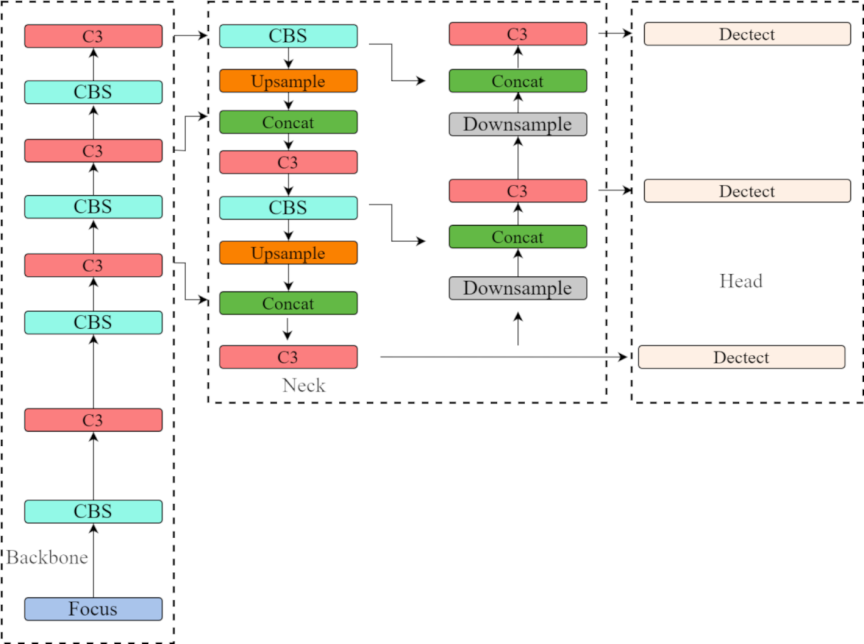
Fig. 1. Network structure of YOLOv5.
3. Method
3.1. YOLOv5 Algorithm
The YOLOv5 algorithm is an improved and iterative algorithm within the YOLO series. Given that the YOLOv5 algorithm demonstrates suitable real-time performance on devices with limited computing power, such as mobile and embedded devices, and compared to newer iterative algorithms, YOLOv5 boasts a highly mature structural system and greater code stability 40. YOLOv5 was selected as the foundational network for this study. Fig. 1 illustrates the basic network structure of YOLOv5. It encompasses five architectures: YOLOv5n, YOLOv5s, YOLOv5m, YOLOv5l, and YOLOv5x. The distinctions among these five architectures lie in their varying model depths, sizes, and parameter quantities. Since this study primarily focused on intelligent wheelchair blind-spot obstacle detection in the context of elderly care communities, where real-time performance is a requirement, an adaptive improvement design based on YOLOv5s was chosen.
As shown in Fig. 1, YOLOv5 is divided into four modules: input, backbone, neck, and output. These four modules are responsible for data input, feature learning, feature enhancement, and target detection and classification.
The input layer performs mosaic operations on the input data, primarily involving cutting, stitching, size adaptation, and optimizing the calculation of anchor boxes for the input image data. By employing mosaic data augmentation, the diversity of the dataset is increased, enhancing model robustness and generalizability. Simultaneously, the image size is optimized at the input end to unify the dimensions of the input data.
The backbone layer is primarily used for feature learning and mainly consists of modules such as C3, CBS, and SPPF. The C3 module is akin to the original CSP structure, comprising CBS and residual-structure modules. The input of the residual structure module undergoes two layers of convolution and is then added to the original value. Through parallel computation, the C3 module outputs features with unchanged depth, facilitating the transmission of residual features. The SPPF module fuses deep and shallow information, enhancing the feature-extraction capability of the network.
The neck layer adopts a PANet structure, achieving feature enhancement through multi-layer feature fusion of deep and shallow features in both top-down and bottom-up directions. This approach increases model robustness and improves the accuracy of target detection.
The head structure in the output layer is designed with three detection heads for detecting targets of different scales. Each detection head acquires feature information of varying scales from different layers of the neck, thereby obtaining the predicted bounding box positions and category information of targets in the input image.
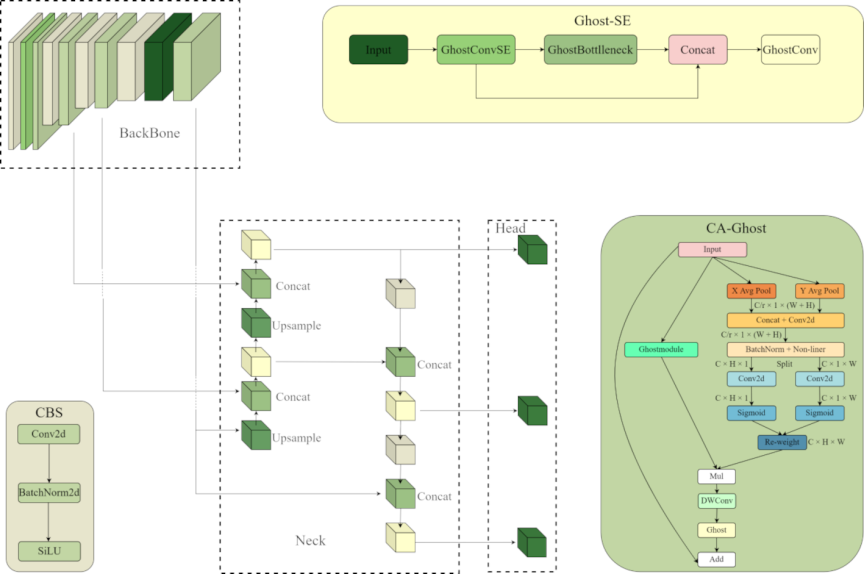
Fig. 2. YOLO-CG network structure.
3.2. YOLO-CG Algorithm
Our proposed YOLO-CG model is based on the YOLOv5 architecture. For model initialization, we leveraged transfer learning by loading the official YOLOv5 pre-trained weights. This provides a strong starting point for convergence. It is important to note that the weights for the newly introduced modules, namely the CA-Ghost and Ghost-SE modules, could not be loaded from these pre-trained weights owing to architectural differences. Therefore, the parameters in these new modules were randomly initialized. The model was then trained and validated on our custom dataset, using the splits defined in Section 4.1. Batch normalization was employed during training to stabilize and accelerate the learning process. To address the challenge of intelligent wheelchair blind-spot obstacle detection in elderly care community environments, ensuring compatibility with devices with limited computational resources while achieving a balance between detection performance and model lightweighting, and guaranteeing a comprehensive model that is both compact and powerful, the YOLO-CG network architecture (Fig. 2) introduces distinct structural modifications in its backbone and neck components. In the backbone, a CA-Ghost structure is proposed based on the Ghost module concept to reduce the number of operators and parameters in the model. Additionally, it leverages the CA mechanism to focus on global information. Compared to other attention mechanisms, CA exhibits stronger feature extraction capabilities, capturing more detailed features both between and within channels through two dimensions. In the neck component, which differs from the CA-Ghost structure of the backbone, the PANet structure is employed. Unlike the deep feature semantic acquisition in the backbone, the neck primarily focuses on feature fusion, proposing a GhostSE structure based on SE attention.
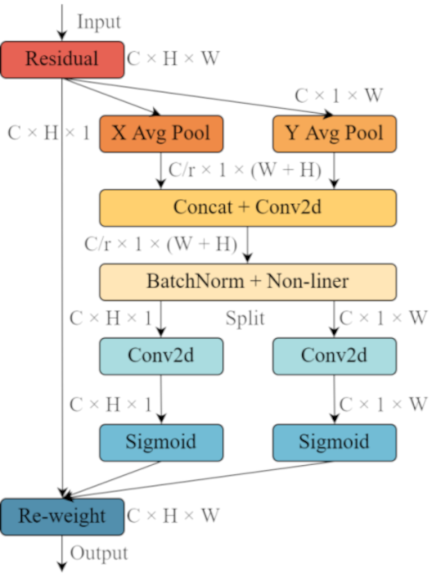
Fig. 3. Schematic diagram of a CA module.
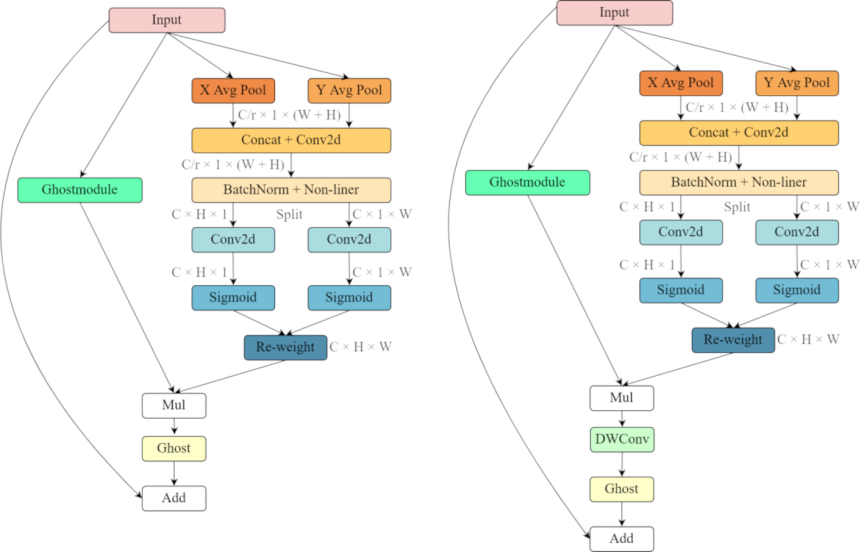
Fig. 4. CA-Ghost module fusion diagram.
3.2.1. CA-Ghost Module
The characteristic of the CA mechanism lies in its ability to focus on both intra-channel and inter-channel information interactions. It can decompose channel attention into a spatial encoding process in both horizontal and vertical directions. Between channels, the CA mechanism can attend to the relationships among different channels based on the vertical spatial direction, enhancing the linked expression of information features across channels and better capturing the characteristics of data among channels. Within a channel, the focus on inter-channel relationships by the CA mechanism influences the feature expression within a single channel. It obtains positional information relationships through the horizontal spatial direction and weights the feature information from both parts to increase emphasis on the regions of interest.
According to the attention module shown in Fig. 3, the CA mechanism performs bidirectional average pooling operations on the information within and between channels in both horizontal and vertical directions, with pooling sizes of \((H,1)\) and \((1,W)\), respectively. The specific mathematical expressions are presented in Eqs. (1) and (2):
The two parts obtained after average pooling are subjected to weighted concatenation, followed by feature dimensionality reduction through the \(F_1\) (\(1\times 1\) convolution) module. Subsequently, normalization and activation function (\(\delta\)) are applied to generate the feature vector \(f\), as expressed by Eq. (3):
The generated feature vector \(f\) is decomposed horizontally and vertically, and feature extraction is performed again on both intra-channel and inter-channel features in terms of width and height. \(F_w\) and \(F_h\) represent the convolutional module operations in the two respective directions. Finally, through mapping with the sigmoid activation function (\(\sigma\)), a weight vector is obtained and multiplied with the original input for concatenation, yielding the final weighted feature map \(y_c\), as mathematically expressed by Eq. (6):
To achieve real-time performance and high detection accuracy in blind-spot obstacle-detection applications for intelligent wheelchairs in elderly care communities, we used the YOLOv5 baseline network to simplify complex backbone networks and enhance feature extraction through attention embedding. The CA-Ghost module, illustrated in Fig. 4 (with a stride of 1 in the left diagram and 2 in the right diagram), is a critical network module within the backbone. Drawing inspiration from GhostnetV2, the CA-Ghost module acknowledges that the Ghost module inherently possesses only half the functionality and fewer essential features compared to the original output features. When extracting features from an input feature map \(X \in R^{H \times W \times C}\), the resulting output \(Y \in R^{H \times W \times C_{\mathit{out}}}\) experiences losses in both channel and positional information. To address this, the CA-Ghost module executes two steps: first, it generates a sparse feature map \(Y\) through the Ghost module; second, it captures channel and positional information using CA. Finally, these two sets of features are integrated to produce a novel output. By employing the CA-Ghost module, the feature-extraction capability of the model is enhanced, effectively capturing both channel and positional information from input features. This approach enables the acquisition of multi-dimensional feature information, better preserving feature details while simultaneously reducing the parameter count of the model.
Given an input feature \(X \in R^{H \times W \times C}\), with height \(H\), width \(W\), and channel count \(C\), the CA-Ghost module can replace standard convolution through a two-step process. First, intrinsic features are generated using a \(1 \times 1\) convolution, denoted by a mathematical computation formula \(F\), where \(\operatorname{Conv}_{1 \times 1}\) represents pointwise convolution, as expressed by Eq. (7):
\(Y' = R^{H \times W \times C'_{\mathit{out}}}\) represents intrinsic features, whose size is typically smaller than the original output features. The CA mechanism possesses stronger feature information compared to Deep-WiseConv. \(\delta\) represents complexity, compensating for the deficiencies in the original channel and positional information. \(\operatorname{Conv}_{\mathit{dp}}\) denotes depthwise separable convolution, and is expressed as Eq. (9):
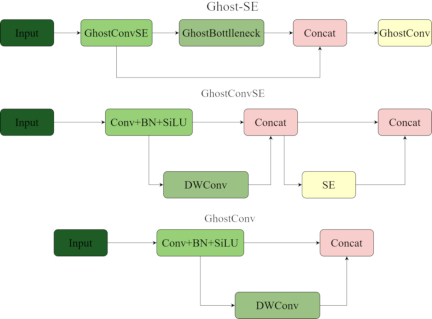
Fig. 5. Module diagram of GhostSE.
3.2.2. Ghost-SE Module
To further make the CA-Ghost-improved YOLO network more lightweight while maintaining a balance in detection performance and addressing the imbalance between lightweight and detection performance, PANet is structurally optimized in the neck layer. The GhostSE structure, which efficiently integrates the Ghost module and SE attention, is proposed, leading to the complete YOLO-CG network structure. Compared to CA in CA-Ghost, the SE attention mechanism focuses on inter-channel feature information. When acquiring inter-channel feature information, SE can adaptively learn the correlations between channels and dynamically adjust attention. Compared to the global computation and two-dimensional feature extraction of CA, SE attention has a smaller computational overhead. Using SE attention in the neck part is more suitable for the overall model solution approach. The GhostSE module in the neck part is shown in Fig. 5.
Figure 5 is divided into three parts: (a) depicts the GhostConvSE module structure. Based on the Ghost convolution concept, SE attention is incorporated to acquire more feature information. With an input channel number of C1, after obtaining a small number of intrinsic features through \(1\times 1\) convolution, DWConv is used to apply pointwise convolution on a single channel, similar to simple linear transformations in each layer, to complete the feature output, combined with SE attention. (b) aggregates the GhostConvSE modules, replacing the original bottleneck module in the C3 network with the GhostBottleneck module, proposing the GhostSE module, and substituting the C3 structure in the neck module. (c) shows the convolutional module GhostConv based on the Ghost module concept.
Assuming that for a given input feature \(X \in R^{H \times W \times C}\) in the module shown in Fig. 5, with a height of \(H\), width of \(W\), and number of channels \(C\), it is output as \(Y'\) through a \(1 \times 1\) Conv. \(Y'\) is then output as \(Y''\) after passing through the SE attention mechanism. By inputting \(Y''\) into the GhostSE module, after the Add operation, \(Z'\) is output. Finally, the output feature map \(Z\) is obtained, as described by Eq. (13):
| Vehicles | Household | Animals | Other |
| Aeroplane | Bottle | Bird | Person |
| Bicycle | Chair | Cat | |
| Boat | Dining table | Cow | |
| Bus | Potted plane | Dog | |
| Car | Sofa | Horse | |
| Motorbike | TV/Monitor | Sheep | |
| Train |
4. Experimental Results and Analysis
4.1. Dataset
Two datasets were employed: a public dataset, PASCAL VOC, and a specially created self-made dataset.
The PASCAL VOC dataset encompasses four major categories, namely Vehicles, Household, Animals, and Person. As shown in Table 1, these four major categories comprise 20 sub-categories. The 2007 version of the dataset contains 9,963 image data, while the 2012 version includes 22,531 image data, totaling 32,494 images.
To address the specific perception challenges of smart wheelchairs, a custom dataset was constructed, simulating real-world operating conditions. The data were acquired using a smartphone fixed to a simulated wheelchair mount, with the camera set to record at 1080p resolution. The camera was positioned to approximate a tilted top-down view, with a fixed angle of approximately 40 degrees relative to the chair back, capturing the critical area in front of and near the ground of the wheelchair. The data were collected from diverse scenarios within a senior community to obtain varied lighting and background conditions.
The dataset focused on seven categories of obstacles with potential hazards: cats, dogs, potholes, water bottles, legs, feet, and wheels. Particular emphasis was placed on legs, feet, and wheels, as they often appear partial, occluded, or at the image edges in this tilted perspective. The initial data pool was gathered through two methods: (1) extracting one frame from every five frames of captured videos and (2) employing web crawlers to collect additional images of specific targets like wheels. The collected images underwent a de-duplication process using a hashing algorithm followed by manual review to ensure quality and uniqueness. This process resulted in approximately 16,000 images: 5,000 from video frames and 11,000 from other sources. Fig. 6 shows sample video frames highlighting human body parts, while Fig. 7 presents data collected via web crawling. To enhance diversity and mitigate overfitting, several data augmentation techniques were applied, including scaling, flipping, cropping, mosaic, and mixup. Subsequently, the entire dataset was randomly partitioned into training, validation, and test sets at a ratio of \({7:2:1}\). This allocation ensures a robust evaluation of the model’s generalization performance on unseen data.
Our novel dataset comprised seven hazardous obstacle categories: cats, dogs, potholes, water bottles, legs, feet, and wheels. The dataset was partitioned into training (70%), validation (20%), and test (10%) sets (total: 16,000 samples), with exact counts provided in Table 2. The class distribution was moderately balanced, with legs and feet each containing 2,500 samples and the other five categories containing 2,200 samples each (Fig. 8). All annotations were performed by three trained annotators following standardized guidelines. (1) Bounding boxes tightly enclose the visible object region. (2) Partially occluded objects are annotated solely based on visible parts.
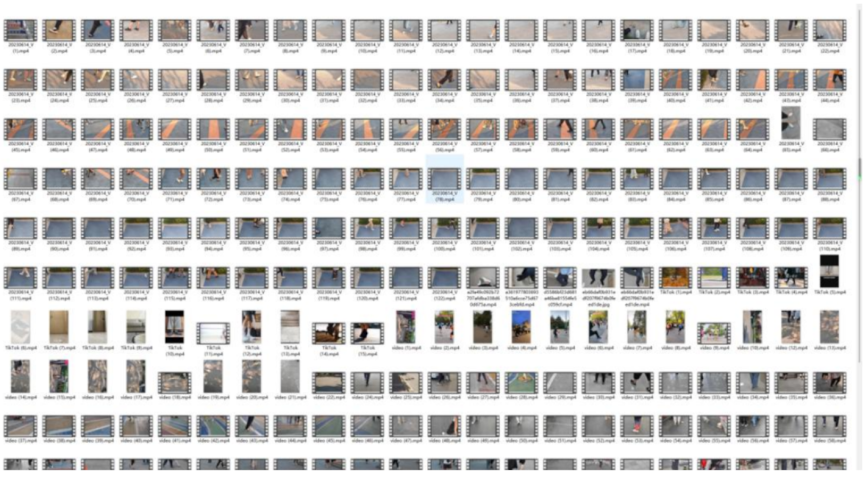
Fig. 6. Collected simulation video data.
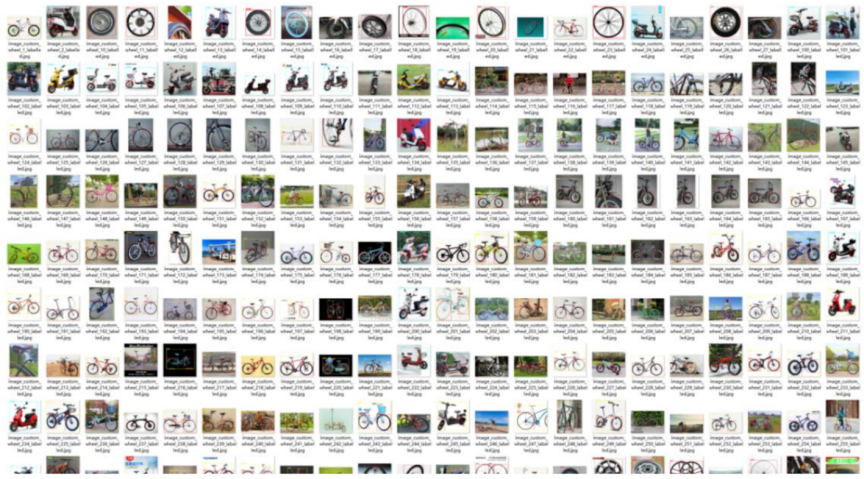
Fig. 7. Collation collection of relevant datasets.
| The total number of datasets | The number of training sets | The number of validation sets | The number of test sets |
| 16,000 | 11,200 | 3,200 | 1,600 |
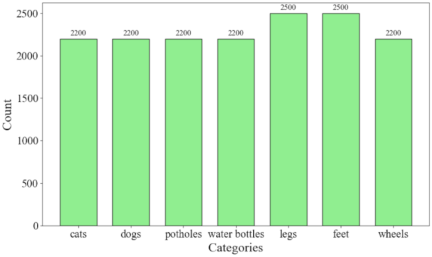
Fig. 8. Visualization of class distribution.
4.2. Evaluation Metrics
In object-detection tasks, it is often necessary to compare the predicted results with the ground truth labels to evaluate the performance of the algorithm. During this process, evaluation metrics are employed to describe the accuracy and completeness of the prediction results. The model is assessed by calculating four evaluation metrics: precision, recall, mean average precision (mAP), and F1-score:
Recall measures the ability of the model to identify all positive samples in a binary classification task. It represents the proportion of correctly identified positive samples out of all actual positive samples. A higher proportion indicates a stronger capability of the model in detecting positive samples. Recall is calculated as follows:
Mean average precision (mAP) integrates the approaches of precision and recall to enable model evaluation in multiclass classification. It typically provides a comprehensive assessment of the overall performance of the model by calculating the average precision for each class, considering the comprehensive performance of the model across all classes. Assuming there are \(n\) classes in the dataset, and \(\mathit{AP}_i\) represents the average precision for the \(i\)-th class, AP and mAP are calculated as follows:
4.3. Ablation Experiment Protocol
We performed ablation experiments to verify the effectiveness of the CA-Ghost and Ghost-SE modules.
All comparison models were trained and tested using the same datasets, partitioning methods, training strategies, and evaluation metrics described in Sections 4.1 and 4.2 to ensure fairness of the comparisons.
4.4. Comparative Experiment Protocol
To comprehensively evaluate the performance of the YOLO-CG model, we compared it with the current advanced lightweight detection models: YOLOv4-tiny, YOLOv4-MobileNetV3, YOLOXs, YOLOv7-tiny, and the original YOLOv5s. All comparison models were retrained and evaluated on our custom dataset using the same settings as in Section 4.3.
4.5. Analysis of Experimental Results
4.5.1. Ablation Experiment
The experimental results are shown in Table 3.
Based on the analysis of the experimental comparison results shown in Table 2, the YOLO-CG model demonstrates superior overall performance compared to the YOLO-C model. It reduces parameters by 1.47M and decreases GFLOPs by 3.29G, significantly reducing the model size, albeit with a slight decrease in mAP and precision. Thus, the proposed YOLO-CG model achieves a balance between accuracy and lightweight design, offering not only high accuracy but also a satisfactory level of model lightweighting.
4.5.2. Comparative Experiments
The experimental results are shown in Table 4.
Compared to the baseline YOLOv5s (7.28M parameters, 17.16G FLOPs, 84.06% mAP), the proposed YOLO-CG achieves a marginal improvement in mAP (84.19%) and F1-score (0.72) while significantly reducing model complexity—reducing parameters by 2.8M (38.5%) and FLOPs by 8.53G (49.7%). More importantly, YOLO-CG outperforms other lightweight models by a considerable margin: YOLOv4-tiny and YOLOv4-MobileNetV3 report mAPs of only 64.00% and 69.13%, respectively, despite having comparable or even larger parameter counts.
| Models |
Parameter (M) |
GFLOPS (G) |
mAP [%] |
| YOLO-C | 5.95 | 11.92 | 85.12 |
| YOLO-CG | 4.48 | 8.63 | 84.19 |
| Model |
Parameter (M) |
GFLOPS (G) |
mAP [%] |
F1 |
| YOLOv5s | 7.28 | 17.16 | 84.06 | 0.62 |
|
YOLOv4- MobileNetV3 |
11.73 | 18.22 | 69.13 | 0.68 |
| YOLOv4-tiny | 6.10 | 6.96 | 64.00 | 0.54 |
| YOLOXs | 8.95 | 26.73 | 83.80 | 0.74 |
| YOLOv7-tiny | 6.23 | 13.86 | 80.83 | 0.76 |
| YOLO-CG | 4.48 | 8.63 | 84.19 | 0.72 |
This performance gap can be attributed to fundamental differences in architectural design philosophy. Conventional lightweight approaches often rely on structural simplification—such as shallow backbones (YOLOv4-tiny) or off-the-shelf efficient networks (MobileNetV3)—which inevitably compromise feature richness and spatial resolution, leading to substantial accuracy loss. In contrast, YOLO-CG preserves detection capability through two purpose-built components: the CA-Ghost module, which fuses CA with ghost convolutions to enhance spatial-channel awareness without heavy computation, and the Ghost-SE module, which introduces a lightweight channel recalibration mechanism to retain discriminative features. Together, these modules enable YOLO-CG to maintain high representational power under strict resource constraints, thereby achieving state-of-the-art efficiency–accuracy trade-offs among compact detectors.
5. Conclusion
This study focused on addressing the challenges of blind-spot obstacle detection for intelligent wheelchairs within elderly care communities, including target overlap, occlusion, partial visibility, and trade-off between detection performance and model lightweightness. We proposed an improved YOLOv5-based model named YOLO-CG to enhance detection in such scenarios. A dedicated dataset for training and evaluation was constructed through field investigation. The main contributions are as follows:
-
(1)
To meet the needs of blind-spot detection in care communities, field surveys and multi-period observations were conducted. We collected images with characteristics of partial visibility and overlap using a smartphone to simulate the wheelchair blind-spot view, and compiled a tailored dataset. Obstacles were categorized into seven types based on on-site assessment: cats, dogs (aggressive), potholes, water bottles (static fragile), and legs, feet, and wheels (complex with clear occlusion and scale variation).
-
(2)
To balance performance and efficiency, we proposed YOLO-CG, which integrates attention mechanisms with Ghost modules. The CA-Ghost module, used in the backbone, combines the Ghost structure with CA to improve feature extraction. The Ghost-SE module in the neck reduces parameters via the Ghost design while strengthening features using SE attention. Experiments show that YOLO-CG maintains competitive mAP, improves F1-score and miss rate, and runs stably, while reducing parameters by 38.5% and GFLOPs by 49.7% compared to YOLOv5.
This performance gap can be attributed to fundamental differences in architectural design philosophy. Conventional lightweight approaches often rely on structural simplification—such as shallow backbones (YOLOv4-tiny) or off-the-shelf efficient networks (MobileNetV3)—which inevitably compromise feature richness and spatial resolution, leading to substantial accuracy loss. In contrast, YOLO-CG preserves detection capability through two purpose-built components: the CA-Ghost module, which fuses CA with ghost convolutions to enhance spatial-channel awareness without heavy computation, and the Ghost-SE module, which introduces a lightweight channel recalibration mechanism to retain discriminative features. Together, these modules enable YOLO-CG to maintain high representational power under strict resource constraints, thereby achieving state-of-the-art efficiency–accuracy trade-offs among compact detectors.
Acknowledgments
General Project of Sichuan Provincial Key Research Institute of Humanities and Social Sciences – Community Correction Research Center: “Research on Early Warning Methods for Abnormal Behaviors of Community Correction Personnel Based on Trajectory and Big Data Analysis,” Project Number: SQJZ2023-08; the planning project of Luzhou Social Sciences Association, “Research on the Mutual Aid Social Elderly Care Model in Rural Luzhou,” Project Number: LZ18A031; and Project Planning Project of Luzhou Science and Technology Bureau: “Research on Key Technologies of Video Pedestrian Re-identification for Complex Scenarios,” Project Number: 2023KTP167.
- [1] L. Lecrosnier et al., “Deep learning-based object detection, localisation and tracking for smart wheelchair healthcare mobility,” Int. J. Environ. Res. Public Health, Vol.18, No.1, Article No.91, 2021. https://doi.org/10.3390/ijerph18010091
- [2] A. Pellichero et al., “Blind spot sensor systems for power wheelchairs: Obstacle detection accuracy, cognitive task load, and perceived usefulness among older adults,” Disability Rehabil. Assist. Technol., Vol.18, No.7, pp. 1084-1092, 2023. https://doi.org/10.1080/17483107.2021.1983654
- [3] J. Zhao et al., “Obstacle avoidance of multi-sensor intelligent robot based on road sign detection,” Sensors, Vol.21, No.20, Article No.6777, 2021. https://doi.org/10.3390/s21206777
- [4] J. Wu, H. Wang, M. Zhang, and Y. Yu, “On obstacle avoidance path planning in unknown 3D environments: A fluid-based framework,” ISA Trans., Vol.111, pp. 249-264, 2021. https://doi.org/10.1016/j.isatra.2020.11.017
- [5] C. Pang et al., “Adaptive obstacle detection for mobile robots in urban environments using downward-looking 2D LiDAR,” Sensors, Vol.18, No.6, Article No.1749, 2018. https://doi.org/10.3390/s18061749
- [6] M. Dulău and F. Oniga, “Obstacle detection using a facet-based representation from 3-D LiDAR measurements,” Sensors, Vol.21, No.20, Article No.6861, 2021. https://doi.org/10.3390/s21206861
- [7] K. Zhao, Q. Han, C.-B. Zhang, J. Xu, and M.-M. Cheng, “Deep Hough transform for semantic line detection,” IEEE Trans. Pattern Anal. Mach. Intell., Vol.44, No.9, pp. 4793-4806, 2022. https://doi.org/10.1109/TPAMI.2021.3077129
- [8] Z. Zheng, H. Feng, Z. Sha, and Z. Zeng, “A sample learning free ϕ-OTDR pattern recognition method for PIG tracking based on Stockwell transform and improved Hough transform,” Opt. Laser Technol., Vol.192, Part D, Article No.113920, 2025. https://doi.org/10.1016/j.optlastec.2025.113920
- [9] K. Zebbara, “Stereo vision-based road obstacles detection and tracking,” Int. J. Comput., Vol.31, No.1, pp. 108-118, 2018. https://doi.org/10.53896/ijc.v31i1.1330
- [10] A. López, F. Chaumette, E. Marchand, and J. Pettré, “Character navigation in dynamic environments based on optical flow,” Comput. Graph. Forum, Vol.38, No.2, pp. 181-192, 2019. https://doi.org/10.1111/cgf.13629
- [11] H. Choi, B. Kang, and D. Kim, “Moving object tracking based on sparse optical flow with moving window and target estimator,” Sensors, Vol.22, No.8, Article No.2878, 2022. https://doi.org/10.3390/s22082878
- [12] N. Sepehri Boroujeni, S. A. Etemad, and A. Whitehead, “Fast obstacle detection using targeted optical flow,” 19th IEEE Int. Conf. Image Process., pp. 65-68, 2012. https://doi.org/10.1109/ICIP.2012.6466796
- [13] Z. Li, F. Liu, W. Yang, S. Peng, and J. Zhou, “A survey of convolutional neural networks: Analysis, applications, and prospects,” IEEE Trans. Neural Netw. Learn. Syst., Vol.33, No.12, pp. 6999-7019, 2022. https://doi.org/10.1109/TNNLS.2021.3084827
- [14] X. Ma and Z. Yang, “A new multi-scale backbone network for object detection based on asymmetric convolutions,” Sci. Prog., Vol.104, No.2, 2021. https://doi.org/10.1177/00368504211011343
- [15] Y. Xian, “Construction and application research of the visual image obstacle type recognition model based on the computer-expanded convolutional neural network,” Comput. Intell. Neurosci., Vol.2022, Article No.3123448, 2022. https://doi.org/10.1155/2022/3123448
- [16] D. Zhang, J. Lv, and Z. Cheng, “An approach focusing on the convolutional layer characteristics of the VGG network for vehicle tracking,” IEEE Access, Vol.8, pp. 112827-112839, 2020. https://doi.org/10.1109/ACCESS.2020.3003229
- [17] A. Krizhevsky, I. Sutskever, and G. E. Hinton, “ImageNet classification with deep convolutional neural networks,” Commun. ACM, Vol.6, No.6, pp. 84-90, 2017. https://doi.org/10.1145/3065386
- [18] C. Szegedy et al., “Going deeper with convolutions,” 2015 IEEE Conf. Comput. Vis. Pattern Recognit. (CVPR), 2015. https://doi.org/10.1109/CVPR.2015.7298594
- [19] K. He, X. Zhang, S. Ren, and J. Sun, “Deep residual learning for image recognition,” 2016 IEEE Conf. Comput. Vis. Pattern Recognit. (CVPR), pp. 770-778, 2016. https://doi.org/10.1109/CVPR.2016.90
- [20] L. Yuan et al., “Tokens-to-token ViT: Training vision transformers from scratch on ImageNet,” 2021 IEEE/CVF Int. Conf. Comput. Vis., pp. 538-547, 2021. https://doi.org/10.1109/ICCV48922.2021.00060
- [21] K. Han et al., “Transformer in transformer,” Proc. 35th Int. Conf. Neural Inf. Process. Syst., pp. 15908-15919, 2021.
- [22] Z. Liu et al., “Swin Transformer: Hierarchical vision Transformer using shifted windows,” 2021 IEEE/CVF Int. Conf. Comput. Vis., pp. 9992-10002, 2021. https://doi.org/10.1109/ICCV48922.2021.00986
- [23] A. A. Alarood and A. A. Ibrahim, “Factors and key criteria of an obstacles detection for people with disabilities,” Disability Rehabil. Assist. Technol., Vol.21, No.2, pp. 886-903, 2026. https://doi.org/10.1080/17483107.2025.2559189
- [24] X.-G. Wang, J.-S. Wang, P. Tang, and W.-Y. Liu, “Weakly- and semi-supervised fast region-based CNN for object detection,” J. Comput. Sci. Technol., Vol.34, No.6, pp. 1269-1278, 2019. https://doi.org/10.1007/s11390-019-1975-z
- [25] S. Ren, K. He, R. Girshick, and J. Sun, “Faster R-CNN: Towards real-time object detection with region proposal networks,” IEEE Trans. Pattern Anal. Mach. Intell., Vol.39, No.6, pp. 1137-1149, 2017. https://doi.org/10.1109/TPAMI.2016.2577031
- [26] J. Redmon, S. Divvala, R. Girshick, and A. Farhadi, “You only look once: Unified, real-time object detection,” 2016 IEEE Conf. Comput. Vis. Pattern Recognit. (CVPR), pp. 779-788, 2016. https://doi.org/10.1109/CVPR.2016.91
- [27] J. Redmon and A. Farhadi, “YOLO9000: Better, faster, stronger,” 2017 IEEE Conf. Comput. Vis. Pattern Recognit. (CVPR), pp. 6517-6525, 2017. https://doi.org/10.1109/CVPR.2017.690
- [28] M. Xu, Z. Wang, X. Liu, L. Ma, and A. Shehzad, “An efficient pedestrian detection for realtime surveillance systems based on modified YOLOv3,” IEEE J. Radio Freq. Identif., Vol.6, pp. 972-976, 2022. https://doi.org/10.1109/JRFID.2022.3212907
- [29] S. Li et al., “Enhanced automatic root recognition and localization in GPR images through a YOLOv4-based deep learning approach,” IEEE Trans. Geosci. Remote Sens., Vol.60, Article No.5114314, 2022. https://doi.org/10.1109/TGRS.2022.3181202
- [30] C.-Y. Wang, A. Bochkovskiy, and H.-Y. M. Liao, “YOLOv7: Trainable bag-of-freebies sets new state-of-the-art for real-time object detectors,” 2023 IEEE/CVF Conf. Comput. Vis. Pattern Recognit. (CVPR), pp. 7464-7475, 2023. https://doi.org/10.1109/CVPR52729.2023.00721
- [31] A. Huo, W. Zhang, and Y. Li, “Traffic sign recognition based on improved SSD model,” 2020 Int. Conf. Comput. Netw. Electron. Autom. (ICCNEA), pp. 54-58, 2020. https://doi.org/10.1109/ICCNEA50255.2020.00021
- [32] B. Qiang et al., “SqueezeNet and fusion network-based accurate fast fully convolutional network for hand detection and gesture recognition,” IEEE Access, Vol.9, pp. 77661-77674, 2021. https://doi.org/10.1109/ACCESS.2021.3079337
- [33] J. Yang, Y. Wang, H. Zhao, and G. Gui, “MobileNet and knowledge distillation-based automatic scenario recognition method in vehicle-to-vehicle systems,” IEEE Trans. Veh. Technol., Vol.71, No.10, pp. 11006-11016, 2022. https://doi.org/10.1109/TVT.2022.3184994
- [34] M. Sandler et al., “MobileNetV2: Inverted residuals and linear bottlenecks,” 2018 IEEE/CVF Conf. Comput. Vis. Pattern Recognit., pp. 4510-4520, 2018. https://doi.org/10.1109/CVPR.2018.00474
- [35] A Howard et al., “Searching for MobileNetV3,” 2019 IEEE/CVF Int. Conf. Comput. Vis. (ICCV), pp. 1314-1324, 2019. https://doi.org/10.1109/ICCV.2019.00140
- [36] M. G. do Nascimento, V. Prisacariu, and R. Fawcett, “DSConv: Efficient convolution operator,” 2019 IEEE/CVF Int. Conf. Comput. Vis., pp. 5147-5156, 2019. https://doi.org/10.1109/ICCV.2019.00525
- [37] X. Zhang, X. Zhou, M. Lin, and J. Sun, “ShuffleNet: An extremely efficient convolutional neural network for mobile devices,” 2018 IEEE/CVF Conf. Comput. Vis. Pattern Recognit. (CVPR), pp. 6848-6856, 2018. https://doi.org/10.1109/CVPR.2018.00716
- [38] M. Tan and Q. Le, “EfficientNet: Rethinking model scaling for convolutional neural networks,” Proc. 36th Int. Conf. Mach. Learn., pp. 6105-6114, 2019.
- [39] K. Han et al., “GhostNet: More features from cheap operations,” 2020 IEEE/CVF Conf. Comput. Vis. Pattern Recognit. (CVPR), pp. 1577-1586, 2020. https://doi.org/10.1109/CVPR42600.2020.00165
- [40] T. Jiang and Y. Zhong, “ODverse33: Is the new YOLO version always better? A multi domain benchmark from YOLO v5 to v11,” arXiv:2502.14314, 2025. https://doi.org/10.48550/arXiv.2502.14314
This article is published under a Creative Commons Attribution-NoDerivatives 4.0 Internationa License.