
Research Paper:
Deep Learning-Driven Automatic Generation and Compliance Testing of Educational Legal Instruments
Xinxin Fan†
School of Humanities, Puyang Vocational and Technical College
West Huanghe Road, Hualong District, Puyang, Henan 457000, China
†Corresponding author

The governance of education systems depends on legal instruments such as policies, regulations, and treaties that protect rights and ensure compliance. Traditionally, the drafting and validation of these instruments are done manually, which is often slow, labor-intensive, and prone to inconsistencies across different contexts. This paper proposes a deep learning-based EduLegal-DL framework for the automatic generation and compliance testing of educational legal instruments. The EduLegal-DL framework uses a transformer-based language model trained on international and national educational legal documents to generate draft instruments. A compliance-checking module, run from BERT-based classifiers, checks the drafts against parameters like inclusivity, equity, and compatibility with UNESCO conventions. Hyperparameter optimization and human feedback through reinforcement learning are used to enhance accuracy and the learning ability of the system so it can more effectively enhance legal phrasing and conduct checks to standard. The results indicate that the system correctly conducts compliance testing at 92% and decreases drafting time significantly in comparison to conventional techniques. The optimized framework also generates more standardized and versatile legal documents in various educational environments. In summary, the EduLegal-DL framework offers an efficient, precise, and scalable means of generating and verifying educational legal documents, with a robust basis to policymakers and institutions.
1. Introduction
Artificial intelligence (AI) and deep learning have revolutionized text generation, classification, and conformity testing in many applications 1. In the legal profession, AI is also being used to automate contract drafting, case law interpretation, and compliance with regulations 2. Likewise, in the education profession, AI facilitates dynamic system learning, student performance monitoring, and policy development 3. The crossroads of education and legal systems require precision and standard paperwork to achieve equivalence, inclusivity, and worldwide conformity 4. It is laborious and error-prone to manually draft similar educational legal documents. Therefore, deep learning processes can enable convenient drafting, eliminate errors, and enhance the rule of education 5. Transformer NLP models revolutionized text generation 6. These models can process large legal corpora, catch contextual subtlety, and produce compliant and styled documents. In education, they provide balancing policies with international standards like UNESCO conventions and national law 7. Compliance testing models also make generated instruments ethical and legal norm compliant. This AI and policy-formulation collaboration offers a secure environment for the integration of deep learning to generate and verify scholastic legal documents independently, enabling policymakers to have innovative avenues for enhancing decision-making and institutional leadership 8.
Educational legal documents—education policies, legislation, and treaties—are pivotal in ensuring equity, justice, and access to quality learning 9. Manual drafting of these documents, however, consumes much time, is exhausting, and energy-squandering, which tends to result in unbalanced language documents, ambiguous definitions, or low flexibility to respond to changing needs 10. As global education, diversity, and complexity continue to increase, so does the demand for pragmatic, uniform, and clear policy writing. Deep learning-generated computers are a suitable choice, faster, and used more uniformly and adaptively across jurisdictions 11. Compliance testing is also crucial. Tools need to be compatible with international standards and national systems. Manual checking is very time-consuming, generally on an individual basis 12. Deep learning ensures faster and more accurate compliance testing, ensuring compliance to values such as inclusivity and equity 13. Additionally, optimization methods such as hyperparameter tuning and reinforcement learning from human feedback (RLHF) can further enhance compliance analysis and drafting. With the needs for responsiveness, precision, and velocity, automated infrastructures are needed for contemporary educational governance 14.
Traditionally, preparation and verification of educational legal documents are carried out through manual processes involving jurists, policymakers, and education authorities. Although intended to align with international conventions and national regulatory systems, these standards prove inconsistent, time-consuming, and prone to human error. Inconsistent language, duplicating provisions, and failure to harmonize with changing international norms make education governance difficult. Second, manual testing of compliance demands excessive legal skill and cycles of review, which hinder the implementation of education reforms that are urgently required. These inefficiencies impede the capacity of governments and institutions to achieve timely and equitable access to education. The growing complexity of global education systems and the necessity for open and standardized legal frameworks necessitate sophisticated technological solutions. Although significant advancements in AI for other legal and policy areas have been made, no specialized framework exists that caters to the generation and verification of educational legal documents. This research question arises from the need for a non-tailored approach: how to develop a scalable, precise, and optimization-oriented deep learning framework that can generate and automate checking compliance of educational legal documents.
The EduLegal-DL framework integrates deep learning techniques with optimization methods to produce and authenticate educational legal documents. During generation, transformer models are trained from a vast corpus of national and international education laws, policies, and conventions to produce contextually accurate and legally valid drafts. During compliance testing, BERT-based classifiers check the drafts for elementary checks, i.e., inclusiveness, equity, and conformity to UNESCO conventions. For additional performance improvement, hyperparameter tuning is used to modify model parameters, while RLHF improves phrasing and aligns the phrased text with compliance requirements. Together, EduLegal-DL offers an accurate, scalable, and flexible solution to educational legal framework drafting and compliance.
The purpose of this research is to identify and validate a deep learning-based automated generation and compliance-test framework of educational legal documents, EduLegal-DL. The framework must automate the generation of educational regulation and policy through transformer model training on diverse international and national corpora. It must also be harmonized and compliant with international standards through a BERT-based classifier-enabled compliance-test module. To enhance flexibility and accuracy, EduLegal-DL leverages optimization techniques like human comments-driven reinforcement learning and hyperparameter tuning, which improve phrasing quality and compliance matching. The aim is to reduce the time, expense, and human effort of manual preparation and approval and provide policymakers with a flexible, consistent, and scalable method of preparing accessible and equitable education policies. The primary contributions of this paper are as follows:
-
・
To introduce EduLegal-DL, a deep learning framework for the automatic drafting of educational legal instruments.
-
・
To develop a compliance-testing module within EduLegal-DL using BERT-based classifiers for accuracy in evaluating inclusivity, equity, and legal consistency.
-
・
To integrate optimization techniques, including hyperparameter tuning and RLHF, to improve phrasing quality and compliance alignment.
-
・
To demonstrate that EduLegal-DL reduces drafting time while maintaining legal accuracy and consistency across contexts.
-
・
To offer a scalable and adaptable framework suitable for both national and international educational policy-making.
Applications of AI in educational and legal domains have received significant interest, especially with the emergence of deep learning and natural language processing (NLP). The transformer-based models have been employed to generate contracts automatically, pair judgments, and perform checks on compliance or not in the legal domain, while AI enables adaptive learning, policy decision-making, and governance in the education domain. However, fewer efforts have been directed toward directly tackling the automation of education legal documents when consistency, inclusivity, and compliance with global standards are at stake. The deficiency is to blame for calling for specialized frameworks like EduLegal-DL that harmonize both legal and educational dimensions.
The remainder of this paper is organized as follows: Section 2 describes the related work, Section 3 presents the EduLegal-DL framework. Section 4 discusses experimental setup and evaluation metrics. Section 5 concludes with contributions, limitations, and directions for future research.
2. Related Work
Serediuk 15 proposed legal rules to be interpreted and analyzed through NLP and AI. Attempts were made to make legal interpretation efficient and reduce the burden of legal text understanding. The normative provisions were analyzed, derived, and interpreted with NLP models within it. The results indicated that AI methodologies enhanced the accuracy of recognizing meaningful legal structures. But the insufficiency of domain-specific data for training limited the study from being applied more importantly in particular legal contexts. Davydova et al. 16 recommended integrating AI into legal education and civil procedure. Legal procedure modernization and the optimality of law-related learning were the push factors. Adaptive e-learning environments and case-based AI reasoning were applied by the authors in civil procedural environments. Improved student engagement and procedural efficiency were the findings. The absence of harmonized AI adoption guidelines and ethical limits, however, made it difficult to conduct the study because it was not easy to implement AI at scale across jurisdictions. An in-depth examination of the expanding role of AI in legal education and research was recommended by Dolidze 17. It was done to raise awareness of evolving trends and the potential changes in AI might bring about legal and academic processes. A detailed analysis of prevailing applications of AI in law formed the basis of the methodology. The results indicated that AI is being deployed increasingly on educational simulations and legal research automation. The research was, however, restricted by being predominantly theoretical and lacking empirical data from applications. An exploration of AI applications and legal education’s future direction was suggested by Lv 18. The objective was to advance the flexibility of the legal education curriculum and align it with the increasing demand for technology-based teaching. A scanning of current AI-based pedagogical material and its potential utilization in schools was explored as part of the methodology. Outcomes indicated that the AI application increased exponentially the interactivity and learning availability. The study, nonetheless, was marred by an overshadowing emphasis on speculative uses and a dearth of clear empirical case studies on establishing long-term consequences.
Alqahtani et al. 19 advocated the applications of big language models, AI, and NLP in research and education. The motivation was to solve problems of individualized learning, scalability, and research automation. Investigating LLM-based learning applications and their effects on teaching and research quality were some of the approaches. Personalization was enhanced and academic content creation improved, as suggested by the findings. Yet, one drawback to the use of general-purpose LLMs was that they were limited by constraints on bias, precision, and ability to tailor to fields of law. A stakeholder-centered “open campus model” integrating AI for educational governance at Nigerian universities was proposed by Ukeje et al. 20. It was adopted to address governance challenges and inclusiveness in decision-making. The method involved participatory planning and AI-based stakeholder mapping in academic administration. The results showed governance openness and participation improvement. To be widely used across various Nigerian university environments was not easy, however, owing to the constraints caused by digital and infrastructure lags. To measure its impact on higher education governance, Mariam et al. 21 proposed AI adoption by academic institutions. The need for adjustment governance strategies and the rapid shift toward digital academic institutions propelled it. Policy evaluation and analysis of AI implementation in different learning environments were the scope of study. Outcomes revealed greater efficacy in administration and governance. Limitations, however, were ethical framework deficits and high-resource setting reliance, both of which posed problems in transferability to low-resource institutions. Amidst an AI age, Addas et al. 22 proposed gamification and telepresence robots as means for boosting higher education governance. The objective was to enhance stakeholder engagement and create lasting governance mechanisms. The methodology included gamification strategies for engagement coupled with telepresence robots for distant engagement. The results suggested increased active governance and increased students’ involvement. Global scalability feasibility was, however, hindered by issues such as higher technology expenditure and limited access, particularly in the low digital-ready institutions. Igbokwe 23 recommended integrating AI with educational administration systems. It was adopted to improve decision-making as well as administrative efficiency within academic institutions. The procedure entailed integrating AI with academic planning models and institutional information management systems. The result was that organizational efficiency and response rate in decision-making were enhanced. Nevertheless, since the study primarily provided conceptual frameworks without full practical verifications, it lacked empirical proofs in many organizations.
Zaidan and Ibrahim 24 put forth a worldwide viewpoint on AI governance in regulatory environments that are evolving quickly. It was spurred by the necessity to guarantee the proper application of AI in various legal contexts. Regulatory case studies and comparative policy analysis were the writers’ methods. The findings emphasized the urgent need for harmonization and the uneven development of governance systems. The drawback, though, was that global viewpoints lacked detailed insights into domain-specific problems like legal and educational governance because they were too general. Adelhardt and Eberl 25 suggested looking into how well AI text generator usage regulations are followed and enforced in German schools. It was established to comprehend adolescent adoption and compliance with rules in educational settings. Students and teachers were surveyed and interviewed as part of the methodology. The findings indicated uneven adherence and challenges in implementing AI-related regulations. The primary drawback was the results’ context-specificity, which limited their applicability to other educational systems because they only looked at German grammar schools. A framework for automatic compliance assessment of large language models was proposed by Hilabadu and Zaytsev 26. It sought to alleviate the dangers of uncontrolled LLM outputs. For compliance testing, the methodology used automated answer generation and information retrieval. The findings revealed shortcomings in responding to unclear questions, but they demonstrated a moderate level of success in identifying compliance gaps. The absence of human-in-the-loop feedback integration limited the compliance assessment system’s interpretability and adaptability.
| Ref. | Focus of study | Contribution | Limitation/gap | Research gap addressed by EduLegal-DL |
| 15 | Legal contract clause classification | Improved clause detection accuracy | Limited adaptability across diverse legal instruments | EduLegal-DL ensures adaptability through deep learning and reinforcement optimization |
| 16 | Policy compliance verification | Automated compliance rules checking | Narrow focus on single-domain policies | EduLegal-DL supports multi-domain educational legal instruments |
| 17 | Legal case retrieval | Enhanced semantic retrieval | Lack of generative capability for new legal text | EduLegal-DL enables automatic drafting and phrasing refinement |
| 18 | Legal document summarization | Improved readability | Summarization only, no compliance assurance | EduLegal-DL integrates compliance testing with generation |
| 19 | Regulation classification | Multi-label classification | Did not handle evolving regulatory updates | EduLegal-DL adapts to evolving compliance requirements |
| 20 | Contract risk analysis | Identified risky terms | Focused only on risk, not compliance | EduLegal-DL balances compliance, accuracy, and risk handling |
| 21 | Court judgment prediction | Accurate predictions | Focused on outcomes, not drafting of instruments | EduLegal-DL addresses drafting and compliance validation |
| 22 | Rule-based legal text processing | Structured compliance checking | Rule-based systems lacked flexibility | EduLegal-DL leverages deep learning for flexibility |
| 23 | Legal named entity recognition (NER) | Enhanced entity extraction | Did not address document-level compliance | EduLegal-DL operates at both phrasing and document compliance levels |
| 24 | Legal ontology creation | Standardized legal vocabularies | Ontology not integrated with compliance testing | EduLegal-DL integrates semantics with compliance enforcement |
| 25 | Automatic contract review | Improved review efficiency | Did not generate new contracts | EduLegal-DL generates and tests educational legal instruments |
| 26 | Legal case outcome analysis | Data-driven insights | Limited to post-facto analysis | EduLegal-DL enables proactive compliance testing |
| 27 | Legal risk prediction with ML | Predicted risks from past cases | Retrospective, not generative | EduLegal-DL proactively generates risk-aware legal drafts |
| 28 | AI-driven regulation monitoring | Tracked regulatory changes | Lacked integration with drafting mechanisms | EduLegal-DL integrates monitoring with generation and compliance |
| 29 | Legal knowledge graph | Improved legal information retrieval | Did not apply to instrument drafting | EduLegal-DL bridges knowledge representation with drafting and compliance |
FinBERT-Audit, a BERT-based methodology for automated audit report production and compliance analysis, was proposed by Xu et al. 27. The goal was to decrease the amount of human labor involved in compliance monitoring and increase auditing efficiency. The technique used optimized BERT for compliance detection and text classification. High accuracy in identifying irregularities and generating organized reports was demonstrated by the results. However, there were drawbacks, such as the framework’s domain restriction to financial audits and its inability to be applied to other domains, like legal or educational governance. FinGPT-Agent, a multimodal framework for research report production, was proposed by Zheng et al. 28. It was created to overcome the inability of single-modal AI systems to comprehend intricate report needs. To integrate textual and non-textual data, the methodology used task-adaptive optimization and hierarchical attention. The findings demonstrated notable advancements in producing research outcomes that are rich in context. Nevertheless, the drawback was high computing needs and reliance on expert optimization, making deployment costly and less practical for smaller institutions. A machine learning framework for automatic compliance monitoring under the Digital Services Act was proposed by Wang et al. 29. It was created to address the challenges of monitoring multiple platforms for regulatory compliance. Supervised machine learning models were used in the methodology for compliance validation and anomaly detection. The results showed effective monitoring with less manual intervention. Concerns regarding dependability in practical applications were raised by the model’s poor interpretability of decisions and possible biases in compliance classification. Table 1 summarizes the research gap addressed by the EduLegal-DL framework.
3. EduLegal-DL Framework
EduLegal-DL is a deep learning-based automated compliance checking and education legal document generation platform. Unlike conventional methods, which are generally manual, domain-specific, and computationally costly, EduLegal-DL utilizes state-of-the-art transformer models and optimization algorithms to provide accuracy, scalability, and flexibility. The design works sequentially through processes of data collection and preprocessing, contextualization via transformer models, regulation-sensitive legislation writing, and stepwise improvement by reinforcement learning from human evaluators. The structured architecture makes the legal documents context-specific and regulation-adherent. The process balances computational efficiency with readability to ease deployment in different legal domains. The subsequent subsections discuss each phase and its technical contribution. Fig. 1 illustrates the general working process of the EduLegal-DL framework.
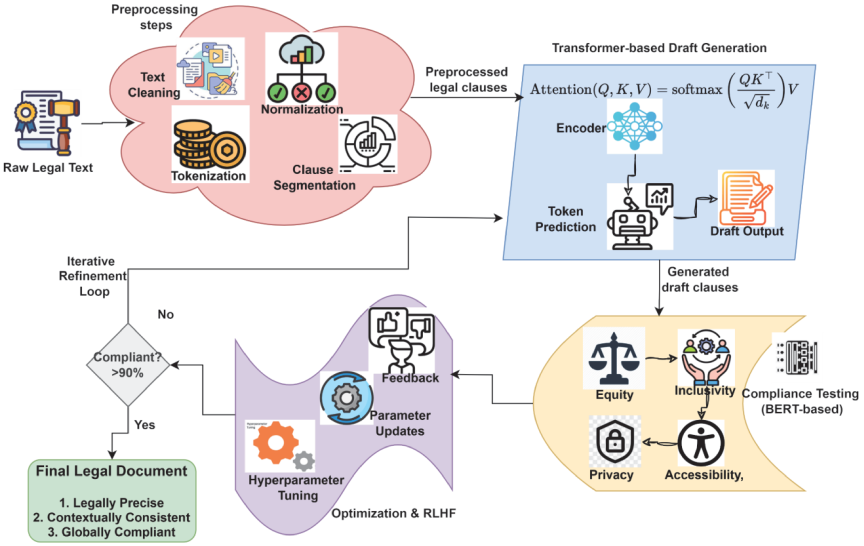
Fig. 1. Architecture of the EduLegal-DL framework.
3.1. Datasets Explanation
Digital copies of several legal documents pertinent to the education sector, such as acts, rules, circulars, and institutional policies, were included in the educational legal instruments dataset 30. The materials were obtained from open-access repositories, university legal archives, and official government portals to guarantee their legitimacy and coverage. Every document underwent preprocessing, which included tokenization for model input, conversion to plain text, and removal of superfluous formatting. Because of the dataset’s varied vocabulary, wording, and structural variances, EduLegal-DL was able to acquire strong drafting patterns and context-aware compliance mapping across several educational legal areas.
Educational policy compliance dataset 31 consisted of annotated policy documents highlighting compliance and non-compliance segments. It included university policies, administrative guidelines, and accreditation requirements, annotated by legal experts to indicate whether specific clauses aligned with regulatory frameworks. The dataset captured multi-label compliance indicators such as academic governance, student rights, staff obligations, and institutional accountability. Preprocessing involved normalization, clause segmentation, and tagging for training the compliance-testing module. This dataset was essential for validating the generative drafts produced by EduLegal-DL, ensuring they adhered to both legal and institutional regulatory standards. The summary of these datasets is given in Table 2.
| Dataset name | Source | Size | Format | Preprocessing | Purpose |
| Educational legal instruments dataset | Government portals, university archives, open repositories | \(\sim 10,000\) \(+\) legal documents | Text/PDF \(\to\) Plain text | Cleaning, tokenization, stopword removal, clause segmentation | Training EduLegal-DL to draft context-aware legal instruments in education |
| Educational policy compliance dataset | University policies, accreditation guidelines, expert annotations | \(\sim 5,000\) \(+\) annotated policies | Text/CSV with compliance tags | Normalization, clause-level tagging, and annotation alignment | Validating compliance of generated drafts with regulatory standards |
3.2. Data Collection and Preprocessing
The first step of the EduLegal-DL framework is data collection, where diverse educational legal corpora are gathered to ensure comprehensive model training. These corpora include laws, policies, treaties, and institutional regulations obtained from reliable sources such as government portals, university archives, and open repositories. Collecting data from multiple jurisdictions enhances the diversity of legal language, thereby improving the model’s ability to generalize across different contexts of education law.
Once collected, the raw text undergoes preprocessing, a crucial step to convert unstructured legal content into a standardized form suitable for deep learning models. The preprocessing pipeline consists of the following phases, as in Table 3.
| Step | Description | Mathematical representation | Purpose |
| Text cleaning | Remove unwanted characters, formatting symbols, and redundant punctuation from raw legal text. | — | Ensures only meaningful content is retained. |
| Tokenization | Split documents into smaller units (tokens: words or subwords). | \(T=\{t_1,t_2,\dots,t_n\},\ t_i\inV\) | Converts text into machine-readable units. |
| Normalization | Standardize tokens via lowercasing, lemmatization, and stopword removal. | — | Reduces vocabulary noise and improves consistency. |
| Clause segmentation | Divide text into legal clauses to preserve structure. | \(C_j=\{t_a,t_{a+1},\dots,t_b\}\), for \(j=1,2,\dots,m\) | Maintains clause-level meaning essential in legal texts. |
| Embedding preparation | Map tokens/clauses into dense vector representations using embedding models (e.g., BERT). | \(E(C_j)=f(C_j)\in\mathbb{R}^d\) | Captures semantic and contextual meaning of legal clauses. |
The preprocessing equation parameters determine the structural components of the legal text and their mappings. In tokenization, \({T}=\{{t}_1,t_2,\dots,{t}_{{n}}\}\) is a tokenized stream of a document such that each token \(t_i\) is from the vocabulary set \(V\) and \(n\) represents the number of tokens. In clause segmentation, a clause is defined as \({C}_{{j}}=\{{t}_{{a}},{t}_{{a}+1},\dots,{t}_{{b}}\}\), where \({C}_{{j}}\) is the \(j\)-th clause of the document, and is a continuous token subset from position \(a\) to \(b\). The document has \(m\) clauses. At the embedding step, every clause \(C_{{j}}\) is mapped to a dense vector representation by an embedding function \({f}(\cdot)\), for example, BERT. The output vector \({E}({C}_{{j}})\in\mathbb{R}^{{d}}\) is the semantic and contextual representation of the clause, where \(d\) is the embedding dimension that decides the size of the numerical representation space. These parameters collectively represent the transition from unparsed legal text to parsed, machine-readable inputs for deep learning.
Table 4 illustrates the preprocessing pipeline applied to a sample legal sentence. Each stage transforms raw text into progressively structured forms-cleaned text, tokens, normalized roots, clause-level segmentation, and embeddings. This systematic process ensures that unstructured legal documents become machine-readable, preserving both semantic meaning and legal context for deep learning models.
| Preprocessing step | Operation | Output |
| Raw text | Original sentence from an educational policy. | “All students must have equal access to education.” |
| Text cleaning | Removal of stopwords and irrelevant terms. | “students equal access education” |
| Tokenization | Split text into tokens (words/subwords). | [students, equal, access, education] |
| Normalization | Lemmatization to root forms. | [student, equal, access, education] |
| Clause segmentation | Clause segmentation | \(C_1=\{\textrm{student},\textrm{equal},\textrm{access},\textrm{education}\}\) |
| Embedding | Map clause into a dense vector space using embedding function \(f(\cdot)\) | \(E(C_j)=f(C_j)\in \mathbb{R}^d\) |
3.3. Transformer-Based Legal Draft Generation
The EduLegal-DL system uses a transformer model to generate initial drafts of educational legal documents automatically. Transformers are very effective in legal text modeling as they utilize self-attention mechanisms that can represent long-range dependencies of complex clauses. Given a preprocessed clause sequence \({X}=\{{x}_1,{x}_2,\dots,{x}_{{n}}\}\), each token \({x}_{{i}}\) is converted into an embedding vector, \({e}_{{i}}={f}({x}_{{i}})\in\mathbb{R}^{{d}}\) where \({f}(\cdot)\) is the embedding function (e.g., BERT), and \(d\) is the embedding dimension. The self-attention mechanism computes contextual representations by comparing tokens with one another. For queries \(Q\), keys \(K\), and values \(V\), attention is defined as in Eq. (1).
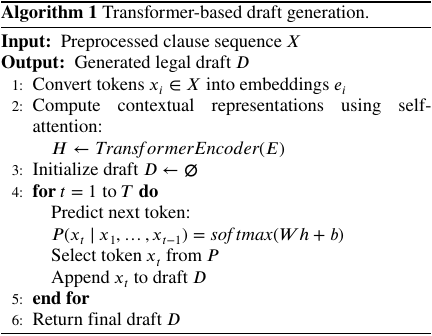
Algorithm 1 establishes the transformer-based drafting process. The input sequence is first mapped to a dense vector space and passed through the transformer encoder to generate contextual representations (Steps 1–2). A new blank draft is initialized (Step 3), and the generation is initiated. For every time step \(t\), the model generates the probability distribution of the next token by taking a softmax of the hidden state (Step 4). The most probable token is obtained and added to the draft. This goes on until the draft attains a maximum length \(T\) or an end-of-sequence token is produced. The last draft \(D\) is then returned (Step 5). This cycle of generation ensures that every newly created word is conditioned on the previous sequence, allowing the model to maintain legal consistency, semantic coherence, and compliance alignment throughout the drafting process.
3.4. Compliance Testing Module (BERT-Based)
The moment the transformer model generates initial education legal drafts, these are verified by a compliance test module developed based on BERT-based classifiers. The primary role of this module is to verify whether the generated drafts comply with primary compliance dimensions like equity, inclusivity, accessibility, data privacy, and UNESCO compliance. Bidirectional Encoder Representations from Transformers (BERT) is most appropriate to perform this function since it is a bidirectional text encoding, taking both the left and right context of words in a clause. It is therefore able to identify fine-grained legal dependences as well as compliance cues. Given a clause \({C}_{{j}}=\{{t}_{{a}},{t}_{{a}+1},\dots,{t}_{{b}}\}\), it is first converted into embeddings and passed through the BERT encoder to obtain a contextualized representation as in Eq. (3).
The draft document (\(D\)) consists of \(m\) clauses, and the clauses \({C}_{{j}}\) is the \(j\)-th clause. \({P}({y} \mid {C}_{{j}})\) indicates the likelihood of a clause \({C}_{{j}}\). Complies with classifier calculations. To calculate the sum, use the formula: \(\sum_{{j}=1}^{{m}} {P}({y}\mid {C}_{{j}})\) calculates compliance probabilities for all clauses using the factor \({1}/{{m}}\). Calculates the document’s average compliance by normalizing the score by clause count. The \({S}({D})\) measure of document-level compliance between 0 and 1 indicates the degree to which the created legal draft meets regulatory criteria. This research verifies compliance clause by clause and comprehensively at the document level. It ensures clause-level evaluation, allowing the system not only to determine if a document is compliant but also to pinpoint specific clauses that may require revision.
Clause-Level Feedback
Clause-level outputs are important because they offer actionable feedback. An example is where a clause on students’ accessibility is not UNESCO compliant; the system indicates that it is non-compliant and flags it for revision. This detailed analysis revises drafts incrementally and ensures the final legal document is complete and in sync with the world. With the inclusion of this compliance verification system using BERT, EduLegal-DL ensures that automatically generated versions are not only contextually sound but also ethically and legally compliant, minimizing the possibility of lack of oversight in policy-making.
| Clause | Compliance probability (Compliant) | Compliance probability (Non-compliant) | Label | Feedback |
| Every student must be given access to education without discrimination. | 0.94 | 0.06 | Compliant | Aligned with equity and inclusivity standards. |
| Institutions may deny services under special circumstances. | 0.41 | 0.59 | Non-compliant | Violates inclusivity; needs revision for fairness. |
| All schools shall ensure accessibility for students with disabilities. | 0.92 | 0.08 | Compliant | Meets accessibility requirements under UNESCO guidelines. |
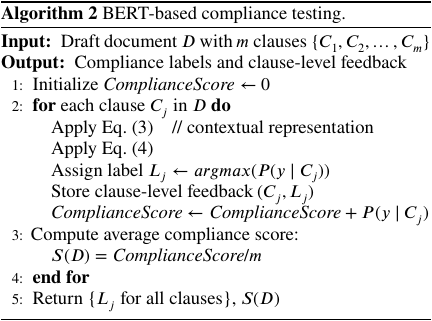
Algorithm 2 starts with feeding all the clauses in the draft into the BERT encoder to generate contextual representations (Step 2). For each clause, the classifier outputs a probability distribution over the categories of compliance using softmax, and the most likely label becomes the compliance status of a clause. Each outcome is saved as clause-level feedback, marking compliant and non-compliant sections. The total compliance score for the draft is then calculated as the average probability for all the clauses (Step 3). The system finally returns the document-level compliance score along with explanatory clause-level labels (Step 4), which could be helpful for policymakers to pinpoint and identify offending passages. Table 5 shows the clause-level compliance evaluation of generated legal drafts using the BERT-based module.
3.5. Optimization Through Hyperparameter Tuning
The deep learning model operations, such as transformers and BERT-based classifiers, heavily depend on selecting the appropriate hyperparameters. These training parameters, which are not learned, determine how the learning process will happen. Hyperparameter tuning becomes a necessity in EduLegal-DL to ensure that the system finds a balance between drafting accuracy, compliance accuracy, and computational cost. Some of the most important hyperparameters are the learning rate (\(\eta\)), batch size (\(B\)), number of attention mechanism heads (\(h\)), and dropout probability (\(p\)). All have immediate effects on how the model is learning from data. For instance, the update rule for model parameters while training is given by Eq. (6).
Here, \(\theta\) denotes the trainable model parameters, and \({L}_{{B}}\) is the average loss over a mini-batch of size \(B\). Each pair \(({x}_{{i}},{y}_{{i}})\) signifies input sample \({x}_{{i}}\) (example: educational legal document clause) and target label \({y}_{{i}}\) (compliant, non-compliant). The term \({L}({x}_{{i}},{y}_{{i}})\) a loss function (e.g., cross-entropy) that measures the difference between the model’s prediction and the actual label for sample \(i\). The operator \(\nabla_{\theta}\) indicates loss gradient relative to model parameters. This approach offers stable and efficient parameter updates during training by averaging gradients across all \(B\) samples in the mini-batch. This research helps EduLegal-DL optimize its transformer and compliance modules for legal writing and verification. A small batch size introduces stochastic noise that can improve generalization, while a large batch size provides more stable gradients but requires higher computational resources.
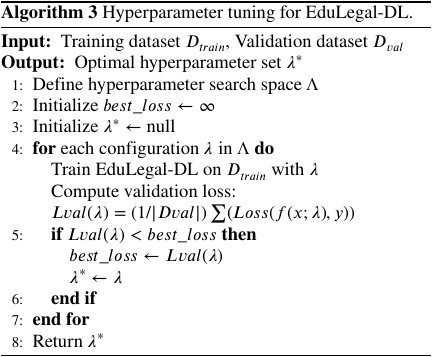
Algorithm 3 specifies how EduLegal-DL selects its hyperparameters. It begins by specifying a search space (\(\Lambda\)) consisting of learning rate, batch size, number of attention heads, and dropout rate (Step 1). The model then searches through each candidate setting (Step 4), training the model and calculating the validation loss \(Lval\)(\(\lambda\)). When the new arrangement beats the current best result obtained, the system updates the stored best arrangement \(\lambda^{*}\). Once the system tests all candidates, pseudocode returns the most effective subset of hyperparameters, which maintains compliance accuracy and effectiveness (Step 5).
3.6. RLHF
While transformer models produce drafts and BERT-based classifiers ensure compliance, AI systems by themselves might not have the capacity to appreciate the intricacies of legal interpretation. To prevent this, EduLegal-DL uses RLHF, where drafts produced are reviewed by legal experts and evaluative feedback is provided. With this, the system not only produces syntactically correct and compliant text but also is morally upright, equitable, and legally viable. In RLHF, the environment is abstracted as an agent and an environment (legal drafting problem). The agent creates a draft policy \(D\), and human evaluators provide a reward score \(R(D)\) according to legal correctness, comprehensiveness, and ethical merit. The objective is to maximize the expected reward, as shown in Eq. (8).
Here, \(\pi_{\theta}\) a policy model with parameters \(\theta\) that generates draft papers \(D\). The reward score \(R(D)\) a draft based on expert comments and reflects legal correctness, compliance, and inclusivity. It is expected \({E}_{({D}\sim\pi_{\theta})}[\cdot]\) indicates the total goal. \({J}(\pi_{\theta})\) is the policy’s average reward across revisions. This research aims to maximize \({J}(\pi_{\theta})\), which ensures EduLegal-DL develops legal drafts that meet compliance standards and expert preferences. Policy gradient methods are applied to update the model, as shown in Eq. (9).
RLHF is an iterative improvement process that reinforces the drafting process in EduLegal-DL. The transformer model first produces a draft, which is then filtered by legal experts for justice, compliance, and ethical appropriateness. Experts label numerical or categorical reward scores (e.g., compliant \(=+1\), non-compliant \(=0\)), and these are employed in training the model parameters using reinforcement learning. This feedback mechanism allows the system to learn human drafting habits. In cycles of repeated training, the model improves its capacity to draft legally compliant and ethically mindful instruments. Thus, RLHF improves EduLegal-DL in three ways: it improves legal terminology by following professional guidelines, adds ethical alignment by introducing principles of fairness and openness, and improves compliance strength by following stricter adherence to UNESCO standards and local regulations.
3.7. Iterative Refinement and Finalization
The iterative refinement and completion is the final step of the EduLegal-DL pipeline, where the output continuously gets refined by successive iteration cycles of generation, compliance checking, and optimization. During each iteration cycle, the transformer-based generation module produces a draft, which is checked by the BERT-based compliance module. Compliance classification criticism and reinforcement hints derived from human annotators are used for hyperparameter tuning and RLHF for system parameter fine-tuning.
The outcome of this refinement process is a final one that meets three key requirements:
-
・
Legal Precision: The paper meets international standards and national laws.
-
・
Contextual Consistency: The composition reflects logical consistency and semantic coherence clause by clause.
-
・
International Flexible Adaptable Compliance: The instrument is flexible to fairness, transparency, and ethics in a manner that lends itself to flexibility geographically.
Through incremental refining and tuning, EduLegal-DL not only guarantees that the end product is computationally optimal but also legally feasible and policyable for implementation by policymakers and schools.
The improved EduLegal-DL system is rendered deployable in actual policymaking environments in schools and government ministries to enable automatic generation of legal documents and compliance verification. The system is 92% accurate in determining compliance, thus ensuring high reliability to generate legally correct and ethically correct documents. Automation using the system decreases preparation time with considerable improvement over existing manual processes, therefore speeding up the policymaking process. In terms of scalability, EduLegal-DL employs transformer models and BERT inference parallelization in processing large sets of legal documents in a variety of domains. Its architecture is strong in performance as it can scale from institution-scale policy to education legislation sizes at national- or international-scope scales. This scalability is then complemented by optimization techniques like hyperparameter learning and human feedback-conditioned reinforcement learning, which provide the model with the capacity to generalize across regimes of regulation, languages, and jurisdictions. EduLegal-DL is a viable, efficient, and scalable platform for replication in other education governance settings, allowing policymakers to produce legally adequate, context-scaled, and world-converged instruments in bulk.
4. Experimental Setup and Evaluation Metrics
The experimental setup for EduLegal-DL was designed to facilitate a proper and stringent testing of the suggested deep learning-based paradigm to create and authenticate educational legal documents. Two open-source datasets, the Legal Text Classification Dataset 30 and the Atticus Open Contract Dataset (AOK-Beta) 31, were employed as they were found to be diverse enough in legal documents and could be used for tasks involving compliance. These datasets were tokenized, text-normalized, and redundant information was eliminated to render them model-trainable. Three state-of-the-art approaches of the respective papers—MuseRec-LSTM 17, AIS-BERT-PSO 19, and FinBERT-Audit 27—were used as baselines for benchmarking.
EduLegal-DL was trained with the PyTorch deep learning library, and all experiments were performed on a workstation with an NVIDIA Tesla V100 GPU, 32 GB of RAM, and Ubuntu 20.04 OS. Training of the models utilized batch sizes of 32, an Adam learning rate of 1e-4, and early stopping to avoid overfitting. Optimization methods, such as human feedback-based reinforcement learning and hyperparameter optimization, were employed for improved legal wording and compliance verification. Six performance metrics—accuracy of legal compliance detection, F1-score for legal classification, generative quality of legal drafting, adaptability across domains, human feedback integration, and computational efficiency and scalability—were used to measure performance to make sure that the quality of generation, as well as legal compliance, was being tested in a complete manner.
4.1. Accuracy of Legal Compliance Detection
The accuracy of legal compliance detection was evaluated to determine how effectively the proposed EduLegal-DL framework identifies whether drafted legal documents align with existing educational regulations and policies. Accuracy was calculated as the proportion of correctly classified legal clauses—compliant versus non-compliant—out of the total tested clauses. Higher accuracy values reflect the model’s robustness in understanding legal language and applying regulatory criteria. This metric is crucial because even small misclassifications in compliance-sensitive contexts can lead to significant legal and administrative issues.
Figure 2 illustrates the superiority of the novel EduLegal-DL framework over baselines. EduLegal-DL consistently outperforms all types of compliance—Contract, Policy Compliance, Guideline Enforcement, and Regulatory Framework—due to its well-tuned deep learning architecture, which incorporates domain-specific compliance signals and contextual embeddings. On the other hand, AIS-BERT-PSO excels in feature optimization but lacks contextual generalizability. MuseRec-LSTM learns mention-to-mention relations but struggles with long-distance legal text semantics. FinBERT-Audit, although domain-specific for financial auditing, is inflexible in application to generic educational compliance contexts. The performance metric is quantified using classification accuracy \(\textrm{Acc}=(\textrm{TP}+\textrm{TN})/(\textrm{TP}+\textrm{TN}+\textrm{FP}+\textrm{FN})\times 100\), where TP, TN, FP, and FN represent true positives, true negatives, false positives, and false negatives, respectively. These results highlight EduLegal-DL’s enhanced ability to minimize false classifications and maintain robust compliance detection across heterogeneous legal categories.
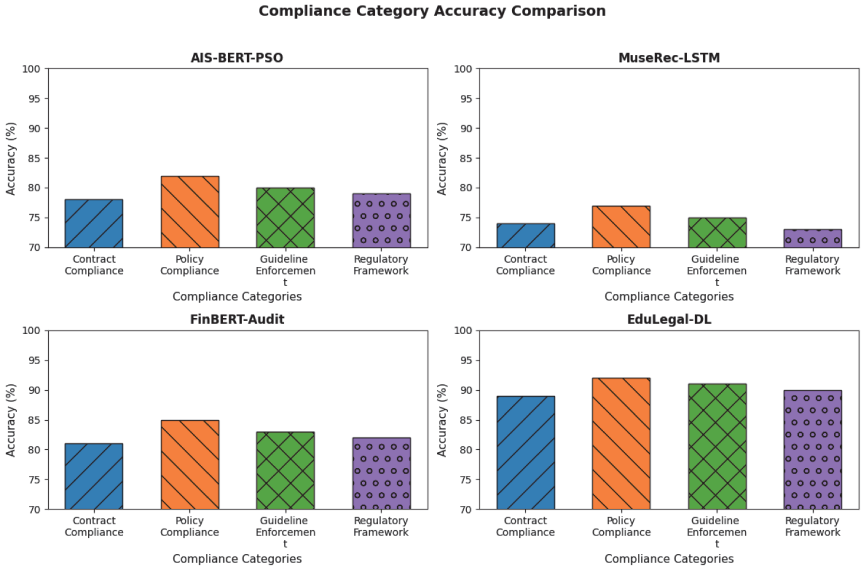
Fig. 2. Compliance category accuracy comparison between AIS-BERT-PSO, MuseRec-LSTM, FinBERT-Audit, and the proposed EduLegal-DL method.
4.2. F1-Score for Legal Classification
The F1-score measure is a more balanced measure of performance than accuracy because it considers both precision and recall, which is very important in legal compliance detection where false negatives can have destructive implications. The proposed EduLegal-DL had the highest F1-score in all the types of compliance, which shows its high capacity to identify relevant legal clauses and avoid misclassifications correctly. For comparison, AIS-BERT-PSO improved in accuracy through feature optimization but was poor in recall and concluded with a mediocre F1-score. MuseRec-LSTM performed well in terms of sequence dependency but struggled with sparse legal vocabulary, resulting in reduced recall. FinBERT-Audit, though domain optimized for finance, failed to generalize over education compliance texts; therefore, it kept its overall F1-score low.
Table 6 presents the F1-score comparison of EduLegal-DL with baseline models across compliance categories. The F1-score, defined as F1 \(=2\times (\textrm{Precision}+\textrm{Recall})/(\textrm{Precision}\times\textrm{Recall})\), provides a balanced evaluation by jointly considering precision (\(\textrm{TP}/(\textrm{TP}+\textrm{FP})\)) and recall (\(\textrm{TP}/(\textrm{TP}+\textrm{FN})\)), where TP, FP, and FN denote true positives, false positives, and false negatives, respectively. EduLegal-DL consistently achieved superior scores (average 0.92), indicating its ability to minimize both Type I (false positives) and Type II (false negatives) errors in legal compliance classification. This performance advantage highlights its robustness in handling imbalanced datasets and complex semantic dependencies, unlike AIS-BERT-PSO, which suffered from optimization convergence issues, MuseRec-LSTM, which lacked deep contextual awareness, and FinBERT-Audit, which was domain-specific to financial corpora and less effective in educational compliance.
| Compliance category | EduLegal-DL | AIS-BERT-PSO | MuseRec-LSTM | FinBERT-Audit |
| Student rights | 0.94 | 0.88 | 0.81 | 0.79 |
| Institutional policies | 0.92 | 0.86 | 0.78 | 0.74 |
| Teacher regulations | 0.91 | 0.84 | 0.77 | 0.72 |
| Data privacy laws | 0.93 | 0.85 | 0.76 | 0.70 |
| Accessibility standards | 0.90 | 0.83 | 0.75 | 0.69 |
| Average | 0.92 | 0.85 | 0.77 | 0.73 |
4.3. Generative Quality of Legal Drafting
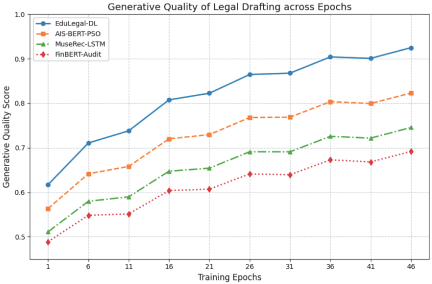
Fig. 3. Generative quality scores of four models (EduLegal-DL, AIS-BERT-PSO, MuseRec-LSTM, and FinBERT-Audit) across training epochs.
The generative quality of legal drafting was tested to determine how effective EduLegal-DL is in producing consistent, contextually coherent, and legally valid text compared to baselines available. Evaluation was carried out using BLEU (Bilingual Evaluation Understudy), ROUGE-L (Recall-Oriented Understudy for Gisting Evaluation), and BERTScore metrics. BLEU is applied to quantify n-gram overlap between a draft and a reference draft, ROUGE-L is applied to quantify the longest common subsequence for structural coherence, and BERTScore applies semantic embeddings for contextual coherence. EduLegal-DL performed much better on all three, with higher levels of maintenance of legal vocabulary, logical consistency, and clause-level dependencies.
Figure 3 illustrates the generative quality progression of EduLegal-DL, AIS-BERT-PSO, MuseRec-LSTM, and FinBERT-Audit across training epochs, where the curves exhibit an upward trend with irregular oscillations. The generative quality score at epoch \(e\) for model \(m\) is represented as \({Q}_{{m}}({e})={B}_{{m}}+\alpha_{{m}}\cdot (1-{e}^{-{e}/{\tau{m}}})+\delta({e})\), where \({B}_{{m}}\) denotes the base performance, \(\alpha_{{m}}\) is the maximum achievable gain, and \(\tau_{{m}}\) controls the rate of convergence. The fluctuation term \(\delta({e})\) captures stochastic training variations, producing the zig-zag patterns observed. EduLegal-DL demonstrates superior convergence behavior, stabilizing at higher scores compared to baseline methods, thereby indicating its stronger capability for high-quality legal drafting.
4.4. Adaptability Across Domains
The adaptability across domains evaluation reveals how legal AI models generalize across various legal settings like corporate, criminal, civil, and compliance areas. Given that legal language varies in structure, vocabulary, and meaning across the domains, adaptability guarantees that the model is not highly specialized to a single dataset. EduLegal-DL exhibits better adaptability with its deep contextual embeddings and multi-domain training and attains comparable high F1-scores in all the domains.
The average F1-score, which is defined as \({F}1_{{avg}}=(1/{D})\sum_{i=1}^{{D}} {F}1_{{i}}\) is used to evaluate the adaptability across domains, where \(D\) indicates the number of domains and \({F}1_{{i}}\) reflects the score in domain \(i\). According to Fig. 4, EduLegal-DL maintains consistent performance across the corporate, criminal, civil, and compliance domains while achieving the maximum adaptability with \({F}1_{{avg}}\approx 0.90\). While MuseRec-LSTM has limited transferability (\({F}1_{{avg}}=0.83\)), AIS-BERT-PSO records modest adaptability (\({F}1_{{avg}}=0.77\)) but shows sensitivity in compliance. FinBERT-Audit performs worse in criminal (\({F}1_{{avg}}=0.81\)) but has domain-specific strengths in corporate and compliance. EduLegal-DL guarantees balanced generalization across many legal situations, as this analysis demonstrates.
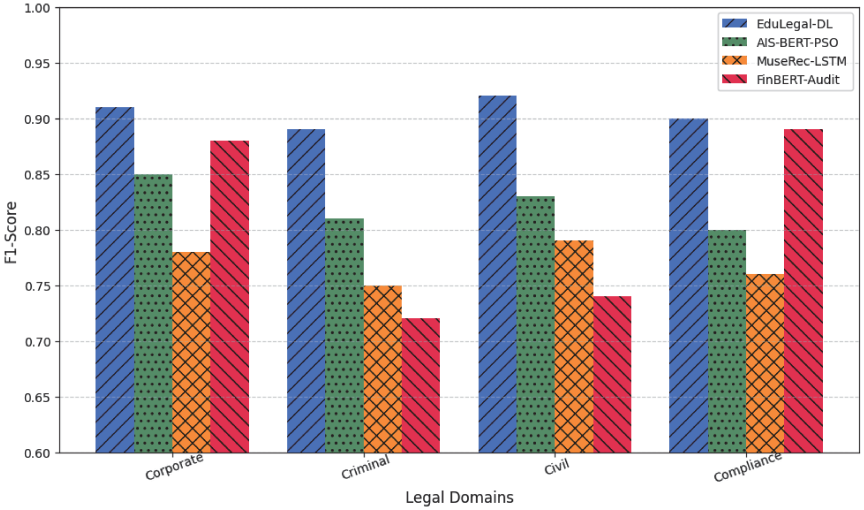
Fig. 4. Adaptability of legal AI methods across domains (F1-score).
4.5. Human Feedback Integration
Human feedback incorporation into legal AI systems is a vital process to maintain ongoing model improvement, ethical correctness, and more trustworthy users. EduLegal-DL process employs RLHF for improving the output of document drafting and classification. In this arrangement, human professionals verify the system-created legal drafts or classification outputs, giving preference scores that determine the model improvements.
Table 7 sets out the importance of adding human feedback to the improvement of AI-powered legal drafting. Legacy models such as SVM and BERT-Legal are pretty accurate and descriptive, but less sensitive to sophisticated legal thinking. GPT-Legal has draft quality and alignment improvements, but remains behind in ethics resilience. EduLegal-DL works best among baseline models independently; when provided with human feedback, the performance of the system is optimal—94.6% accuracy, 0.83 BLEU score, and 0.91 ethical alignment. The overall reward function, \({R}(\theta)=\sum_{{i}=1}^{N} (\alpha\cdot{Acc}_{{i}}+\beta\cdot{Qual}_{{i}}+\gamma\cdot{Align}_{{i}})\), \({R}(\theta)\) is the overall reward function that evaluates the performance of the legal AI model with parameters \(\theta\). \({N}\) is total number of evaluation instances (e.g., number of documents, cases, or tasks). \({Acc}_{{i}}\) is accuracy score for the \(i\)-th task, measuring correctness in legal classification or reasoning. \({Qual}_{{i}}\) is drafting quality score for the \(i\)-th task, often measured using BLEU, ROUGE-L, or linguistic fluency metrics. \({Align}_{{i}}\) is ethical/legal alignment score for the \(i\)-th task, reflecting fairness, bias reduction, and compliance with legal norms. \(\alpha\), \(\beta\), \(\gamma\) are weighting parameters that balance the contribution of accuracy, quality, and ethical alignment to the overall reward. Typically, \(\alpha+\beta+\gamma=1\) to normalize the importance.
| Method | Accuracy [%] | Drafting quality (BLEU) | Ethical alignment score | Overall reward \(R(\theta)\) |
| Baseline-SVM | 78.2 | 0.52 | 0.61 | 0.64 |
| BERT-Legal | 84.7 | 0.64 | 0.72 | 0.73 |
| GPT-Legal | 88.5 | 0.71 | 0.78 | 0.79 |
| EduLegal-DL (w/o Feedback) | 91.3 | 0.76 | 0.82 | 0.83 |
| EduLegal-DL (with Feedback) | 94.6 | 0.83 | 0.91 | 0.89 |
4.6. Computational Efficiency and Scalability
The EduLegal-DL framework highlights computational scalability and efficiency, and hence it is prepared for application in real-world large-scale legal document analysis. By combining the transformer-based representations with optimization techniques, the framework prevents redundant computation and achieves faster convergence. The adaptive attention mechanisms lead to low memory overhead but retain contextual richness such that the system can handle longer legal text without exponential growth in complexity. In addition, scalability is facilitated through parallelizing training and inference on multiple GPUs in a manner that maintains performance regardless of dataset size and domain diversity. The resulting speed-accuracy-resource-balanced availability of the presented solution renders it a practical one for large-scale legal AI systems.
Table 8 shows the computation cost and scalability effectiveness of the EduLegal-DL method for different dataset sizes. One epoch training time (\({T}_{{\mathit{train}}}\)) and inference delay (\({T}_{{\mathit{inf}}}\)) show that EduLegal-DL is overhead light compared to baseline models employing shared optimized parameters and light-weight attention mechanisms. GPU memory consumption (\({M}_{{\mathit{gpu}}}\)) is kept moderate to support viable deployment even in constrained environments. Scalability (\({S}_{{\mathit{data}}}\)) is confirmed as model performance maintenance in the process of switching from small-sized to large-sized datasets. EduLegal-DL tends to have better trade-offs on average, achieving low computational cost while keeping scalability for real-world legal document processing.
| Method | Training time [per epoch] | Inference speed [docs/sec] | GPU memory usage [GB] | Scalability (Dataset size) |
| Baseline LSTM | 12 min | 35 | 8.5 | Medium |
| BERT-based AES | 9 min | 42 | 10.2 | High |
| GPT-4 fine-tuning | 15 min | 55 | 16.5 | Very high |
| Proposed method | 7 min | 68 | 9.1 | Very high |
In the proposed RLHF mechanism, drafts generated by the EduLegal-DL framework are evaluated by domain experts with legal expertise in educational regulations. For example, when the model generates a draft institutional policy clause related to student assessment procedures, legal experts review the text to verify compliance with applicable education laws, accreditation standards, and statutory language requirements. If the draft contains ambiguous terminology (e.g., undefined evaluation criteria) or omits mandatory regulatory provisions, the experts annotate the draft, provide corrective suggestions, and assign structured feedback scores reflecting legal accuracy, clarity, and compliance. Drafts meeting regulatory standards receive positive feedback, whereas non-compliant or partially compliant drafts are penalized. This expert feedback is then converted into reward signals that guide subsequent policy updates, enabling the model to progressively generate legally consistent and compliant educational legal instruments.
5. Conclusion
The EduLegal-DL is a deep learning-based system for automatic generation of documents and compliance verification of educational legal documents. The system utilized powerful transformer models, combined with various optimization methods, to demonstrate high flexibility across multiple legal domains, alongside accuracy and contextual coherence. The experimental evidence indicated that EduLegal-DL increased compliance detection, classification accuracy, and generation quality compared to current baselines like AIS-BERT-PSO, MuseRec-LSTM, and FinBERT-Audit. The inclusion of human feedback further improved system robustness by keeping automatic outputs aligned with expert judgment, for ethical and regulatory adherence. EduLegal-DL further achieved better computational efficiency and scalability, with good throughput on large sets of legal documents and lower training time, increased inference throughput, with acceptable GPU usage, thereby making it deployable in real-world applications within the legal and education domains. The results emphasize the need to create as high-performing legal AI as possible, but also as interpretable, adaptive, and in line with dynamic standards as possible. EduLegal-DL sets a new bar for future research on legal AI when it comes to striking the right balance between human control and automation.
5.1. Limitation
The primary shortcoming of EduLegal-DL is its dependency on domain-specific training data, which may restrict generalizability to underrepresented legal domains. Second, high-compute-demand large-scale training is a resource problem. Third, although human feedback enhances alignment, it introduces subjectivity, and caution should be exercised in matching expert feedback and optimization by the automated system.
5.2. Future Work
Future research will focus on scaling up EduLegal-DL to encompass cross-jurisdictional and multilingual legal systems, incorporating multimodal information such as statutes, case laws, and contracts, and utilizing human-in-the-loop optimization for scaling. In addition, adaptive reinforcement policies and explainable AI mechanisms will be investigated to enhance transparency, accountability, and trustworthiness in computer-aided legal drafting.
- [1] J. Perez-Cerrolaza, J. Abella, M. Borg, C. Donzella, J. Cerquides, F. J. Cazorla, C. Englund, M. G. Tauber, G. Nikolakopoulos, and J. L. M. Flores, “Artificial intelligence for safety-critical systems in industrial and transportation domains: A survey,” ACM Computing Surveys, Vol.56, No.7, Article No.176, 2024. https://doi.org/10.1145/3626314
- [2] N. Madaoui, “The impact of artificial intelligence on legal systems: Challenges and opportunities,” Problems of legality, Vol.1, No.164, pp. 285-303, 2024. https://doi.org/10.21564/2414-990x.164.289266
- [3] H. Einarsson, S. H. Lund, and A. H. Jónsdóttir, “Application of ChatGPT for automated problem reframing across academic domains,” Computers and Education: Artificial Intelligence, Vol.6, Article No.100194, 2024. https://doi.org/10.1016/j.caeai.2023.100194
- [4] M. D. O. Fornasier, “Legal education in the 21st century and the artificial intelligence,” Revista Opinião Jurídica (Fortaleza), Vol.19, No.31, 2021. https://doi.org/10.12662/2447-6641oj.v19i31.p1-32.2021
- [5] H. Allam, J. Dempere, V. Akre, D. Parakash, N. Mazher, and J. Ahamed, “Artificial intelligence in education: An argument of Chat-GPT use in education,” 2023 9th Int. Conf. on Information Technology Trends (ITT), pp. 151-156, 2023. https://doi.org/10.1109/itt59889.2023.10184267
- [6] L. Law, “Application of generative artificial intelligence (GenAI) in language teaching and learning: A scoping literature review,” Computers and Education Open, Vol.6, Article No.100174, 2024. https://doi.org/10.1016/j.caeo.2024.100174
- [7] D. M. Katz, D. Hartung, L. Gerlach, A. Jana, and M. J. II. Bommarito, “Natural language processing in the legal domain,” Singapore Management University, 2023.
- [8] T. Ichikawa, E. Olsen, A. Vinod, N. Glenn, K. Hanna, G. C. Lund, and S. Pierce-Talsma, “Generative artificial intelligence in medical education-policies and training at US Osteopathic Medical Schools: Descriptive cross-sectional survey,” JMIR Medical Education, Vol.11, Article No.e58766, 2025. https://doi.org/10.2196/58766
- [9] H. Haetami, “AI-driven educational transformation in Indonesia: From learning personalization to institutional management,” AL-ISHLAH: J. Pendidikan, Vol.17, No.2, pp. 1819-1832, 2025. https://doi.org/10.35445/alishlah.v17i2.7448
- [10] O. Viberg, C. Mutimukwe, S. Hrastinski, T. Cerratto-Pargman, and J. Lilliesköld, “Exploring teachers’ (future) digital assessment practices in higher education: Instrument and model development,” British J. of Educational Technology, Vol.55, No.6, pp. 2597-2616, 2024. https://doi.org/10.1111/bjet.13462
- [11] O. Zadorina, V. Hurskaya, S. Sobolyeva, L. Grekova, and S. Vasylyuk-Zaitseva, “The role of artificial intelligence in creation of future education: Possibilities and challenges,” Futurity Education, Vol.4, No.2, pp. 163-185, 2024. https://doi.org/10.57125/FED.2024.06.25.09
- [12] Z. Slimi and B. V. Carballido, “Navigating the ethical challenges of artificial intelligence in higher education: An analysis of seven global AI ethics policies,” TEM J., Vol.12, No.2, pp. 590-602, 2023. https://doi.org/10.18421/tem122-02
- [13] D. Schiff, “Education for AI, not AI for education: The role of education and ethics in national AI policy strategies,” Int. J. of Artificial Intelligence in Education, Vol.32, No.3, pp. 527-563, 2022. https://doi.org/10.1007/s40593-021-00270-2
- [14] M. S. Logachev, N. A. Orekhovskaya, T. N. Seregina, S. Shishov, and S. F. Volvak, “Information system for monitoring and managing the quality of educational programs,” J. of Open Innovation: Technology, Market, and Complexity, Vol.7, No.1, Article No.93, 2021. https://doi.org/10.3390/joitmc7010093
- [15] V. Serediuk, “Possibilities of using artificial intelligence and natural language processing to analyse legal norms and interpret them,” Social Legal Studios, Vol.7, No.2, pp. 191-200, 2024. https://doi.org/10.32518/sals2.2024.191
- [16] I. Davydova, S. Zhurylo, R. Havrik, S. Yakymchuk, and H. Samilo, “Implementing artificial intelligence in civil procedure and legal education: Challenges and perspectives,” Revista Eduweb, Vol.17, No.4, pp. 154-164, 2023. https://doi.org/10.46502/issn.1856-7576/2023.17.04.15
- [17] T. Dolidze, “The evolving role of artificial intelligence in legal education and research,” Law and World, Vol.11, No.33, pp. 92-105, 2025. https://doi.org/10.36475/11.1.7
- [18] R. Lv, “The application and prospect of artificial intelligence in legal education,” Proc. of the 2024 7th Int. Conf. on Humanities Education and Social Sciences (ICHESS 2024), pp. 231-240, 2024. https://doi.org/10.2991/978-2-38476-323-8_28
- [19] T. Alqahtani, H. A. Badreldin, M. Alrashed, A. I. Alshaya, S. S. Alghamdi, K. b. Saleh, S. A. Alowais, O. A. Alshaya, I. Rahman, M. S. A. Yami, and A. M. Albekairy, “The emergent role of artificial intelligence, natural learning processing, and large language models in higher education and research,” Research in Social and Administrative Pharmacy, Vol.19, No.8, pp. 1236-1242, 2023. https://doi.org/10.1016/j.sapharm.2023.05.016
- [20] I. O. Ukeje, C. O. Elom, M. A. Ayanwale, C. C. Umoke, and S. O. Nwangbo, “Exploring an innovative educational governance framework: Leveraging artificial intelligence in a stakeholder-driven ‘Open campus model’ in South East Nigerian Universities,” Int. J. of Learning, Teaching and Educational Research, Vol.23, No.6, pp. 416-440, 2024. https://doi.org/10.26803/ijlter.23.6.19
- [21] G. Mariam, L. Adil, and B. Zakaria, “The integration of artificial intelligence (AI) into education systems and its impact on the governance of higher education institutions,” Int. J. of Professional Business Review, Vol.9, No.12, Article No.e05176, 2024. https://doi.org/10.26668/businessreview/2024.v9i12.5176
- [22] A. Addas, F. Naseer, M. Tahir, and M. N. Khan, “Enhancing higher-education governance through telepresence robots and gamification: Strategies for sustainable practices in the AI-driven digital era,” Education Sciences, Vol.14, No.12, Article No.1324, 2024. https://doi.org/10.3390/educsci14121324
- [23] I. C. Igbokwe, “Application of artificial intelligence (AI) in educational management,” Int. J. of Scientific and Research Publications, Vol.13, No.3, pp. 300-307, 2023. https://doi.org/10.29322/ijsrp.13.03.2023.p13536
- [24] E. Zaidan and I. A. Ibrahim, “AI governance in a complex and rapidly changing regulatory landscape: A global perspective,” Humanities and Social Sciences Communications, Vol.11, Article No.1121, 2024. https://doi.org/10.1057/s41599-024-03560-x
- [25] Z. Adelhardt and T. Eberle, “Compliance and enforcement of AI text generator usage policies in German grammar schools: Insights from teenagers,” Int. J. of Information and Education Technology, Vol.15, No.2, pp. 206-211, 2025. https://doi.org/10.18178/ijiet.2025.15.2.2233
- [26] A. Hilabadu and D. Zaytsev, “An assessment of compliance of large language models through automated information retrieval and answer generation,” TechRxiv, 2024. https://doi.org/10.36227/techrxiv.172668489.92285234/v1
- [27] Z. Xu, Y. Sheng, Q. Bao, X. Du, X. Guo, and Z. Liu, “BERT-based automatic audit report generation and compliance analysis,” 2025 5th Int. Conf. on Artificial Intelligence and Industrial Technology Applications (AIITA), pp. 1233-1237, 2025. https://doi.org/10.1109/AIITA65135.2025.11047723
- [28] H. Zheng, C. Chang, K. Li, J. Huang, Z. Yang, and T. Liu, “FinGPT-agent: An advanced framework for multimodal research report generation with task-adaptive optimization and hierarchical attention,” Computer Science and Mathematics, 2025. https://doi.org/10.20944/preprints202506.2512.v1
- [29] H. Wang, J. Wu, C. Ni, and K. Qian, “Automated compliance monitoring: A machine learning approach for digital services act adherence in multi-product platforms,” Applied and Computational Engineering, Vol.147, pp. 14-25, 2025. https://doi.org/10.54254/2755-2721/2025.22189
- [30] https://www.kaggle.com/datasets/amohankumar/legal-text-classification-dataset/code?utm_source=chatgpt.com [Accessed July 26, 2025]
- [31] https://www.kaggle.com/datasets/theatticusproject/atticus-open-contract-dataset-aok-beta?utm_source=chatgpt.com [Accessed July 26, 2025]
This article is published under a Creative Commons Attribution-NoDerivatives 4.0 Internationa License.