
Research Paper:
YOLO-Pooling: Exploring the Potential of Pooling Operations in Object Detection
Xuebin Yue†, Mengkui Hao, Yao Yao, Yangyang Wang, and Yan Wang
School of Automation and Electrical Engineering, Zhongyuan University of Technology
No.1 Huaihe Road, Longhu Town, Xinzheng, Zhengzhou, Henan 451191, China
†Corresponding author

Pooling operations play a crucial role in object detection by reducing feature map dimensions, enhancing position invariance, enabling multi-scale detection capabilities, and lowering computation overhead, which is particularly important in industrial inspection scenarios such as metal surface defect detection, concrete crack detection, hot-rolled strip inspection, and PCB defect analysis where complex backgrounds and subtle defects demand high accuracy and robustness. However, existing architectures (e.g., FPN/PANet, U-Net with attention) rely on single-type pooling or simple multi-scale concatenation, leading to information loss or inefficient feature aggregation. To address these limitations, we aim to explore the potential of pooling operations in the context of object detection tasks. To this end, we propose two modules based on pooling operations. The first is the dimension reduction pooling (DRP) module, which differs from traditional single pooling by combining 3×3 max pooling and average pooling during dimension reduction (to preserve both salient features and global distribution) and compressing channels via 1×1 convolution (to avoid redundancy), providing a richer feature representation. The second is the multi-scale feature aggregation (MFA) module, which innovatively integrates CSP structure, multi-step weighted feature aggregation, and stereoscopic attention (parallel channel-spatial attention)—distinct from U-Net’s symmetric mapping and FPN/PANet’s simple pathway concatenation. It seamlessly integrates coarse semantic information with fine-grained semantic information through top-down and bottom-up pathways, employs a stereoscopic attention mechanism to enhance feature representation, expands perception scope, and improves generalization capabilities. Based on these two modules, the YOLO-Pooling is proposed, an object detection model that progressively refines deep and shallow semantic features. The proposed method is evaluated on six public datasets: GC10-DET, Crack, Barcodes, NEU-DET, PCB, and a subset of COCO, and the mAP of the method is 67.74%, 86.11%, 97.78%, 73.27%, 96.56%, and 6.49%, respectively, significantly higher than the state-of-the-art detection methods. Experimental results demonstrate that the proposed DRP + MFA design outperforms existing multi-scale aggregation and pooling-based architectures by solving the trade-off between pooling-induced information loss and model accuracy, fundamentally improving object localization and detection accuracy, and maintains efficient inference speed. This efficiency stems from precise FLOPs control, optimized memory access patterns, and operator fusion, enabling higher fps than many mainstream YOLO models despite additional modules (DRP and MFA).
YOLO-pooling overall framework
1. Introduction
Object detection is a challenging task in computer vision, aiming to detect specific objects in images or videos and determine their classes and bounding boxes 1. This task enables computers to automatically recognize and locate objects in images, with typical applications including autonomous driving 2,3, robotic vision 4,5, salient object detection 6,7, IoT applications 8, and cultural heritage protection 9,10.
In recent years, convolutional neural networks (CNNs) have substantially contributed to object detection with their powerful ability to extract multi-scale deep semantic and shallow detail information efficiently. This is mainly attributed to CNNs exhibiting a typical pyramidal structure, wherein the feature maps outputted by shallow modules often possess larger spatial dimensions, containing more complex and detailed shallow features. Conversely, deep modules are better at encoding deep semantic information and the specific location of objects 11.
In object detection, deep semantic features help identify objects’ shape, texture, size, and relative position, thereby more accurately locating and identifying objects of different classes. Shallow and intermediate layer features capture different information levels, helping the model understand different aspects of the image. In current research, effectively integrating deep and shallow information has become the focus of academic and industrial. The challenge of this problem is to fully exploit the high-level semantic information extracted by deep networks while retaining the sensitivity of shallow networks to spatial structure and details. Researchers use various methods and techniques to solve this problem to improve the performance and generalization ability of the model.
Building on this understanding, we propose two pooling-based modules to accurately determine objects’ classes and locations in images. During the dimensionality reduction, max pooling emphasizes salient features, whereas average pooling preserves the overall feature distribution. To provide a more comprehensive and enriched feature representation, we concatenate max pooling and average pooling in the dimensionality reduction process, creating the dimension reduction pooling (DRP) module. Based on path aggregation network (PANet) 12, we construct the multi-scale feature aggregation (MFA) module, seamlessly integrating coarse-grained with fine-grained semantic information through top-down and bottom-up pathways. Simultaneously, the module incorporates a stereoscopic attention mechanism to reinforce crucial features, broaden the perception range, and enhance the model’s generalization ability. Based on the aforementioned two modules, we develop the YOLO-Pooling, an object detection model aimed at progressively refining deep and shallow semantic features and gradually extracting semantic information, thereby enhancing the accuracy and precision of object detection. Overall, the specific contributions are as follows.
-
・
Propose YOLO-Pooling: a pooling-based object detection model that progressively refines deep and shallow semantic features, achieving an optimal balance between pooling-induced information loss and detection accuracy.
-
・
Design the DRP module: concatenates max pooling and average pooling to integrate salient features and global distribution, enhancing feature representation while reducing dimensions.
-
・
Develop the MFA module: fuses coarse- and fine-grained information via top-down/bottom-up pathways and incorporates a stereoscopic attention mechanism to broaden perception scope and improve generalization.
The rest of this article is organized as follows. The related works are discussed in Section 2. The details of the proposed method are introduced in Section 3. Section 4 presents the implementation details, datasets, results, ablation study, discussion, and future work. Section 5 concludes the paper.
2. Related Work
This section briefly overviews the pertinent literature concerning object detection, various pooling operations, and methods for multi-scale feature fusion. Additionally, related literature on attention mechanisms is also introduced. We elaborate on the following.
2.1. Object Detection
Object detection methods can generally be divided into two mainstream paradigms: two-stage detectors and one-stage detectors, which mainly differ in whether region proposal generation and classification are conducted separately or jointly.
Two-stage object detection methods typically first generate candidate regions and then perform classification and localization on these regions to achieve higher detection accuracy. In this line of research, R-CNN 13 extracts candidate regions using selective search, employs CNNs for feature extraction, and utilizes SVM for classification and bounding box regression. Faster R-CNN 14, a classical representative of two-stage detectors, further introduces a region proposal network to efficiently generate candidate boxes and adopts ROI pooling for feature extraction, significantly improving detection performance while maintaining reasonable speed.
In contrast, one-stage object detection methods aim to accomplish object localization and classification simultaneously in a single step, thereby demonstrating advantages in simplicity and computational efficiency. RetinaNet 15 introduces the Focal Loss function to effectively alleviate the class imbalance problem and achieves notable improvements in both accuracy and robustness. The You Only Look Once (YOLO) series 16,17 is another typical representative that transforms the object detection task into a regression problem and successfully achieves real-time performance. The YOLO family has continued to evolve rapidly, leading to the emergence of several improved models such as YOLOv5, YOLOX 18, and YOLOv7 19. More recently, transformer-based or anchor-free detectors have further advanced real-time detection performance 20,21,22.
Building upon these general detection frameworks, numerous studies have further extended object detection models to domain-specific application scenarios. Yue et al. 23 propose an ultra-lightweight tableware detection model YOLO-GS along with a grasping point algorithm to enable automatic tableware detection and recycling by Empty-Dish Recycling Robots. Hsu and Lin 24 introduce the ratio- and scale-aware YOLO (RSA-YOLO) method to address the challenges caused by small pedestrian ratios and large variations in input image aspect ratios. Hui et al. 25 develop WSA-YOLO to enhance detection performance under low-light conditions through image decomposition, adaptive enhancement, and feature correlation utilization, leading to improvements in both image quality and detection accuracy. Tang et al. 26 present Light-YOLO, a lightweight model for infrared ship small target detection that employs snake convolutions and a multi-scale feature enhancement module to improve detection accuracy and robustness.
2.2. Pooling Operation
Pooling is a critical component in modern CNNs and mainly serves two purposes. First, it reduces computational overhead by decreasing the spatial size of feature maps. Second, pooling alleviates overfitting and enhances translation invariance during the optimization process 11.
The two most commonly used pooling strategies are average pooling and max pooling. In average pooling, gradients are evenly distributed to each pixel within the pooling window during backpropagation. In contrast, max pooling only propagates gradients to the pixel corresponding to the maximum value, while the gradients of the remaining pixels are set to zero.
Beyond these basic strategies, numerous studies have proposed advanced pooling variants to better preserve spatial information and enhance feature representation. Hou et al. 27 introduce strip pooling, which replaces conventional \(N\times N\) spatial pooling windows with horizontal and vertical strip-shaped windows to capture long-range contextual dependencies. Gao et al. 28 propose a local importance-based pooling layer that automatically emphasizes discriminative features by learning adaptive importance weights from the input during downsampling. Wu et al. 29 incorporate pyramid pooling into multi-head self-attention for visual transformers to reduce sequence length while preserving contextual information, and further build a general visual transformer backbone named Pyramid Pool Transformer (P2T).
2.3. Feature Fusion
Features at different levels exhibit distinct information distributions. Shallow features preserve high-resolution spatial structure details but contain relatively limited global contextual information. In contrast, deep features are rich in high-level semantic representations and are beneficial for accurate object localization, yet they often lack fine-grained spatial details due to lower resolution. Therefore, to comprehensively capture object characteristics, interactive fusion between shallow and deep features is essential 30.
To address this issue, a series of pyramid-based feature fusion frameworks have been proposed. Lin et al. 30 introduce a top-down architecture with lateral connections, known as the feature pyramid network (FPN), which constructs high-level semantic feature maps at multiple scales. Building upon FPN, Liu et al. 12 propose a PANet by incorporating bottom-up path augmentation to enrich the entire feature hierarchy with precise localization signals from lower layers and shorten the information path between low- and high-level features, thereby improving information flow.
Subsequent studies further enhance pyramid-based fusion strategies to overcome the limitations of the original design. Guo et al. 31 analyze the structural deficiencies of FPN and propose AugFPN, which introduces consistent supervision, residual feature augmentation, and soft RoI selection to strengthen multi-scale feature representation. Chen et al. 32 develop a high-resolution FPN by integrating a high-resolution feature alignment module, a high-resolution feature fusion module, and a multi-scale decoupled head, aiming to improve small-object detection accuracy while reducing feature redundancy. On this basis, more recent studies further explore dynamic or adaptive fusion strategies 33,34,35,36.
In addition to these general fusion frameworks, feature fusion strategies have also been extended to scenario-oriented tasks. Liu and Li 37 propose the enhanced context-aware parallel fusion network, which leverages advanced multi-scale fusion and an expanded receptive field to address object detection challenges in surface defect scenarios.
2.4. Attention Mechanisms
In recent years, attention mechanisms have been widely introduced into object detection to enhance feature representation and improve model performance. Existing attention mechanisms are generally categorized into channel attention, spatial attention, and channel–spatial attention 38. Channel attention focuses on modeling the interdependencies among different channels in feature maps, enabling the network to adaptively emphasize informative channels while suppressing less useful ones. In contrast, spatial attention concentrates on the relationships among spatial positions, allowing the model to better capture object shape, structural layout, and spatial correlations within the feature map. By combining both dimensions, channel–spatial attention mechanisms aim to simultaneously refine channel-wise and spatial-wise feature responses.
Based on these principles, several representative attention modules have been proposed. Squeeze-and-excitation networks 39 and efficient channel attention 40 are widely adopted channel attention methods that enhance channel feature discrimination with lightweight structures. Convolutional block attention modules 41 and coordinate attention 42 are typical channel–spatial attention mechanisms that jointly exploit channel and positional information to improve feature refinement capability.
Beyond these generic attention modules, numerous studies have developed advanced or task-oriented attention strategies to further improve detection performance in specific scenarios. Kang et al. 43 propose a vehicle detection model named YOLO-FA that incorporates a Type-1 fuzzy attention mechanism, which reduces feature uncertainty through fuzzification and entropy reduction to enhance critical target information. Wang et al. 44 introduce a pyramid attention module into salient object detection, extending conventional attention with multi-scale information to achieve more efficient training and stronger saliency representation. Guo et al. 45 design a novel self-attention mechanism based on two external learnable shared memories implemented with cascaded linear and normalization layers. Zhang et al. 46 develop a spatio-temporal attention fusion network that integrates temporal and spatial features through a polarized self-attention module to improve performance in non-intrusive load monitoring tasks. Recently, lightweight or hybrid attention mechanisms have also been explored to balance efficiency and accuracy 47,48,49,50.
3. Methodology
This section elaborates on the object detection network YOLO-Pooling. In Subsection 3.1, the overall structure of YOLO-Pooling is introduced. We introduce the DRP module in Subsection 3.2. Then, an MFA module is introduced in Subsection 3.3.
3.1. The Overall Framework of YOLO-Pooling
The structure of YOLO-Pooling is illustrated in Fig. 1, and consists of the Backbone, Neck, and YOLO Head. The Backbone is responsible for extracting features from input images. We integrate the DRP and MFA modules into the Backbone structure to enhance the feature representation capability. Unlike traditional object detection Backbone structures, we concatenate the bottom layers’ outputs with the spatial pyramid pooling (SPP) output to obtain a richer and more comprehensive feature representation. The Neck layer is utilized for multi-scale feature fusion. Similarly, we implement the DRP and MFA modules within the Neck structure, creating both bottom-up and top-down pathways, each containing sub-pathways with the same structure. This design enhances feature fusion at both coarse and fine-grained levels. In the output layer, we first employ the MFA module to strengthen input features and then use the anchor-free method to generate object bounding boxes and class predictions.
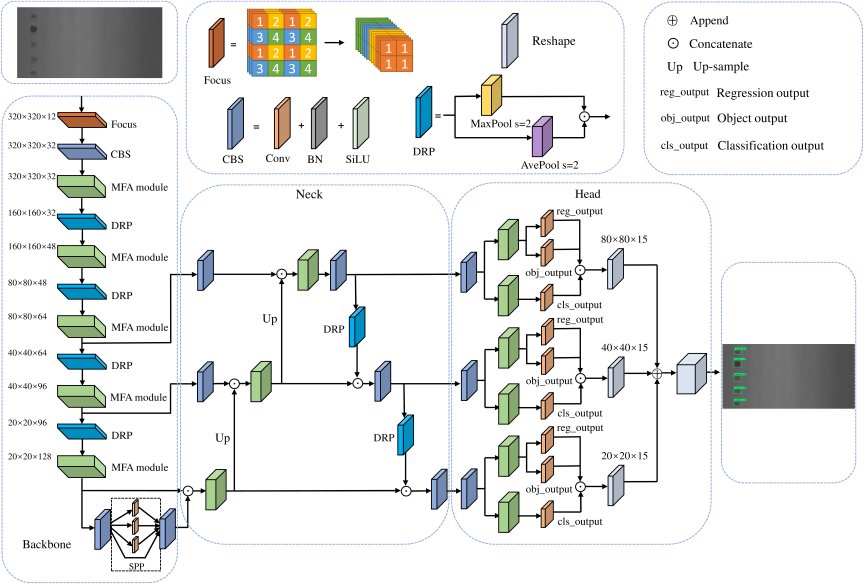
Fig. 1. The overall framework of YOLO-Pooling. The Focus is to slice the image and perform a double downsampling feature map without information loss. Reshape is to adjust the feature map. SPP is spatial pyramid pooling. Up is an upsampling operation using nearest neighbor interpolation.
3.1.1. Backbone
As shown on the left in Fig. 1, the backbone network begins by employing the Focus operation (a dimensionality reduction operation similar to channel grouping) to minimize computational costs while retaining information richness in the input. Furthermore, we use the DRP and MFA modules in the feature extraction stage of the backbone network. Precisely, the DRP constitutes a unique operation by concatenating max-pooling and average-pooling. In the backbone’s feature extraction pipeline, DRP is applied after each Conv-BN-SiLU (CBS) block to reduce dimensions without losing key information, and the subsequent MFA module aggregates the refined features across scales-forming a “dimensionality reduction-aggregation” cascade. This mechanism reduces feature space dimensions while preserving critical information, enhancing the backbone’s ability to capture and represent image features. Unlike traditional pooling operations, the combination of DRP allows for a more comprehensive feature acquisition, introducing novel advantages to the network’s feature extraction and utilization.
On the other hand, the MFA module combines the stereoscopic attention mechanism and top-down and bottom-up pathways to promote multi-scale and layered information interaction. This strategy captures lower-level features bottom-up and utilizes upper-level semantics to guide lower-level feature processing top-down. At the same time, the stereoscopic attention mechanism accentuates critical regions, enhancing feature representation and image comprehension. Integrating the DRP and MFA modules into the backbone network significantly improves the network’s feature expression capabilities, bringing more efficient and accurate feature extraction and utilization to image processing tasks. In the output of the backbone structure, we concatenate the bottom-level output with the original output after SPP to extract multi-scale features, preserve spatial information, and enhance the model’s perceptual abilities and adaptability.
3.1.2. Network
The Neck structure, illustrated in the center of Fig. 1, holds pivotal importance in object detection networks, primarily facilitating feature fusion and information transmission. Derived from the design principles of PANet, the Neck structure seamlessly integrates bottom-up and top-down pathways, effectively amalgamating diverse levels of feature information to enhance detection performance. Within the three branches of the Neck, we incorporate the MFA module as a critical component aimed at elevating feature expression.
3.1.3. YOLO Head
We adopt the anchor-free YOLO Head method, shown on the right side of Fig. 1. This method achieves object detection by predicting the target’s center point and the offset of the bounding box, making the model more flexible and able to better adapt to targets of different sizes and proportions. Additionally, a dynamic head mechanism is introduced that dynamically adjusts the detection head’s structure based on the input image’s dimensions and target sizes, thus improving detection performance for varying scale targets. Simultaneously, we integrate the MFA module at the input end of the YOLO Head, providing a richer and more diverse feature representation for final predictions and augmenting the model’s adaptability to object detection tasks. The YOLO Head enhances the model’s detection capability for objects of various sizes and proportions, thereby improving the overall robustness and accuracy of the model.
3.2. Dimension Reduction Pooling Module
In object detection tasks, dimensionality reduction operations are frequently employed for processing feature maps. To reduce parameter and computational overhead, spatial dimensions of feature maps are commonly decreased through pooling operations (such as max pooling or average pooling). This approach retains primary features while reducing computational overhead. We consider the \(X\in \mathbb{R}^{H\times W \times C}\) to be the input feature, in which \(H\), \(W\), and \(C\) denote the height, width, and channels, respectively. The max pooling is shown in Eq. (1), and the average pooling is shown in Eq. (2).
Based on max pooling and average pooling, we construct the DRP module as presented in Eq. (3) to offer a richer feature expression. Specifically, we adopt a \(3\times3\) pooling window for both max pooling and average pooling to ensure feature consistency, and the concatenated feature map is compressed back to the original channel number via a \(1\times1\) convolution to avoid computational redundancy. DRP aims to preserve more feature details while reducing dimensions, given that max pooling emphasizes salient features, whereas average pooling tends to retain the overall feature distribution. Concatenating the results of these two pooling methods provides a more comprehensive feature representation, helping the model better learn target features and improve detection performance.
3.3. Multi-Scale Feature Aggregation Module
Based on the PANet architecture, we introduce an MFA module, illustrated in Fig. 2. The MFA module comprises three components: the CSP structure, the feature aggregation structure, and the stereoscopic attention structure. These components work collaboratively: the CSP structure first purifies the input feature flow to reduce redundancy, the feature aggregation structure fuses multi-scale information via top-down/bottom-up pathways, and the stereoscopic attention structure highlights critical features. Finally, the outputs of the three structures are concatenated, and the interaction ability between features is improved through channel shuffle. Fusing the three structures enables the MFA module to better capture and integrate feature information at different scales and levels in the image, providing the model with a more comprehensive and accurate feature representation. Within the MFA, the CSP structure is employed to streamline information flow, enhance gradient propagation, and diminish computational complexity, thereby improving model efficiency and performance.
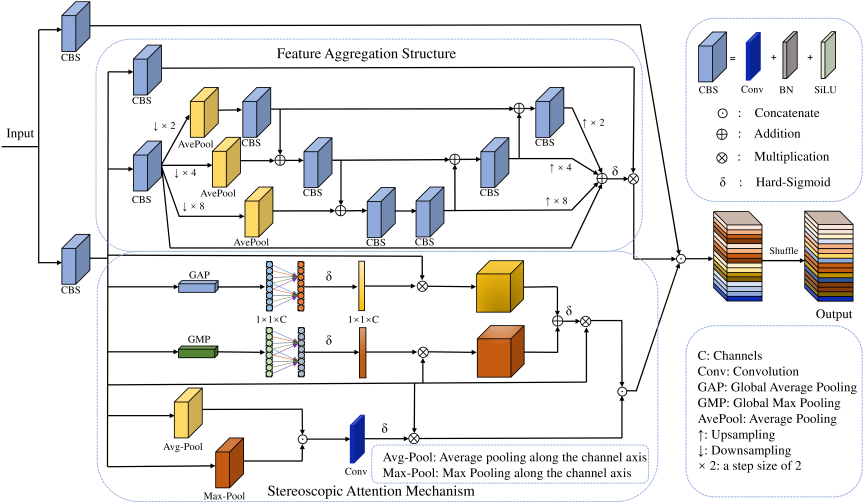
Fig. 2. The structure of the MFA module. The function of shuffle is channel mixing. ↑: Upsampling represents upsampling, achieved through the resize operation. ↓: Downsampling denotes the average pooling operation.
3.3.1. Feature Aggregation Structure
The feature aggregation structure is shown in the upper part of Fig. 2. We first use average pooling operations with different step sizes \(\{2, 4, 8 \}\) to provide multi-level feature expression. Among them, in the branch of average pooling with different step sizes, \(3\times3\) convolution operations are incorporated to alleviate the aliasing effects caused by downsampling and upsampling. Using top-down and bottom-up pathways similar to PANet allows information to be interacted with and integrated at different scales and levels. The bottom-up pathway captures low-level features and passes them to higher levels. In contrast, the top-down pathway utilizes upper-level semantic information to guide and adjust the processing of low-level features through feedback pathways. Finally, the output of each channel is reshaped and processed by Hard-Sigmoid (as shown in Eq. (4)) as weight and loaded into another branch of the CSP structure.
3.3.2. Stereoscopic Attention Mechanism
The stereoscopic attention mechanism is implemented by parallel combining the channel and spatial attention mechanisms, with clear interaction logic between branches as illustrated in Fig. 2. In the channel attention mechanism: we first use GAP (as shown in Eq. (5)) and GMP (as shown in Eq. (6)) to convert the input features into fixed-length vector features.
These two vector features are then fed into separate one-dimensional convolution layers for local feature extraction, and each output is processed by the Hard-Sigmoid activation function to generate channel attention weights for the GAP branch and GMP branch, respectively. Subsequently, the GMP branch’s attention weights are multiplied with the CBS-processed input feature branch to preliminary enhance critical channel information. Finally, the GAP branch’s attention weights are multiplied with the aforementioned enhanced feature branch to further optimize channel-wise feature representation.
Afterward, local features are extracted through a one-dimensional convolution operation and loaded as weights in the output of this branch through Hard-Sigmoid processing. In spatial attention, we first process the input feature map through a CBS block to refine feature representation, then apply average and max pooling operations along the channel axis and concatenate them to generate efficient feature descriptors 41,51. The feature descriptor is subjected to linear transformation via a one-dimensional convolution layer, followed by Hard-Sigmoid activation to generate spatial attention weights. The resulting spatial attention weights are multiplied with the CBS-processed feature branch (the same branch involved in channel attention interactions) to emphasize or suppress spatial location-specific feature information. The parallel output of the channel attention branch and spatial attention branch is concatenated to form the final output of the stereoscopic attention mechanism, ensuring comprehensive enhancement of both channel and spatial dimensions—consistent with the information flow paths in Fig. 2.
4. Evaluation
In this section, we introduce the implementation details in Subsection 4.1. The datasets are introduced in Subsection 4.2. The evaluation metrics are expressed as Subsection 4.3. In Subsection 4.4, we perform performance comparisons, including the effectiveness of the proposed DRP and MFA modules, ablation experiments of different structures of YOLO-Pooling, comparison of YOLO-Pooling and the state-of-the-art (SOTA) object detection model on Crack, Barcodes, NEU-DET, and PCB public datasets. In Subsection 4.5, we discuss the limitations of this paper and look forward to future work.
4.1. Implementation Details
All experiments utilize an i9-10900 CPU with a single NVIDIA GeForce RTX 3090 GPU. The operating system environment is based on Ubuntu 21.04, utilizing CUDA version 11.4 and the GPU acceleration library cuDNN 8.2.4. In order to ensure the reproducibility and comparability of the results, all models in this article are reproduced based on TensorFlow using officially provided codes.
To clarify the efficiency of the proposed model despite additional modules (DRP and MFA), we analyze the key factors influencing inference speed as follows. FLOPs and parameter control: the DRP module uses pooling operations (lower computational complexity than strided convolution) and \(1\times1\) convolution for channel compression, while the MFA module adopts a CSP structure to reduce redundant computation. The overall FLOPs (37.76G) and parameters (9.13M) of YOLO-Pooling are significantly lower than mainstream YOLO models (e.g., YOLOv5-L: 108.40G FLOPs, 46.25M parameters), reducing core computation overhead. Memory access optimization: consistent \(3\times3\) kernels in DRP/MFA ensure spatial locality of memory access, optimizing cache utilization. The model’s lightweight weight size (38.30 MB) reduces data transfer latency between CPU/GPU and GPU memory levels. Operator fusion: discrete operations in DRP (max pooling \(+\) average pooling \(+\) concatenation \(+\) \(1\times1\) convolution) and MFA (average pooling \(+\) convolution \(+\) weighting) are fused into composite CUDA kernels via TensorFlow’s graph optimization, eliminating intermediate data copying. Anchor-free post-processing: the anchor-free YOLO Head reduces the number of candidate boxes for NMS by 40% compared to anchor-based models, simplifying post-processing latency.
The epoch and batch size are set to 300 and 8, respectively. In object detection, Mosaic and Mixup are commonly used data augmentation techniques for splicing multiple images and mixing pixel values to generate new training samples to improve the robustness and generalization capabilities of the model. In this paper, the augmentation rates of both data augmentations are set to \(0.5\). However, the training images generated by Mosaic deviate from the true distribution. Therefore, we use data augmentation in the first 210 epochs but not in the last 90 epochs to prevent over-augmentation of the data.
The confidence is set to \(0.5\) during the evaluation process and the IoU to \(0.3\) for non-maximum suppression. All models are trained using the Adam optimizer, with parameters \(\beta_{1} = 0.937\), \(\beta_{2} = 0.999\). The learning rate uses a warm-up cosine annealing algorithm during the training process. The learning rate of the model gradually increases from 4\(\mathrm{e}\)-6 to the initial setting of 1\(\mathrm{e}\)-3 in the first five epochs and then decreases according to cosine, with a minimum learning rate of \(1\mathrm{e}\)-5.
The same loss function is adopted for YOLO-Pooling as one of our previously published papers 51. This loss function has demonstrated certain advantages in prior research and exhibited strong performance in task processing. We continue using this loss function due to its applicability and effectiveness in the problem domain and datasets. Leveraging this loss function optimizes the model more effectively, producing satisfactory experimental results.
4.2. Datasets
This article selects five public datasets as the evaluation benchmark of the YOLO-Pooling model. These datasets represent different scenarios, objects, and challenges, covering diverse visual recognition tasks. Widely applied in academic and industrial domains, these datasets offer a robust foundation for algorithm performance evaluation. Through systematic experimental evaluation of these datasets, this study aims to explore the effectiveness and generalization ability of the proposed method. The following content provides comprehensive details on each dataset, revealing their unique characteristics and applications.
4.2.1. GC10-DET
GC10-DET public dataset, available at https://www.kaggle.com/datasets/alex000kim/gc10det, is a dataset collected from real industrial scenarios designed explicitly for metallic surface defect detection. The dataset contains 2,294 images, encompassing 10 distinct defect classes. Regarding dataset partitioning, 1,857 images are allocated for training, 207 for validation, and 230 for testing.
4.2.2. Crack
Crack public dataset is available at https://universe.roboflow.com/new-workspace-nuxum/sdnet2018-d-cd-pub. This object detection dataset annotated for concrete crack detection contains 996 images of one class. Among these are 879 images allocated for training, 80 for validation, and 37 for testing.
4.2.3. Barcodes
Barcodes public dataset is available at https://universe.roboflow.com/mjuks/barcodes-sddct. This dataset contains 4,333 barcode images with one class. Among them, 3,792 images are used for training, 360 for validation, and 181 for testing. These images provide various barcode samples for training, validation, and testing different models’ detection performance.
4.2.4. NEU-DET
NEU-DET public dataset is available at http://faculty.neu.edu.cn/songkechen/zh_CN/zdylm/263270/list/index.htm. This dataset comprises 1,800 images covering six surface defects in hot rolled strip images. Specifically, 1,458 images are allocated for training, 162 for validation, and 180 for testing. Each type of defect consists of 300 samples. This dataset provides a diverse and comprehensive collection of samples, facilitating research and evaluation of models related to surface defect analysis.
4.2.5. PCB
PCB public dataset is available at https://www.kaggle.com/datasets/akhatova/pcb-defects. The publicly available synthetic PCB dataset comprises 693 images categorized into six classes for detection tasks. The dataset designates 560 images for training, 63 for validation, and 70 for testing. These images feature six types of defects created using Photoshop, a graphics editor developed by Adobe Systems.
4.2.6. COCO
This is a subset of the COCO public dataset. Images in the COCO public dataset are divided into 80 classes for detection tasks. The dataset we used for experiments specifies 20,000 images for training, 5,000 for validation, and 5,000 for testing.
4.3. Evaluation Metrics
To evaluate the effectiveness of YOLO-Pooling, we utilize three values computed based on the predicted confusion matrix: true positives (TP), false positives (FP), and false negatives (FN). Subsequently, these values are used to calculate Precision and Recall as shown in Eqs. (7) and (8). \(Pre\) and \(Rec\) represent the Precision and Recall, respectively.
Average Precision (\(AP\)) is usually used to evaluate the performance of algorithms on different classes. \(AP\) is generally obtained by calculating the area between the PR:curve and the coordinate axis. The PR:curve here has Recall as the horizontal axis and Precision as the vertical axis. In practical applications, we smooth the PR:curve to simplify the steps of calculating \(AP\) as follows:
The mean Average Precision (\(mAP\)) is the average of \(AP\) across all classes (\(K\)), which is used to evaluate the model’s performance in multiple classes, as shown in Eq. (10).
To measure the accuracy and robustness of YOLO-Pooling and other SOTA object detection models in detecting objects, we also use the evaluation metrics in COCO_API to evaluate the results, as detailed in the 51.
4.4. Performance Comparison
Experiments are conducted on the GC10-DET dataset to validate the proposed modules. The module’s performance is explored under different model configurations and hyperparameter settings, conducting comparative studies to assess its effectiveness and robustness in object detection tasks. We pay particular attention to the performance discrepancies among different modules and their applicability in specific scenarios.
In all tables of this paper, FLOPs means floating point operations, Param. indicates the model’s parameters, Size represents the model’s weight, Speed represents the model’s inference speed, and the fps means frame per second. \(-1.000\) means that no corresponding result is detected. \(-\) represents not applicable.
4.4.1. Effectiveness Evaluation of MFA and DRP Modules in the Backbone Structure
We select eight classic CNNs as backbone structures and compare them with backbone structures containing DRP and MFA modules. These classic networks, including CSPDarkNet53 17, VGG16 52, ResNet50 53, DenseNet121 54, InceptionV3 55, Xception 56, MobileNetV3 57, GhostNet 58, are widely used in classification tasks. We chose these network structures due to their distinctive characteristics in feature extraction, parameter quantity, and network depth. During comparative experiments, we replace the backbone structure of YOLO-Pooling and maintain the training strategy to ensure the fairness and comparability of the experiments.
Table 1 shows the experimental results of different backbone structures based on YOLO-Pooling. It is worth noting that the backbone structure (Ours) designed based on DRP and MFA achieved 67.74% \(mAP\) in object detection, which is much higher than other models. The remarkable improvement suggests that the specific design of YOLO-Pooling might more effectively capture object features, demonstrating superior performance in information extraction. Furthermore, the results validate the potential advantage of DRP and MFA modules based on pooling operations in object detection tasks, highlighting their importance in feature extraction and fusion. These comparative experiments further reveal performance discrepancies among different backbone network structures in object detection tasks, emphasizing the advantages and potential application prospects of the proposed DRP and MFA modules based on pooling operations.
| BackBone | FLOPs (G) | Param. (M) | Size [MB] | Speed [fps] | \(mAP\) [%] | \(AP_{11}\) | \(AP_{50}\) | \(AP_{75}\) | \(AP_{s}\) | \(AP_{m}\) | \(AP_{l}\) | \(AR_{s}\) | \(AR_{m}\) | \(AR_{l}\) |
| CSPDarknet53 | 113.66 | 36.62 | 148.20 | 47.46 | 53.92 | 0.267 | 0.534 | 0.248 | \(-\)1.000 | 0.136 | 0.272 | \(-\)1.000 | 0.153 | 0.315 |
| VGG16 | 281.44 | 23.50 | 95.20 | 54.53 | 62.10 | 0.289 | 0.613 | 0.259 | \(-\)1.000 | 0.136 | 0.288 | \(-\)1.000 | 0.177 | 0.321 |
| ResNet50 | 102.35 | 36.80 | 148.80 | 56.50 | 60.63 | 0.301 | 0.598 | 0.291 | \(-\)1.000 | 0.148 | 0.295 | \(-\)1.000 | 0.172 | 0.340 |
| DenseNet121 | 78.20 | 17.01 | 70.10 | 45.81 | 62.74 | 0.327 | 0.624 | 0.317 | \(-\)1.000 | 0.157 | 0.325 | \(-\)1.000 | 0.175 | 0.361 |
| InceptionV3 | 97.18 | 34.46 | 139.70 | 50.76 | 61.81 | 0.316 | 0.613 | 0.302 | \(-\)1.000 | 0.155 | 0.317 | \(-\)1.000 | 0.181 | 0.364 |
| Xception | 109.36 | 33.44 | 135.20 | 53.39 | 62.88 | 0.310 | 0.617 | 0.314 | \(-\)1.000 | 0.135 | 0.316 | \(-\)1.000 | 0.169 | 0.358 |
| MobileNetV3 | 28.89 | 10.11 | 42.20 | 58.15 | 59.77 | 0.307 | 0.595 | 0.304 | \(-\)1.000 | 0.152 | 0.308 | \(-\)1.000 | 0.174 | 0.357 |
| GhostNet | 27.60 | 9.81 | 41.10 | 55.64 | 59.18 | 0.302 | 0.581 | 0.290 | \(-\)1.000 | 0.157 | 0.300 | \(-\)1.000 | 0.184 | 0.338 |
4.4.2. Effectiveness Evaluation of MFA and DRP Modules in the Neck Structure
We compare four different Neck structures, namely FPN 30, PANet 12, AugFPN 31, and the proposed Neck structure with DRP and MFA modules. The primary aim is to verify the effectiveness of DRP and MFA introduced in the feature fusion stage. In the experiments, the Neck structure of YOLO-Pooling is replaced for comparative experiments, maintaining consistent training strategies to ensure experiment comparability and result reliability.
Table 2 shows the results of using different Neck structures in YOLO-Pooling. The proposed Neck structure achieved an \(mAP\) of 67.74%, significantly better than the other three structures. It is worth noting that the \(mAP\) result using the PANet structure is the worst, only 47.11%. Furthermore, the proposed Neck structure has few parameters and model weight sizes. Although AugFPN’s FLOPs is lower than the proposed Neck structure, the \(mAP\) accuracy drops by 16.32%. These results indicate that the Neck structure integrating the proposed DRP and MFA structures fuse features more effectively and exhibits higher effectiveness.
| Neck | FLOPs (G) | Param. (M) | Size [MB] | Speed [fps] | \(mAP\) [%] | \(AP_{11}\) | \(AP_{50}\) | \(AP_{75}\) | \(AP_{s}\) | \(AP_{m}\) | \(AP_{l}\) | \(AR_{s}\) | \(AR_{m}\) | \(AR_{l}\) |
| FPN | 44.12 | 18.21 | 74.40 | 57.77 | 51.59 | 0.252 | 0.512 | 0.208 | \(-\)1.000 | 0.120 | 0.252 | \(-\)1.000 | 0.146 | 0.291 |
| PANet | 76.65 | 40.93 | 165.40 | 51.57 | 47.11 | 0.241 | 0.467 | 0.207 | \(-\)1.000 | 0.111 | 0.248 | \(-\)1.000 | 0.130 | 0.288 |
| AugFPN | 32.58 | 9.26 | 38.50 | 59.08 | 51.42 | 0.245 | 0.509 | 0.205 | \(-\)1.000 | 0.123 | 0.248 | \(-\)1.000 | 0.146 | 0.288 |
| Ours | 37.76 | 9.13 | 38.30 | 51.94 | 67.74 | 0.311 | 0.669 | 0.263 | \(-\)1.000 | 0.136 | 0.314 | \(-\)1.000 | 0.160 | 0.364 |
4.4.3. Ablation Study
| Config | Method | FLOPs (G) | Param. (M) | Size [MB] | Speed [fps] | \(mAP\) [%] | \(AP_{11}\) | \(AP_{50}\) | \(AP_{75}\) | \(AP_{s}\) | \(AP_{m}\) | \(AP_{l}\) | \(AR_{s}\) | \(AR_{m}\) | \(AR_{l}\) |
| Down Sample | Conv2D | 38.78 | 9.32 | 39.00 | 49.24 | 60.26 | 0.308 | 0.590 | 0.300 | \(-\)1.000 | 0.151 | 0.299 | \(-\)1.000 | 0.172 | 0.335 |
| Max pooling | 34.50 | 8.42 | 35.40 | 51.90 | 59.27 | 0.309 | 0.585 | 0.275 | \(-\)1.000 | 0.139 | 0.312 | \(-\)1.000 | 0.174 | 0.352 | |
| Average Pooling | 34.50 | 8.42 | 35.40 | 52.55 | 63.23 | 0.304 | 0.625 | 0.278 | \(-\)1.000 | 0.135 | 0.303 | \(-\)1.000 | 0.161 | 0.346 | |
| MFA (Without Shuffle) | 37.76 | 9.13 | 38.20 | 52.94 | 56.85 | 0.277 | 0.562 | 0.258 | \(-\)1.000 | 0.137 | 0.284 | \(-\)1.000 | 0.169 | 0.319 | |
| Loss Func. (CIoU) | 37.76 | 9.13 | 38.30 | 51.27 | 60.10 | 0.292 | 0.596 | 0.254 | \(-\)1.000 | 0.147 | 0.287 | \(-\)1.000 | 0.167 | 0.328 | |
| Ours (DRP) | 37.76 | 9.13 | 38.30 | 51.94 | 67.74 | 0.311 | 0.669 | 0.263 | \(-\)1.000 | 0.136 | 0.314 | \(-\)1.000 | 0.160 | 0.364 | |
To evaluate the proposed YOLO-Pooling model more comprehensively, we conduct extensive ablation experiments. Table 3 summarizes the various ablation experiments.
First, in the downsampling process, we designed an isolated validation experiment for the DRP module and set four comparison schemes: the convolution operation with a stride of 2, max pooling, average pooling, and the proposed DRP module for independent verification. The results show that the independent use of the DRP module achieves the mAP of 67.74%, which is significantly higher than the other three downsampling methods (Conv2D: 60.26%, Max pooling: 59.27%, Average Pooling: 63.23%). This result directly verifies the individual contribution of the DRP module in the downsampling process, which can retain more feature details while reducing the dimensionality, integrate the salient feature information captured by max pooling and the global feature distribution preserved by average pooling, and provide a more comprehensive and rich feature representation for the model, thus effectively improving the detection accuracy of the model.
Secondly, we add a channel shuffle operation at the MFA module’s output. The results show that the \(mAP\) without channel shuffle is 56.85%, which is significantly lower than the result after channel shuffle operation. It shows that many noise features are mixed after pooling operations and feature fusion with different step sizes, reducing the model’s generalization ability. Through channel shuffle, important features are enhanced, irrelevant features are weakened, and the correlation between features is improved, improving the model’s performance.
In addition, ablation experiments on loss functions reveal the impact of different loss functions on model training and generalization performance. The results show that the model using the CIoU loss function obtained an \(mAP\) of 60.10%, much lower than the SIoU loss function we used, indicating that SIoU has significant advantages in improving model performance and generalization capabilities.
In summary, the ablation experiments quantitatively reveal the independent contribution of each core component of the YOLO-Pooling model to the overall performance, especially the isolated validation experiment of the DRP module verifies its outstanding performance in the downsampling process, which can effectively improve the model’s feature representation ability and detection accuracy alone. These findings provide crucial insights for further improving and optimizing the model.
4.4.4. Comparison with SOTA Models on GC10-DET Dataset
To verify the superiority of the YOLO-Pooling model, we compare the performance with 20 other SOTA models. These studies include Faster-RCNN (using different backbone networks) 14, EfficientDet D1 59, RetinaNet 15, SSD 60, YOLOv3 16, YOLOv4 series 17, YOLOv5 series, YOLOX series 18, and YOLOv7 series 19. The experimental environment and configuration are shown in Subsection 4.1. For a fair comparison, we set the input resolution to \(640\times640\times3\). The SSD uses the default resolution of \(500\times500\times3\) in their officially released code.
The evaluation results are summarized in Table 4. The YOLO-Pooling model achieved the highest \(mAP\), surpassing other SOTA models by a significant margin. Among them, \(AP_m\) and \(AP_l\) represent the average precision of the object detection model on medium and large-sized targets. YOLO-Pooling efficiently detects and localizes objects of various sizes, ensuring reliability and robustness in diverse detection scenarios.
| Model | Input Res. | FLOPs (G) | Param. (M) | Size [MB] | Speed [fps] | \(mAP\) [%] | \(AP_{11}\) | \(AP_{50}\) | \(AP_{75}\) | \(AP_{s}\) | \(AP_{m}\) | \(AP_{l}\) | \(AR_{s}\) | \(AR_{m}\) | \(AR_{l}\) |
| Faster-RCNN (VGG16) | 600 | \(-\) | 136.85 | 547.50 | 25.04 | 43.80 | 0.198 | 0.432 | 0.146 | \(-\)1.000 | 0.098 | 0.207 | \(-\)1.000 | 0.136 | 0.250 |
| Faster-RCNN (ResNet50) | 600 | \(-\) | 28.43 | 114.20 | 16.40 | 43.29 | 0.201 | 0.423 | 0.164 | \(-\)1.000 | 0.114 | 0.200 | \(-\)1.000 | 0.145 | 0.258 |
| Efficientdet (D1) | 640 | 11.28 | 6.63 | 28.50 | 39.90 | 44.32 | 0.230 | 0.434 | 0.220 | \(-\)1.000 | 0.122 | 0.238 | \(-\)1.000 | 0.137 | 0.261 |
| RetinaNet | 640 | 162.43 | 36.57 | 146.70 | 20.70 | 55.68 | 0.248 | 0.554 | 0.183 | \(-\)1.000 | 0.141 | 0.255 | \(-\)1.000 | 0.180 | 0.326 |
| SSD | 500 | 174.23 | 24.95 | 99.90 | 70.91 | 39.23 | 0.196 | 0.388 | 0.184 | \(-\)1.000 | 0.074 | 0.211 | \(-\)1.000 | 0.100 | 0.231 |
| YOLOv3 | 640 | 154.90 | 61.62 | 247.10 | 61.94 | 19.47 | 0.093 | 0.195 | 0.050 | \(-\)1.000 | 0.085 | 0.092 | \(-\)1.000 | 0.095 | 0.099 |
| YOLOv4 | 640 | 141.49 | 64.05 | 257.10 | 46.10 | 31.33 | 0.169 | 0.314 | 0.164 | \(-\)1.000 | 0.090 | 0.166 | \(-\)1.000 | 0.098 | 0.179 |
| YOLOv4-Tiny | 640 | 16.13 | 5.90 | 23.80 | 224.54 | 52.18 | 0.227 | 0.508 | 0.173 | \(-\)1.000 | 0.129 | 0.225 | \(-\)1.000 | 0.158 | 0.256 |
| YOLOv5-X | 640 | 204.31 | 86.37 | 346.50 | 48.23 | 55.57 | 0.269 | 0.552 | 0.248 | \(-\)1.000 | 0.106 | 0.276 | \(-\)1.000 | 0.127 | 0.313 |
| YOLOv5-L | 640 | 108.40 | 46.25 | 185.80 | 64.97 | 47.54 | 0.233 | 0.476 | 0.195 | \(-\)1.000 | 0.112 | 0.236 | \(-\)1.000 | 0.131 | 0.275 |
| YOLOv5-M | 640 | 48.12 | 20.94 | 84.40 | 89.49 | 47.29 | 0.231 | 0.470 | 0.212 | \(-\)1.000 | 0.109 | 0.241 | \(-\)1.000 | 0.134 | 0.279 |
| YOLOv5-S | 640 | 15.91 | 7.07 | 28.70 | 123.01 | 47.69 | 0.217 | 0.473 | 0.180 | \(-\)1.000 | 0.097 | 0.226 | \(-\)1.000 | 0.119 | 0.251 |
| YOLOv5-Nano | 640 | 4.21 | 1.79 | 7.60 | 121.40 | 41.29 | 0.200 | 0.409 | 0.160 | \(-\)1.000 | 0.098 | 0.210 | \(-\)1.000 | 0.116 | 0.240 |
| YOLOX-X | 640 | 281.52 | 99.11 | 397.60 | 38.83 | 53.53 | 0.252 | 0.536 | 0.207 | \(-\)1.000 | 0.123 | 0.246 | \(-\)1.000 | 0.143 | 0.289 |
| YOLOX-L | 640 | 155.33 | 54.22 | 217.90 | 58.41 | 48.95 | 0.245 | 0.485 | 0.208 | \(-\)1.000 | 0.107 | 0.250 | \(-\)1.000 | 0.123 | 0.282 |
| YOLOX-M | 640 | 73.52 | 25.33 | 102.20 | 79.95 | 49.84 | 0.250 | 0.494 | 0.229 | \(-\)1.000 | 0.119 | 0.249 | \(-\)1.000 | 0.142 | 0.284 |
| YOLOX-S | 640 | 26.66 | 8.96 | 36.50 | 94.92 | 47.91 | 0.233 | 0.475 | 0.176 | \(-\)1.000 | 0.094 | 0.228 | \(-\)1.000 | 0.116 | 0.258 |
| YOLOX-Tiny | 640 | 15.16 | 5.05 | 20.80 | 97.23 | 44.25 | 0.215 | 0.441 | 0.151 | \(-\)1.000 | 0.095 | 0.211 | \(-\)1.000 | 0.111 | 0.237 |
| YOLOv7-X | 640 | 188.59 | 70.94 | 284.60 | 49.87 | 36.84 | 0.196 | 0.364 | 0.209 | \(-\)1.000 | 0.102 | 0.204 | \(-\)1.000 | 0.111 | 0.228 |
| YOLOv7-L | 640 | 104.90 | 37.29 | 149.90 | 70.24 | 31.92 | 0.160 | 0.319 | 0.153 | \(-\)1.000 | 0.075 | 0.172 | \(-\)1.000 | 0.091 | 0.192 |
| Ours | 640 | 37.76 | 9.13 | 38.30 | 51.94 | 67.74 | 0.311 | 0.669 | 0.263 | \(-\)1.000 | 0.136 | 0.314 | \(-\)1.000 | 0.160 | 0.364 |
On the other hand, \(AR_m\) and \(AR_l\) denote the average recall for medium and large-sized targets. YOLO-Pooling also outperforms other models significantly, demonstrating higher recall rates for medium and large-sized targets and effectively discovering more targets of these sizes. Notably, the dataset itself contains concurrent multi-scale objects (e.g., tiny scratches and large indentations in the same image), and the model’s \(AP_s=0.311\), \(AP_m=0.669\), \(AP_l=0.263\) (Table 4) confirm its ability to detect small, medium, and large objects simultaneously. This directly validates the MFA module’s multi-scale feature aggregation design, ensuring reliability in multi-size object detection.
It is noteworthy that YOLO-Pooling has significantly fewer parameters, weights, and FLOPs than most models (although slightly higher relative to YOLOv5-Nano). However, YOLO-Pooling achieves a 26.45% higher \(mAP\) than YOLOv5-Nano. Although slightly higher than some models, the highest \(mAP\) we achieved is 12.06% higher than the suboptimal RetinaNet.
Furthermore, the inference speed of YOLO-Pooling is only 51.94 fps. In terms of accuracy, YOLO-Pooling demonstrates superior performance, achieving the highest accuracy. The proposed YOLO-Pooling surpasses other SOTA models in finding the optimal balance between accuracy and efficiency.
To demonstrate the trade-off between accuracy and efficiency more clearly, we present three images in Fig. 3, showing the relationship between \(mAP\) and the number of parameters, FLOPs, and inference speed. In the plots of \(mAP\) against Parameters and \(mAP\) against FLOPs, YOLO-Pooling is in the upper left corner, showing satisfactory accuracy while maintaining a lightweight setup. In the plot of \(mAP\) against fps, YOLO-Pooling is located in the upper-middle corner and to the left, showing a good balance between accuracy and inference speed. Therefore, YOLO-Pooling balances accuracy, number of parameters, FLOPs, and inference speed.
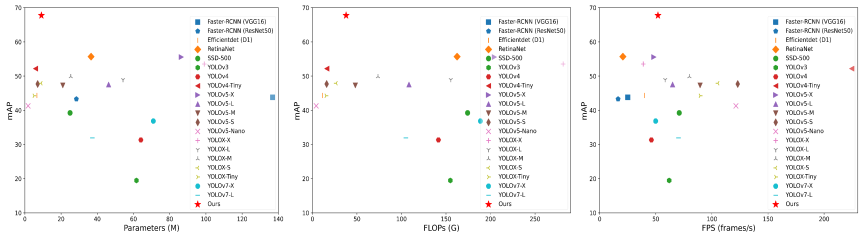
Fig. 3. Illustration of the trade-off among mAP, the number of parameters, FLOPs, and inference speed.
4.4.5. Visualization Results
To improve understanding and communication of model performance, the results are visualized. We present three critical views: original image, heatmap, and detection result map. All sample images in Fig. 4 are selected from the GC10-DET dataset (metallic surface defect detection scenario), and typical defect samples (e.g., scratches and indentations on metallic surfaces) are chosen to demonstrate the model’s detection capability in practical industrial scenarios. The original image shows the real scene of the input image, while the heatmap shows the area of interest of the model during the object detection process. Through the heatmap, we observe how the model locates the object in the image, with prominently highlighted areas intuitively depicting the probability distribution of the model for the object’s position. It is worth emphasizing that in the results, the center point of the heatmap is always concentrated at the exact center of the object, highlighting the model’s sensitivity and accuracy to the object’s location.
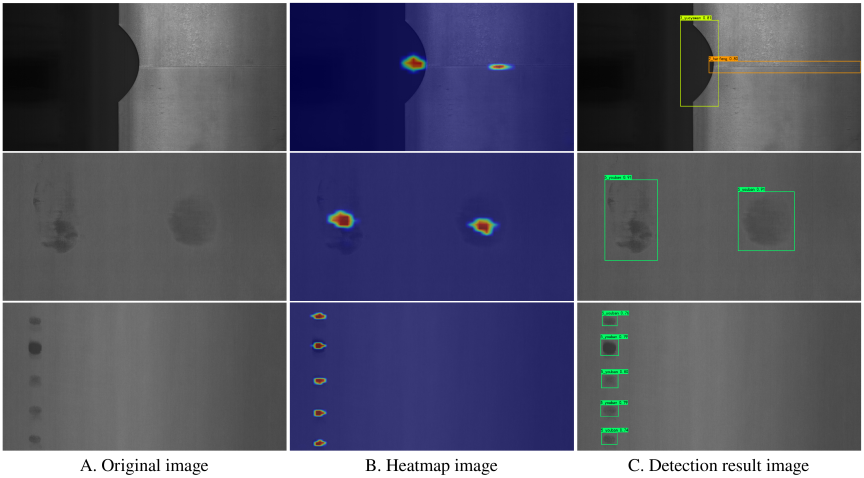
Fig. 4. Visualization results of YOLO-Pooling.
The final detection result image combines the model’s output with the original image, demonstrating the model’s ability to successfully detect and mark the object’s location in the image. The final detection accuracy and bounding box quality are both satisfactory. The comprehensive presentation of these three views provides a window for a comprehensive evaluation of YOLO-Pooling performance, focusing on the accuracy of the object location and profoundly exploring the model’s understanding and application of image information.
4.4.6. Comparison with SOTA Models on Other Public Datasets
In order to verify the generalization performance of the YOLO-Pooling model, we conduct extensive experiments on four public datasets, covering diverse fields such as crack detection, barcode detection, metal surface defect detection, and PCB defect detection. A comprehensive comparison is made with 20 other SOTA object detection models, and the results are summarized in Table 5.
| Model | Input Res. | Crack | Barcodes | NEU-DET | Input Res. | PCB | ||||||||||||
| \(mAP\) [%] | \(AP_{11}\) | \(AP_{50}\) | \(AP_{75}\) | \(mAP\) [%] | \(AP_{11}\) | \(AP_{50}\) | \(AP_{75}\) | \(mAP\) [%] | \(AP_{11}\) | \(AP_{50}\) | \(AP_{75}\) | \(mAP\) [%] | \(AP_{11}\) | \(AP_{50}\) | \(AP_{75}\) | |||
| Faster-RCNN (VGG16) | 600 | 81.04 | 0.452 | 0.763 | 0.516 | 96.45 | 0.465 | 0.933 | 0.448 | 72.30 | 0.389 | 0.713 | 0.362 | 600 | 80.98 | 0.367 | 0.802 | 0.305 |
| Faster-RCNN (ResNet50) | 600 | 76.78 | 0.445 | 0.738 | 0.524 | 95.38 | 0.499 | 0.940 | 0.440 | 74.21 | 0.416 | 0.731 | 0.403 | 600 | 76.05 | 0.326 | 0.754 | 0.194 |
| Efficientdet (D0) | 512 | 57.83 | 0.301 | 0.579 | 0.291 | 94.62 | 0.451 | 0.935 | 0.397 | 53.07 | 0.284 | 0.526 | 0.259 | 640 | 38.31 | 0.179 | 0.384 | 0.109 |
| RetinaNet | 600 | 64.74 | 0.356 | 0.644 | 0.330 | 95.54 | 0.491 | 0.940 | 0.453 | 68.84 | 0.361 | 0.680 | 0.325 | 640 | 21.07 | 0.083 | 0.208 | 0.029 |
| SSD | 300 | 68.91 | 0.367 | 0.688 | 0.376 | 96.94 | 0.504 | 0.956 | 0.469 | 58.65 | 0.314 | 0.578 | 0.297 | 500 | 44.05 | 0.204 | 0.436 | 0.148 |
| YOLOv3 | 416 | \(-\) | \(-\) | \(-\) | \(-\) | 93.74 | 0.471 | 0.923 | 0.460 | 26.17 | 0.134 | 0.256 | 0.103 | 640 | 89.00 | 0.352 | 0.877 | 0.160 |
| YOLOv4 | 416 | 49.12 | 0.274 | 0.496 | 0.299 | 93.43 | 0.493 | 0.913 | 0.413 | 37.92 | 0.211 | 0.377 | 0.190 | 640 | 92.85 | 0.399 | 0.922 | 0.186 |
| YOLOv4-Tiny | 416 | 75.00 | 0.292 | 0.713 | 0.126 | 93.85 | 0.450 | 0.923 | 0.419 | 61.69 | 0.282 | 0.605 | 0.196 | 640 | 87.64 | 0.380 | 0.873 | 0.222 |
| YOLOv5-X | 416 | 72.22 | 0.480 | 0.681 | 0.589 | 94.95 | 0.507 | 0.934 | 0.442 | 59.14 | 0.368 | 0.588 | 0.382 | 640 | 85.48 | 0.358 | 0.851 | 0.186 |
| YOLOv5-L | 416 | 77.78 | 0.506 | 0.742 | 0.592 | 97.03 | 0.538 | 0.958 | 0.486 | 54.38 | 0.326 | 0.540 | 0.331 | 640 | 88.61 | 0.395 | 0.879 | 0.277 |
| YOLOv5-M | 416 | 77.78 | 0.486 | 0.737 | 0.595 | 97.28 | 0.512 | 0.956 | 0.475 | 54.05 | 0.333 | 0.539 | 0.339 | 640 | 48.27 | 0.201 | 0.480 | 0.096 |
| YOLOv5-S | 416 | 63.89 | 0.387 | 0.601 | 0.398 | 97.20 | 0.495 | 0.938 | 0.474 | 45.95 | 0.276 | 0.457 | 0.283 | 640 | 66.65 | 0.259 | 0.664 | 0.115 |
| YOLOv5-Nano | 416 | 63.08 | 0.348 | 0.582 | 0.408 | 96.65 | 0.497 | 0.944 | 0.458 | 42.86 | 0.264 | 0.428 | 0.288 | 640 | 33.80 | 0.127 | 0.328 | 0.047 |
| YOLOX-X | 416 | 80.82 | 0.474 | 0.761 | 0.599 | 95.29 | 0.509 | 0.927 | 0.480 | 70.12 | 0.407 | 0.697 | 0.416 | 640 | 96.48 | 0.488 | 0.958 | 0.397 |
| YOLOX-L | 416 | 78.98 | 0.514 | 0.747 | 0.606 | 97.31 | 0.531 | 0.959 | 0.520 | 65.99 | 0.379 | 0.647 | 0.391 | 640 | 93.60 | 0.470 | 0.925 | 0.380 |
| YOLOX-M | 416 | 83.85 | 0.475 | 0.793 | 0.522 | 96.65 | 0.507 | 0.946 | 0.463 | 69.67 | 0.398 | 0.687 | 0.408 | 640 | 96.08 | 0.500 | 0.953 | 0.427 |
| YOLOX-S | 416 | 84.11 | 0.534 | 0.796 | 0.633 | 95.76 | 0.513 | 0.940 | 0.486 | 64.12 | 0.354 | 0.632 | 0.322 | 640 | 93.15 | 0.460 | 0.924 | 0.352 |
| YOLOX-Tiny | 416 | 80.56 | 0.496 | 0.770 | 0.599 | 96.93 | 0.533 | 0.950 | 0.478 | 66.06 | 0.368 | 0.656 | 0.349 | 640 | 92.75 | 0.456 | 0.921 | 0.323 |
| YOLOv7-X | 416 | 75.00 | 0.512 | 0.713 | 0.614 | 97.07 | 0.532 | 0.955 | 0.490 | 56.72 | 0.344 | 0.565 | 0.358 | 640 | 94.18 | 0.477 | 0.935 | 0.398 |
| YOLOv7-L | 416 | 72.12 | 0.511 | 0.687 | 0.651 | 97.11 | 0.560 | 0.957 | 0.487 | 55.95 | 0.337 | 0.552 | 0.331 | 640 | 85.05 | 0.395 | 0.846 | 0.288 |
| Ours | 416 | 86.11 | 0.568 | 0.828 | 0.641 | 97.78 | 0.518 | 0.961 | 0.474 | 73.27 | 0.408 | 0.727 | 0.406 | 640 | 96.56 | 0.462 | 0.958 | 0.339 |
Combining the experimental results of the four datasets, the YOLO-Pooling model shows excellent generalization performance and a superior comprehensive effect on the object detection task. Although it is slightly inferior on the NEU-DET dataset, 0.94% lower than Faster-RCNN (ResNet50), this gap is negligible after considering the large number of parameters and weights of Faster-RCNN (ResNet50) and the relatively slow inference speed.
Beyond the excellent performance, the YOLO-Pooling model demonstrates significant parameter efficiency. Compared with other SOTA models, YOLO-Pooling has a more compact model structure while maintaining a high level of detection accuracy, reducing the computational overhead of model training and inference. This efficiency improves the practical deployment of the model and provides a more feasible solution for resource-constrained environments.
It is particularly worth mentioning that YOLO-Pooling surpassed competitors by 2.00% and 0.47% on the Crack and Barcodes datasets, respectively. These results strongly support the exceptional performance of YOLO-Pooling in specific scenarios and applications. On the PCB dataset, the model also surpassed the sub-optimal model (YOLOX-X) by 0.08%, consolidating its leading position in various tasks.
In summary, YOLO-Pooling shows significant potential in practical object detection applications with comprehensive performance, parameter efficiency, and fast inference speed. YOLO-Pooling’s exceptional performance and efficient computing characteristics provide strong support for various application scenarios and contribute an advanced and feasible solution to the future development of object detection.
4.4.7. Comparison with SOTA Models on COCO Dataset
To further verify the generalizability of YOLO-Pooling beyond industrial defect detection scenarios, we conducted comparative experiments on the COCO dataset—a widely used general-purpose object detection benchmark. Due to the excessive scale of the original COCO dataset, we extracted a representative subset while preserving the data distribution characteristics of the original dataset. The subset includes 20,000 training images, 5,000 validation images, and 5,000 test images, covering all 80 object categories defined in COCO (e.g., pedestrians, vehicles, daily necessities, animals).
The experimental settings are consistent with those in Section 4.1: the input resolution is \(640\times640\times3\), the Adam optimizer is used for training (\(\beta_1=0.937\), \(\beta_2=0.999\)), the learning rate adopts a warm-up cosine annealing strategy, and the same loss function is used. Table 6 summarizes the comparative results with mainstream YOLO models on the COCO dataset.
| Model | Input Res. | FLOPs (G) | Param. (M) | Size [MB] | Speed [fps] | \(mAP\) [%] | \(AP_{11}\) | \(AP_{50}\) | \(AP_{75}\) | \(AP_{s}\) | \(AP_{m}\) | \(AP_{l}\) | \(AR_{s}\) | \(AR_{m}\) | \(AR_{l}\) |
| YOLOv5-X | 416 | 204.31 | 86.37 | 346.50 | 48.23 | 2.91 | 2.10 | 2.90 | 2.40 | 0.10 | 1.00 | 3.00 | 0.10 | 1.10 | 3.30 |
| YOLOv5-L | 416 | 108.40 | 46.25 | 185.80 | 64.97 | 1.78 | 1.20 | 1.80 | 1.40 | 0.10 | 0.70 | 1.90 | 0.10 | 0.80 | 2.10 |
| YOLOv5-M | 416 | 48.12 | 20.94 | 84.40 | 89.49 | 0.71 | 0.40 | 0.70 | 0.40 | 0.10 | 0.40 | 0.70 | 0.10 | 0.50 | 0.80 |
| YOLOv5-S | 416 | 15.91 | 7.07 | 28.70 | 123.01 | 0.42 | 0.20 | 0.40 | 0.20 | 0.00 | 0.20 | 0.40 | 0.00 | 0.30 | 0.50 |
| YOLOv5-Nano | 416 | 4.21 | 1.79 | 7.60 | 121.40 | 0.29 | 0.20 | 0.30 | 0.10 | 0.00 | 0.10 | 0.30 | 0.00 | 0.10 | 0.40 |
| YOLOX-X | 416 | 281.52 | 99.11 | 397.60 | 38.83 | 23.06 | 15.30 | 23.30 | 16.80 | 1.80 | 10.60 | 23.90 | 2.00 | 12.10 | 27.60 |
| YOLOX-L | 416 | 155.33 | 54.22 | 217.90 | 58.41 | 25.96 | 17.10 | 26.10 | 18.90 | 2.50 | 13.40 | 25.60 | 2.80 | 15.50 | 29.50 |
| YOLOX-M | 416 | 73.52 | 25.33 | 102.20 | 79.95 | 28.19 | 18.50 | 28.40 | 20.50 | 2.40 | 15.90 | 27.20 | 2.70 | 18.70 | 31.40 |
| YOLOX-S | 416 | 26.66 | 8.96 | 36.50 | 94.92 | 21.92 | 13.50 | 22.20 | 14.70 | 1.70 | 11.20 | 19.70 | 1.90 | 13.20 | 22.50 |
| YOLOX-Tiny | 416 | 15.16 | 5.05 | 20.80 | 97.23 | 17.52 | 10.70 | 17.70 | 11.70 | 0.90 | 8.00 | 16.00 | 1.10 | 9.30 | 18.60 |
| YOLOv7-X | 416 | 188.59 | 70.94 | 284.60 | 49.87 | 6.00 | 4.30 | 6.00 | 4.90 | 0.20 | 2.00 | 6.10 | 0.20 | 2.20 | 6.90 |
| YOLOv7-L | 416 | 104.90 | 37.29 | 149.90 | 70.24 | 4.61 | 2.70 | 4.70 | 2.70 | 0.00 | 0.80 | 4.10 | 0.00 | 0.80 | 4.60 |
| Ours | 416 | 37.76 | 9.13 | 38.30 | 51.94 | 6.49 | 3.90 | 6.80 | 4.00 | 0.50 | 3.50 | 4.80 | 0.60 | 3.90 | 5.60 |
As shown in Table 6, YOLO-Pooling achieves a mAP of 6.49% on the COCO dataset subset, with \(AP_s=0.50\)%, \(AP_m=3.50\)%, \(AP_l=4.80\)%, and corresponding \(AR_s=0.60\)%, \(AR_m=3.90\)%, \(AR_l=5.60\)%. The COCO subset explicitly includes images with concurrent small (e.g., keys, buttons), medium (e.g., books, bottles), and large (e.g., sofas, cars) objects, and the multi-scale AP/AR metrics confirm the model’s ability to detect objects of different sizes simultaneously. Although this result is lower than that of YOLOX series models, it outperforms all YOLOv5 series models except YOLOv5-X. Considering the significant difference in application scenarios between general-purpose object detection (COCO) and industrial defect detection (the original target scenario of YOLO-Pooling), this result not only verifies the basic generalizability of the model—its core modules (DRP and MFA) can effectively extract features for non-industrial objects—but also validates the MFA module’s multi-scale feature aggregation design across diverse scenarios. Additionally, YOLO-Pooling maintains the advantages of lightweight (9.13M parameters, 38.30 MB size) and efficient inference (51.94 fps) on the COCO dataset, which is consistent with its performance on industrial datasets, demonstrating the stability of the model’s structural design.
4.5. Discussion and Future Work
Table 4 shows some models’ parameters and \(\mathit{FLOPs}\) are higher than YOLO-Pooling, and the inference speed is higher than YOLO-Pooling, indicating YOLO-Pooling involves relatively high data read/write operations and is constrained by GPU memory access bandwidth. Results are significantly wasted when YOLO-Pooling reads and writes data from the graphics memory. Looking at Table 5, YOLO-Pooling exhibits optimal performance in terms of \(AP_{50}\) on the Barcodes and PCB datasets, but it does not achieve the best results in \(AP_{11}\) and \(AP_{75}\), suggests that, in these two datasets, YOLO-Pooling performs well under relatively lenient matching conditions but may encounter challenges under more stringent conditions.
Regarding the inference speed advantage of YOLO-Pooling despite additional modules (DRP and MFA), the key lies in the balance between module functionality and computational efficiency: traditional YOLO models often rely on strided convolution and complex feature pyramids, leading to redundant FLOPs and discontinuous memory access; in contrast, our DRP and MFA modules replace inefficient operations with lightweight, memory-friendly designs (e.g., pooling instead of strided convolution, parallel attention instead of serial attention) while leveraging operator fusion and anchor-free post-processing. These optimizations collectively offset the computational cost of additional modules, enabling higher fps than models with higher FLOPs and more parameters.
Regarding the statistical reliability of small-scale industrial datasets: The test sets of Crack (37 images) and PCB (70 images) are indeed relatively small, which may introduce potential statistical fluctuations. To address this, we note that these datasets have distinct characteristics that ensure the reliability of the results: first, the datasets cover the full range of defect types in their respective application scenarios (Crack dataset focuses on concrete crack detection with consistent defect characteristics; PCB dataset includes all typical synthetic defects), ensuring the test samples are representative of real-world scenarios; second, the model’s mAP on these small datasets (Crack: 86.11%, PCB: 96.56%) shows consistent superiority over mainstream SOTA models (e.g., YOLOX-S: 84.11% on Crack, 93.15% on PCB), with the performance gap (2.00% on Crack, 3.41% on PCB) significantly larger than the potential 1%–2% statistical fluctuation range, indicating the improvements are meaningful and not caused by random variation; third, the model’s performance trend on small datasets is consistent with that on large-scale industrial datasets (e.g., GC10-DET: 2294 images, \(mAP=67.74\)%), further verifying the stability of the model’s performance.
Regarding multi-scale detection capability: The model’s performance on industrial datasets (GC10-DET, NEU-DET, PCB) and the COCO subset—supported by multi-scale AP/AR metrics and dataset inherent multi-scale object distributions—fully validates the MFA module’s design intent for multi-scale feature aggregation. The concurrent small/medium/large objects in single images across datasets, combined with the module’s bidirectional feature pathways and weighted aggregation mechanism, ensure effective multi-scale detection without the need for additional dedicated experiments.
Regarding the model’s performance in borderline industrial scenarios (consistent with typical failure case characteristics) and comparisons with standard YOLO baselines, the \(3\times3\) pooling window in the DRP module may cause irreversible loss of fine-grained information for extremely small defects below \(10\times10\) pixels, resulting in lower \(AP_s\) values than larger YOLOX models but still better performance than all YOLOv5 variants. For noise-like patterns, the model’s noise suppression relies on the channel shuffle operation in the MFA module, and ablation experiments show that removing this component causes a 10.89% mAP drop; its mAP on the Crack dataset (with partial noise-like crack patterns) is 86.11% while AP@0.75 is 0.641, indicating acceptable robustness compared to advanced YOLOX baselines. For low-contrast or ambiguous regions, the relatively large gap between AP@0.50 and AP@0.75 across datasets reflects reduced precision under strict matching conditions, with performance slightly lower than top-tier YOLOX models but noticeably higher than YOLOv5 models. In summary, the proposed YOLO-Pooling performs better than YOLOv5 series models and YOLOX-Tiny in most industrial defect detection scenarios (medium/large defects, clear boundaries, low-to-moderate noise) due to its efficient pooling-based feature fusion, while it is comparable to YOLOX-S in noise-like pattern detection and slightly inferior to YOLOX-M/X in ultra-small defect and high-strictness low-contrast detection, fully reflecting the model’s limitations and applicable scope.
For generalizability verification: The supplementary experiments on the COCO dataset subset (Section 4.4.7) show that YOLO-Pooling can adapt to non-industrial object detection scenarios, maintaining its lightweight and efficient characteristics while achieving competitive performance compared to YOLOv5 series models. This indicates that the DRP and MFA modules are not limited to industrial defect detection but have certain general feature extraction and fusion capabilities. The relatively lower mAP compared to YOLOX series models is attributed to the fact that YOLO-Pooling is optimized for industrial defects (small size, low contrast, simple background) rather than general objects (diverse shapes, complex backgrounds, large scale variations).
In future work, we plan to continue optimizing the structure of MFA, enhancing the feature extraction and fusion capabilities for complex scenes, reducing data read/write operations to improve inference efficiency, and further expanding experiments on more general-purpose datasets and larger-scale industrial datasets to enhance the model’s generalizability and statistical reliability.
5. Conclusion
This paper proposes YOLO-Pooling, an object detection model built around pooling operations and enhanced with two novel modules—DRP and MFA—to address key challenges in industrial defect detection, including multi-scale feature representation, efficient dimensionality reduction, and real-time inference.
The DRP module concatenates max pooling and average pooling to preserve both locally salient features and global distribution information, mitigating the information bias introduced by single-mode pooling. Ablation studies verify its effectiveness: replacing DRP with conventional max pooling results in a 5.43% drop in mAP (from 67.74% to 62.31%). The MFA module integrates top-down and bottom-up multi-scale fusion pathways with a stereoscopic attention mechanism, enabling simultaneous enhancement of channel and spatial features—an ability absent in most existing single-dimension attention designs. Together, these modules form a unified framework that balances accuracy, efficiency, and feature richness, addressing a research gap in pooling-oriented optimization for industrial object detection.
Experimental results on six public datasets covering typical industrial target detection scenarios demonstrate that the DRP and MFA modules significantly improve target localization and detection accuracy. YOLO-Pooling achieves an excellent balance between solving the information loss caused by pooling and overall accuracy and performs better when comparing existing SOTA methods. YOLO-Pooling is applied to six public object detection datasets to evaluate the model’s generalization ability. The achieved \(mAP\) values on specific datasets are as follows: 67.74% on GC10-DET, 86.11% on Crack, 97.78% on Barcodes, 73.27% on NEU-DET, 96.56% on PCB, and 6.49% on the COCO dataset subset. YOLO-Pooling achieves an excellent balance between solving the information loss caused by pooling and overall accuracy, outperforms existing SOTA methods in most industrial object detection scenarios, and demonstrates basic generalizability in general-purpose object detection tasks through supplementary experiments on the COCO dataset. Despite the small size of the Crack and PCB test sets, the representative nature of their samples and the significant performance gap over baseline models confirm the reliability of the results. The research results verify the effectiveness of the pooling-based modules and highlight the robustness, excellent performance, and certain generalizability of YOLO-Pooling across different types of datasets.
Despite these advantages, YOLO-Pooling has several limitations, especially in borderline industrial scenarios which align with typical failure case characteristics and have been verified through comparisons with standard YOLO baselines. For ultra-small defects (pixel size \(< 10 \times 10\)), the \(3 \times 3\) pooling window in the DRP module may cause irreversible loss of fine-grained information, leading to lower recall in densely distributed micro-defect scenarios, with \(AP_s\) values lower than larger YOLOX models but higher than all YOLOv5 variants. For noise-like patterns, the model’s noise suppression depends on the channel shuffle operation in the MFA module, and its detection stability in scenes with intense noise interference is slightly inferior to YOLOX-M but better than YOLOv5-L. For low-contrast or ambiguous regions, under strict IoU matching (AP@0.75), the model’s performance on low-contrast defects is slightly lower than YOLOX-X but significantly higher than YOLOv5 series models. Furthermore, although the inference speed satisfies general industrial needs, the model’s parameter count (9.13M) and computational cost (37.76 GFLOPs) are not yet ideal for resource-constrained edge devices, such as low-power embedded systems. In addition, the model has been primarily evaluated on industrial defect datasets; its applicability to other detection domains—such as autonomous driving or pedestrian detection—has not yet been verified. The attention weights and fusion coefficients in the MFA module also rely on empirical tuning for specific datasets and currently lack an adaptive mechanism to accommodate diverse data distributions.
Future work will focus on three main directions. First, the DRP module will be enhanced with adaptive multi-scale pooling strategies to improve feature preservation for ultra-small defects. Second, lightweight architectural techniques, such as Depthwise Separable Convolutions, will be incorporated to reduce computational overhead while maintaining detection accuracy. Third, validation will be extended to more diverse application scenarios, and an adaptive parameter adjustment mechanism will be developed for the MFA module to improve flexibility and cross-dataset generalization.
Overall, the proposed YOLO-Pooling framework, together with the DRP and MFA modules, effectively addresses the core requirements of industrial defect detection—multi-scale feature capture, efficient dimensionality reduction, and real-time performance—while offering a clear path for further optimization and broader applicability.
Acknowledgments
This research was partially funded by the Henan Province Key Research and Development Project (Grant No.241111312000), Henan Province Key International Science and Technology Cooperation Project (Grant No.251111520400), the Key R&D Project of Henan Province (Grant No.251111220900), and the Henan Province Key Technologies Research Development Project (Grant Nos.252102211106, 252102320281).
- [1] Y. Zhou, “A YOLO-NL Object Detector for Real-Time Detection,” Expert Systems with Applications, Vol.238, Article No.122256, 2024. https://doi.org/10.1016/j.eswa.2023.122256
- [2] Y. Cai, T. Luan, H. Gao, H. Wang, L. Chen, Y. Li, M. A. Sotelo, and Z. Li, “YOLOv4-5D: An Effective and Efficient Object Detector for Autonomous Driving,” IEEE Trans. on Instrumentation and Measurement, Vol.70, Article No.4503613, 2021. https://doi.org/10.1109/TIM.2021.3065438
- [3] Z. Wang, Y. Li, Y. Liu, and F. Meng, “Improved Object Detection via Large Kernel Attention,” Expert Systems with Applications, Vol.240, Article No.122507, 2024. https://doi.org/10.1016/j.eswa.2023.122507
- [4] R. Xu, X. Zhao, F. Liu, and B. Tao, “High-Precision Monocular Vision Guided Robotic Assembly Based on Local Pose Invariance,” IEEE Trans. on Instrumentation and Measurement, Vol.72, Article No.5031312, 2023. https://doi.org/10.1109/TIM.2023.3328699
- [5] X. Yue, H. Li, M. Shimizu, S. Kawamura, and L. Meng, “YOLO-GD: A Deep Learning-Based Object Detection Algorithm for Empty-Dish Recycling Robots,” Machines, Vol.10, No.5, Article No.294, 2022. https://doi.org/10.3390/machines10050294
- [6] W. Zhou, Y. Zhu, J. Lei, J. Wan, and L. Yu, “APNet: Adversarial Learning Assistance and Perceived Importance Fusion Network for All-Day RGB-T Salient Object Detection,” IEEE Trans. on Emerging Topics in Computational Intelligence, Vol.6, No.4, pp. 957-968, 2022. https://doi.org/10.1109/TETCI.2021.3118043
- [7] R. Cong, W. Song, J. Lei, G. Yue, Y. Zhao, and S. Kwong, “PSNet: Parallel Symmetric Network for Video Salient Object Detection,” IEEE Trans. on Emerging Topics in Computational Intelligence, Vol.7, No.2, pp. 402-414, 2023. https://doi.org/10.1109/TETCI.2022.3220250
- [8] Y. Ge, Z. Li, X. Yue, H. Li, Q. Li, and L. Meng, “IoT-Based Automatic Deep Learning Model Generation and the Application on Empty-Dish Recycling Robots,” Internet of Things, Vol.25, Article No.101047, 2024. https://doi.org/10.1016/j.iot.2023.101047
- [9] X. Yue, H. Li, Y. Fujikawa, and L. Meng, “Dynamic Dataset Augmentation for Deep Learning-Based Oracle Bone Inscriptions Recognition,” J. Comput. Cult. Herit., Vol.15, No.4, Article No.76, 2022. https://doi.org/10.1145/3532868
- [10] X. Yue, Z. Wang, R. Ishibashi, H. Kaneko, and L. Meng, “An Unsupervised Automatic Organization Method for Professor Shirakawa’s Hand-Notated Documents of Oracle Bone Inscriptions,” Int. J. on Document Analysis and Recognition (IJDAR), Vol.27, pp. 583-601, 2024.
- [11] J.-J. Liu, Q. Hou, Z.-A. Liu, and M.-M. Cheng, “PoolNet: Exploring the Potential of Pooling for Salient Object Detection,” IEEE Trans. on Pattern Analysis and Machine Intelligence, Vol.45, No.1, pp. 887-904, 2023. https://doi.org/10.1109/TPAMI.2021.3140168
- [12] S. Liu, L. Qi, H. Qin, J. Shi, and J. Jia, “Path Aggregation Network for Instance Segmentation,” 2018 IEEE/CVF Conf. on Computer Vision and Pattern Recognition, pp. 8759-8768, 2018. https://doi.org/10.1109/cvpr.2018.00913
- [13] R. Girshick, J. Donahue, T. Darrell, and J. Malik, “Rich Feature Hierarchies for Accurate Object Detection and Semantic Segmentation,” 2014 IEEE Conf. on Computer Vision and Pattern Recognition (CVPR), pp. 580-587, 2014. https://doi.org/10.1109/cvpr.2014.81
- [14] S. Ren, K. He, R. B. Girshick, and J. Sun, “Faster R-CNN: Towards Real-Time Object Detection with Region Proposal Networks,” arXiv preprint, arXiv:1506.01497, 2015. http://arxiv.org/abs/1506.01497
- [15] T.-Y. Lin, P. Goyal, R. Girshick, K. He, and P. Dollár, “Focal Loss for Dense Object Detection,” 2017 IEEE Int. Conf. on Computer Vision (ICCV), pp. 2999-3007, 2017. https://doi.org/10.1109/iccv.2017.324
- [16] J. Redmon and A. Farhadi, “YOLOv3: An Incremental Improvement,” arXiv preprint, arXiv:1804.02767, 2018. http://arxiv.org/abs/1804.02767
- [17] A. Bochkovskiy, C.-Y. Wang, and H. M. Liao, “YOLOv4: Optimal Speed and Accuracy of Object Detection,” arXiv preprint, arXiv:2004.10934, 2020. https://arxiv.org/abs/2004.10934
- [18] Z. Ge, S. Liu, F. Wang, Z. Li, and J. Sun, “YOLOX: Exceeding YOLO Series in 2021,” arXiv preprint, arXiv:2107.08430, 2021. https://arxiv.org/abs/2107.08430
- [19] C.-Y. Wang, A. Bochkovskiy, and H. M. Liao, “YOLOv7: Trainable Bag-of-Freebies Sets New State-of-the-Art for Real-Time Object Detectors,” arXiv preprint, arXiv:2207.02696, 2022. https://doi.org/10.48550/arXiv.2207.02696
- [20] I. Robinson, P. Robicheaux, M. Popov, D. Ramanan, and N. Peri, “RF-DETR: Neural Architecture Search for Real-Time Detection Transformers,” arXiv preprint, arXiv:2511.09554, 2025. https://doi.org/10.48550/arXiv.2511.09554
- [21] Z. Liao, Y. Zhao, X. Shan, Y. Yan, C. Liu, L. Lu, X. Ji, and J. Chen, “RT-DETRv4: Painlessly Furthering Real-Time Object Detection With Vision Foundation Models,” arXiv preprint, arXiv:2510.25257, 2025. https://doi.org/10.48550/arXiv.2510.25257
- [22] L. Deng, Y. Tan, and S. Chen, “RAFNet: Rotation-Aware Anchor-Free Framework for Geospatial Object Detection,” Computer Vision and Image Understanding, Vol.257, Article No.104373, 2025. https://doi.org/10.1016/j.cviu.2025.104373
- [23] X. Yue, H. Li, and L. Meng, “An Ultralightweight Object Detection Network for Empty-Dish Recycling Robots,” IEEE Trans. on Instrumentation and Measurement, Vol.72, Article No.2505612, 2023. https://doi.org/10.1109/TIM.2023.3241078
- [24] W.-Y. Hsu and W.-Y. Lin, “Ratio-and-Scale-Aware YOLO for Pedestrian Detection,” IEEE Trans. on Image Processing, Vol.30, pp. 934-947, 2021. https://doi.org/10.1109/TIP.2020.3039574
- [25] Y. Hui, J. Wang, and B. Li, “WSA-YOLO: Weak-Supervised and Adaptive Object Detection in the Low-Light Environment for YOLOV7,” IEEE Trans. on Instrumentation and Measurement, Vol.73, Article No.2507012, 2024. https://doi.org/10.1109/TIM.2024.3350120
- [26] J. Tang, X. Hu, S. Jeon, and W. Chen, “Light-YOLO: A lightweight Detection Algorithm Based on Multi-Scale Feature Enhancement for Infrared Small Ship Target,” Complex & Intelligent Systems, Vol.11, Article No.130, 2025. https://doi.org/10.1007/s40747-024-01726-3
- [27] Q. Hou, L. Zhang, M.-M. Cheng, and J. Feng, “Strip Pooling: Rethinking Spatial Pooling for Scene Parsing,” 2020 IEEE/CVF Conf. on Computer Vision and Pattern Recognition (CVPR), pp. 4002-4011, 2020. https://doi.org/10.1109/cvpr42600.2020.00406
- [28] Z. Gao, L. Wang, and G. Wu, “LIP: Local Importance-Based Pooling,” 2019 IEEE/CVF Int. Conf. on Computer Vision (ICCV), pp. 3354-3363, 2019. https://doi.org/10.1109/iccv.2019.00345
- [29] Y.-H. Wu, Y. Liu, X. Zhan, and M.-M. Cheng, “P2T: Pyramid Pooling Transformer for Scene Understanding,” IEEE Trans. on Pattern Analysis and Machine Intelligence, Vol.45, No.11, pp. 12760-12771, 2023. https://doi.org/10.1109/TPAMI.2022.3202765
- [30] T.-Y. Lin, P. Dollar, R. Girshick, K. He, B. Hariharan, and S. Belongie, “Feature Pyramid Networks for Object Detection,” 2017 IEEE Conf. on Computer Vision and Pattern Recognition (CVPR), pp. 936-944, 2017. https://doi.org/10.1109/cvpr.2017.106
- [31] C. Guo, B. Fan, Q. Zhang, S. Xiang, and C. Pan, “AugFPN: Improving Multi-Scale Feature Learning for Object Detection,” 2020 IEEE/CVF Conf. on Computer Vision and Pattern Recognition (CVPR), pp. 12592-12601, 2020. https://doi.org/10.1109/cvpr42600.2020.01261
- [32] Z. Chen, H. Ji, Y. Zhang, Z. Zhu, and Y. Li, “High-Resolution Feature Pyramid Network for Small Object Detection on Drone View,” IEEE Trans. on Circuits and Systems for Video Technology, Vol.34, No.1, pp. 475-489, 2024. https://doi.org/10.1109/TCSVT.2023.3286896
- [33] G. Zhou, L. Yu, E. Gao, and Y. Lu, “DMEFF-Net: A Dynamic Multiscale Enhanced Feature Fusion Model for Small Object Detection in Remote Sensing Images,” IEEE J. of Selected Topics in Applied Earth Observations and Remote Sensing, Vol.19, pp. 1006-1022, 2025. https://doi.org/10.1109/JSTARS.2025.3634977
- [34] M. A. Jahin, S. Soudeep, M. F. Mridha, N. Fahad, and M. J. Hossen, “DyCAF-Net: Dynamic Class-Aware Fusion Network,” 2025 IEEE 12th Int. Conf. on Data Science and Advanced Analytics (DSAA), 2025. https://doi.org/10.1109/dsaa65442.2025.11247981
- [35] Z. Guo, Y. Wang, and N. Chen, “LAR-TSDETR: A Lightweight Adaptive Robust Traffic Sign Detection Transformer with Multi-Scale Fusion for Real-Time Recognition Under Challenging Conditions,” Measurement Science and Technology, Vol.36, No.9, Article No.096129, 2025. https://doi.org/10.1088/1361-6501/ae050a
- [36] J. Lian, Z. Wan, M. Gao, and J. Chen, “CFMD: Dynamic Cross-Layer Feature Fusion for Salient Object Detection,” Int. Conf. on Intelligent Computing, pp. 91-102, 2025. https://doi.org/10.1007/978-981-96-9901-8_8
- [37] S. Liu and J. Li, “EC-PFN: A Multiscale Woven Fusion Network for Industrial Product Surface Defect Detection,” Complex & Intelligent Systems, Vol.11, Article No.59, 2025. https://doi.org/10.1007/s40747-024-01699-3
- [38] C. Peng, X. Li, and Y. Wang, “TD-YOLOA: An Efficient YOLO Network With Attention Mechanism for Tire Defect Detection,” IEEE Trans. on Instrumentation and Measurement, Vol.72, Article No.3529111, 2023. https://doi.org/10.1109/TIM.2023.3312753
- [39] J. Hu, L. Shen, and G. Sun, “Squeeze-and-Excitation Networks,” 2018 IEEE/CVF Conf. on Computer Vision and Pattern Recognition (CVPR), pp. 7132-7141, 2018. https://doi.org/10.1109/cvpr.2018.00745
- [40] Q. Wang, B. Wu, P. Zhu, P. Li, W. Zuo, and Q. Hu, “ECA-Net: Efficient Channel Attention for Deep Convolutional Neural Networks,” 2020 IEEE/CVF Conf. on Computer Vision and Pattern Recognition (CVPR), pp. 11531-11539, 2020. https://doi.org/10.1109/cvpr42600.2020.01155
- [41] S. Woo, J. Park, J. Lee, and I. S. Kweon, “CBAM: Convolutional Block Attention Module,” Proc. of the European Conf. on Computer Vision (ECCV), 2018.
- [42] Q. Hou, D. Zhou, and J. Feng, “Coordinate Attention for Efficient Mobile Network Design,” 2021 IEEE/CVF Conf. on Computer Vision and Pattern Recognition (CVPR), pp. 13708-13717,2021. https://doi.org/10.1109/cvpr46437.2021.01350
- [43] L. Kang, Z. Lu, L. Meng, and Z. Gao, “YOLO-FA: Type-1 Fuzzy Attention Based Yolo Detector for Vehicle Detection,” Expert Systems with Applications, Vol.237, Article No.121209, 2024. https://doi.org/10.1016/j.eswa.2023.121209
- [44] W. Wang, S. Zhao, J. Shen, S. C. H. Hoi, and A. Borji, “Salient Object Detection with Pyramid Attention and Salient Edges,” 2019 IEEE/CVF Conf. on Computer Vision and Pattern Recognition (CVPR), pp. 1448-1457, 2019. https://doi.org/10.1109/cvpr.2019.00154
- [45] M.-H. Guo, Z.-N. Liu, T.-J. Mu, and S.-M. Hu, “Beyond Self-Attention: External Attention Using Two Linear Layers for Visual Tasks,” IEEE Trans. on Pattern Analysis and Machine Intelligence, Vol.45, No.5, pp. 5436-5447, 2023. https://doi.org/10.1109/TPAMI.2022.3211006
- [46] S. Zhang, Y. Fu, X. Zhao, J. Fang, Y. Liu, X. Wang, B. Zhang, and J. Yu, “Sequence-to-Point Learning Based on Spatio-Temporal Attention Fusion Network for Non-Intrusive Load Monitoring,” Complex & Intelligent Systems, Vol.11, Article No.171, 2025. https://doi.org/10.1007/s40747-025-01803-1
- [47] K. Wu, Y. Xu, and J. Zhang, “Lightweight Multi-Scale Dynamic Feature Focusing Network Integrating Spatial Channel Attention Mechanism for Autonomous Driving Object Detection,” Digital Signal Processing, Vol.170, Article No.105770, 2025. https://doi.org/10.1016/j.dsp.2025.105770
- [48] M. E. Aghili, H. Ghassemian, and M. Imani, “YOLO-PICO: Lightweight Object Recognition in Remote Sensing Images Using Expansion Attention Modules,” Pattern Recognition, Vol.176, Article No.113114, 2026. https://doi.org/10.1016/j.patcog.2026.113114
- [49] J. Yang, X. Yue, and L. Wu, “A Collaborative Multi-Attention Network for Real-Time Small Object Detection in UAV Imagery,” Scientific Reports, Vol.16, Article No.5852, 2026. https://doi.org/10.1038/s41598-026-36440-2
- [50] N. Anwar, G.-A. Bilodeau, and W. Bouachir, “Dual-Stream Attention With Multi-Modal Queries for Object Detection in Transportation Applications,” arXiv preprint, arXiv:2508.04868, 2025. https://doi.org/10.48550/arXiv.2508.04868
- [51] X. Yue and L. Meng, “YOLO-MSA: A Multiscale Stereoscopic Attention Network for Empty-Dish Recycling Robots,” IEEE Trans. on Instrumentation and Measurement, Vol.72, Article No.2528014, 2023. https://doi.org/10.1109/TIM.2023.3315355
- [52] K. Simonyan and A. Zisserman, “Very Deep Convolutional Networks for Large-Scale Image Recognition,” arXiv preprint, arXiv:1409.1556, 2014. https://doi.org/10.48550/arXiv.1409.1556
- [53] K. He, X. Zhang, S. Ren, and J. Sun, “Deep Residual Learning for Image Recognition,” 2016 IEEE Conf. on Computer Vision and Pattern Recognition (CVPR), pp. 770-778, 2016. https://doi.org/10.1109/cvpr.2016.90
- [54] G. Huang, Z. Liu, L. V. D. Maaten, and K. Q. Weinberger, “Densely Connected Convolutional Networks,” 2017 IEEE Conf. on Computer Vision and Pattern Recognition (CVPR), pp. 2261-2269, 2017. https://doi.org/10.1109/cvpr.2017.243
- [55] C. Szegedy, V. Vanhoucke, S. Ioffe, J. Shlens, and Z. Wojna, “Rethinking the Inception Architecture for Computer Vision,” 2016 IEEE Conf. on Computer Vision and Pattern Recognition (CVPR), pp. 2818-2826, 2016. https://doi.org/10.1109/cvpr.2016.308
- [56] F. Chollet, “Xception: Deep Learning With Depthwise Separable Convolutions,” 2017 IEEE Conf. on Computer Vision and Pattern Recognition (CVPR), pp. 1800-1807, 2017. https://doi.org/10.1109/cvpr.2017.195
- [57] A. Howard, M. Sandler, B. Chen, W. Wang, L.-C. Chen, M. Tan, G. Chu, V. Vasudevan, Y. Zhu, R. Pang, H. Adam, and Q. Le, “Searching for MobileNetV3,” 2019 IEEE/CVF Int. Conf. on Computer Vision (ICCV), pp. 1314-1324, 2019. https://doi.org/10.1109/iccv.2019.00140
- [58] K. Han, Y. Wang, Q. Tian, J. Guo, C. Xu, and C. Xu, “GhostNet: More Features From Cheap Operations,” 2020 IEEE/CVF Conf. on Computer Vision and Pattern Recognition (CVPR), pp. 1577-1586, 2020. https://doi.org/10.1109/cvpr42600.2020.00165
- [59] M. Tan, R. Pang, and Q. V. Le, “EfficientDet: Scalable and Efficient Object Detection,” 2020 IEEE/CVF Conf. on Computer Vision and Pattern Recognition (CVPR), pp. 10778-10787, 2020. https://doi.org/10.1109/cvpr42600.2020.01079
- [60] W. Liu, D. Anguelov, D. Erhan, C. Szegedy, S. Reed, C. Fu, and A. C. Berg, “SSD: Single Shot MultiBox Detector,” 2016 European Conf. on Computer Vision (ECCV), pp. 21-37, 2016. https://doi.org/10.1007/978-3-319-46448-0_2
This article is published under a Creative Commons Attribution-NoDerivatives 4.0 Internationa License.