
Research Paper:
R2-Net: A Hybrid Meta-Learning Framework for Cross-Domain Few-Shot Industrial Defect Detection
Ziyi Huang*,**, Xinyu Ouyang*, Haigang Zhang**
 , and Jinfeng Yang**
*School of Electronic and Information Engineering, University of Science and Technology Liaoning
No.189 Qianshan Middle Road, Lishan District, Anshan, Liaoning 114051, China
**Institute of Applied Artificial Intelligence of the Guangdong–Hong Kong–Macao Greater Bay Area, Shenzhen Polytechnic University
No.7098 Liuxian Avenue, Nanshan District, Shenzhen, Guangdong 518055, China

Few-shot industrial defect detection is critically challenged by poor cross-domain generalization, where models often fail to adapt from a source domain to new target domains. Existing meta-learning paradigms also face significant constraints in addressing this. Metric-based methods are prone to overfitting, while optimization-based approaches often suffer from high computational costs and training instability. To this end, we propose R2-Net, a hybrid meta-learning framework that balances performance and efficiency. Its core contribution lies in resolving the aforementioned dilemma through a synergy of optimization and inference: we employ the efficient first-order meta-optimizer Reptile to learn a high-quality set of meta-initial parameters. Building on this foundation, the model utilizes a backbone network integrated with an attention mechanism to extract high-quality features, which are then fed into a relation network for rapid and fine-grained relational defect inference. Experimental results on the MVTec AD and NEU-CLS datasets demonstrate that our framework significantly outperforms a range of strong baseline models in cross-domain few-shot tasks, validating its effectiveness.
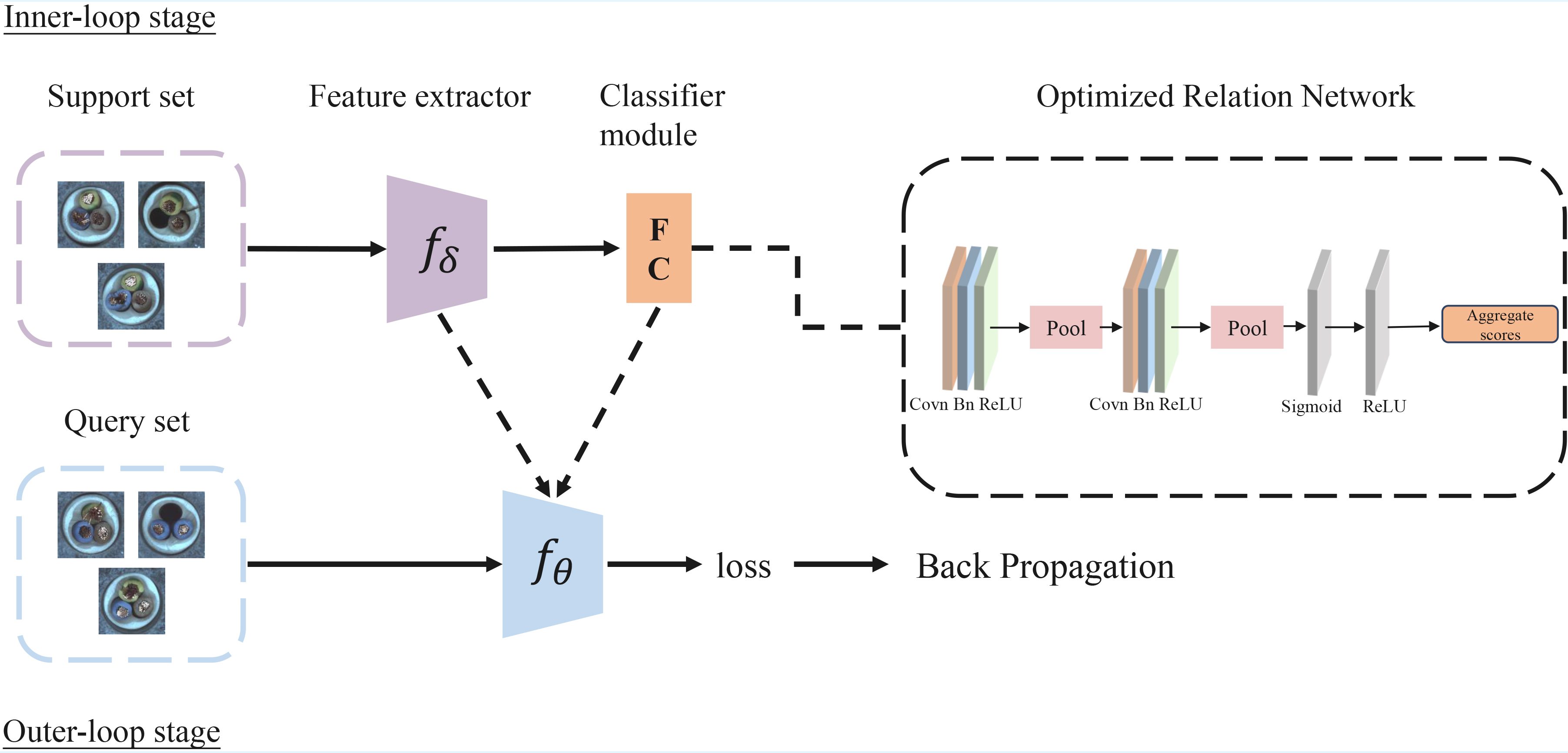
The R2-Net architecture, illustrating the bi-level meta-learning process
- [1] K. L. Mak, P. Peng, and K. F. C. Yiu, “Fabric defect detection using morphological filters,” Image and Vision Computing, Vol.27, Issue 10, pp. 1585-1592, 2009. https://doi.org/10.1016/j.imavis.2009.03.007
- [2] R. Brunelli, “Template Matching Techniques in Computer Vision: Theory and Practice,” John Wiley & Sons, 2009. https://doi.org/10.1002/9780470744055
- [3] L. Zheng, Y. Yang, and Q. Tian, “SIFT Meets CNN: A Decade Survey of Instance Retrieval,” IEEE Trans. on Pattern Analysis and Machine Intelligence, Vol.40, Issue 5, pp. 1224-1244, 2018. https://doi.org/10.1109/TPAMI.2017.2709749
- [4] L. Li, X. Mu, S. Li, and H. Peng, “A Review of Face Recognition Technology,” IEEE Access, Vol.8, pp. 139110-139120, 2020. https://doi.org/10.1109/ACCESS.2020.3011028
- [5] S. Suthaharan, “Machine Learning Models and Algorithms for Big Data Classification: Thinking with Examples for Effective Learning,” Springer, 2016. https://doi.org/10.1007/978-1-4899-7641-3
- [6] Z. Li, F. Liu, W. Yang, S. Peng, and J. Zhou, “A Survey of Convolutional Neural Networks: Analysis, Applications, and Prospects,” IEEE Trans. on Neural Networks and Learning Systems, Vol.33, Issue 12, pp. 6999-7019, 2021. https://doi.org/10.1109/TNNLS.2021.3084827
- [7] X. Zhao, L. Wang, Y. Zhang, X. Han, M. Deveci, and M. Parmar, “A review of convolutional neural networks in computer vision,” Artificial Intelligence Review, Vol.57, No.4, Article No.99, 2024. https://doi.org/10.1007/s10462-024-10721-6
- [8] S. Tammina, “Transfer Learning Using VGG-16 with Deep Convolutional Neural Network for Classifying Images,” Int. J. of Scientific and Research Publications (IJSRP), Vol.9, Issue 10, pp. 143-150, 2019. https://doi.org/10.29322/IJSRP.9.10.2019.p9420
- [9] P. Ballester and R. Araujo, “On the Performance of GoogLeNet and AlexNet Applied to Sketches,” Proc. of the AAAI Conf. on Artificial Intelligence, Vol.30, No.1, 2016. https://doi.org/10.1609/aaai.v30i1.10171
- [10] K. He, X. Zhang, S. Ren, and J. Sun, “Deep Residual Learning for Image Recognition,” 2016 IEEE Conf. on Computer Vision and Pattern Recognition (CVPR), pp. 770-778, 2016. https://doi.org/10.1109/CVPR.2016.90
- [11] Y. Song, T. Wang, P. Cai, S. K. Mondal, and J. P. Sahoo, “A Comprehensive Survey of Few-shot Learning: Evolution, Applications, Challenges, and Opportunities,” ACM Computing Surveys, Vol.55, Issue 13s, Article No.271, 2023. https://doi.org/10.1145/3582688
- [12] J. Beck, R. Vuorio, E. Z. Liu, Z. Xiong, L. Zintgraf, C. Finn, and S. Whiteson, “A Tutorial on Meta-Reinforcement Learning,” Foundations and Trends in Machine Learning, Vol.18, Issues 2-3, pp. 224-384, 2025. https://doi.org/10.1561/2200000080
- [13] F. Sung, Y. Yang, L. Zhang, T. Xiang, P. H. S. Torr, and T. M. Hospedales, “Learning to Compare: Relation Network for Few-Shot Learning,” 2018 IEEE/CVF Conf. on Computer Vision and Pattern Recognition, pp. 1199-1208, 2018. https://doi.org/10.1109/CVPR.2018.00131
- [14] C. Finn, P. Abbeel, and S. Levine, “Model-agnostic meta-learning for fast adaptation of deep networks,” Proc. of Int. Conf. on Machine Learning (ICML’17), Vol.70, pp. 1126-1135, 2017.
- [15] A. Nichol, J. Achiam, and J. Schulman, “On First-Order Meta-Learning Algorithms,” arXiv preprint, arXiv:1803.02999, 2018. https://doi.org/10.48550/arXiv.1803.02999
- [16] J. Hu, L. Shen, and G. Sun, “Squeeze-and-Excitation Networks,” 2018 IEEE/CVF Conf. on Computer Vision and Pattern Recognition, pp. 7132-7141, 2018. https://doi.org/10.1109/CVPR.2018.00745
- [17] T. T. Khoei, H. O. Slimane, and N. Kaabouch, “Deep learning: Systematic review, models, challenges, and research directions,” Neural Computing and Applications, Vol.35, No.31, pp. 23103-23124, 2023. https://doi.org/10.1007/s00521-023-08957-4
- [18] R. Archana and P. S. E. Jeevaraj, “Deep learning models for digital image processing: A review,” Artificial Intelligence Review, Vol.57, No.1, Article No.11, 2024. https://doi.org/10.1007/s10462-023-10631-z
- [19] Z. Zou, K. Chen, Z. Shi, Y. Guo, and J. Ye, “Object Detection in 20 Years: A Survey,” Proc. of the IEEE, Vol.111, Issue 3, pp. 257-276, 2023. https://doi.org/10.1109/JPROC.2023.3238524
- [20] Z. Chen and Q. Sun, “Weakly-supervised Semantic Segmentation with Image-level Labels: From Traditional Models to Foundation Models,” ACM Computing Surveys, Vol.57, Issue 5, Article No.111, 2025. https://doi.org/10.1145/3707447
- [21] J. Zhou, C. Xie, S. Gong, Z. Wen, X. Zhao, Q. Xuan, and X. Yang, “Data Augmentation on Graphs: A Technical Survey,” ACM Computing Surveys, Vol.57, Issue 11, Article No.274, 2025. https://doi.org/10.1145/3732282
- [22] A. Bansal, R. Sharma, and M. Kathuria, “A Systematic Review on Data Scarcity Problem in Deep Learning: Solution and Applications,” ACM Computing Surveys (CSUR), Vol.54, Issue 10s, Article No.208, 2022. https://doi.org/10.1145/3502287
- [23] W. Jiang, K. Huang, J. Geng, and X. Deng, “Multi-Scale Metric Learning for Few-Shot Learning,” IEEE Trans. on Circuits and Systems for Video Technology, Vol.31, Issue 3, pp. 1091-1102, 2020. https://doi.org/10.1109/TCSVT.2020.2995754
- [24] X. Li, X. Yang, Z. Ma, and J.-H. Xue, “Deep metric learning for few-shot image classification: A review of recent developments,” Pattern Recognition, Vol.138, Article No.109381, 2023. https://doi.org/10.1016/j.patcog.2023.109381
- [25] H. Gharoun, F. Momenifar, F. Chen, and A. H. Gandomi, “Meta-learning Approaches for Few-Shot Learning: A Survey of Recent Advances,” ACM Computing Surveys, Vol.56, Issue 12, Article No.294, 2024. https://doi.org/10.1145/3659943
- [26] J. Snell, K. Swersky, and R. S. Zemel, “Prototypical Networks for Few-shot Learning,” Advances in Neural Information Processing Systems, Vol.30, 2017.
- [27] O. Vinyals, C. Blundell, T. Lillicrap, K. Kavukcuoglu, and D. Wierstra, “Matching Networks for One Shot Learning,” Advances in Neural Information Processing Systems, Vol.29, 2016.
- [28] S. Baik, M. Choi, J. Choi, H. Kim, and K. M. Lee, “Learning to Learn Task-Adaptive Hyperparameters for Few-Shot Learning,” IEEE Trans. on Pattern Analysis and Machine Intelligence, Vol.46, Issue 3, pp. 1441-1454, 2023. https://doi.org/10.1109/TPAMI.2023.3261387
- [29] H. Zhang, D. Wang, Z. Chen, and R. Pan, “Adaptive visual detection of industrial product defects,” PeerJ Computer Science, Vol.9, Article No.e1264, 2023. https://doi.org/10.7717/peerj-cs.1264
- [30] J. Feng, H. Zhang, and Z. Wang, “Eternal-MAML: A meta-learning framework for cross-domain defect recognition,” PeerJ Computer Science, Vol.11, Article No.e2757, 2025. https://doi.org/10.7717/peerj-cs.2757
- [31] A. Santoro, S. Bartunov, M. Botvinick, D. Wierstra, and T. Lillicrap, “Meta-learning with memory-augmented neural networks,” Proc. of the 33rd Int. Conf. on Machine Learning, Vol.48, pp. 1842-1850, 2016.
- [32] T. Munkhdalai and H. Yu, “Meta Networks,” Proc. of the 34th Int. Conf. on Machine Learning, Vol.70, pp. 2554-2563, 2017.
- [33] Y. Zhao, T. Zhang, J. Li, and Y. Tian, “Dual Adaptive Representation Alignment for Cross-Domain Few-Shot Learning,” IEEE Trans. on Pattern Analysis and Machine Intelligence, Vol.45, Issue 10, pp. 11720-11732, 2023. https://doi.org/10.1109/TPAMI.2023.3272697
- [34] X. Yue, Z. Zheng, S. Zhang, Y. Gao, T. Darrell, K. Keutzer, and A. S. Vincentelli, “Prototypical Cross-domain Self-supervised Learning for Few-shot Unsupervised Domain Adaptation,” 2021 IEEE/CVF Conf. on Computer Vision and Pattern Recognition (CVPR), pp. 13829-13839, 2021. https://doi.org/10.1109/CVPR46437.2021.01362
- [35] J. Du, S. Zhang, Q. Chen, H. Le, Y. Sun, Y. Ni, J. Wang, B. He, and J. Wang, “σ-Adaptive Decoupled Prototype for Few-Shot Object Detection,” 2023 IEEE/CVF Int. Conf. on Computer Vision (ICCV), pp. 18904-18914, 2023. https://doi.org/10.1109/ICCV51070.2023.01737
This article is published under a Creative Commons Attribution-NoDerivatives 4.0 Internationa License.