
Research Paper:
Detection and Cleaning of Foreign Objects on the Surface of Photovoltaic Solar Panels Through Intelligent Robots
Chenxu Tang†
Zhoukou Polytechnic
No.1 Kaiyuan Avenue, Zhoukou, Henan 466000, China
†Corresponding author

This study briefly introduces an intelligent detection algorithm for foreign objects on solar panel surfaces, as well as an intelligent cleaning robot. In the intelligent detection algorithm, the improved Retinex algorithm was used to improve low-light images, and the You Only Look Once version 5 (YOLOv5) algorithm was used to detect foreign objects on the surface. Simulation experiments were performed. The improved Retinex algorithm was compared with the traditional Retinex and histogram equalization methods. The YOLOv5 algorithm was compared with the faster region-based convolutional neural network (R-CNN) and YOLOv4 algorithms. The surface foreign object cleaning ability of the developed intelligent robot was compared with the robot that did not use the same algorithm. The results showed that the improved Retinex algorithm could increase image brightness while preserving color. The edge strength, information entropy, and locally orderless error of the improved images were 79.8±1.6, 7.5±0.7, and 813.6±2.6, respectively. The YOLOv5 algorithm could identify and locate foreign objects more accurately, with a precision of 0.987, a recall rate of 0.985, and an F-value of 0.986. It was also discovered that the intelligent robot using the proposed surface foreign object detection algorithm cleaned foreign objects on the surface of photovoltaic panels faster and better. The time consumed in one round of cleaning was 6.2±0.1 min, and the residual foreign object on the surface was 0.7%±0.1%.
1. Introduction
In the context of the accelerated transition of the global energy structure towards clean and low-carbon energy, solar photovoltaic power generation, one of the most promising renewable energy technologies, has been widely used in large-scale ground-mounted power stations, distributed rooftop systems, and off-grid power supply scenarios 1. During long-term outdoor operations, the solar panel surface is prone to being covered with foreign substances such as dust, bird droppings, leaves, snow, and sand, resulting in a decrease in the light transmittance of the glass surface of the solar panels and a reduction in the amount of solar radiation that can be received by the photovoltaic modules 2. Darker foreign substances cause local hotspot effects owing to their higher absorption of solar radiation. Therefore, the surfaces of solar panels must be cleaned regularly during their operation and maintenance. Traditional manual cleaning methods are costly and inefficient, and pose safety risks in complex terrains, such as high altitudes, deserts, and rooftops. The emergence and development of intelligent robot technology has provided new solutions for intelligent automatic cleaning of solar panels 3. Intelligent robots use machine vision and artificial intelligence technology to identify and detect foreign objects on the surface of solar panels and then formulate appropriate cleaning routes to remove foreign objects. Su et al. 4 proposed a deep learning-based framework for identifying the overheated areas of photovoltaic modules and discovered that the method outperformed the benchmark in terms of effectiveness and efficiency. Han et al. 5 proposed a lightweight model for photovoltaic panel surface defect detection based on a real-time detection transformer-based (RT-DER-R18) object detection model for three typical defects commonly found on the surface of photovoltaic panels, such as shading, glass breakage, and hotspots. Xu and Wu 6 proposed a federated contrastive self-supervised pretraining method in response to problems such as data security, labor-intensive data annotation, and limited data availability for photovoltaic panel defect detection. All the aforementioned studies analyzed the surface cleaning problem of photovoltaic panels. Some have focused on intelligent algorithms capable of detecting abnormal areas in photovoltaic panels, some on the types of typical defects, and some on the detection data of photovoltaic panels. This study, however, focuses on an intelligent algorithm for identifying foreign objects on the surface of photovoltaic panels and combines the intelligent algorithm with a cleaning robot to achieve automatic cleaning of the photovoltaic panel surface. This study briefly introduces an intelligent detection algorithm for foreign objects on the surfaces of solar panels and intelligent cleaning robots. In the intelligent detection algorithm, an improved Retinex algorithm was used to improve low-light images, and the You Only Look Once version 5 (YOLOv5) algorithm was used to detect foreign objects on the surface. Simulations were also performed. The novelty of this study lies in the combination of an intelligent cleaning robot and a foreign object detection algorithm for the surface of photovoltaic panels, which provides an effective reference for improving the efficiency and targeting of intelligent cleaning robots for cleaning foreign objects on the surface of photovoltaic panels.
2. Recognition and Cleaning of Foreign Objects on Solar Panel Surfaces by an Intelligent Robot
2.1. Detection of Foreign Objects on Solar Panel Surfaces Based on Intelligent Algorithms
Compared with large solar panels, the area of local foreign objects, such as bird droppings and leaves, is typically smaller. Therefore, we selected the YOLOv5 algorithm to identify the small local foreign objects 7. The YOLOv5 algorithm was chosen for the following reasons. First, compared with the YOLOv1–YOLOv4 algorithms, the structural optimization of the YOLOv5 algorithm significantly improves its detection speed and accuracy. As successors of YOLOv5, YOLOv6–YOLOv8 improves the overall accuracy through structural adjustments. However, this also results in a longer training time, which affects the iterations and optimization of the algorithm model. This may become a limiting factor in application environments that require rapid iterations and deployment. Second, in the application scenarios of small-target detection algorithms, the detection accuracy usually only requires being sufficient, and there is no requirement to pursue ultimate accuracy. In this case, the complex structures of YOLOv6–YOLOv8, which can result in higher accuracy, may not necessarily result in better performance but in higher costs. The YOLOv5 algorithm achieves a good balance between detection accuracy and speed, and its classic model architecture has great potential for improvement. Therefore, this study makes improvements based on YOLOv5. In addition, intelligent robots are bound to encounter low-light scenarios (caused by early mornings, evenings, cloudy days, and obstruction by surrounding obstacles) during their continuous inspection of solar panels. This study used the Retinex algorithm to improve the images and the YOLOv5 algorithm for the detection of foreign objects.
The detailed process is shown below.
-
(1)
The image captured by the camera was converted from red, green, blue (RGB) to hue, saturation, value (HSV) 8.
\begin{equation} \label{eq:1} \left\{\begin{aligned} S(x) & =\begin{cases} 0, & C_{\max}(x)=0,\\ \dfrac{C_{\max}(x)-C_{\min}(x)}{C_{\max}(x)}, & C_{\max}(x)\ne 0,\\ \end{cases}\\ V(x) & =C_{\max}(x),\\ H(x) & =\begin{cases} &\!\!\!\!\! 0°, ~\,\qquad C_{\max}(x)-C_{\min}(x) =0, \\ &\!\!\!\!\! 60°\cdot \left(\displaystyle\frac{G(x)-B(x)}{C_{\max}(x)-C_{\min}(x)}+0\right),\\ & C_{\max}(x)=R(x),\\ &\!\!\!\!\! 60°\cdot \left(\displaystyle\frac{B(x)-R(x)}{C_{\max}(x)-C_{\min}(x)}+2\right),\\ & C_{\max}(x)=G(x), \\ &\!\!\!\!\! 60°\cdot\left(\displaystyle\frac{R(x)-G(x)}{C_{\max}(x)-C_{\min}(x)}+4\right),\\ & C_{\max}(x)=B(x),\\ \end{cases}\\ \end{aligned}\right. \end{equation}where \(R(x)\), \(G(x)\), and \(B(x)\) denotes the gray values of the image pixel \(x\) in the R, G, and B color channels, respectively, \(C_{\max}\) and \(C_{\min}\) denote the maximum and minimum values of the pixel in the RGB three-channel component, respectively, and \(S(x)\), \(V(x)\), and \(H(x)\) denote the saturation, luminance, and hue of the pixel, respectively.
-
(2)
After converting the image to the color space, it was processed using an image enhancement formula 9:
\begin{equation} \label{eq:2} \hspace{-1.3em} \left\{\begin{aligned} & G_F(x)=\frac{\displaystyle\sum_{y\in T} G_d\left(\| y-x\|\right)\cdot G_r\left(\vert V(y)-V(x)\vert\right)\cdot V(y)}{\displaystyle\sum_{y\in T} G_d\left(\| y-x\|\right)\cdot G_r\left(\vert V(y)-V(x)\vert\right)},\\ & G_d\left(\Vert y-x\Vert\right)=\exp\left(-\dfrac{\Vert y-x\Vert^2}{2\sigma_d^2}\right), \\ & G_r\left(\vert V(y)-V(x)\vert\right)=\exp\left(-\dfrac{\vert V(y)-V(x)\vert^2}{2\sigma_r^2}\right), \\ & V_C(x)=\exp\left(\ln \left(V(x)\right)-\ln\left(G_F(x)\right)\right), \\ & S_C(x)=S(x)+t\cdot \left(V_C(x)-V(x)\right)\cdot\varepsilon, \\ & H_C(x)=H(x), \\ \end{aligned}\right. \end{equation}where \(G_F(x)\) denotes the result of the brightness of pixel \(x\) after bilateral filtering, \(G_d(\cdot)\) and \(G_r(\cdot)\) denote Gaussian functions, \(T\) represents the neighboring area centered on pixel \(x\), \(y\) denotes the pixel within \(T\), \(S_C(x)\), \(V_C(x)\), and \(H_C(x)\) denote the saturation, brightness, and hue of the pixel after enhancement, respectively 10.
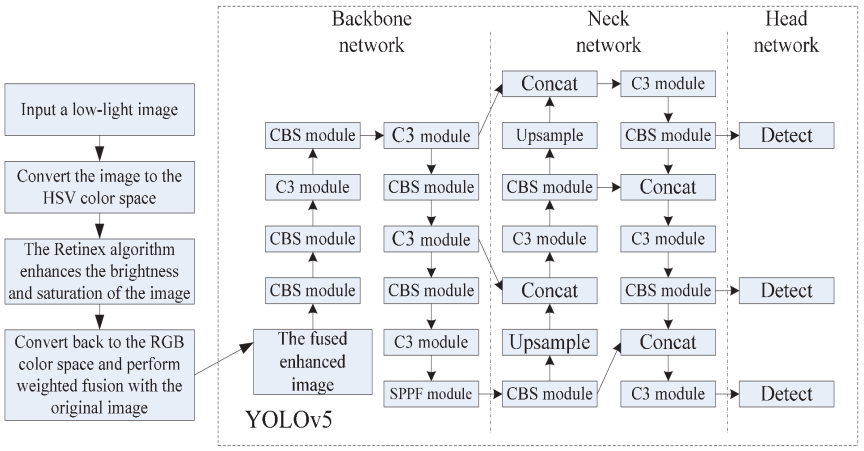
Fig. 1. The process of detecting foreign objects on the surface of solar panels.
-
(3)
The image was restored to the RGB space and fused with the original image using a weighted sum:
\begin{equation} \label{eq:3} \left\{\begin{aligned} \omega(x) &= 1-\dfrac{1}{\exp\left(\displaystyle\frac{\left(R_C(x),G_C(x),B_C(x)\right)}{255}\right)},\\ F(x) &= \omega(x)\cdot \left(R_C(x),G_C(x),B_C(x)\right)\\ &\phantom{=~} + \left(1-\omega(x)\right)\cdot\left(R(x),G(x),B(x)\right), \\ \end{aligned}\right. \end{equation}where \(R_C(x)\), \(G_C(x)\), and \(B_C(x)\) denote the values of the enhanced image pixel \(x\) converted back to the RGB color space, \(\omega(x)\) denotes the fusion weight, and \(F(x)\) denotes the pixel \(x\) after the weighted fusion of the original low-light image and enhanced image.
-
(4)
The fused enhanced image was input into the YOLOv5 model for forward computation 11 to identify and detect foreign objects. The structure of the YOLOv5 model is shown in Fig. 1. During the layer-by-layer forward computation, feature extraction was first performed on the backbone network, and then computations were performed in two CBS [convolution \(+\) batch normalization \(+\) sigmoid-weighted linear unit (SiLU) activation (CBS)] modules and C3 modules three times. The output was the input to the spatial pyramid pooling-fast (SPPF) module, which comprised two CBS modules, three max-pooling layers, and one splicing layer.
-
(5)
Different scale features extracted by the backbone network were fused to the neck network. First, the features extracted by the SPFF module 12 were fused with those extracted by the third C3 module of the backbone network after being processed by the CBS module and upsampled in the neck network. The fusion features continued to fuse with the second C3 module of the backbone network after being processed by the C3 module, CBS module, and upsampling in the neck network. The features obtained from the second fusion continued to be fused with the second CBS module of the neck network after processing with the C3 and CBS modules. The features obtained from the third fusion were processed by the C3 and CBS modules again, fused with the features extracted by the first CBS module of the neck network, and processed by the C3 module.
-
(6)
Target recognition was performed on the fused features of the neck and head networks. The head network used three different scales of candidate boxes to identify the extracted features of the third and fourth CBS modules and the fourth C3 module of the neck network. First, it was determined whether an object within the candidate box was foreign based on its features. If this was true, a reverse calculation was performed on the grid points of the candidate box to obtain the coordinates of the target box in the original image.
2.2. Cleaning of Foreign Objects on Solar Panel Surfaces by Intelligent Robots
An intelligent robot captures images of the surface of a solar panel using cameras that it carries or sets around the solar panel. The process by which an intelligent robot cleans the surface of a solar panel is as follows: Under normal circumstances, the robot moved regularly along a set route and used a brush or electrostatic adsorption device to clean the dust on the surface of solar panels during movement. Simultaneously, the algorithm mentioned earlier was used to identify foreign objects in the images captured by the camera. When a foreign object was identified, the robot prioritized moving towards the object for cleaning. The cleaning process is as follows:
-
(1)
The intelligent robot moved along a set route on the surface of the solar panel to clean the dust. The movement route allowed the cleaning device of the robot to cover the entire surface of the solar panel while collecting surface images.
-
(2)
The intelligent robot used the solar-panel surface foreign-object intelligent detection algorithm described earlier to detect foreign objects on the surface.
-
(3)
If the intelligent robot did not detect foreign objects on the surface of the solar panel, it continued to move along the set cleaning route. If a foreign object was detected, the robot moved in the direction of the foreign object and cleaned it.
-
(4)
After cleaning the object for a period set based on the demands, the robot left to avoid obstruction and collected images of the solar panel surface to check if it had been cleaned again. If cleaned, the robot returned to its original set route to continue moving and cleaning. Otherwise, the foreign objects were cleaned.
-
(5)
If the same foreign object was required to be cleaned after reaching the threshold set based on the demands, an alert was sent to the console to notify the staff to handle it manually.
3. Simulation Experiment
3.1. Experimental Data
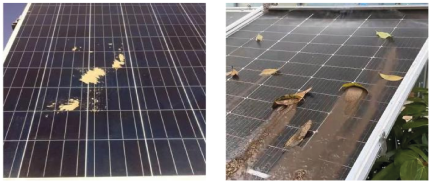
Fig. 2. The surface images of the photovoltaic panel with foreign objects.
Because there is no publicly available dataset, this study used self-collected solar surface images as the dataset for the simulation experiment. Related images were collected at a local photovoltaic base and in the laboratory. Images of photovoltaic panels with foreign objects, such as bird droppings and leaves, in a real environment were captured at the photovoltaic base. Photovoltaic panels were set up in the laboratory, and foreign objects were placed on the surface for the simulations. Images were captured using a WSD-4K-V1.0 camera (Shenzhen Weishida Technology Co., Ltd., China) with eight million pixels and a maximum resolution of 3,840 \(\times\) 2,160 pixels. The camera was placed 2 m away from the photovoltaic panel. Low-light images were captured at 5 a.m. in a real power generation base and captured in a laboratory by controlling the indoor lighting. A total of 4,216 images were obtained, of which 2,782 were obtained from the power generation base and 1,434 were obtained from the laboratory. The two images are shown in Fig. 2. Seventy percent was used as the training set, whereas 30% was used as the test set.
3.2. Experimental Setup
A Pai’an brand automatic solar panel-cleaning robot (Bazhou Lixun Hardware Appliance Factory, China) was used in this study. Its body size was \(654\times 507\times 232\) mm, with front and rear roller brushes, and its body weight was 27.4 kg. In this study, the intelligent algorithm for detecting foreign objects on solar panel surfaces was divided into two parts: low-light image enhancement and surface foreign object recognition. The former method used an improved Retinex algorithm. To verify its effectiveness, it was compared with traditional Retinex and histogram equalization algorithms 13.
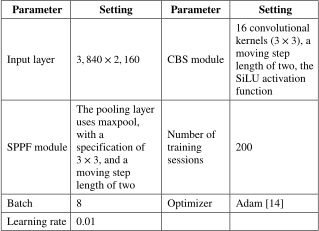
The relevant parameters of the YOLOv5 model are listed in Table 1. To verify the effectiveness of the YOLOv5 model, it was compared with a faster region-based convolutional neural network (R-CNN) and YOLOv4 algorithms that were equivalently optimized using parameters.
After verifying the algorithm, to test the cleaning ability of the intelligent robot with the assistance of the YOLOv5 algorithm, an intelligent robot that did not use the YOLOv5 algorithm was compared with another robot that used the YOLOv5 algorithm.
When testing the robot, the test site was set at the local photovoltaic power generation base, and the surface of a photovoltaic panel with a specification of \(3\times 4\) m was selected as the test area. To avoid the impact of the simulated surface foreign object obstruction on the photovoltaic panel power generation during the test, the photovoltaic panel within the test range was temporarily disconnected from other photovoltaic equipment.
Table 1. Parameters related to the YOLOv5 model.
Before testing the robot, wet tissue paper fragments were attached to the surface of the photovoltaic panel to simulate the obstruction caused by foreign objects. After the test began, the robot that did not use the proposed algorithm moved along the route set in Fig. 3 for cleaning, and the robot using the proposed algorithm also moved along the route set in Fig. 3 but prioritized cleaning the foreign objects detected on the surface. After the robot reached the starting point of the set route, one round of testing was completed, with a total of 30 rounds of testing.
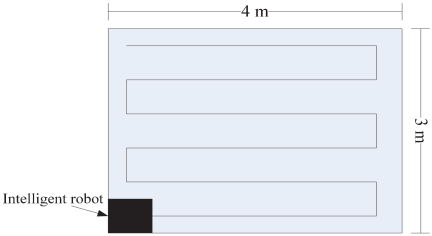
Fig. 3. The preset cleaning route.
3.3. Evaluation Indicators
This study uses the edge strength, information entropy, and locally orderless errors to measure the enhancement effect of low-light images. The relevant formulas are as follows:
For the evaluation indicators of the improved Retinex algorithm, the precision, recall rate, and \(F\)-value were used to evaluate the accuracy of the foreign object identification, and the intersection over union (IoU) was used to evaluate the accuracy of the foreign object localization. The relevant formulas are as follows:
The cleaning effect of the intelligent robots was measured based on the average time required to complete one round and the residual amount of foreign objects on the surface after cleaning.
3.4. Experimental Results
Table 2. Evaluation indicators for image enhancement effects.
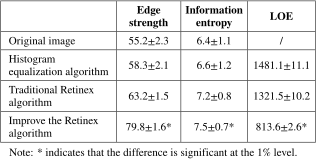
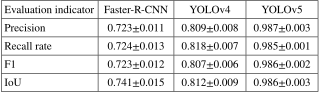
Table 3. Performance comparison of three surface foreign object detection algorithms.
As listed in Table 2, the improved Retinex algorithm had the best enhancement effect, followed by the traditional Retinex algorithm, and the histogram equalization algorithm had the worst effect. The reason for this is that the histogram equalization algorithm, in principle, increases image brightness by statistically analyzing the grayscale distribution within the image and then adjusting the grayscale levels to make the grayscale distribution of the image more uniform. Although this method is simple and fast, it is prone to oversaturation when adjusting the grayscale image; that is, partial areas are bright and white, resulting in the loss of some image features. The traditional Retinex algorithm enhances the image by eliminating the light component, which has the advantage of maintaining the original color and achieving a large dynamic compression ratio. However, this algorithm performs different enhancement processes on the R, G, and B color components of the pixels and finally performs weighted fusion, resulting in a change in the color ratio. The principle of the improved Retinex algorithm is to first convert the image from the RGB color space into the HSV space, enhance the saturation (S) and luminance (V), and then fuse the H, S, and V components to achieve enhancement. Because the hue (H) is not adjusted, there is no effect on the color.
Table 3 shows that the YOLOv5 algorithm had the best performance, followed by the YOLOv4 algorithm; the faster R-CNN algorithm had the poorest performance. This is because the faster R-CNN algorithm is a two-stage object detection algorithm that first generates an appropriate candidate box based on image features and then identifies the type of target through the image features within the candidate box. This two-stage judgment process results in an accumulation of errors. The YOLOv4 algorithm is a one-stage object detection algorithm that detects object categories and locations through a single neural network forward propagation. Therefore, it is faster, and its SPPF module increases the receptive field of the network, allowing it to obtain more image features and improve detection accuracy. The YOLOv5 algorithm further simplified the model structure based on YOLOv4.
Table 4. Cleaning performance of two smart robots.
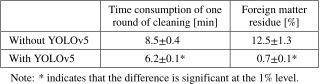
Finally, the cleaning performances of the intelligent robots were tested. The cleaning time and foreign object residue of the robot without the YOLOv5 algorithm and the robot adopting the YOLOv5 algorithm are listed in Table 4. The robot adopting the YOLOv5 algorithm required significantly less time to clean foreign objects on the surface of photovoltaic panels and left less foreign-object residue. This is because the intelligent robot that did not adopt the YOLOv5 algorithm only cleaned along the set route. It could clean a foreign object on the route; however, if the foreign object was slightly sticky, it continued to remain, and the robot did not return to clean it. Upon detecting foreign surface objects, the robot adopting the YOLOv5 algorithm first moved to the foreign object for cleaning and then checked for residue and cleaned again.
4. Conclusions
This study briefly introduces an intelligent detection algorithm for foreign objects on solar panel surfaces and an intelligent cleaning robot. In the intelligent detection algorithm, an improved Retinex algorithm was used to enhance the low-light images, and the YOLOv5 algorithm was used to detect foreign objects on the surface. The improved Retinex algorithm, YOLOv5, and surface foreign object removal capability of the intelligent robot were tested using simulation experiments. The low-light images processed by the improved Retinex algorithm had the best enhancement effect, followed by those processed by the traditional Retinex algorithm. The histogram equalization algorithm had the worst effect. The YOLOv5 algorithm had the best performance in detecting and locating foreign surface objects, followed by the YOLOv4 algorithm. The faster R-CNN algorithm had the worst performance. The intelligent robot adopting the YOLOv5 algorithm required significantly less time to clean foreign objects on the surface of photovoltaic panels and had much less foreign object residue.
In conclusion, the improved Retinex algorithm can effectively enhance low-light images. Combined with the YOLOv5 algorithm, foreign objects on the surface of photovoltaic panels can be effectively identified. After the intelligent cleaning robot was integrated with a foreign object detection algorithm for photovoltaic panel surfaces, it could clean foreign objects on the photovoltaic panel surfaces more quickly. The limitations of this study are that the low-light enhancement algorithm does not consider extreme scenarios, such as midnight, when there is almost no light, and no restrictions are placed on the size of the detected foreign objects. Therefore, future research should consider extremely low-light environments and make a detailed classification of the sizes of detected foreign objects.
- [1] X. Bai, R. Wang, Y. Pi, and W. Zhang, “DMFR-YOLO: An infrared small hotspot detection algorithm based on double multi-scale feature fusion,” Meas. Sci. Technol., Vol.36, No.1, pp. 1-12, 2025. https://doi.org/10.1088/1361-6501/ad8e77
- [2] J. Zhu, D. Zhou, R. Lu, X. Liu, and D. Wan, “C2DEM-YOLO: Improved YOLOv8 for defect detection of photovoltaic cell modules in electroluminescence image,” Nondestruct. Test. Eva., Vol.40, No.1, pp. 309-331, 2025. https://doi.org/10.1080/10589759.2024.2319263
- [3] J. Zhang, W. Yang, Y. Chen, M. Ding, H. Huang, B. Wang, K. Gao, S. Chen, and R. Du, “Fast object detection of anomaly photovoltaic (PV) cells using deep neural networks,” Appl. Energ., Vol.372, No.C, pp. 1-12, 2024. https://doi.org/10.1016/j.apenergy.2024.123759
- [4] Y. Su, F. Tao, J. Jin, and C. Zhang, “Automated overheated region object detection of photovoltaic module with thermography image,” IEEE J. Photovolt., Vol.11, No.2, pp. 535-544, 2021. https://doi.org/10.1109/JPHOTOV.2020.3045680
- [5] T. Han, M. Bao, T. He, R. Zhang, X. Feng, and Y. Huang, “LW-PV DETR: Lightweight model for photovoltaic panel surface defect detection,” Eng. Res. Express, Vol.7, No.1, Article No.015357, 2025. https://doi.org/10.1088/2631-8695/adb4be
- [6] F. Xu and Z. Wu, “Federated contrastive self-supervised pre-training for photovoltaic panels defect detection,” Proc. 4th Int. Conf. on Image Processing and Intelligent Control (IPIC 2024), Article No.132502Z, 2024. https://doi.org/10.1117/12.3038604
- [7] H. Chen, Y. Zhang, Y. Zhang, X. Yan, X. Zhang, and K. Zou, “Defect detection of photovoltaic panels to suppress endogenous shift phenomenon,” IEEE Trans. Semiconduct. Manufacturing, Vol.38, No.1, pp. 83-95, 2025. https://doi.org/10.1109/TSM.2024.3510358
- [8] J. Luo, G. Wang, Y. Lei, D. Wang, and H. Zhang, “YOLOv8n-PP: A lightweight pose recognition algorithm for photovoltaic array cleaning robot,” J. Real-Time Image Pr., Vol.22, Article No.136, 2025. https://doi.org/10.1007/s11554-025-01713-y
- [9] F. Saeed, S. Aldera, A. A. Al-Shamma’a, and H. M. H. Farh, “Rapid adaptation in photovoltaic defect detection: Integrating CLIP with YOLOv8n for efficient learning,” Energy Rep., Vol.12, pp. 5383-5395, 2024. https://doi.org/10.1016/j.egyr.2024.11.033
- [10] G. Yang, J. Zhang, H. Li, and C. Bai, “Research on defect detection of photovoltaic cells based on improved mask R-CNN-attention model,” Proc. 4th Int. Conf. on Automation Control, Algorithm, and Intelligent Bionics (ICAIB 2024), Article No.132593M, 2024. https://doi.org/10.1117/12.3039405
- [11] L. Zhou, X. Sun, and Y. Liu, “Application of interpretability method based on FN-v8 in defect detection of photovoltaic panels,” Proc. 3rd Int. Conf. on Electronics, Electrical and Information Engineering (ICEEIE 2023), Article No.129220N, 2023. https://doi.org/10.1117/12.3008834
- [12] X. Jiang, W. X. Chen, H. T. Nie, and Z. C. Hao, “Real-time ship target detection based on aerial remote sensing images,” Opt. Precis. Eng., Vol.28, No.10, pp. 2360-2369, 2020. https://doi.org/10.37188/OPE.20202810.2360
- [13] F. Gao, T. Huang, J. Sun, J. Wang, A. Hussain, and E. Yang, “A new algorithm of SAR image target recognition based on improved deep convolutional neural network,” Cogn. Comput., Vol.11, pp. 809-824, 2019. https://doi.org/10.1007/s12559-018-9563-z
- [14] S. Kim, “Infrared variation reduction by simultaneous background suppression and target contrast enhancement for deep convolutional neural network-based automatic target recognition,” Opt. Eng., Vol.56, No.6, Article No.063108, 2017. https://doi.org/10.1117/1.OE.56.6.063108
- [15] J. Pei, Y. Huang, Z. Sun, Y. Zhang, J. Yang, and T. S. Yeo, “Multiview synthetic aperture radar automatic target recognition optimization: Modeling and implementation,” IEEE Trans. Geosci. Remote, Vol.11, pp. 6425-6439, 2018. https://doi.org/10.1109/TGRS.2018.2838593
This article is published under a Creative Commons Attribution-NoDerivatives 4.0 Internationa License.