
Research Paper:
Personalized Tourist Route Optimization Algorithm Based on an Enhanced Ant Colony Approach: A Case Study in Southwest China
Ruihong Wang*,†, Weiqi Ma**, Xinnan Zhang*, Mengping Lin*, and Ni Yan*
*Qujing Economic and Technological Development Zone Industry Research Institute, Qujing Normal University
No.222 Sanjiang Avenue, Qujing Economic and Technological Development Zone, Qujing, Yunnan 655011, China
†Corresponding author
**School of Teacher Education, Qujing Normal University
No.222 Sanjiang Avenue, Qujing Economic and Technological Development Zone, Qujing, Yunnan 655011, China

Reasonable planning of tourist routes is crucial for enhancing tourist satisfaction. This paper addresses the problem of tourist route optimization by proposing a solution that considers multiple influencing factors. A tourist route optimization model is established with the objective of maximizing tourist satisfaction, taking into account constraints such as tourist preferences, travel time, budget, and attraction opening hours. To improve the algorithm, a heuristic information mechanism and an adaptive adjustment factor are introduced to the ant colony algorithm, enhancing its global search ability and convergence speed. Using Southwest China as a case study, the results show that the proposed approach increases tourist satisfaction by 18.28% and 11.83% compared to the minimum travel budget plan and the random plan, respectively. This study provides a more efficient and accurate solution for personalized tourist route planning.
1. Introduction
With the rapid development of the tourism industry, the optimization of tourist routes has gradually become a prominent research topic in both academia and practice. Optimizing tourist routes not only enhances the experience for tourists but also effectively reduces transportation costs and saves time resources. With the continuous advancement of information technology, tourism methods have undergone significant transformations. People’s travel demands are continuously evolving in both form and content, increasingly inclined toward tourism experiences that emphasize service quality and personalization 1.
Compared to conventional product recommendation systems, tourist route recommendation systems present a higher level of decision-making complexity. This process not only requires the integration of user preferences but also needs to simultaneously optimize multiple constraints such as time restrictions, spatial distribution of attractions, economic costs, trip length, and environmental variables 2. Only by optimizing the design of tourist routes can tourists visit multiple points of interest (POIs) during their journey, which means maximizing the number of POIs visited by tourists 3. In the current field of tourism recommendation research, multi-objective optimization algorithms and hypergraph learning techniques have been widely applied, covering areas such as POI prediction, historical travel sequence mining, and route planning.
Derya et al. introduced the problem related to personalized tourist route construction, known as the tourist trip design problem (TTDP) 4. TTDP involves planning a travel itinerary to visit various POIs without exceeding the constraints related to time, transportation, budget, and tourist preferences. The core of TTDP lies in optimizing the access sequence for multiple POIs while strictly satisfying multi-dimensional constraints such as time windows, transportation methods, budget limits, and tourist preferences 5,6,7.
A large number of studies have been conducted on tourist route planning. Niu 1 proposed a multi-objective optimization method based on an improved ant colony algorithm and topological optimization for personalized tourist route recommendations. A multi-objective optimization model was developed, considering factors such as time, cost, and service quality, to optimize the tourist service combination. The planning efficiency of tourist routes was improved through the enhanced ant colony algorithm and topological structure optimization. Zheng et al. 8 proposed a route optimization method based on the improved ant colony optimization (ACO) algorithm and tourism big data for route planning in intelligent tourism. The study combined the MAX–MIN ant system, principal component analysis, and clustering analysis to construct a flexible optimization model capable of optimizing tourist routes according to different demands.
Lin et al. 9 proposed a greedy-algorithm-based tourist route planning method that integrates hotel and attraction evaluation recommendations into an intelligent management system, enabling efficient and personalized route suggestions by minimizing travel time and cost while maximizing attraction coverage. Wang 10 developed a tourist route optimization approach based on the teaching-learning-based optimization algorithm, generating personalized travel plans by incorporating tourists’ historical data and preferences while optimizing both time and distance. Hua 11 addressed the multi-day tourism problem using an improved Monte Carlo simulated annealing algorithm to optimize route-related objectives such as time and cost, aiming to obtain short and low-cost itineraries. Lu et al. 12 constructed multiple tourism route models using Nanjing as a case study, optimizing different path structures (e.g., single-node and linear paths) to support multi-node, circular, and radial tourism and enhance tourist satisfaction. Zhang and Sun 13 proposed an improved ACO-based model that enhances path selection and pheromone updating to efficiently identify optimal routes while considering tourist preferences, travel time, and attraction quality.
Early tourist route planning studies often relied on the traveling salesman problem (TSP); however, TSP fails to incorporate activity selection, accommodation, multi-objective requirements, and tourist preferences 14. To address these limitations, several extended models have been proposed, such as the trip planning problem 15, the one-period bus touring problem 16, the city bus tour problem 17, and the optimal tourist problem, including the reward maximization tourist and budget minimization tourist variants 18. Among these, the orienteering problem is widely regarded as a fundamental modeling framework for TTDP, as it determines both the set and visiting sequence of nodes to maximize rewards under budget and time constraints 4,19.
There are various methods for solving tourist route planning problems. Exact methods are typically used for solving small-scale cases. For example, Zhao and Alfandari 20 applied the Branch and Price and Branch-and-Cut-and-Price algorithms to solve instances of the TOP-DC problem with 21 to 66 nodes. Heuristic methods are commonly used to solve large-scale problems in a shorter time frame. For instance, Jia et al. 21 presents a multi-objective optimization model to address the sightseeing bus problem, aiming to balance tourist benefits and operational costs. A two-stage adaptive large neighborhood search (MO-ALNS) algorithm is designed to solve the decisions related to bus fleet scheduling, route planning, and tourist assignment. Additionally, meta-heuristics are the primary methods for solving such models, including improved large neighborhood search 22, improved iterated local search 23, improved particle swarm optimization (PSO) 24, and improved Genetic Algorithms 25.
Existing research on tourist route optimization often focuses on a single objective or simplifies constraints, neglecting the comprehensive consideration of personalized tourist needs and multi-dimensional constraints. Moreover, the algorithms used to solve these models tend to get trapped in local optima when processing large-scale data, lacking efficiency. Therefore, this paper establishes a tourist route optimization model that comprehensively considers multiple constraints, including tourist preferences, travel time, budget, and attraction opening hours. Based on the characteristics of the model, the ant colony algorithm is improved by introducing a heuristic information mechanism and an adaptive adjustment factor, enhancing the algorithm’s global search capability and convergence speed, ultimately achieving a more personalized and efficient tourist route optimization. ACO is chosen for this study due to its ability to solve complex combinatorial optimization problems in dynamic and constrained environments. While reinforcement learning, particularly deep reinforcement learning, has gained popularity in combinatorial optimization, it often requires large datasets and significant training time. In contrast, ACO relies on simple agents (ants) and uses a pheromone-based heuristic that is less data-intensive and more suited for real-time applications with predefined constraints, such as travel time, budget, and tourist preferences.
Although reinforcement learning offers greater flexibility, its application in highly constrained environments like tourism route optimization can be computationally expensive and slow to converge. ACO’s balance of exploration and exploitation, along with its adaptive nature, makes it a more efficient and practical choice for personalized tourist route planning in such scenarios.
2. Problem Description and Mathematical Model
2.1. Problem Description
This section establishes a mathematical model for tourist route optimization, aiming to optimize the selection of tourist routes to maximize the overall travel experience for tourists. The model comprehensively considers multiple key factors, including tourists’ preferences for attractions, travel time, budget constraints, transportation conditions, and attraction opening hours. The objective of the model is to select the optimal sequence of attraction visits and transportation paths, ensuring that tourists’ preferences are met while adhering to constraints related to time, budget, and transportation. The constraints include requirements for the order of attraction visits, limitations on transportation choices, the impact of weather conditions on attraction visits, and the scheduling of rest periods, among other factors. Furthermore, the model also takes into account the minimum and maximum number of attractions to be visited, ensuring that the travel plan is neither too tight nor misses any key attractions. Through the optimization of this model, an efficient and personalized travel itinerary can be provided for tourists. To simplify certain irrelevant factors, the following basic assumptions are made in the optimization model:
-
The time and cost of the transportation network are subject to real-time variations, including factors such as traffic conditions, price fluctuations, and weather conditions.
-
The weather conditions of attractions are determined before the trip and do not change during the journey.
-
Tourists’ preference weights remain constant throughout the trip.
-
The travel time from one attraction to another is fixed.
-
The model does not consider unforeseen events, such as traffic accidents or natural disasters.
-
The time spent at each attraction is independent and known.
-
The total budget and available time for tourists are fixed.
-
Tourists’ decisions are independent and do not consider group behavior or social interactions.
2.2. Notations
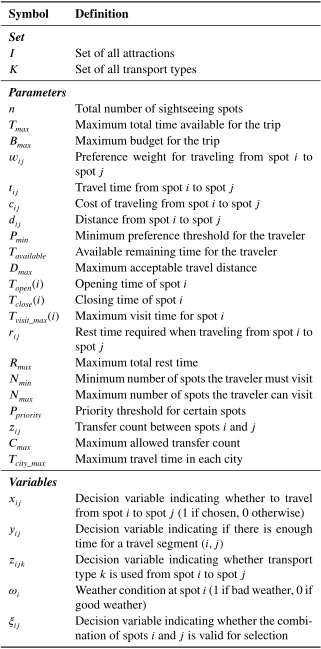
The sets, parameters, and notation used in this paper are summarized in Table 1.
Table 1. Notation description.
2.3. Tourist Route Optimization Model
Equation 1 represents the objective function, aiming to maximize the overall experience of the tourists. The difference between the tourist’s preference weight \(w_{ij}\) for each segment of the trip and the travel time \(t_{ij}\) determines the overall travel experience.
Constraint conditions:
Equations 2–5 define the core feasibility constraints, including total travel time, segment distance, budget, and minimum preference satisfaction. Eqs. 6–8 specify the route structure and temporal feasibility, ensuring unique visits, fixed start/end points, and sufficient remaining time for attraction switching. Eqs. 9 and 10 enforce route connectivity and visiting order to avoid invalid links and unreasonable detours. Eqs. 11 and 12 constrain visiting times according to attraction opening hours and maximum stay duration. Eqs. 13 and 14 restrict transportation mode selection to a single feasible type that complies with the transport network. Eqs. 15–17 incorporate external conditions and traveler constraints, including weather restrictions, single-leg travel time limits, and allowable rest time. Eqs. 18 and 19 limit the number of visited attractions within a predefined range, while Eqs. 20–22 further regulate attraction priority coverage, the maximum number of transfers, and inter-city travel time limits. Eq. 23 represents the attraction combination constraint, ensuring that certain combinations of attractions are visited together in the travel route. Eq. 24 represents the real-time travel time between attractions \(i\) and \(j\), where \(\Delta t_{ij}(t)\) is the time fluctuation factor at time \(t\). Eq. 25 represents the real-time travel cost between attractions \(i\) and \(j\), where \(\Delta c_{ij}(t)\) is the cost fluctuation factor at time \(t\).
3. Hybrid Multi-Strategy Improved ACO (HMIACO) Algorithm
3.1. Traditional ACO Algorithm
The ACO algorithm is a swarm intelligence method inspired by ants’ foraging behavior. It relies on a pheromone-based mechanism in which ants deposit pheromones along traveled paths, and higher pheromone intensity increases the probability of a path being selected. In ACO, artificial ants construct solutions probabilistically according to pheromone trails and heuristic information (e.g., inverse distance). Pheromones are iteratively updated to reinforce high-quality routes, enabling the colony to converge toward near-optimal solutions for complex optimization problems 26.
3.2. Improved ACO Algorithm
3.2.1. A Heuristic Information Mechanism with Directional Guidance
To enhance the global performance of the algorithm, the Euclidean distance from the current node to the next node and from the next node to the target node is integrated into the heuristic information. A weight factor is used to optimize the trade-off between the distance from the current node to the next node and the distance from the next node to the target node. Additionally, an angle-guided factor is introduced to strengthen the directionality toward the target node, and an adaptive adjustment factor based on the current iteration number is designed to dynamically regulate the algorithm’s convergence rate. The expression for the improved heuristic information function is shown in Eq. 26 27:
Equation 28 explicitly defines the angle-guided factor \(\delta_{2}\), which is used to penalize turning angles and encourage smoother route transitions.
The calculation of \(\theta\) is shown in Eq. 29:
3.2.2. Pseudorandom Transition Strategy
To regulate the ant path selection mechanism, a node selection strategy combining determinism and randomness is adopted to determine the next visited node for the decision-making ants at their current position. Specifically, the transition rule for an ant moving from the current node \(j\) to a node \(i\) in the candidate set L\(_\textit{1}\) is defined as Eq. 30 28:
3.2.3. Elite Ant Strategy
In ACO, all ants release pheromones along the paths during each iteration to guide the selection of subsequent ants. However, this approach may lead to an overly uniform pheromone distribution, which can slow down the convergence speed of the algorithm. The core idea of the elite ant strategy is that, in each iteration, only the best-performing ant (i.e., the ant that finds the shortest path) or a few high-performing ants are allowed to release pheromones. This approach enhances the pheromone concentration on high-quality solutions, thereby accelerating the convergence of the algorithm. In the standard ACO, the pheromone update formula is typically expressed as
In the elite ant strategy, the pheromone update formula can be adjusted as follows:
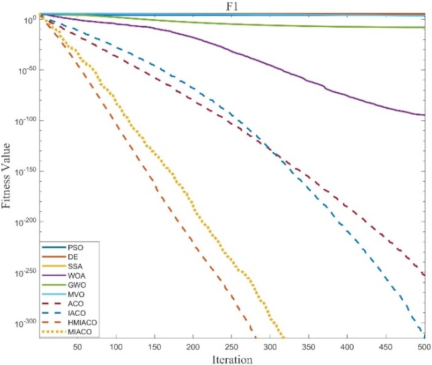
Fig. 1. Iteration curve of test function F1.
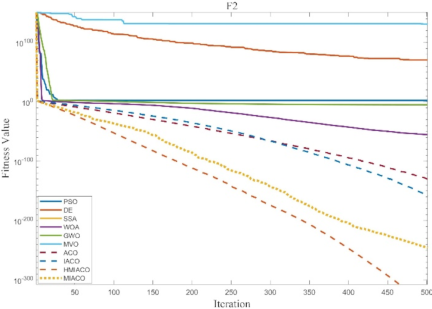
Fig. 2. Iteration curve of test function F2.
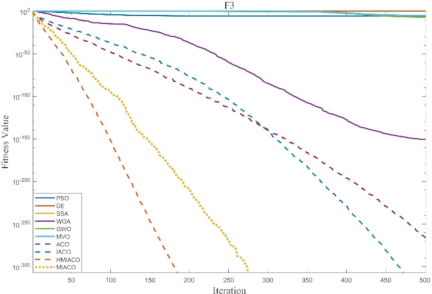
Fig. 3. Iteration curve of test function F3.
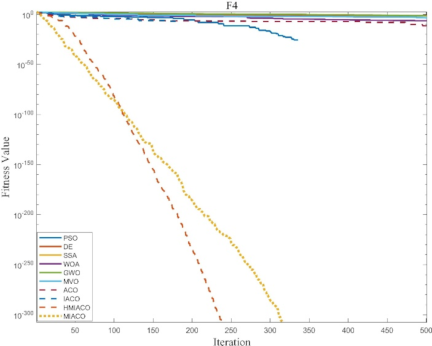
Fig. 4. Iteration curve of test function F4.
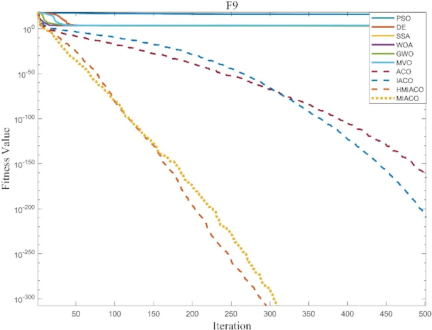
Fig. 5. Iteration curve of test function F9.
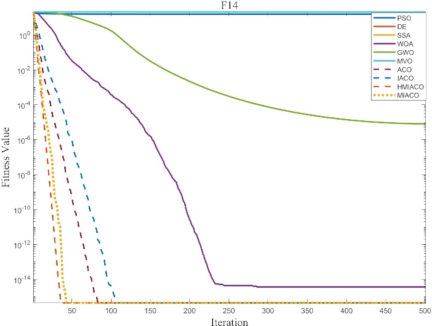
Fig. 6. Iteration curve of test function F14.
Table 2. Parameters of ACO.
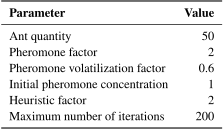
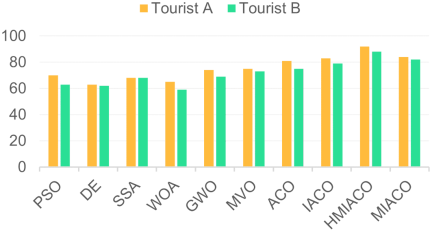
Fig. 7. The solution results of the objective function for Tourists A’s and B’s travel route.
4. Simulation Experiments and Analysis
4.1. Algorithm Performance Testing
To evaluate the performance of the improved HMIACO algorithm proposed in this paper, 15 benchmark test functions from the International Conference on Evolutionary Computation were selected for performance testing. The test results were compared with seven common optimization algorithms: the traditional ACO algorithm, differential evolution (DE), PSO, grey wolf optimizer (GWO), whale optimization algorithm (WOA), sparrow search algorithm (SSA), and multi-strategy improved ACO (MIACO), as well as two advanced improved ACO algorithms. Due to space limitations, the convergence curve diagrams of selected algorithms are shown in Figs. 1–6, where Figs. 1–3 represent the results for single-peak test functions, and Figs. 4–6 represent the results for multi-peak test functions.
From the benchmark test functions shown, it is evident that the HMIACO algorithm proposed in this paper outperforms the comparison algorithms in terms of both optimization speed and effectiveness, whether applied to single-peak or multi-peak test functions. It also surpasses the traditional ACO algorithm and existing improved ACO algorithms, thus confirming the superiority of the algorithm proposed in this paper.
4.2. Case Study
Taking the tourism case of Yunnan Province, China, as an example, this paper references the tourist attraction information of Kunming City, Yunnan Province, provided in the study by Wang et al. 29, to validate the effectiveness of the proposed approach. There are two tourists, A and B, in the study. Tourist A prefers to explore natural landscapes and has strict round-trip time constraints, while Tourist B prefers shopping in commercial streets and has a more relaxed schedule.
Based on the preferences of Tourists A and B, the improved HMIACO algorithm proposed in this paper is used to solve the models established according to the preference parameters of the two tourists. The parameters of the ant colony algorithm used in this experiment are shown in Table 2.
Referring to the tourist attraction information of Kunming City, Yunnan Province, in reference 29, the attractions are numbered from 1 to 14, starting from Daguan Park to the World Horticultural Expo Garden. The HMIACO algorithm and the other nine optimization algorithms were compared and used to solve the problem. The average objective function values for Tourists A and B obtained from running the algorithm 30 times are shown in Fig. 7.
To validate the effectiveness of the model and algorithm proposed in this paper, a comparison is made between the proposed solution (Tourists A and B) and several state-of-the-art methods, including (1) deep graph convolutional networks and (2) reinforcement learning as well as traditional approaches such as (3) the minimum travel budget plan and (4) the random plan. The comparison focuses on key metrics such as tourist satisfaction and the number of attractions visited. The results are shown in Table 3.
As shown in Table 3, the solution proposed in this paper results in higher customer satisfaction compared to both the random plan and the minimum travel cost plan. Additionally, the travel time required is lower than that of the other four plans.
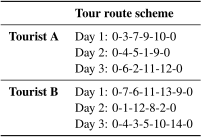
The route planning solutions for Tourists A and B obtained from the proposed tourist route planning scheme are shown in Table 4.
Table 3. Solution results of different schemes.
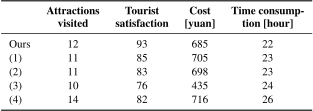
Table 4. The travel routes of Tourists A and B.
5. Conclusion
This study proposed an HMIACO algorithm for personalized tourist route planning under practical constraints. A multi-objective optimization model was developed to maximize tourist satisfaction while considering travel time and cost, attraction opening hours, transportation mode, rest time, weather conditions, transfer limits, and inter-city travel constraints. The proposed enhancements strengthen global search ability and accelerate convergence compared with conventional ACO and representative meta-heuristics.
Experiments on 15 benchmark functions and a real-world case study in Kunming verify that HMIACO produces higher-quality and feasible personalized itineraries, improving tourist satisfaction by 22.37% and 13.41% over budget-minimum and random strategies, respectively, with competitive time and cost performance. Future work will extend the framework to support dynamic preference updates and real-time re-optimization under uncertain travel conditions.
Acknowledgments
This study was funded by Yunnan Provincial Department of Education General Project: Mechanisms and Implementation Pathways for Local Normal Universities to Support Rural Cultural Revitalization (2023J1027); Qujing Normal University Philosophy and Social Sciences Joint Special Project: Research on High Quality Development of Qujing Homestay Tourism under the Background of Rural Revitalization (ZSLH2023ZD02); and National College Students’ Innovative Entrepreneurial Projects: Investigation and Research on the Integration Development of Rural Literature and Tourism under the Background of Digital Technology (202410684022).
- [1] W. Niu, “A novel multiobjective optimization for tourism route based on improvement ACO method and topology optimization,” 6th Int. Conf. Intell. Comput. Control Syst., pp. 701-704, 2022. https://doi.org/10.1109/ICICCS53718.2022.9788179
- [2] Z. Ma, C. Chen, and Z. Huang, “Multi-objective travel-route recommendation method based on integration of user features and group-intelligence,” J. Geo-Inf. Sci., Vol.24, No.10, pp. 2033-2044, 2022. https://doi.org/10.12082/dqxxkx.2022.210640
- [3] F. S. Moosavi Heris, S. F. Ghannadpour, M. Bagheri, and F. Zandieh, “A new accessibility based team orienteering approach for urban tourism routes optimization (A Real Life Case),” Comput. Oper. Res., Vol.138, Article No.105620, 2022. https://doi.org/10.1016/j.cor.2021.105620
- [4] T. Derya, K. Didem Atalay, E. Dinler, and B. Keçeci, “Selective clustered tourist trip design problem with time windows under intuitionistic fuzzy score and exponential travel times,” Expert Syst. Appl., Vol.255, Article No.124792, 2024. https://doi.org/10.1016/j.eswa.2024.124792
- [5] W. Zheng and Z. Liao, “Using a heuristic approach to design personalized tour routes for heterogeneous tourist groups,” Tour. Manag., Vol.72, pp. 313-325, 2019. https://doi.org/10.1016/j.tourman.2018.12.013
- [6] T. Karabaş and M. K. Tural, “Energy-constrained orienteering problem for green tourist trip design: Mathematical formulation and heuristic solution approaches,” Comput. Ind. Eng., Vol.200, Article No.110853, 2025. https://doi.org/10.1016/j.cie.2024.110853
- [7] B. Pérez-Cañedo, P. Novoa-Hernández, C. Porras, D. A. Pelta, and J. L. Verdegay, “Contextual analysis of solutions in a tourist trip design problem: A fuzzy logic-based approach,” Appl. Soft Comput., Vol.154, Article No.111351, 2024. https://doi.org/10.1016/j.asoc.2024.111351
- [8] J. Zheng et al., “A novel route optimization method for feature extraction of big data in smart tourism,” IEEE 4th Int. Conf. Electron. Technol. Commun. Inf., pp. 490-494, 2024. https://doi.org/10.1109/ICETCI61221.2024.10594461
- [9] J. Lin, X. Zhuo, and W. Lyu, “Tourism route management planning of the belt and road cities based on greedy optimization algorithm,” 7th Asian Conf. Artif. Intell. Technol., pp. 1478-1483, 2023. https://doi.org/10.1109/ACAIT60137.2023.10528462
- [10] C. Wang, “Intelligent tourism route optimization based on teaching and learning optimization algorithms,” 2023 World Conf. Commun. Comput., 2023. https://doi.org/10.1109/WCONF58270.2023.10235189
- [11] G.-M. Hua, “Tourism route design and optimization based on heuristic algorithm,” 8th Int. Conf. Meas. Technol. Mechatron. Autom., pp. 449-452, 2016. https://doi.org/10.1109/ICMTMA.2016.113
- [12] F. Lu, J. Zhang, and Y. Yang, “Analysis and optimization of urban tourism spatial behavior path: —Taking Nanjing City as an example,” 2021 Int. Conf. Cult.-oriented Sci. Technol., pp. 16-19, 2021. https://doi.org/10.1109/ICCST53801.2021.00013
- [13] L. Zhang and P. Sun, “An optimal travel route optimization model based on ant colony optimization algorithm,” 5th Asia Conf. Mach. Learn. Comput., pp. 105-110, 2022. https://doi.org/10.1109/ACMLC58173.2022.00026
- [14] J. Ruiz-Meza and J. R. Montoya-Torres, “A systematic literature review for the tourist trip design problem: Extensions, solution techniques and future research lines,” Oper. Res. Perspect., Vol.9, Article No.100228, 2022. https://doi.org/10.1016/j.orp.2022.100228
- [15] J.-M. Godart, “Combinatorial optimisation based decision support system for trip planning,” Information and Communication Technologies in Tourism 1999 (Proc. 6th Int, Conf. Inf. Commun. Technol. Tour.), pp. 318-327, 1999. https://doi.org/10.1007/978-3-7091-6373-3_31
- [16] R. Deitch and S. P. Ladany, “The one-period bus touring problem: Solved by an effective heuristic for the orienteering tour problem and improvement algorithm,” European J. of Operational Research, Vol.127, No.1, pp. 69-77, 2000. https://doi.org/10.1016/S0377-2217(99)00323-9
- [17] S. A. Bagloee, M. Tavana, D. Di Caprio, M. Asadi, and M. Heshmati, “A multi-user decision support system for online city bus tour planning,” J. Mod. Transp., Vol.25, No.2, pp. 59-73, 2017. https://doi.org/10.1007/s40534-017-0126-x
- [18] J. Yu, J. Aslam, S. Karaman, and D. Rus, “Anytime planning of optimal schedules for a mobile sensing robot,” 2015 IEEE/RSJ Int. Conf. Intell. Robots Syst., pp. 5279-5286, 2015. https://doi.org/10.1109/IROS.2015.7354122
- [19] O. Shcherbina and E. Shembeleva, “Modeling recreational systems using optimization techniques and information technologies,” Ann. Oper. Res., Vol.221, pp. 309-329, 2014. https://doi.org/10.1007/s10479-011-1011-3
- [20] Y. Zhao and L. Alfandari, “Design of diversified package tours for the digital travel industry: A branch-cut-and-price approach,” Eur. J. Oper. Res., Vol.285, No.3, pp. 825-843, 2020. https://doi.org/10.1016/j.ejor.2020.02.020
- [21] Z. Jia et al., “Multi-objective optimization for the sightseeing bus problem: Trade-off between tourists and operator,” Expert Syst. Appl., Vol.269, Article No.126341, 2025. https://doi.org/10.1016/j.eswa.2024.126341
- [22] M. H. Kolaee, A. Jabbarzadeh, and S. M. J. Mirzapour Al-e-hashem, “Sustainable group tourist trip planning: An adaptive large neighborhood search algorithm,” Expert Syst. Appl., Vol.237, Article No.121375, 2024. https://doi.org/10.1016/j.eswa.2023.121375
- [23] J. Xu, X. Peng, and M. Chen, “Memory-based iterated local search with multiple perturbation operators for personalized learning path planning,” Appl. Soft Comput., Vol.188, Article No.114426, 2026. https://doi.org/10.1016/j.asoc.2025.114426
- [24] L. Wu et al., “Multi-day tourism recommendations for urban tourists considering hotel selection: A heuristic optimization approach,” Omega, Vol.126, Article No.103048, 2024. https://doi.org/10.1016/j.omega.2024.103048
- [25] T. Zhang and F. Gao, “A traditional cultural route planning and design system based on improved genetic algorithm,” Procedia Comput. Sci., Vol.247, pp. 211-217, 2024. https://doi.org/10.1016/j.procs.2024.10.025
- [26] X. Guan and G. Li, “Optimization of cold chain logistics vehicle transportation and distribution model based on improved ant colony algorithm,” Procedia Comput. Sci., Vol.228, pp. 974-982, 2023. https://doi.org/10.1016/j.procs.2023.11.128
- [27] B. Zhang and Y. Li, “Path planning of mobile robot based on the dynamic optimization ant colony algorithm,” Chin. J. Sci. Instrum., Vol.46, No.3, pp. 74-85, 2025 (in Chinese). https://doi.org/10.19650/j.cnki.cjsi.J2513718
- [28] G. Li, Z. Hao, J. Yang, and J. Cheng, “Living materials temporary distribution points location-routing optimization under transportation capacity shortage,” J. Transp. Syst. Eng. Inf. Technol., Vol.25, No.2, pp. 304-313, 2025 (in Chinese). https://doi.org/10.16097/j.cnki.1009-6744.2025.02.028
- [29] W. Wang, X. Wang, Q. Niu, and M. Dong, “Research on multi-preference travel route planning based on logic model,” Mod. Electron. Tech., Vol.48, No.7, pp. 169-176, 2025 (in Chinese). https://doi.org/10.16652/j.issn.1004-373x.2025.07.024
This article is published under a Creative Commons Attribution-NoDerivatives 4.0 Internationa License.