
Research Paper:
Design and Implementation of a Nonverbal Information Analysis System
Jinseok Woo*,†
 , Chifuyu Matsumoto**, and Yuka Sone**
*Department of Mechanical Engineering, School of Engineering, Tokyo University of Technology
1404-1 Katakuramachi, Hachioji, Tokyo 192-0982, Japan
†Corresponding author
**Sustainable Engineering Program, Graduate School of Engineering, Tokyo University of Technology
1404-1 Katakuramachi, Hachioji, Tokyo 192-0982, Japan

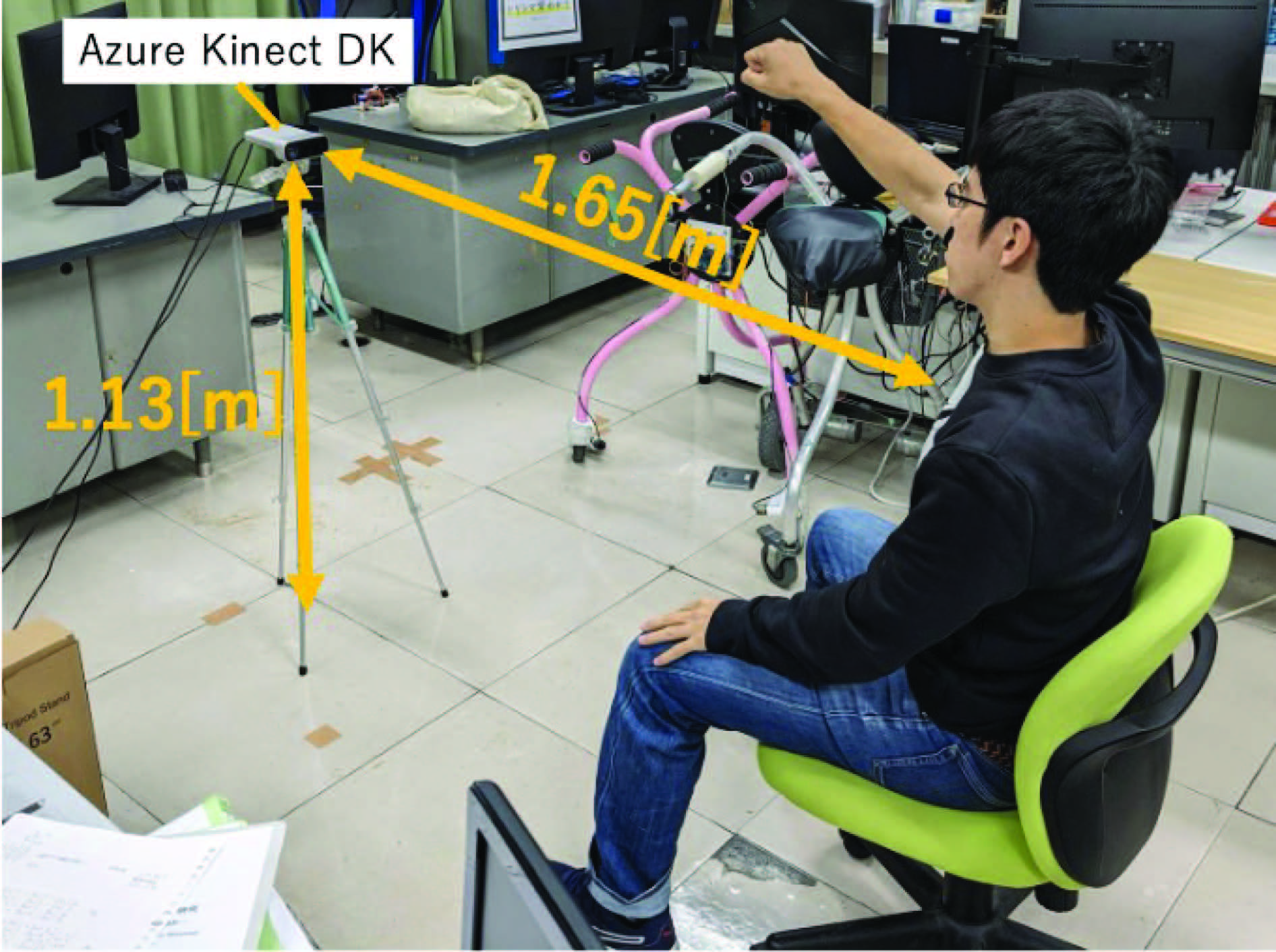
In recent years, achieving sustainable development goals has required of personalized support systems that can adapt to diverse users through natural human–system interactions. Understanding the nonverbal information of users is essential for facilitating these interactions. In this study, we focus on human gestures as a fundamental nonverbal modality that conveys user emotions and intentions. Therefore, we propose a gesture analysis system based on the relative positions of human joints and arm orientations. Using an RGB-D camera, we acquire human skeletal information and develop a gesture recognition system. Within this system, two analytical approaches are investigated: dynamic time warping-based classification method and a neural network-based classification methods. Through experimental evaluation of a small-scale dataset, we analyze the behavioral characteristics and recognition tendencies of each approach under controlled conditions. In addition, we present several cases demonstrating the effectiveness of the proposed system and discuss its applicability.
Nonverbal analysis using RGB-D camera
- [1] C. Wong, E. Yang, X.-T. Yan, and D. Gu, “An overview of robotics and autonomous systems for harsh environments,” 2017 23rd Int. Conf. on Automation and Computing (ICAC), 2017. https://doi.org/10.23919/IConAC.2017.8082020
- [2] S. Yamamoto, J. Woo, W. H. Chin, K. Matsumura, and N. Kubota, “Interactive information support by robot partners based on informationally structured space,” J. Robot. Mechatron., Vol.32, No.1, pp. 236-243, 2020. https://doi.org/10.20965/jrm.2020.p0236
- [3] R. Jahanmahin, S. Masoud, J. Rickli, and A. Djuric, “Human-robot interactions in manufacturing: A survey of human behavior modeling,” Robotics and Computer-Integrated Manufacturing, Vol.78, Article No.102404, 2022. https://doi.org/10.1016/j.rcim.2022.102404
- [4] T. Kanda, M. Kamasima, M. Imai, T. Ono, D. Sakamoto, H. Ishiguro, and Y. Anzai, “A humanoid robot that pretends to listen to route guidance from a human,” Autonomous Robots, Vol.22, pp. 87-100, 2007. https://doi.org/10.1007/s10514-006-9007-6
- [5] B. B. Lonkar, A. Kuthe, R. Shrivastava, and P. Charde, “Design and implement smart home appliances controller using IOT,” Information Systems and Management Science: Conf. Proc. of 3rd Int. Conf. on Information Systems and Management Science (ISMS) 2020, pp. 105-117, 2022. https://doi.org/10.1007/978-3-030-86223-7_11
- [6] S. K. Roy, G. Singh, R. L. Gruner, B. L. Dey, S. Shabnam, S. S. Muhammad, and M. Quaddus, “Relationship quality in customer-service robot interactions in Industry 5.0: An analysis of value recipes,” Information Systems Frontiers, 2023. https://doi.org/10.1007/s10796-023-10445-y
- [7] Y. Wang, H. Wu, G. Tian, G. Liu, F. Lu, and Y. Wang, “Fast search strategy for robots in dynamic home environment,” J. Adv. Comput. Intell. Intell. Inform., Vol.26, No.3, pp. 315-324, 2022. https://doi.org/10.20965/jaciii.2022.p0315
- [8] P. Bull and J. P. Doody, “Gesture and body movement,” J. A. Hall and M. L. Knapp (Eds.), “Nonverbal Communication,” pp. 205-228, 2013. https://doi.org/10.1515/9783110238150.205
- [9] S. Kita, “Why do people make gesture?,” Cognitive Studies, Vol.7, No.1, pp. 9-21, 2000 (in Japanese). https://doi.org/10.11225/jcss.7.9
- [10] W.-F. Hsieh, E. Sato-Shimokawara, and T. Yamaguchi, “Investigation of robot expression style in human-robot interaction,” J. Robot. Mechatron., Vol.32, No.1, pp. 224-235, 2020. https://doi.org/10.20965/jrm.2020.p0224
- [11] J. Woo, T. Sato, and Y. Ohyama, “Development of a human-centric system using an IoT-based socially embedded robot partner,” J. Robot. Mechatron., Vol.35, No.3, pp. 859-866, 2023. https://doi.org/10.20965/jrm.2023.p0859
- [12] C. Matsumoto, Y. Sone, J. Woo, and Y. Ohyama, “Development of a gesture analysis system for human system interaction,” 2024 Joint 13th Int. Conf. on Soft Computing and Intelligent Systems and 25th Int. Symp. on Advanced Intelligent Systems (SCIS&ISIS), 2024. https://doi.org/10.1109/SCISISIS61014.2024.10760070
- [13] Y. Sone, C. Matsumoto, J. Woo, and Y. Ohyama, “Development of a control support system for smart homes using the analysis of user interests based on mixed reality,” ROBOMECH J., Vol.12, Article No.2, 2025. https://doi.org/10.1186/s40648-024-00288-w
- [14] J. Woo and J. Hu, “System for analyzing user interest based on eye gaze responses to enhance empathy with users,” J. Adv. Comput. Intell. Intell. Inform., Vol.29, No.3, pp. 641-648, 2025. https://doi.org/10.20965/jaciii.2025.p0641
- [15] J. Woo and J. Hu, “System for analyzing user interest based on eye gaze responses to enhance empathy with users,” J. Adv. Comput. Intell. Intell. Inform., Vol.29, No.3, pp. 641-648, 2025. https://doi.org/10.20965/jaciii.2025.p0641
- [16] Y. Sone and J. Woo, “Design of a human-centric robotic system for user support based on gaze information,” J. Adv. Comput. Intell. Intell. Inform., Vol.29, No.4, pp. 796-802, 2025. https://doi.org/10.20965/jaciii.2025.p0796
- [17] M. Servi, A. Profili, R. Furferi, and Y. Volpe, “Comparative evaluation of Intel RealSense D415, D435i, D455 and Microsoft Azure Kinect DK Sensors for 3D vision applications,” IEEE Access, Vol.12, pp. 111311-111321, 2024. https://doi.org/10.1109/ACCESS.2024.3441238
- [18] A. Hussain, H. Shakeel, F. Hussain, N. Uddin, and T. L. Ghouri, “Unity game development engine: A technical survey,” Univ. Sindh J. Inf. Commun. Technol., Vol.4, No.2, pp. 73-81, 2020.
- [19] M. Tomasello, “Origins of Human Communication,” MIT Press, 2010.
- [20] M. Müller, “Dynamic time warping,” Information Retrieval for Music and Motion, pp. 69-84, 2007. https://doi.org/10.1007/978-3-540-74048-3_4
- [21] F. Petitjean, A. Ketterlin, and P. Gançarski, “A global averaging method for dynamic time warping, with applications to clustering,” Pattern Recognition, Vol.44, No.3, pp. 678-693, 2011. https://doi.org/10.1016/j.patcog.2010.09.013
- [22] X. Huang, Y. Ye, L. Xiong, R. Y. Lau, N. Jiang, and S. Wang, “Time series k-means: A new k-means type smooth subspace clustering for time series data,” Information Sciences, Vol.367, pp. 1-13, 2016. https://doi.org/10.1016/j.ins.2016.05.040
- [23] M. Cui et al., “Introduction to the k-means clustering algorithm based on the elbow method,” Accounting, Auditing and Finance, Vol.1, No.1, pp. 5-8, 2020. https://dx.doi.org/10.23977/accaf.2020.010102
- [24] C. Lugaresi, J. Tang, H. Nash, C. McClanahan, E. Uboweja, M. Hays, F. Zhang, C.-L. Chang, M. G. Yong, J. Lee et al., “MediaPipe: A framework for building perception pipelines,” arXiv:1906.08172, 2019. https://doi.org/10.48550/arXiv.1906.08172
- [25] J. Liu, L. Zhong, J. Wickramasuriya, and V. Vasudevan, “uWave: Accelerometer-based personalized gesture recognition and its applications,” Pervasive and Mobile Computing, Vol.5, No.6, pp. 657-675, 2009. https://doi.org/10.1016/j.pmcj.2009.07.007
- [26] X. Zhang, X. Chen, Y. Li, V. Lantz, K. Wang, and J. Yang, “A framework for hand gesture recognition based on accelerometer and emg sensors,” IEEE Trans. on Systems, Man, and Cybernetics – Part A: Systems and Humans, Vol.41, No.6, pp. 1064-1076, 2011. https://doi.org/10.1109/TSMCA.2011.2116004
- [27] F. Farhadi-Niaki, J. Gerroir, A. Arya, S. A. Etemad, R. Laganiére, P. Payeur, and R. Biddle, “Usability study of static/dynamic gestures and haptic input as interfaces to 3D games,” Proc. of the 6th Int. Conf. on Advances in Computer-Human Interactions, pp. 315-323, 2013.
- [28] Z. Tang, J. Ma, W. Liu, P. Zhang, and F. Lv, “Sliding window dynamic time-series warping-based ultrasonic guided wave temperature compensation and defect monitoring method for turnout rail foot,” IEEE Trans. on Ultrasonics, Ferroelectrics, and Frequency Control, Vol.69, No.9, pp. 2681-2695, 2022. https://doi.org/10.1109/TUFFC.2022.3195933
- [29] J. Lee, T. Ahmed, T. Rikakis, and P. Turaga, “Automatic temporal segmentation for post-stroke rehabilitation: A keypoint detection and temporal segmentation approach for small datasets,” Proc. of the Winter Conf. on Applications of Computer Vision, pp. 21-29, 2025. https://doi.org/10.1109/WACVW65960.2025.00008
- [30] H. Liu, A. Panahi, D. Andrews, and A. Nelson, “An fpga-based upper-limb rehabilitation device for gesture recognition and motion evaluation using multi-task recurrent neural networks,” IEEE Sensors J., Vol.22, No.4, pp. 3605-3615, 2022. https://doi.org/10.1109/JSEN.2022.3141659
- [31] E. Rahimian, S. Zabihi, A. Asif, D. Farina, S. F. Atashzar, and A. Mohammadi, “Hand gesture recognition using temporal convolutions and attention mechanism,” 2022-2022 IEEE Int. Conf. on Acoustics, Speech and Signal Processing (ICASSP), pp. 1196-1200, 2022. https://doi.org/10.1109/ICASSP43922.2022.9746174
This article is published under a Creative Commons Attribution-NoDerivatives 4.0 Internationa License.