
Research Paper:
Operating Parameters Optimization Based on BPNN and NSGA-III in Rotating Mode for Pneumatic Directional Drilling
Hao Li*1,*2, Lijuan Fan*3,*4,*5
 , Ningping Yao*1,*2,†, Hongchao Wei*2, and Chengda Lu*4,*5,*6
*1China Coal Research Institute
No.5 East Qingnian Gou Road, Hepingli, Chaoyang District, Beijing 10013, China
*2China Coal Technology Engineering Group (CCTEG) Xi’an Research Institute (Group) Co., Ltd.
No.82 Jinye 1st Road, Gaoxin District, Xi’an, Shaanxi 710077, China
*3School of Future Technology, China University of Geosciences
No.388 Lumo Road, Hongshan District, Wuhan, Hubei 430074, China
*4Hubei Key Laboratory of Advanced Control and Intelligent Automation for Complex Systems
No.388 Lumo Road, Hongshan District, Wuhan, Hubei 430074, China
*5Engineering Research Center of Intelligent Technology for Geo-Exploration, Ministry of Education
No.388 Lumo Road, Hongshan District, Wuhan, Hubei 430074, China
*6School of Artificial Intelligence and Automation, China University of Geosciences
No.388 Lumo Road, Hongshan District, Wuhan, Hubei 430074, China
†Corresponding author

Drilling operations face the problems of low drilling efficiency and more difficult slag discharge in coal seams. A multi-objective optimization method is proposed to solve these problems. Rate of penetration (ROP), air pressure, and pull-out pressure are determined as the optimization objectives by characterization of the rotating mode. The maximum information coefficient (MIC) method is used to select the decision variables related to the optimization objectives, which are feed pressure, air volume, borehole depth, coal seam hardness, and rotary pressure. Then, a multi-objective optimization model is established using back propagation neural network (BPNN). The Non-Dominated Sorting Genetic Algorithm-III (NSGA-III) is used to solve the optimal operating parameters when the ROP is maximum and the air pressure and the pull-out pressure are minimum. Comparative experiments show that the method proposed in this study is effective. The results of this study can provide a new solution to improving drilling efficiency and resolving slag discharge difficulties in coal mines.
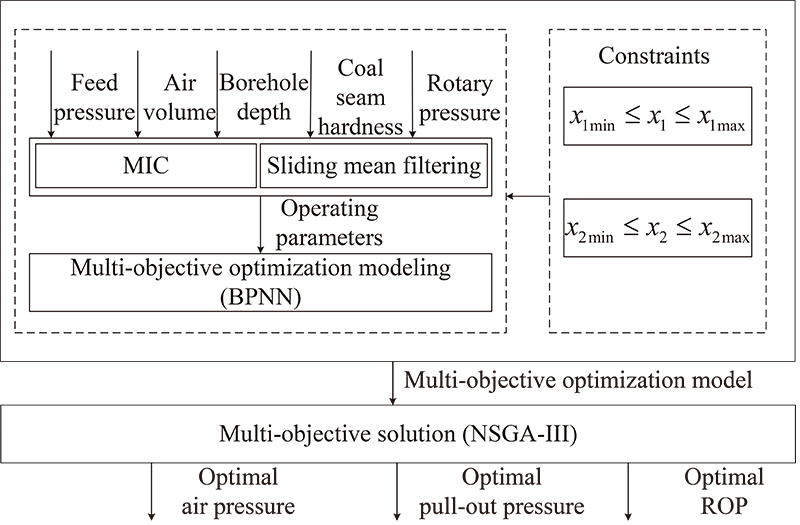
Overall scheme of operating parameters optimization
- [1] V. Ramba, S. Selvaraju, S. Subbiah, M. Palanisamy, and A. Srivastava, “Optimization of drilling parameters using improved play-back methodology,” J. of Petroleum Science and Engineering, Vol.206, Article No.108991, 2021. https://doi.org/10.1016/j.petrol.2021.108991
- [2] P. Antil, S. Kumar Antil, C. Prakash, G. Królczyk, and C. Pruncu, “Multi-objective optimization of drilling parameters for orthopaedic implants,” Measurement and Control, Vol.53, Nos.9-10, pp. 1902-1910, 2020. https://doi.org/10.1177/0020294020947126
- [3] X. Liao, M. Khandelwal, H. Yang, M. Koopialipoor, and B. R. Murlidhar, “Effects of a proper feature selection on prediction and optimization of rop using intelligent techniques,” Engineering with Computers, Vol.36, No.2, pp. 499-510, 2020. https://doi.org/10.1007/s00366-019-00711-6
- [4] L. Wang, “Techniques of double-pipe and double-acting directional drilling with air in broken and soft coal seams in underground coal mines,” Coal Geology & Exploration, Vol.50, No.7, pp. 166-172, 2022 (in Chinese). https://doi.org/10.12363/issn.1001-1986.22.02.0072
- [5] W. Long, S. Sun and J. Chen, “Study on long-distance fixed-point sealed coring technology in broken-soft coal seams,” Coal Geology & Exploration, Vol.50, No.8, pp. 93-98, 2022 (in Chinese). https://doi.org/10.12363/issn.1001-1986.21.12.0882
- [6] Y. Xu, Y. Zhu, and P. Zhang, “Application of CBM horizontal well development technology in the roof strata close to broken-soft coal seams,” Natural Gas Industry B, Vol.6, No.2, pp. 168-174, 2019. https://doi.org/10.1016/j.ngib.2018.09.006
- [7] C. Gan, W.-H. Cao, L.-Z. Wang, K.-Z. Liu, and M. Wu, “An improved dynamic optimization control system for the drilling rate of penetration (ROP) and its industrial application,” IEEE Trans. on Industrial Electronics, Vol.70, No.6, pp. 6201-6208, 2023. https://doi.org/10.1109/TIE.2022.3199916
- [8] M. Oyedere and K. Gray, “ROP and TOB optimization using machine learning classification algorithms,” J. of Natural Gas Science and Engineering, Vol.77, Article No.103230, 2020. https://doi.org/10.1016/j.jngse.2020.103230
- [9] J. Hao, H. Xu, Z. Peng, and Z. Cao, “An online adaptive ROP prediction model using GBDT and Bayesian optimization algorithm in drilling,” Geoenergy Science and Engineering, Vol.246, Article No.213596, 2025. https://doi.org/10.1016/j.geoen.2024.213596
- [10] A. Jamshidi, “Prediction of TBM penetration rate from brittleness indexes using multiple regression analysis,” Modeling Earth Systems and Environment, Vol.4, No.1, pp. 383-394, 2018. https://doi.org/10.1007/s40808-018-0432-2
- [11] H. Basarir, L. Tutluoglu, and C. Karpuz, “Penetration rate prediction for diamond bit drilling by adaptive neuro-fuzzy inference system and multiple regressions,” Engineering Geology, Vol.173, pp. 1-9, 2014. https://doi.org/10.1016/j.enggeo.2014.02.006
- [12] A. T. Bourgoyne and F. S. Young, Jr., “A multiple regression approach to optimal drilling and abnormal pressure detection,” Society of Petroleum Engineers J., Vol.14, No.4, pp. 371-384, 1974. https://doi.org/10.2118/4238-PA
- [13] Y. Zhao, A. Noorbakhsh, M. Koopialipoor, A. Azizi, and M. M. Tahir, “A new methodology for optimization and prediction of rate of penetration during drilling operations,” Engineering with Computers, Vol.36, No.2, pp. 587-595, 2020. https://doi.org/10.1007/s00366-019-00715-2
- [14] A. M. Alali, M. F. Abughaban, B. M. Aman, and S. Ravela, “Hybrid data driven drilling and rate of penetration optimization,” J. of Petroleum Science and Engineering, Vol.200, Article No.108075, 2021. https://doi.org/10.1016/j.petrol.2020.108075
- [15] Y. Zhou et al., “A novel rate of penetration prediction model with identified condition for the complex geological drilling process,” J. of Process Control, Vol.100, pp. 30-40, 2021. https://doi.org/10.1016/j.jprocont.2021.02.001
- [16] A. G. Gad, “Particle swarm optimization algorithm and its applications: A systematic review,” Archives of Computational Methods in Engineering, Vol.29, No.5, pp. 2531-2561, 2022. https://doi.org/10.1007/s11831-021-09694-4
- [17] A. M. Keller, T. Feng, N. Demirer, R. Darbe, and D. Chen, “Rate of penetration estimation downhole with machine learning for drilling position control,” Geoenergy Science and Engineering, Vol.224, Article No.211593, 2023. https://doi.org/10.1016/j.geoen.2023.211593
- [18] F. Qu et al., “Establishment of data-driven multi-objective model to optimize drilling performance,” Geoenergy Science and Engineering, Vol.231, Part A, Article No.212295, 2023. https://doi.org/10.1016/j.geoen.2023.212295
- [19] F. S. Boukredera et al., “Enhancing the drilling efficiency through the application of machine learning and optimization algorithm,” Engineering Applications of Artificial Intelligence, Vol.126, Part C, Article No.107035, 2023. https://doi.org/10.1016/j.engappai.2023.107035
- [20] J. O. Agushaka, A. E. Ezugwu, and L. Abualigah, “Gazelle optimization algorithm: A novel nature-inspired metaheuristic optimizer,” Neural Computing and Applications, Vol.35, No.5, pp. 4099-4131, 2023. https://doi.org/10.1007/s00521-022-07854-6
- [21] M. Bajolvand, A. Ramezanzadeh, M. Mehrad, and A. Roohi, “Optimization of controllable drilling parameters using a novel geomechanics-based workflow,” J. of Petroleum Science and Engineering, Vol.218, Article No.111004, 2022. https://doi.org/10.1016/j.petrol.2022.111004
- [22] A. Yang et al., “Decision fusion scheme based on mode decomposition and evidence theory for fault diagnosis of drilling process,” IEEE Trans. on Industrial Informatics, Vol.20, No.2, pp. 2017-2028, 2024. https://doi.org/10.1109/TII.2023.3285040
- [23] M. Dehghani, Z. Montazeri, E. Trojovská, and P. Trojovský, “Coati optimization algorithm: A new bio-inspired metaheuristic algorithm for solving optimization problems,” Knowledge-Based Systems, Vol.259, Article No.110011, 2023. https://doi.org/10.1016/j.knosys.2022.110011
- [24] W. Li et al., “Design of an intelligent control system for compound directional drilling in underground coal mines,” J. Adv. Comput. Intell. Intell. Inform., Vol.28, No.4, pp. 1052-1062, 2024. https://doi.org/10.20965/jaciii.2024.p1052
This article is published under a Creative Commons Attribution-NoDerivatives 4.0 Internationa License.