
Research Paper:
Industrial Structure Upgrading, Household Consumption Level, and High-Quality Economic Development
Yong Wang
 and Zhenyu Wan†
School of Statistics and Data Science, Jiangxi Economic Forecasting and Decision Research Center, Jiangxi University of Finance and Economics
No.169 Shuanggang East Street, Nanchang, Jiangxi 330013, China
†Corresponding author

Industrial structure upgrading and household consumption are key factors affecting high-quality economic development. Based on provincial panel data from 2001 to 2021, this work constructs a dynamic panel threshold model to analyze the impact of industrial structure upgrading on high-quality economic development, using household consumption levels as the threshold variable. The results of the model show that rising household consumption levels strengthen the positive effect of industrial structure upgrading on high-quality economic development across regions, with the central region showing the largest increase. The work further reveals that the increase in household consumption levels amplifies the negative impact of an unreasonable industrial structure on high-quality economic development in the eastern and western regions while mitigating its negative effect in the central region. Finally, this paper puts forward suggestions such as changing the concept of heavy production and light consumption, promoting the upgrading of industrial structure according to local conditions, and making every effort to promote high-quality economic development.
1. Introduction
The 20th CPC National Congress report emphasized the crucial role of expanding domestic demand in driving future economic growth. To effectively implement this expansion, it is essential to reinforce the fundamental role of consumption in economic development. While total demand for economic growth comprises investment, consumption, and net exports, consumption plays an increasingly pivotal role as the economy reaches a certain stage, becoming the foremost of the three main drivers. According to data from the National Bureau of Statistics, the contribution of final consumption expenditures to GDP growth surged from 39.4% in 2022 to 82.5% in 2023, and its impact on GDP growth increased from 1.2 percentage points in 2022 to 4.3 percentage points in 2023. At this stage of high-quality development, China’s three primary industries have stabilized with improvements in industrial efficiency, optimized industrial structures, and enhanced product and service qualities. However, some traditional industries remain stuck at mid to low levels, with limited product diversity, weak innovation, and short supply chains, which impede high-quality economic growth. President Xi Jinping has emphasized that achieving high-quality development requires a strong focus on upgrading the industrial structure by strengthening and improving the real economy. Accelerating industrial upgrades and addressing existing weaknesses in this process are crucial for constructing a modern industrial system that supports high-quality economic development.
The Central Economic Work Conference of December 2023 outlined the direction of China’s economic development for 2024, emphasizing high-quality growth. Building a modern industrial system is key to this objective. Household consumption and industrial upgrading are critical drivers of high-quality development. Households with stronger purchasing power tend to shift toward growth-oriented consumption, particularly in transportation, communication, and healthcare. To meet these demands, resources are reallocated across industries to improve efficiency, enhance performance, and promote upgrading, all of which drive high-quality development. However, once consumption reaches saturation, consistent with diminishing marginal utility, demand weakens, limiting production expansion and the positive effect of consumption on industrial upgrading. Consequently, the influence of industrial upgrading on high-quality development may be subject to a consumption-threshold effect. This study examines the nonlinear impact of industrial upgrading on high-quality development through this consumption-threshold effect aligned with China’s current national conditions and provides empirical evidence to guide economic entities and inform differentiated policies across stages of expanding domestic demand.
2. Literature Review
Several researchers have explored the relationship between industrial upgrades and high-quality economic development. Using panel data from 30 Chinese provinces between 2010 and 2020, Chen and Zhao constructed a semiparametric model and found that industrial upgrading significantly boosts high-quality economic development, although the effects vary across regions 1. Cheng and Wang used city-level panel data from 2006 to 2019, employed a spatial Durbin model, and concluded that industrial upgrades enhance economic growth 2. Li and Li analyzed data from 13 cities in the Beijing–Tianjin–Hebei region between 2000 and 2018 and found that while advanced industrial structures initially suppressed high-quality growth in the short term, their long-term effects were positive, and irrational industrial structures significantly increased regional growth levels. Both advanced and irrational structures were found to have spillover effects on the economic development of neighboring cities 3. Wu used panel data from 30 provinces between 2008 and 2020 and a partial least squares structural equation model (PLS-SEM) to demonstrate that industrial upgrading leads to significant improvements in the quality of regional economic development 4. Liu used panel data from 30 provinces between 2013 and 2023, constructed a panel mediating effect and moderating effect model, and found that upgrading and rationalizing the industrial structure promotes the high-quality development of the regional economy 5.
Other scholars have investigated the influence of household consumption on industrial upgrades. Clark argued that consumption demand and structure play crucial roles in shaping industrial structures and are key factors driving industrial restructuring 6. Yang used macroeconomic data from Hubei Province between 1980 and 2007, constructed a VAR model, and found that the consumption structure did not contribute significantly to industrial restructuring 7. Similarly, Zhou studied Shanghai’s macro data from 1980 to 2008 using a VEC model and concluded that household consumption structure had limited effects on industrial changes 8. However, Lee et al. 9 showed that shifts in household consumption patterns could propel industrial optimization. Zhang and Zhang 10 used panel data from 1997 to 2012 across Chinese provinces and demonstrated that the optimization of urban and rural consumption structures positively drives industrial transformation and upgrading. Wu applied Granger causality tests to panel data covering 2000 to 2015 and found that improved household consumption structures significantly induced industrial upgrading 11. Yang and Chen 12 used data from 2000 to 2016 and found that consumption upgrading in urban middle-income households was the primary force behind industrial transformation. Liao and Zhang discovered that changes in consumption patterns, preferences, and methods drive industrial transformation, with diversified consumption innovations directing further industrial optimization 13. Zhang et al. 14 used panel data from 1998 to 2007 and concluded that consumption was a key driver of industrial transformation. Dong and Zhang 15 used spatial Durbin models on data from 30 provinces between 2000 and 2018 and found that higher levels of household consumption significantly promoted industrial transformation, with positive spatial spillover effects on neighboring regions. Using a machine learning method, Sun et al. used panel data from 31 provinces between 2000 and 2022 and found that the consumption structure has a nonlinear effect on promoting industrial upgrading 16.
Several scholars have examined the effects of household consumption on economic development. Chen and Wu used panel data from 30 provinces (including autonomous regions and municipalities) from 2001 to 2017 and employed the generalized method of moments (GMM) approach, finding that upgrading the consumption structure significantly improves economic quality in both the eastern and western regions of China, although its effects on the central region are less pronounced. They also identified a threshold effect on the impact of consumption structure upgrades on high-quality development; beyond a certain point, the role of consumption structure upgrades becomes more pronounced 17. Using data from 1993 to 2017, Chen et al. noted that the effect of entrepreneurship on economic growth during the high-quality development phase varied depending on changes in the consumption structure. They highlight the significant dual threshold effect of entrepreneurship and the consumption demand structure, with the role of entrepreneurship in economic growth becoming more important as consumption structures are upgraded 18. Liu and Zhong used panel data from 30 provinces between 2004 and 2018 to construct spatial econometric and threshold models and showed that aging has a notable spatial spillover effect on high-quality development through increased health-related consumption. Aging promotes economic development through changes in labor supply and growing demand for health consumption, with a dual threshold effect evident in the relationship between age-related health consumption and economic quality 19. Wang and Chen used data from 30 provinces between 2011 and 2018 and found that consumption structure upgrades were robust drivers of high-quality economic development, particularly in the eastern and western regions. They also found that consumption upgrades had a stronger positive effect on development in regions with higher marketization indices or government efficiency 20. Li and Wu 21 used panel data from 31 provinces between 2010 and 2020 to construct a fixed-effect threshold model and found that the threshold effect of consumer demand led to an inverted U-type effect of the digital economy, enabling high-quality economic development.
While industrial upgrading, household consumption, and high-quality economic development are widely studied topics in economics, few studies have systematically explored the intricate relationships among them 22,23. Given that the effect of industrial upgrading on high-quality economic development may exhibit regional variation due to differing levels of household consumption and that these effects could be nonlinear, this study utilizes provincial panel data from 2001 to 2021. Using household consumption levels as a threshold variable, we construct a dynamic panel threshold model to investigate the impact of industrial upgrades on high-quality economic development.
3. Mechanism of Action and Research Hypotheses
Industrial upgrading is often accompanied by technological advancements and gains in production efficiency, which lower production costs and enhance product quality. This, in turn, boosts enterprises’ competitiveness and strengthens their positions in the marketplace. Innovation is a key driver of industrial upgrading and steers the economy toward high-quality development. As household income increases and consumption preferences evolve, consumer demand becomes more diversified and shifts toward higher-end products. This shift in consumer demand has driven industrial upgrades, making industries more responsive to market requirements. Both industrial upgrading and rising consumption levels foster a dynamic equilibrium between supply and demand, helping to mitigate issues such as overproduction and weak demand, thereby enhancing overall economic efficiency. Moreover, industrial upgrading demands a more skilled labor force, leading to greater investments in education and training, while the accumulation of human capital plays a pivotal role in advancing high-quality economic development. Industrial upgrading also promotes environmentally sustainable industries aligned with increasing consumer demand for green products and services, both of which contribute to sustainable economic growth. In addition, industrial upgrades and enhanced consumer spending contribute to better income distribution, reduce poverty and inequality, and promote social stability and growth.
Classical economics, through “Say’s Law,” posits that supply creates its own demand, asserting that investment and production are more significant than consumption in driving economic growth. Neoclassical growth models further argue that investment fuels GDP and income, which, subsequently, lead to consumption. Consumption signifies that the goods and capital produced are utilized, prompting further investment and production, thereby generating higher GDP and more consumption. However, classical and neoclassical models assume a perfectly functioning economy and market with no information asymmetries or transaction frictions, and the goods produced can be seamlessly sold and converted into income. However, market imperfections persist. During economic downturns, unsold goods accumulate, and workers lack sufficient income to consume. Keynesian economics asserts that demand rather than supply drives economic activity. New Keynesians argue that long-term economic growth is determined by supply-side factors such as factor endowment and total factor productivity. Although investment-driven growth surpasses consumption-driven growth in the long term, market imperfections in the short term imply that economic growth is demand-driven. Although markets eventually become more efficient, making production and supply paramount in the long term, short-term growth depends on consumption and demand. Traditional models that primarily focus on the secondary sector fail to account for the dynamics of the tertiary sector, in which consumption dictates production. In 2013, China’s tertiary sector surpassed its secondary sector in terms of value-added output, and consumption is currently the primary engine of economic growth. Sustained consumer demand is essential to expediting industrial upgrades and achieving high-quality economic development. Achieving these goals without high energy consumption is challenging. Consequently, the impact of industrial upgrading on high-quality economic development varies depending on household consumption levels, implying a potential threshold effect. Accordingly, we propose the following hypotheses:
Hypothesis 1: Higher household consumption enhances the positive effects of advanced industrial upgrades on high-quality economic development.
Hypothesis 2: Higher household consumption intensifies the negative effects of irrational industrial upgrades on high-quality economic development.
4. Threshold Effect of Industrial Upgrading on High-Quality Economic Development
Referring to Nie and Jian 24 and Wang et al. 25, we constructed an index system for high-quality economic development based on the “Four Highs and One Good” standard. This study employed methods such as the vertical and horizontal differentiation approach, efficacy coefficient method, and linear weighting method to calculate a high-quality economic development index from 2001 to 2021. Given that variables such as high-quality economic development and industrial upgrading differ across the various stages of domestic demand expansion, the impact of industrial upgrading on high-quality economic development may exhibit nonlinearity depending on household consumption levels in different regions. Therefore, this study used provincial-level panel data (excluding Tibet) from 30 provinces, autonomous regions, and municipalities in China from 2001 to 2021. A dynamic panel threshold model was constructed using household consumption levels as the threshold variable to analyze the threshold effect of industrial upgrading on high-quality economic development.
4.1. Threshold Analysis of the Advanced Industrial Structure Index
4.1.1. National-Level Analysis
First, we use household consumption levels as the threshold variable and the advanced industrial structure index as the core explanatory variable to construct a dynamic panel threshold model for studying the impact of industrial upgrading on high-quality economic development. Because high-quality economic development is a dynamic and continuous process that becomes more comprehensive over time, an index from the previous period may significantly influence that of the current period. To emphasize the advantages of the dynamic model, we construct Eq. \(\eqref{eq:1}\) for the dynamic panel threshold model:
Among them, \({\textit{QD}}_{\textit{it}}\) represents the economic quality development index for province \(i\) at time \(t\), \(t=2,\dots,T\); \(\rho\) is the coefficient measuring the effect of the logarithm of the previous period’s economic quality development index \(\ln{\textit{QD}}_{\textit{it}-1}\) on the logarithm of the current period’s economic quality development index \(\ln\textit{QD}_{\textit{it}}\); \(\textit{advance}_{\textit{it}}\) is the advanced industrial structure and serves as a core explanatory variable. Following Gan et al. 26, this study measures the industrial upgrading index using the ratio of output between the tertiary and secondary sectors. \(I(\cdot)\) is a dummy variable, \(\gamma_1\), \(\gamma_2\), \(L\), \(\gamma_n\) are threshold values, \(\beta\) and \(\delta\) are the coefficients corresponding to the variables, \(z_i\) is a time-invariant variable, \(\lambda_t\) represents the time effect, \(u_i\) represents the individual effect, and \(\varepsilon_{\textit{it}}\) is a random error term. To avoid endogeneity issues due to omitted variables and obtain reliable estimation results, this study controls for the effects of several relevant variables, specifically real GDP \({\textit{GDP}}_{\textit{it}}\) 22, urbanization rate \(\textit{urban}_{\textit{it}}\) 27, trade dependence \(\textit{trade}_{\textit{it}}\) 23, and total dependency ratio \(\textit{old}_{\textit{it}}\) 28. In this study, the regional GDP deflator was used to adjust the nominal GDP of each province to the real GDP, with 2000 as the base year. The data sources include the National Bureau of Statistics, the China Economic Net Statistical Database, and the China Economic and Social Development Statistical Database.
Before estimating the dynamic panel threshold model, we determined the threshold value. To address the endogeneity issues related to dynamic panel bias, the logarithm of household consumption levels was used as the threshold variable. The logarithm of the industrial upgrade index serves as a GMM-type instrumental variable for the difference equation, whereas the lagged logarithm of household consumption levels is used as the standard instrumental variable. We employ a two-step GMM estimation method. The results indicate that the threshold value for the logarithm of household consumption levels is 9.9340 with a confidence interval of [9.6216, 9.9415]. Consequently, the impact of industrial upgrading on high-quality economic development can be categorized into two ranges based on household consumption levels: \(\ln\textit{pconsum}_{\textit{it}}\le 9.9340\) and \(\ln\textit{pconsum}_{\textit{it}}>9.9340\).
Table 1. Regression results of dynamic panel threshold model with logarithm of industrial upgrading index as core explanatory variable.
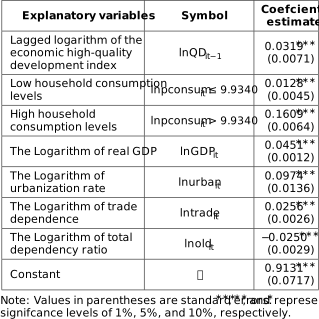
From Table 1, it is evident that a 1% increase in the lagged logarithm of the economic high-quality development index leads to a 0.0319% increase in the current index. This finding supports the appropriateness of using a dynamic model. Within the low household consumption level range (\(\ln\textit{pconsum}_{\textit{it}}\le 9.9340\)), a 1% increase in the industrial upgrading index resulted in a 0.0128% increase in the high-quality economic development index. By contrast, within the high household consumption level range (\(\ln\textit{pconsum}_{\textit{it}}>9.9340\)), a 1% increase in the industrial upgrading index results in a 0.1609% increase. This indicates that, as household consumption levels rise, the positive effect of industrial upgrading on high-quality economic development becomes more pronounced. Increasing household consumption enhances the positive impact of industrial upgrades on high-quality economic development, thereby validating Hypothesis 1.
Regarding the control variables, when the logarithm of the industrial upgrading index is the core explanatory variable, the results are as follows: a 1% increase in real GDP, which is a positive indicator, leads to a 0.0451% increase in the index of high-quality economic development; a 1% increase in the urbanization rate, another positive indicator, results in a 0.0974% increase in the index; a 1% increase in trade dependence, a positive indicator, leads to a 0.0256% increase; and a 1% increase in the total dependency ratio, a negative indicator, results in a 0.0250% decrease in the index.
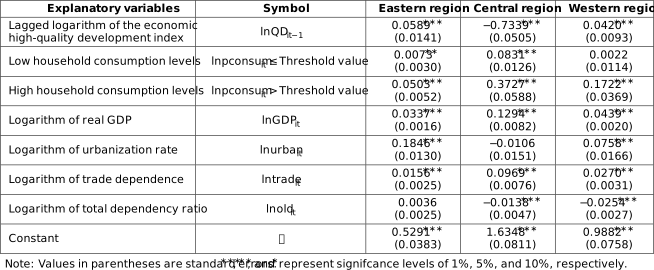
Table 2. Regression results of dynamic panel threshold model with logarithm of industrial upgrading index as core explanatory variable.
4.1.2. Regional Analysis
Before estimating the dynamic panel threshold model, we determined the threshold value. To address the endogeneity arising from dynamic panel bias, the logarithm of the household consumption level was selected as the threshold variable. The lagged logarithm of the industrial upgrade index was used as the GMM-type instrumental variable, whereas the lagged logarithm of the household consumption level was used as the standard instrumental variable for the difference equation. The two-step GMM method is then applied to the estimation. The estimation results show that the threshold value of household consumption level in the eastern region is 10.0982 (confidence interval: \([8.4269, 10.2343]\)), in the central region it is 9.7521 (confidence interval: \([8.0857, 9.7956]\)), and in the western region, it is 9.9348 (confidence interval: \([9.6240, 9.9348]\)). Consequently, the impact of industrial upgrading on high-quality economic development can be divided into two ranges—one for low and one for high household consumption levels—based on these threshold values.
Table 2 shows that the lagged high-quality economic development index significantly affects all regions, supporting the use of a dynamic model for analysis in this study. In both the low and high household consumption-level ranges, the industrial upgrading index in the central region had the most significant impact on high-quality economic development. As household consumption levels rise, the positive effect of industrial upgrading on economic development increases across all regions, with the central region experiencing the largest growth. This may be attributed to the national government policies that have supported regional development in the central region, including efforts to promote industrial upgrading and technological innovation. These efforts, combined with increasing consumption, have driven high-quality economic development. Additionally, they may serve a crucial role in regional cooperation by facilitating the flow of technology and capital between the eastern and western regions, thereby accelerating industrial structural upgrades.
4.1.3. Robustness Test
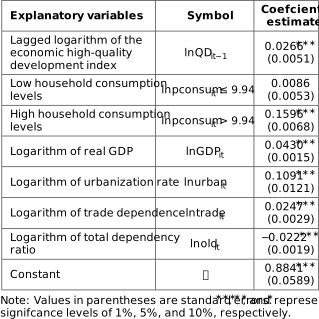
To ensure the reliability of the empirical results, we performed a robustness check by adjusting the sample period using panel data from 30 Chinese provinces from 2002 to 2021. To address the issue of endogeneity due to dynamic panel bias, the logarithm of the household consumption level was selected as the threshold variable, with the logarithm of the industrial upgrade index serving as the GMM-type instrumental variable and the lagged first-order logarithm of the household consumption level as the standard instrumental variable. A two-step GMM was applied for the estimation. The results indicate that the threshold value of the household consumption level is 9.9400, with a confidence interval of \([9.6216, 9.9511]\). Therefore, the effects of industrial upgrading on high-quality economic development can be divided into two categories: low household consumption (\(\ln \textit{pconsum}_{\textit{it}}\le 9.9400\)) and high household consumption (\(\ln \textit{pconsum}_{\textit{it}}>9.9400\)).
From Table 3, we observe that, in the low household consumption range (\(\ln\textit{pconsum}_{\textit{it}}\le 9.9400\)), a 1% increase in the industrial upgrading index leads to a 0.0086% increase in the high-quality economic development index. By contrast, in the high household consumption range (\(\ln\textit{pconsum}_{\textit{it}}>9.9400\)), the same 1% increase results in a 0.1596% increase. This demonstrates that, as household consumption increases, the positive effect of industrial upgrading on economic development becomes more pronounced. Increasing household consumption has strengthened the positive impact of industrial upgrades on high-quality economic development. These findings align with the results shown in Table 1, confirming the robustness of the conclusions drawn from Table 1.
Table 3. Robustness test results after adjusting sample period.
4.2. Threshold Analysis with Rationalization of Industrial Structure Index as Core Explanatory Variable
4.2.1. National-Level Analysis
In this section, we construct a dynamic panel threshold model to investigate the effect of industrial structure rationalization on high-quality economic development. Household consumption level is used as the threshold variable, while the rationalization of the industrial structure index serves as the core explanatory variable. The dynamic panel threshold model in Eq. \(\eqref{eq:2}\) used in this analysis is as follows:
Among them, \(t=2\), \(L\), \(T\); \(\textit{raion}_{\textit{it}}\) is the rationalization of industrial structure index and serves as the core explanatory variable. Following Gan et al. 26, this study measures the industrial upgrading index using the output ratio between the tertiary and secondary sectors. \(I(\cdot)\) is a dummy variable, \(\gamma_1\), \(\gamma_2,\) \(L\), \(\gamma_n\) are threshold values, \(\beta\) and \(\delta\) are the coefficients corresponding to the variables, \(z_i\) is a time-invariant variable, \(\lambda_t\) represents the time effect, \(u_i\) represents the individual effect, and \(\varepsilon_{\textit{it}}\) is a random error term. To avoid endogeneity issues due to omitted variables and obtain reliable estimation results, this study controls for the effects of several relevant variables, specifically real GDP \(\textit{GDP}_{\textit{it}}\) 22, urbanization rate \(\textit{urban}_{\textit{it}}\) 27, trade dependence \(\textit{trade}_{\textit{it}}\) 23, and the total dependency ratio \(\textit{old}_{\textit{it}}\) 28.
Table 4. Regression results of dynamic panel threshold model using the logarithm of industrial structure rationalization index as core explanatory variable.
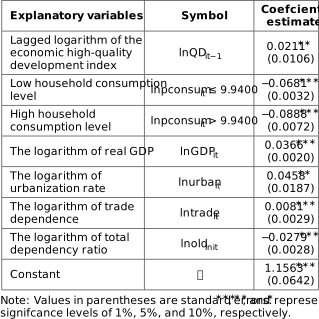
Before estimating the dynamic panel threshold model, a threshold value estimation was conducted to address the endogeneity issue stemming from dynamic panel bias. The logarithm of household consumption serves as the threshold variable, whereas the logarithm of the industrial structure rationalization index is used as the GMM-type instrumental variable. The lagged first-order logarithm of the household consumption level was selected as the standard instrumental variable, and the two-step GMM method was employed for the estimation. The results show that the threshold value for the logarithm of the household consumption level is 9.9400, with a confidence interval of \([8.8301, 9.9415]\). Therefore, the effect of industrial structure rationalization on high-quality economic development can be categorized into two ranges: low household consumption range (\(\ln\textit{pconsum}_{\textit{it}}\le 9.9400\)) and high household consumption range (\(\ln\textit{pconsum}_{\textit{it}}>9.9400\)).
Table 5. Regression results of dynamic panel threshold model with logarithm of industrial structure rationalization index as core explanatory variable.
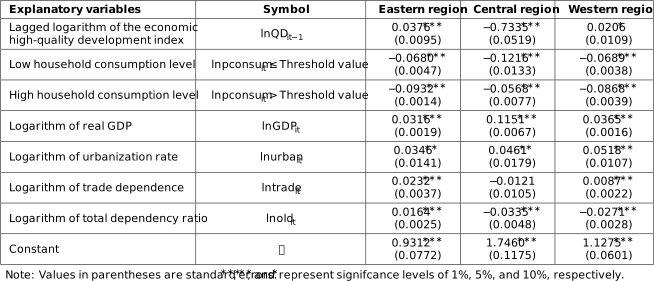
Table 4 shows that a 1% increase in the lagged high-quality economic development index results in a 0.0211% increase in the current index, justifying the use of the dynamic model. In the low household consumption range (\(\ln\textit{pconsum}_{\textit{it}}\le 9.9400\)), a 1% rise in the industrial structure rationalization index reduces the high-quality development index by 0.0681%. Similarly, in the high consumption range (\(\ln\textit{pconsum}_{\textit{it}}>9.9400\)), a 1% rise in the index decreases the high-quality development index by 0.0888%. This suggests that as household consumption grows, the negative impact of an irrational industrial structure on high-quality development intensifies, supporting Hypothesis 2.
For the control variables, when the industrial structure rationalization index is the main explanatory variable, the following effects are observed: a 1% increase in the actual GDP boosts the high-quality development index by 0.0366%, a 1% increase in the urbanization rate raises it by 0.0458%, a 1% increase in foreign trade dependency leads to a 0.0081% increase, and a 1% increase in the population dependency ratio lowers it by 0.0279%.
4.2.2. Regional Analysis
Before estimating the dynamic panel threshold model, threshold values were determined to address the endogeneity issue caused by dynamic panel bias. The logarithm of the household consumption level was selected as the threshold variable, with the lagged logarithm of the industrial structure rationalization index serving as the GMM-type instrumental variable for the difference equation. The lagged logarithm of the household consumption level was used as the standard instrumental variable. Using the two-step GMM method, the results show that the threshold value for household consumption in the eastern region is 9.9912 with a confidence interval of \([9.9242, 10.0236]\); in the central region, the threshold value is 9.7521 with a confidence interval of \([8.0857, 9.7956]\); and in the western region, the threshold value is 9.9348 with a confidence interval of \([8.8301, 9.9348]\). This categorization divides the effects of industrial structure rationalization on high-quality economic development into two ranges: below and above the household consumption threshold. Table 5 presents the regression results of the dynamic panel threshold model with the logarithm of the industrial upgrade index as the core explanatory variable.
Table 5 shows that the lagged high-quality economic development index significantly influences the current index across all regions, supporting the rationale for the dynamic model used in this analysis. In regions with lower household consumption levels, the central region experiences the strongest negative impact from the industrial structure rationalization index on high-quality economic development. Conversely, in regions with higher household consumption, the eastern region experiences the largest negative effect, while the central region has the smallest impact. As household consumption levels rise, the negative impact of an irrational industrial structure on high-quality economic development intensifies in both the eastern and western regions while diminishing in the central region. This suggests that increasing household consumption reinforces the adverse effects of structural imbalances in the eastern and western regions while mitigating their impact in the central region. The eastern region, having matured rapidly, may face industrial upgrading bottlenecks, whereas the west struggles with underdeveloped infrastructure and innovation capacity, lagging behind consumer demand. Additionally, homogeneous industry competition in the east and geographical limitations in the west may further exacerbate these issues, limiting the region’s ability to meet rising consumption needs effectively.
Table 6. Robustness test results after adjusting sample period.
4.2.3. Robustness Check
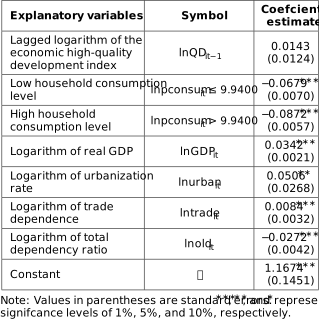
To ensure the reliability of the empirical findings, we conducted a robustness check by adjusting the sample period using panel data from 30 Chinese provinces (including autonomous regions and municipalities) from 2002 to 2021. To address the potential endogeneity arising from dynamic panel bias, we used the logarithm of household consumption as the threshold variable, the logarithm of the industrial structure rationalization index as a GMM-type instrumental variable for the difference equation, and the lagged first-order logarithm of household consumption as the standard instrumental variable. A two-step generalized method of moments (GMM) was applied for the estimation. The results indicate that the threshold value for household consumption is 9.9400, with a confidence interval of \([8.9460, 9.9511]\). Based on this threshold, the effect of industrial structure rationalization on high-quality economic development can be divided into two categories: low consumption (\(\ln\textit{pconsum}_{\textit{it}}\le 9.9400\)) and high consumption (\(\ln\textit{pconsum}_{\textit{it}}>9.9400\)).
Table 6 shows that in the low household consumption range (\(\ln\textit{pconsum}_{\textit{it}}\le 9.9400\)), a 1% increase in the industrial structure rationalization index leads to a 0.0679% decrease in the high-quality economic development index. In the high household consumption range (\(\ln\textit{pconsum}_{\textit{it}}>9.9400\)), a 1% increase in the industrial structure rationalization index resulted in a 0.0872% decrease in the high-quality economic development index. Thus, as household consumption continues to increase, the negative effect of an irrational industrial structure on high-quality economic development also increases. An irrational industrial structure reinforces negative effects on high-quality economic development by suppressing household consumption. These empirical findings are consistent with the results in Table 4, confirming the robustness of the results in Table 4.
5. Conclusions and Implications
This study uses provincial panel data from 2001 to 2021 to construct a dynamic panel threshold model using household consumption levels as the threshold variable to explore the impact of industrial structure upgrades on high-quality economic development. The analysis reveals that an increase in household consumption enhances the positive impact of industrial structure upgrades on high-quality economic development. This effect is particularly pronounced in the central region, where the positive impact of upgrading the industrial structure is the most significant. Furthermore, focusing on the industrial structure rationalization index, the results show that an increase in household consumption amplifies the negative effects of an irrational industrial structure on high-quality economic development. This negative effect was most pronounced in the eastern and western regions and was mitigated in the central region. Based on these findings, the following policy recommendations were made to promote industrial structure upgrades, expand domestic demand, and foster high-quality economic development.
-
(1)
Changing the concept of heavy production and light consumption: The domestic economy faces downward pressure from cyclical and structural factors. Currently, a major issue is insufficient overall demand. Consumption is a primary driver of economic growth, determining production and creating market value for goods and services. During periods of economic downturn, governments must use debt-financed spending or provide direct cash subsidies to households, especially low-income families, to boost domestic demand and support economic recovery.
-
(2)
Promoting the upgrading of the industrial structure according to local conditions: Traditional industries have reached growth bottlenecks. Accelerating the development of strategic emerging industries and establishing a modern industrial system are critical for overcoming technological challenges and gaining a competitive advantage. Each region has unique resource endowments and cultural contexts. To effectively upgrade the industrial structure, a thorough analysis of the local industrial landscape, market needs, and policy support is necessary. This approach helps identify the most suitable development directions and priority areas for local industries, thereby enabling the creation of targeted industrial upgrade plans.
-
(3)
Making every effort to promote high-quality economic development: At present, China’s economy is facing tighter constraints on resources and the environment, and the traditional development model is unsustainable. The economy is experiencing cyclical fluctuations and facing structural challenges. The promotion of high-quality economic development has become inevitable. Qualitative improvements and reasonable growth are fundamental for high-quality economic development. The focus should be on upgrading the industrial structure and building a modern industrial system that transitions from low to high technology and productivity. Each region should leverage its strengths and align with its industrial systems to drive effective upgrades.
-
(4)
This study uses provincial panel data to analyze the impact of industrial structure upgrading on high-quality economic development. Because the data below the provincial level is more refined, one of the future research directions is to use high spatial and temporal resolution data, such as prefecture-level city data or district-level data, and even satellite remote sensing data.
Acknowledgments
This project was supported by the National Social Science Foundation of China (21CTJ018) and the Key Project of Philosophy and Social Sciences in Jiangxi Province, China (25YJ02).
- [1] H. Chen and J. Zhao, “Digital finance, industrial structure optimization and high-quality economic development,” J. of Southwest Minzu University (Humanities and Social Science), Vol.43, No.5, pp. 94-108, 2022 (in Chinese).
- [2] K. Chen and G. Wang, “Urbanization, industrial structure upgrading and high-quality economic development—Test of mediation effect based on spatial Durbin model,” Systems Engineering-Theory and Practice, Vol.43, No.3, pp. 648-666, 2023 (in Chinese). https://doi.org/10.12011/SETP2022-1329
- [3] G. Li and X. Li, “Environmental regulation, upgrading of industrial structure and high-quality economic development: A case study of Beijing-Tianjin-Hebei,” Statistics and Decision, Vol.38, No.18, pp. 26-31, 2022 (in Chinese). https://doi.org/10.13546/j.cnki.tjyjc.2022.18.005
- [4] L. Wu, “An empirical study on the promotion of high-quality development of regional economy by the optimization of industrial structure enabled by digitalization,” Guizhou Social Sciences, Vol.391, No.7, pp. 125-132, 2022 (in Chinese). https://doi.org/10.13713/j.cnki.cssci.2022.07.013
- [5] K. Liu, “Industrial structure upgrading, narrowing the urban-rural consumption gap, and high-quality regional development,” Price: Theory and Practice, No.2, pp. 155-159, 2025 (in Chinese). https://doi.org/10.19851/j.cnki.CN11-1010/F.2025.02.110
- [6] C. Clark, “The Conditions of economic progress,” The Economic J., No.51, No.201, pp. 120-124, 1941.
- [7] M. Yang, “The VAR model analysis on the relationship of consumption structure, industrial structure and economic growth – An empirical study of Hubei province,” Statistics and Information Forum, Vol.24, No.4, pp. 32-35+52, 2009 (in Chinese).
- [8] H. Zhou, “Consumption structure, industrial structure and economic growth: An empirical study based on Shanghai,” J. of Zhongnan University of Economics and Law, No.2, pp. 27-31, 2012 (in Chinese).
- [9] M. I. H. Lee, M. M. H. Syed and M. L. Xueyan, “China’s path to consumer-based growth: Reorienting investment and enhancing efficiency,” Int. Monetary Fund, 2013.
- [10] C. Zhang and Z. Zhang, “Research on the spatial effect consumption structure on industrial structure and economic growth: Based on spatial panel model,” Statistics and Information Forum, Vol.31, No.8, pp. 46-52, 2016 (in Chinese).
- [11] J. Wu, “Household consumption structure, industrial structure and economic growth,” Inquiry into Economic Issues, No.12, pp. 18-22+180, 2017 (in Chinese).
- [12] T. Yang and M. Chen, “The driving effect of consumption upgrading on industry to the middle and high end: Theoretical logic and empirical evidence,” Economist, No.11, pp. 48-54, 2018 (in Chinese). https://doi.org/10.16158/j.cnki.51-1312/f.2018.11.007
- [13] H. Liao and L. Zhang, “New consumption promotes the transformation and upgrading of industrial structure,” People’s Tribune, No.26, pp. 86-87, 2019 (in Chinese).
- [14] D. Zhang, X. Ma, J. Zhang, and Q. Deng, “Can consumption drive industrial upgrades? Evidence from Chinese household and firm matching data,” Emerging Markets Finance and Trade, Vol.56, No.1, pp. 409-426, 2020. https://doi.org/10.1080/1540496X.2019.1610878
- [15] J. Dong and M. Zhang, “The impact of residents’ consumption level and public service on industrial structure upgrading,” Statistics and Decision, Vol.37, No.16, pp. 106-109, 2021 (in Chinese). https://doi.org/10.13546/j.cnki.tjyjc.2021.16.023
- [16] W. Sun, S. Liang, and W. Pan, “Consumption-induced innovation and industrial upgrading: Mathematical analysis and machine learning validation,” Economic Review, No.4, pp. 3-20, 2025 (in Chinese). https://doi.org/10.19361/j.e.r.2025.04.01
- [17] C. Chen and W. Wu, “Consumption structure upgrading and high-quality economic development: Driving mechanism and empirical test,” Shanghai J. of Economics, No.6, pp. 59-71, 2019 (in Chinese). https://doi.org/10.19626/j.cnki.cn31-1163/f.2019.06.005
- [18] H. Chen, S. Zhuang and M. Zhou, “Shift in consumer demand, entrepreneurship and high-quality economic development,” J. of Capital University of Economics and Business, Vol.22, No.6, pp. 3-16, 2022 (in Chinese). https://doi.org/10.13504/j.cnki.issn1008-2700.2020.06.001
- [19] J. Liu and X. Zhong, “The impact of healthiness consumption on high-quality economic development from the perspective of aging,” Statistics and Decision, Vol.37, No.5, pp. 65-70, 2021 (in Chinese). https://doi.org/10.13546/j.cnki.tjyjc.2021.05.013
- [20] Z. Wang and J. Chen, “Consumption structure upgrading and high-quality economic development – The threshold characteristics of effective market and promising government,” Fiscal Science, Vol.68, No.8, pp. 48-63+114, 2021 (in Chinese). https://doi.org/10.19477/j.cnki.10-1368/f.2021.08.005
- [21] X. Li and Q. Wu, “Digital economy, consumption expansion and high-quality economic development,” Statistics and Decision, Vol.40, No.16, pp. 5-9, 2021 (in Chinese). https://doi.org/10.13546/j.cnki.tjyjc.2024.16.001
- [22] Y. Wang, “Industrial transformation and upgrading, resident consumption structure and high-quality development,” J. of Nanchang University (Humanities and Social Sciences), Vol.54, No.3, pp. 47-58, 2023 (in Chinese). https://doi.org/10.13764/j.cnki.ncds.2023.03.007
- [23] Y. Wang, “Industrial transformation and upgrading, consumption gap between urban and rural residents and high-quality development,” Statistics and Decision, Vol.39, No.13, pp. 117-120, 2023 (in Chinese). https://doi.org/10.13546/j.cnki.tjyjc.2023.13.021
- [24] C. Nie and X. Jian, “Measurement of China’s high-quality development and analysis of provinces status,” J. of Quantitative and Technological Economics, Vol.37, No.2, pp. 26-47, 2020 (in Chinese). https://doi.org/10.13653/j.cnki.jqte.2020.02.002
- [25] X. Wang, L. Hu, and G. Fan, “Marketization index of China’s provinces: Neri report 2021,” Social Sciences Academic Press (China), 2022 (in Chinese).
- [26] C. Gan, R. Zheng, and D. Yu, “An empirical study on the effects of industrial structure on economic growth and fluctuations in China,” Economic Research J., Vol.46, No.5, pp. 4-16+31, 2021 (in Chinese).
- [27] C. Liu, “Population aging and high-quality development of manufacturing industry: Mechanism analysis and empirical test,” J. of Nanchang University (Humanities and Social Sciences), Vol.54, No.2, pp. 55-67, 2023 (in Chinese). https://doi.org/10.13764/j.cnki.ncds.20230404.001
- [28] Y. Wang, “Population aging and consumption rate of urban households: An empirical analysis based on dynamic stochastic general equilibrium model,” Contemporary Finance and Economics, No.3, pp. 16-25, 2020 (in Chinese). https://doi.org/10.13676/j.cnki.cn36-1030/f.2020.03.003
This article is published under a Creative Commons Attribution-NoDerivatives 4.0 Internationa License.