
Research Paper:
Panoramic Information Perception of Insulation Arm in Distribution Network Operation Based on AI and Improved Tunicate Swarm Algorithm
Yuchao Wan, Pengpeng Wang, Guiyue Jin, Zhiwei Xue, Chunxian Teng, and Bing Li†
Dezhou Power Supply Company, State Grid Shandong Electric Power Company
No.1237, Xinhu Street, Decheng District, Dezhou, Shandong 253000, China
†Corresponding author

To address the issue of insufficient panoramic information perception capability of insulation arms in large-scale distribution network operations, a method based on AI and an improved tunicate swarm algorithm is proposed for panoramic information perception of distribution network operation insulation arms. AR equipment and panoramic cameras are employed to monitor panoramic information during distribution network operations. Fusion terminals are used to integrate the multi-source and heterogeneous data collected by the panoramic cameras and AR devices. By introducing a Poisson reconstruction mechanism, the fused monitoring information is converted into continuous point cloud surfaces, and a panoramic environmental spatial database is constructed. An AI-based image ICP registration algorithm is utilized to accomplish 3D point cloud panoramic imaging modeling of the insulation arm in distribution network operation. The particle swarm optimization algorithm is incorporated to enhance the tunicate swarm algorithm for optimizing the modeled point cloud, thereby achieving panoramic information perception for insulation arms in distribution network operations. Experimental results demonstrate that the curvature error of this method for spatial data labeling of power equipment, insulation arms, and obstacles is below the required threshold. The similarity between objects in the constructed 3D point cloud model of the distribution network operation insulation arm and the actual scene exceeds 90%, and the RE value for panoramic perception is high, indicating significantly improved perception accuracy.
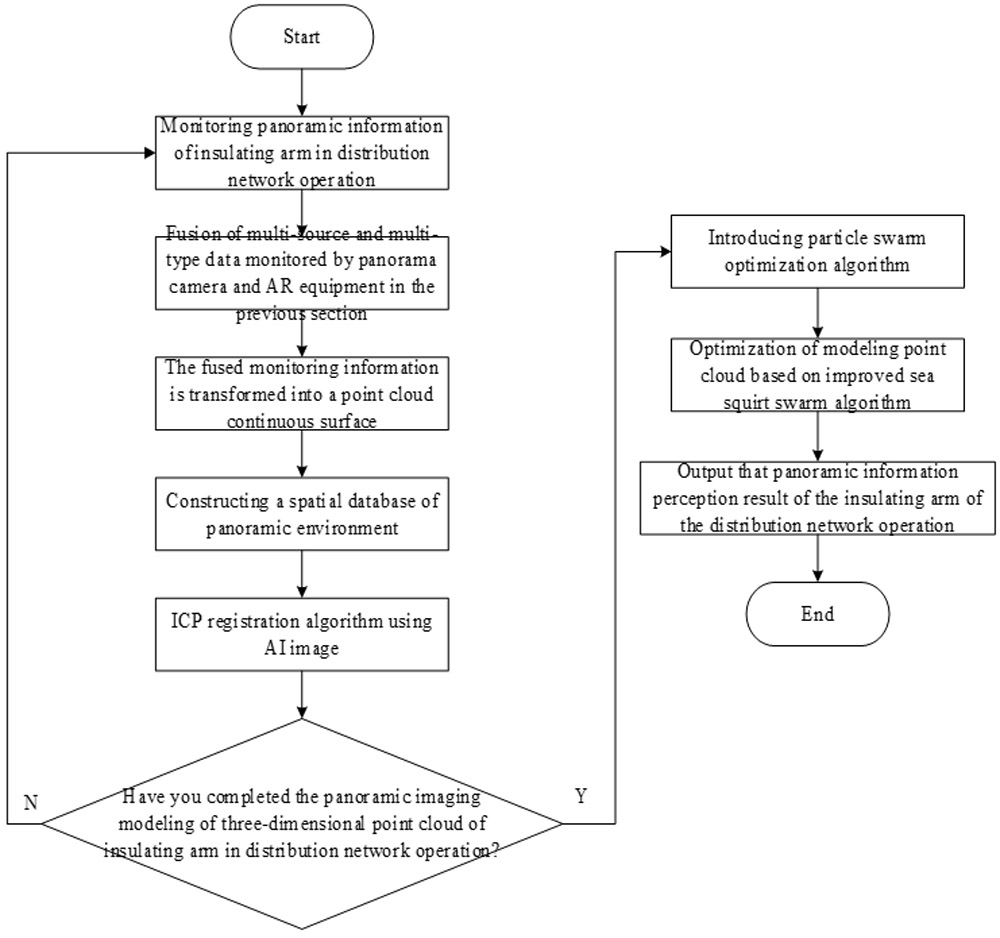
AI-enhanced insulated arm perception flowchart
- [1] X. Yue, H. Wang, L. Wang et al., “Development of insulation coating robot for distribution network lines maintenance,” Springer, Vol.16, No.3, pp. 2163-2174, 2022. https://doi.org/10.1007/978-981-16-7381-8_135
- [2] J. Z. Huang, L. Duan, and Y. X. Wei, “Cross-region cooperative panoramic monitoring technology of distribution network one and two fusion based on internet of things,” Techniques of Automation and Applications, Vol.43, No.2, pp. 94-97, 2024.
- [3] H. Y. Li, J. Shi, and J. C. Song, “Panoramic perception of transformer vibration state driven by digital twin,” High Voltage Engineering, Vol.51, No.1, pp. 40-49, 2025.
- [4] Q. Tu, J. Li, D. L. Fan et al., “Automatic target recognition of substation 3D scene for digital twin,” J. of System Simulation, Vol.35, No.12, pp. 2594-2601, 2023.
- [5] P. Wang, J. Y. Lin, X. Ning et al., “Architecture of power distribution network measurement system,” High Voltage Engineering, Vol.47, No.7, pp. 2293-2300, 2021.
- [6] F. Chavez, C. T. Tung, and C. S. Khandelwal, “Deep learning-based I-V global parameter extraction for BSIM-CMG,” Solid-State Electronics, Vol.209, No.11, Article No.108766, 2023. https://doi.org/10.1016/j.sse.2023.108766
- [7] M. M. H. Sifat, S. K. Das, and S. M. Choudhury, “Design, development, and optimization of a conceptual framework of digital twin electric grid using systems engineering approach,” Electric Power Systems Research, Vol.226, No.1, Article No.109958, 2024. https://doi.org/10.1016/j.epsr.2023.109958
- [8] D. B. Rosch, N. Thomas, and B. P. Steffen, “Delay modeling for virtualization-based co-simulation of IEC 61850 substations,” J. of Cleaner Production, Vol.368, Article No.133179, 2022. https://doi.org/10.1016/j.jclepro.2022.133179
- [9] T. S. L. V. Ayyarao and P. P. Kumar, “Parameter estimation of solar PV models with a new proposed war strategy optimization algorithm,” Int. J. of Energy Research, Vol.46, No.6, pp. 7215-7238, 2022. https://doi.org/10.1002/er.7629
- [10] A. Baouya, S. Chehida, S. Ouchani et al., “Generation and verification of learned stochastic automata using k-NN and statistical model checking,” Applied Intelligence, Vol.52, No.8, pp. 8874-8894, 2022. https://doi.org/10.1007/s10489-021-02884-4
- [11] A. Kheireddine, E. Renault, and S. Baarir, “Towards better heuristics for solving bounded model checking problems,” Constraints, Vol.28, No.1, pp. 45-66, 2023. https://doi.org/10.1007/s10601-022-09339-8
- [12] L. Bozzelli, A. Molinari, and P. P. Sala, “Satisfiability and model checking for the logic of sub-intervals under the homogeneity assumption,” Logical Methods in Computer Science, Vol.18, No.1, pp. 1-25, 2022. https://doi.org/10.46298/lmcs-18(1:24)2022
- [13] C. E. Campbell, “Zonal reconstruction of surfaces from gradient fields,” Optical Engineering, Vol.61, No.12, Article No.121802, 2022. https://doi.org/10.1117/1.OE.61.12.121802
- [14] H. Ebadi, A. Cammi, E. Gajetti et al., “Development, verification and experimental validation of a 3D numerical model for tubular solar receivers equipped with Raschig ring porous inserts,” Solar Energy, Vol.267, No.1, Article No.112236, 2024. https://doi.org/10.1016/j.solener.2023.112236
- [15] M. V. Yaroslavtsev and E. A. Spiridonov, “Simulation model of an electric-traction network,” Russian Electrical Engineering, Vol.93, No.5, pp. 331-335, 2022. https://doi.org/10.3103/S1068371222050145
- [16] F. Javadnejad, R. K. Slocum, D. T. Gillins et al., “Dense point cloud quality factor as proxy for accuracy assessment of image-based 3D reconstruction,” J. of Surveying Engineering, Vol.147, No.1, Article No.04020021, 2021. https://doi.org/10.1061/(ASCE)SU.1943-5428.0000333
- [17] M. R. Ben and S. Hajji, “Parameter extraction and mathematical modelling of the DMFC using Salp Swarm Algorithm,” Polymer Bulletin, Vol.80, No.5, pp. 4891-4908, 2022. https://doi.org/10.1007/s00289-022-04293-0
- [18] K. Matsuzaki and S. Komorita, “Efficient deep super-resolution of voxelized point cloud in geometry compression,” IEEE Sensors J., Vol.23, No.2, pp. 1328-1342, 2023. https://doi.org/10.1109/JSEN.2022.3225170
- [19] A. A. Poltavtsev, “Reactive and proactive methods for database protection against logical inference attacks,” Automatic Control and Computer Sciences, Vol.56, No.8, pp. 888-897, 2023. https://doi.org/10.3103/S014641162208017X
- [20] K. S. Saraswathy and S. S. Sujatha, “Using attribute-based access control, efficient data access in the cloud with authorized search,” Int. J. of Electrical and Computer Engineering Systems, Vol.13, No.7, pp. 569-575, 2022. https://doi.org/10.32985/ijeces.13.7.9
- [21] S. B. Zhang, Y. C. Yao, and F. Zhan, “Key technologies of cluster based distributed real-time database for power dispatching and control system,” Electrical Engineering, Vol.24, No.1, pp. 91-95, 2023.
- [22] T. K. Fayez, L. Elbieta, S. Jie et al., “Three-dimensional modeling and visualization of single tree LiDAR point cloud using matrixial form,” IEEE J. of Selected Topics in Applied Earth Observations and Remote Sensing, Vol.17, pp. 3010-3022, 2024. https://doi.org/10.1109/JSTARS.2024.3349549
- [23] Y. Liu, H. Jiang, G. Nader et al., “Local topology constrained point cloud registration in building information modeling,” IEEE Sensors J., Vol.24, No.3, pp. 4036-4046, 2024. https://doi.org/10.1109/JSEN.2023.3341218
- [24] W. Peitao, Z. Bo, and H. Daowuerjiang, “Modeling of the three-dimensional point cloud based on the binocular stereovision and structure identification,” J. of Testing and Evaluation: A Multidisciplinary Forum for Applied Sciences and Engineering, Vol.51, No.4, pp. 2535-2552, 2023. https://doi.org/10.1520/JTE20220383
- [25] C. Chen, Y. S. Wang, H. H. Chen et al., “GeoSegNet: point cloud semantic segmentation via geometric encoder-decoder modeling,” The Visual Computer, Vol.40, No.8, pp. 5107-5121, 2024. https://doi.org/10.1007/s00371-023-02853-7
- [26] Y. J. Shi and G. D. Xiao, “Simulation analysis of scene restoration of damaged ancient building in virtual reality environment,” Computer Simulation, Vol.9, No.360, pp. 173-176, 2024.
This article is published under a Creative Commons Attribution-NoDerivatives 4.0 Internationa License.