
Research Paper:
An Early-Warning Educational System with Small Samples and Across Academic Year Based on Combination of Transformer and XGBoost
Xiangfeng Tan
 , Jinhua She†
, Shumei Chen
, Sumio Ohno
, and Hiroyuki Kameda
, Jinhua She†
, Shumei Chen
, Sumio Ohno
, and Hiroyuki Kameda
Graduate School of Engineering, Tokyo University of Technology
1404-1 Katakuramachi, Hachioji, Tokyo 192-0982, Japan
†Corresponding author

Japan’s declining birthrate has been leading to an increasing distribution of academic abilities among university students. To ensure the successful completion of studies, it is crucial to identify students at-risk of academic failure at an early stage and provide them with the necessary support. In conventional teaching systems, this task is highly dependent on teaching experience. Recently developed early-warning systems (EWSs), which are based on the data mining of learning management systems, are built in post-hoc models and lack sufficient generalizability to new academic years. In this study, we present an EWS that combines data augmentation with a transfer learning-enhanced classification model. Through the use of multiple sub-modules, we construct a deep-learning classification model that enhances the generalizability of the EWS. A comparison between a conventional predictive classification model and the presented model shows that our model achieved the optimal overall performance. The stability of this fine-tuned model is verified by the hold-out method. Our EWS is purposefully addressed for difficulties in real-world teaching environments (that is, year-to-year sample domain shifts and small sample sizes); thus, it is robustly adaptable to diverse teaching environments. Teachers can use the recommendations made by the EWS to implement next steps in academic interventions, improve learning strategies, and help students succeed in their studies. All data collection uses non-identifiable information and protects privacy.
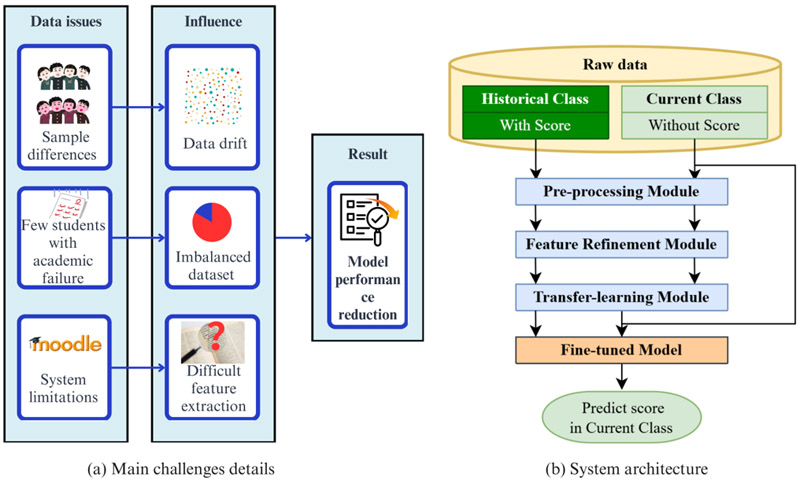
An early-warning educational system design
- [1] Statistics Bureau of Japan, “Population estimates.” https://www.stat.go.jp/english/data/jinsui/index.html [Accessed September 24, 2025]
- [2] Ministry of Education, Culture, Sports, Science and Technology (MEXT), “New entrants.” https://www.mext.go.jp/b_menu/houdou/2020/1414952_00007.htm [Accessed September 24, 2025]
- [3] Ministry of Education, Culture, Sports, Science and Technology (MEXT), “School basic survey,” (in Japanese). https://www.e-stat.go.jp/stat-search/files?page=1&toukei=00400001&tstat=000001011528&cycle=0&cycle_facet=cycle&metadata=1&data=1 [Accessed September 24, 2025]
- [4] Ministry of Education, Culture, Sports, Science and Technology (MEXT), “Admissions rate,” (in Japanese). https://www.e-stat.go.jp/stat-search/files?page=1&layout=datalist&toukei=00400001&tstat=000001011528&cycle=0&tclass1=000001021812&stat_infid=000031852304&tclass2val=0 [Accessed September 24, 2025]
- [5] T. Ui, “The problem of declining academic ability among university students and possible solutions,” Communications of the Operations Research Society of Japan, Vol.54, No.5, pp. 243-248, 2009 (in Japanese).
- [6] S. Yamamoto, “The reality that 10% of each cohort drops out of university before graduation; Efforts are needed to prevent this, an expert points out,” (in Japanese). https://www.asahi.com/edua/article/14928001 [Accessed September 24, 2025]
- [7] Ministry of Education, Culture, Sports, Science and Technology (MEXT), “Student support,” (in Japanese). https://www.mext.go.jp/a_menu/koutou/gakuseishien/1269672.htm [Accessed September 24, 2025]
- [8] P. Black and D. Wiliam, “Assessment and classroom learning,” Assessment in Education: Principles, Policy & Practice, Vol.5, No.1, pp. 7-74, 1998. https://doi.org/10.1080/0969595980050102
- [9] N. Safer and S. Fleischman, “Research matters: How student progress monitoring improves instruction,” Educational Leadership, Vol.62, No.5, pp. 81-83, 2005.
- [10] V.-A. Romero-Zaldivar, A. Pardo, D. Burgos, and C. Delgado-Kloos, “Monitoring student progress using virtual appliances: A case study,” Computers & Education, Vol.58, No.4, pp. 1058-1067, 2012. https://doi.org/10.1016/j.compedu.2011.12.003
- [11] K. J. Cotton, “Monitoring student learning in the classroom: School improvement research series close-up #4,” Assessment and Evaluation Program of Northwest Regional Educational Laboratory, 1988.
- [12] K. E. Arnold and M. D. Pistilli, “Course signals at Purdue: Using learning analytics to increase student success,” Proc. of the 2nd Int. Conf. on Learning Analytics and Knowledge, pp. 267-270, 2012. https://doi.org/10.1145/2330601.2330666
- [13] R. Villano, S. Harrison, G. Lynch, and G. Chen, “Linking early alert systems and student retention: A survival analysis approach,” Higher Education, Vol.76, No.5, pp. 903-920, 2018. https://doi.org/10.1007/s10734-018-0249-y
- [14] R. Rumberger, H. Addis, E. Allensworth, R. Balfanz, J. Bruch, E. Dillon, D. Duardo, M. Dynarski, J. Furgeson, M. Jayanthi, R. Newman-Gonchar, K. Place, and C. Tuttle, “Preventing dropout in secondary schools (NCEE 2017-4028),” Washington, DC: National Center for Education Evaluation and Regional Assistance (NCEE), Institute of Education Sciences, U.S. Department of Education. https://whatworks.ed.gov, 2017. https://ies.ed.gov/ncee/wwc/Docs/PracticeGuide/wwc_dropout_092617.pdf [Accessed September 24, 2025]
- [15] T. Netsu, “Reconsideration of subjectivity in evaluation of education: Based on the discussions of researchers,” Bulletin of Faculty of Education and Integrated Arts and Sciences, Waseda University, Vol.71, pp. 13-23, 2023 (in Japanese).
- [16] L. Mai, A. Köchling, and M. C. Wehner, “‘This student needs to stay back’: To what degree would instructors rely on the recommendation of learning analytics?,” SN Computer Science, Vol.3, No.4, Article No.259, 2022. https://doi.org/10.1007/s42979-022-01137-6
- [17] L. P. Macfadyen and S. Dawson, “Mining LMS data to develop an ‘early warning system’ for educators: A proof of concept,” Computers & Education, Vol.54, No.2, pp. 588-599, 2010. https://doi.org/10.1016/j.compedu.2009.09.008
- [18] G. Akçapınar, A. Altun, and P. Aşkar, “Using learning analytics to develop early-warning system for at-risk students,” Int. J. of Educational Technology in Higher Education, Vol.16, No.1, Article No.40, 2019. https://doi.org/10.1186/s41239-019-0172-z
- [19] T.-T. Goh, “Learning management system log analytics: The role of persistence and consistency of engagement behaviour on academic success,” J. of Computers in Education, 2025. https://doi.org/10.1007/s40692-025-00358-x
- [20] V. Paajanen, “LMS log activity as a predictor of learning success on an undergraduate flipped classroom course of cellular biology,” CEUR Workshop Proc., Vol.3383, 2022. https://ceur-ws.org/Vol-3383/FLAIEC22_paper_3090.pdf [Accessed September 24, 2025]
- [21] X. Tan, S. Chen, S. Ohno, H. Kameda, and J. She, “Establishing an early warning system using machine learning algorithms to identify students at high risk of academic failure in online education,” ISCIIA&ITCA 2024, 2024.
This article is published under a Creative Commons Attribution-NoDerivatives 4.0 Internationa License.