
Research Paper:
Tobacco Mildew Detection Based on Semi-Supervised Semantic Segmentation Techniques
Tianran Xu*
 , Rui Wang*
, Qinglin Han*
, Bin Zhang*
, Qian Zhao*
, Qian Li**
, Jiandong Du**
, and Xiangyang Xu**,†
, Rui Wang*
, Qinglin Han*
, Bin Zhang*
, Qian Zhao*
, Qian Li**
, Jiandong Du**
, and Xiangyang Xu**,†
*China Tobacco Shandong Industrial Co., Ltd.
Tengzhou, Shandong 277599, China
**School of Automation, Beijing Institute of Technology
No.5 Zhongguancun South Street, Haidian District, Beijing 100081, China
†Corresponding author

Tobacco mildew detection is a crucial aspect of the tobacco industry in China. Detection techniques based on semi-supervised semantic segmentation have attracted significant attention due to their low cost and high efficiency. Therefore, this study designed a semi-supervised segmentation model tailored for complex tobacco mildew detection scenarios, and conducted research from both the semi-supervised strategy and model perspectives. In terms of the semi-supervised strategy design, this study employed the standard teacher–student framework, focusing on data perturbation to achieve satisfactory results without introducing additional complexity and cost. First, the CutMix technique was improved to ensure high accuracy in predicting weakly perturbed images and to implement strong perturbation strategies more effectively. Second, a simple feature perturbation method was proposed as a supplement to image perturbation to further explore the perturbation space. In terms of the segmentation model design, this study enhanced the widely used DeepLabV3+ in the semi-supervised domain. To address the issue of losing fine structural information, the down-sampling convolution in the encoder was replaced with dilated convolution, and a multi-scale decoder was introduced to fully utilize the multi-stage features of the encoder, ensuring a comprehensive understanding of the images. Extensive experiments conducted on a self-made dataset demonstrated the effectiveness and superiority of this method in tobacco mildew detection.
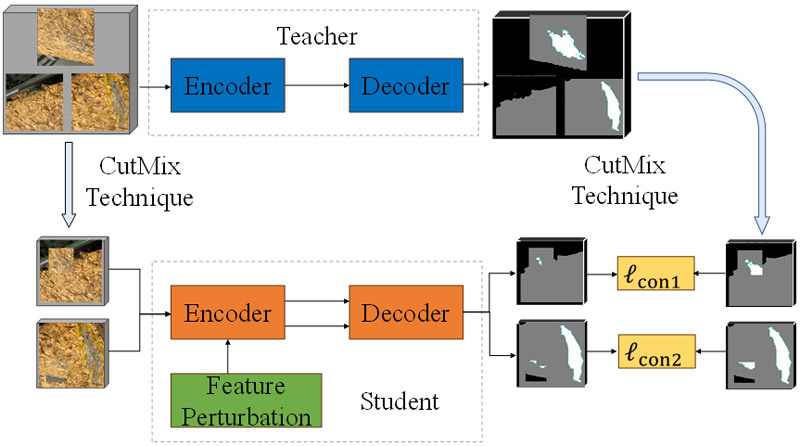
Semi-supervised semantic segmentation model for tobacco mildew detection
- [1] G. Yang, “Exploring mildew in stored tobacco leaves and its biological control measures,” Nong Min Zhi Fu Zhi You, Vol.16, No.1, 2020 (in Chinese).
- [2] “Tobacco and tobacco products. Molding control guide,” State Tobacco Monopoly Administration, YC/T 475-2013, 2013 (in Chinese).
- [3] L. Yang, “Effect of environmental factors on quality of tobacco leaves and prediction method of mildew,” Ph.D. thesis, Kunming University of Science and Technology, 2016 (in Chinese).
- [4] Yunnan Tobacco Science Research Institute, “Tobacco microbiology (Advanced),” Science Press, 2008 (in Chinese).
- [5] W. Su, Y. Wu, M. Cheng et al., “Visual detection system for cutting mildew and sundries of tobacco bag slicer,” Development & Innovation of Machinery & Electrical Products, Vol.35, No.2, pp. 71-74, 2022 (in Chinese). https://doi.org/10.3969/j.issn.1002-6673.2022.02.021
- [6] P. Zhou, S. Zhang, Z. Zhang et al., “Design of online tobacco leaf mildew detection model based on vision and BP neural network,” Scientific and Technological Innovation, Vol.2022, No.02, pp. 13-16, 2022 (in Chinese).
- [7] Y. Lai, Y. Lin, H. Tao, and Y. Wang, “Rapid identification of tobacco mildew based on near infrared spectroscopy and random forest algorithm,” Acta Tabacaria Sinica, Vol.26, No.2, pp. 36-43, 2020 (in Chinese). https://doi.org/10.16472/j.chinatobacco.2019.173
- [8] J. Zhang, W. Liu, and Y. Hou, “Automatic discriminate the classes of tobacco leaves based on near-infrared spectroscopy and sparse representation classification algorithm,” Spectroscopy and Spectral Analysis, Vol.38, No.S1, pp. 23-24, 2018 (in Chinese).
- [9] J. Li, “Automatic identification research of tobacco diseases based on convolutional neural network,” Master’s thesis, Shandong Agricultural University, 2016 (in Chinese).
- [10] W.-C. Hung, Y.-H. Tsai, Y.-T. Liou et al., “Adversarial learning for semi-supervised semantic segmentation,” arXiv preprint, arXiv:1802.07934, 2018. https://doi.org/10.48550/arXiv.1802.07934
- [11] T. Karras, S. Laine, M. Aittala et al., “Analyzing and improving the image quality of StyleGAN,” 2020 IEEE/CVF Conf. on Computer Vision and Pattern Recognition (CVPR), pp. 8107-8116, 2020. https://doi.org/10.1109/CVPR42600.2020.00813
- [12] D. Li, J. Yang, K. Kreis, A. Torralba, and S. Fidler, “Semantic segmentation with generative models: Semi-supervised learning and strong out-of-domain generalization,” 2021 IEEE/CVF Conf. on Computer Vision and Pattern Recognition (CVPR), pp. 8296-8307, 2021. https://doi.org/10.1109/CVPR46437.2021.00820
- [13] J. Zhang and H. Liu, “Health big data classification based on collaborative training optimization algorithm,” J. Adv. Comput. Intell. Intell. Inform, Vol.28, No.6, pp. 1313-1323, 2024. https://doi.org/10.20965/jaciii.2024.p1313
- [14] N. Souly, C. Spampinato, and M. Shah, “Semi supervised semantic segmentation using generative adversarial network,” Proc. of the IEEE Int. Conf. on Computer Vision, pp. 5689-5697, 2017. https://doi.org/10.1109/ICCV.2017.606
- [15] J. E. Van Engelen and H. H. Hoos, “A survey on semi-supervised learning,” Machine Learning, Vol.109, pp. 373-440, 2020. https://doi.org/10.1007/s10994-019-05855-6
- [16] B. Chen, H. Zhang, Y. Chen, Y. Li, and J. Xiong, “Semantic segmentation method of hydraulic structure crack based on feature enhancement,” J. of Tsinghua University (Science and Technology), Vol.63, No.7, pp. 1135-1143, 2023 (in Chinese). https://doi.org/10.16511/j.cnki.qhdxxb.2023.26.009
- [17] Y. Li, Y. Ma, W. Cai, Z. Xie, and T. Zhao, “Complementary convolution residual networks for semantic segmentation in street scenes with deep Gaussian CRF,” J. Adv. Comput. Intell. Intell. Inform., Vol.25, No.1, pp. 3-12, 2021. https://doi.org/10.20965/jaciii.2021.p0003
- [18] J. Rogelio, E. Dadios, R. Vicerra, and A. Bandala, “Object detection and segmentation using Deeplabv3 deep neural network for a portable X-Ray source model,” J. Adv. Comput. Intell. Intell. Inform., Vol.26, No.5, pp. 842-850, 2022. https://doi.org/10.20965/jaciii.2022.p0842
- [19] S. Huang, T. Bao, Y. Li, and H. Niu, “Semantic segmentation method of hydraulic concrete cracks based on improved Deeplab V3+ network,” Advances in Science and Technology of Water Resources, Vol.43, No.1, pp. 81-86, 2023 (in Chinese). https://doi.org/10.3880/j.issn.1006-7647.2023.01.012
- [20] X. Liu, Y. Chen, Y. Wang, and S. Liu, “Research on tunnel lining crack identification algorithm based on cascade neural network,” J. of the China Railway Society, Vol.43, No.288(10), pp. 127-135, 2021 (in Chinese).
- [21] F. Liu, J. Wang, Z. Chen, and F. Xu, “Parallel attention based UNet for crack detection,” J. of Computer Research and Development, Vol.58, No.8, pp. 1718-1726, 2021 (in Chinese). https://doi.org/10.7544/issn1000-1239.2021.20210335
- [22] P. Wang, L. Li, F. Pan, and L. Wang, “Lightweight bilateral network for real-time semantic segmentation,” J. Adv. Comput. Intell. Intell. Inform., Vol.27, No.4, pp. 673-682, 2023. https://doi.org/10.20965/jaciii.2023.p0673
- [23] X. Su, L. Li, J. Xiao, and P. Wang, “Research on efficient asymmetric attention module for real-time semantic segmentation networks in urban scenes,” J. Adv. Comput. Intell. Intell. Inform., Vol.28, No.3, pp. 562-572, 2024. https://doi.org/10.20965/jaciii.2024.p0562
- [24] L. Yang, W. Zhuo, L. Qi, Y. Shi, and Y. Gao, “ST++: Make self-training work better for semi-supervised semantic segmentation,” 2022 IEEE/CVF Conf. on Computer Vision and Pattern Recognition (CVPR), pp. 4258-4267, 2022. https://doi.org/10.1109/CVPR52688.2022.00423
- [25] Z. Feng, Q. Zhou, Q. Gu, X. Tan, G. Cheng, X. Lu, J. Shi, and L. Ma, “DMT: Dynamic mutual training for semi-supervised learning,” Pattern Recognition, Vol.130, Article No.108777, 2022. https://doi.org/10.1016/j.patcog.2022.108777
- [26] Y. Zhou, R. Jiao, D. Wang et al., “Catastrophic forgetting problem in semi-supervised semantic segmentation,” IEEE Access, Vol.10, pp. 48855-48864, 2022. https://doi.org/10.1109/ACCESS.2022.3172664
- [27] V. Olsson, W. Tranheden, J. Pinto, and L. Svensson, “ClassMix: Segmentation-based data augmentation for semi-supervised learning,” 2021 IEEE Winter Conf. on Applications of Computer Vision (WACV), pp. 1368-1377, 2021. https://doi.org/10.1109/WACV48630.2021.00141
- [28] T. DeVries and G. W. Taylor, “Improved regularization of convolutional neural networks with Cutout,” arXiv preprint, arXiv:1708.04552, 2017. https://doi.org/10.48550/arXiv.1708.04552
- [29] S. Yun, D. Han, S. Chun, S. J. Oh, Y. Yoo, and J. Choe, “CutMix: Regularization strategy to train strong classifiers with localizable features,” 2019 IEEE/CVF Int. Conf. on Computer Vision (ICCV), pp. 6022-6031, 2019. https://doi.org/10.1109/ICCV.2019.00612
- [30] Y. Chen, X. Ouyang, K. Zhu, and G. Agam, “ComplexMix: Semi-supervised semantic segmentation via mask-based data augmentation,” 2021 IEEE Int. Conf. on Image Processing (ICIP), pp. 2264-2268, 2021. https://doi.org/10.1109/ICIP42928.2021.9506602
This article is published under a Creative Commons Attribution-NoDerivatives 4.0 Internationa License.