
Research Paper:
Discrimination Between Command and Drawing Strokes Based on Fuzzy Spline Curve Fragmentation and its Application to Sketch-Based CAD Interfaces
Satoshi Warita
 , Asahi Takaoka
, and Sato Saga
, Asahi Takaoka
, and Sato Saga
Muroran Institute of Technology
27-1 Mizumoto, Muroran, Hokkaido 050-8585, Japan

Sketch-based computer-aided design (CAD) interfaces based on fuzzy spline curve identifier allow users to create geometric drawings intuitively using penstrokes. However, they cannot create technical drawings because they lack command input. To naturally integrate command inputs into these interfaces, commands should be recognizable from penstrokes alone. Therefore, it is necessary to distinguish between command strokes (CS) for command input and drawing strokes (DS) for geometric-shape input in real-time without relying on contextual information or geometric features. We propose a CS/DS discriminator based on fuzzy spline curve fragmentation, introducing two techniques: fuzziness enhancement (FzEn) and phantom elimination (PhEl). We then illustrate the effects of FzEn and PhEl, experimentally showing that FzEn and PhEl significantly enhance the CS/DS discriminator performance. Furthermore, we apply the discriminator in sketch-based CAD interfaces and implement several trial command inputs. We demonstrate through drawing experiments that both the command and geometric-shape inputs are performed seamlessly to efficiently complete technical drawings.
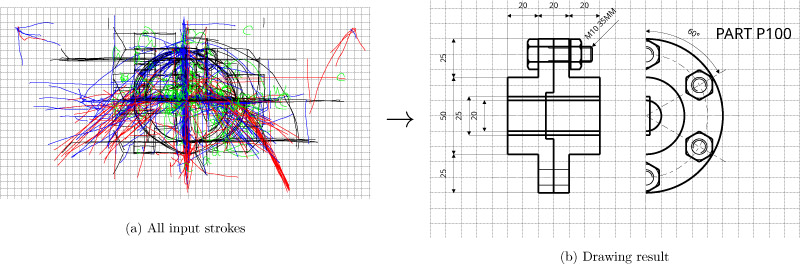
Complete technical drawing via strokes
- [1] J. D. Camba, P. Company, and F. Naya, “Sketch-based modeling in mechanical engineering design: Current status and opportunities,” Computer-Aided Design, Vol.150, Article No.103283, 2022. https://doi.org/10.1016/j.cad.2022.103283
- [2] T. Igarashi, S. Matsuoka, and H. Tanaka, “Teddy: A sketching interface for 3D freeform design,” Proc. of the 26th Annual Conf. on Computer Graphics and Interactive Techniques, pp. 409-416, 1999. https://doi.org/10.1145/311535.311602
- [3] H. Mo, E. Simo-Serra, C. Gao, C. Zou, and R. Wang, “General virtual sketching framework for vector line art,” ACM Trans. on Graphics, Vol.40, No.4, Article No.51, 2021. https://doi.org/10.1145/3450626.3459833
- [4] P. A. C. Varley, R. R. Martin, and H. Suzuki, “Frontal geometry from sketches of engineering objects: Is line labelling necessary?” Computer-Aided Design, Vol.37, No.12, pp. 1285-1307, 2005. https://doi.org/10.1016/j.cad.2005.01.002
- [5] S. Yuan, L. Y. Tsui, and S. Jie, “Regularity selection for effective 3D object reconstruction from a single line drawing,” Pattern Recognition Letters, Vol.29, No.10, pp. 1486-1495, 2008. https://doi.org/10.1016/j.patrec.2008.03.003
- [6] L. Olsen, F. F. Samavati, M. C. Sousa, and J. A. Jorge, “Sketch-based modeling: A survey,” Computers & Graphics, Vol.33, No.1, pp. 85-103, 2009. https://doi.org/10.1016/j.cag.2008.09.013
- [7] S. Saga, H. Makino, and J. Sasaki, “The fuzzy spline curve identifier,” IEICE Trans. on Information and Systems, Vol.J77-D-II, No.8, pp. 1620-1629, 1994 (in Japanese).
- [8] S. Saga and H. Makino, “Fuzzy spline interpolation and its application to online freehand curve identification,” 2nd IEEE Int. Conf. on Fuzzy Systems, Vol.2, pp. 1183-1190, 1993. https://doi.org/10.1109/FUZZY.1993.327560
- [9] T. Ito, T. Kaneko, Y. Tanaka, and S. Saga, “An interactive sketch-based CAD interface realizing geometrical and topological editing across multiple objects based on fuzzy logic,” Computers & Graphics, Vol.103, pp. 153-167, 2022. https://doi.org/10.1016/j.cag.2022.02.007
- [10] S. Warita, A. Takaoka, and S. Saga, “Canvas manipulation by two-finger touchstrokes for sketch-based CAD interfaces based on dual fuzzy stroke identification,” SSRN (Preprint), 2024. https://doi.org/10.2139/ssrn.4831538
- [11] A. Nishikawa, S. Saga, and J. Maeda, “Performance improvement of geometric curve sequence recognition in the freehand curve identifier FSCI,” IPSJ J., Vol.51, No.2, pp. 380-390, 2010 (in Japanese).
- [12] Y.-T. Yang, Y.-M. Zhang, X.-L. Yun, F. Yin, and C.-L. Liu, “DyGAT: Dynamic stroke classification of online handwritten documents and sketches,” Pattern Recognition, Vol.141, Article No.109564, 2023. https://doi.org/10.1016/j.patcog.2023.109564
- [13] X.-D. Zhou and C.-L. Liu, “Text/non-text ink stroke classification in Japanese handwriting based on Markov random fields,” 9th Int. Conf. on Document Analysis and Recognition (ICDAR 2007), pp. 377-381, 2007. https://doi.org/10.1109/ICDAR.2007.4378735
- [14] A. Delaye and C.-L. Liu, “Contextual text/non-text stroke classification in online handwritten notes with conditional random fields,” Pattern Recognition, Vol.47, No.3, pp. 959-968, 2014. https://doi.org/10.1016/j.patcog.2013.04.017
- [15] R. G. Schneider and T. Tuytelaars, “Example-based sketch segmentation and labeling using CRFs,” ACM Trans. on Graphics, Vol.35, No.5, Article No.151, 2016. https://doi.org/10.1145/2898351
- [16] K. Jain, A. Namboodiri, and J. Subrahmonia, “Structure in on-line documents,” Proc. of 6th Int. Conf. on Document Analysis and Recognition, pp. 844-848, 2001. https://doi.org/10.1109/ICDAR.2001.953906
- [17] D. Willems, S. Rossignol, and L. Vuurpijl, “Features for mode detection in natural online pen input,” Advances of Graphonomics: Proc. of the 12th Biennial Conf. of the Int. Graphonomics Society, pp. 113-117, 2005.
- [18] M. Weber, M. Liwicki, Y. T. H. Schelske, C. Schoelzel, F. Strauß, and A. Dengel, “MCS for online mode detection: Evaluation on pen-enabled multi-touch interfaces,” 2011 Int. Conf. on Document Analysis and Recognition, pp. 957-961, 2011. https://doi.org/10.1109/ICDAR.2011.194
- [19] L. A. Zadeh, “Fuzzy sets as a basis for a theory of possibility,” Fuzzy Sets and Systems, Vol.1, No.1, pp. 3-28, 1978. https://doi.org/10.1016/0165-0114(78)90029-5
- [20] D. Dubois and H. Prade, “Fuzzy sets and systems: Theory and applications,” Academic Press, 1980.
- [21] G. Cohen, S. Afshar, J. Tapson, and A. van Schaik, “EMNIST: An extension of MNIST to handwritten letters,” arXiv:1702.05373, 2017. https://doi.org/10.48550/arXiv.1702.05373
- [22] T. Watanabe, T. Yoshikawa, T. Ito, Y. Miwa, T. Shibata, and S. Saga, “An infinite-resolution grid snapping technique based on fuzzy theory,” Applied Soft Computing, Vol.89, Article No.106112, 2020. https://doi.org/10.1016/j.asoc.2020.106112
- [23] S. Warita, “Supplemental videos for CS/DS discriminator,” Figshare, 2025. https://doi.org/10.6084/m9.figshare.28237181
- [24] K. Ryota, N. Akira, and S. Sato, “A freehand sketch input front-end processor: SKIT,” IEICE Trans. on Information and Systems, Vol.J88-D-II, No.5, pp. 897-905, 2005 (in Japanese).
This article is published under a Creative Commons Attribution-NoDerivatives 4.0 Internationa License.