
Research Paper:
Pure Copper Coating Layer Formation via Uniform Heating of Metal Powders and Substrates Using Multi-Beam Metal Powder Deposition with Rectangular Profile Blue Diode Lasers
Keisuke Takenaka*,†
 , Yuji Sato*
, Peng Chen**
, Takayuki Mokudai*,***
, Hiroyasu Kanetaka**
, and Masahiro Tsukamoto*
, Yuji Sato*
, Peng Chen**
, Takayuki Mokudai*,***
, Hiroyasu Kanetaka**
, and Masahiro Tsukamoto*
*Joining and Welding Research Institute, The University of Osaka
11-1 Mihogaoka, Ibaraki, Osaka 567-0047, Japan
†Corresponding author
**Graduate School of Dentistry, Tohoku University
Sendai, Japan
***Institute for Materials Research, Tohoku University
Sendai, Japan

A high-efficiency, high-quality coating technology for pure copper was developed using a multi-beam metal powder deposition method with a rectangular beam profile at the processing point. Pure copper is a metal with antibacterial properties and high thermal and electrical conductivity. Its use in multi-material applications via metal powder deposition is expected to conserve resources and further expand its applications. In this study, a pure copper layer was formed on a stainless-steel substrate using a blue diode laser with high light absorption in pure copper and a rectangular top-hat beam capable of uniform heating of both the substrate and pure copper powder. Compared with a circular beam, the rectangular beam improved layer formation efficiency up to twofold and was also found to reduce dilution, the mixed layer between the layer and substrate. The pure copper layer formed using the rectangular beam exhibited a smaller difference in dilution between the center and edge of the cross-section compared to the circular beam. This demonstrates that the rectangular beam achieves uniform heating, which is beneficial for layer formation using the multi-beam metal powder deposition method.
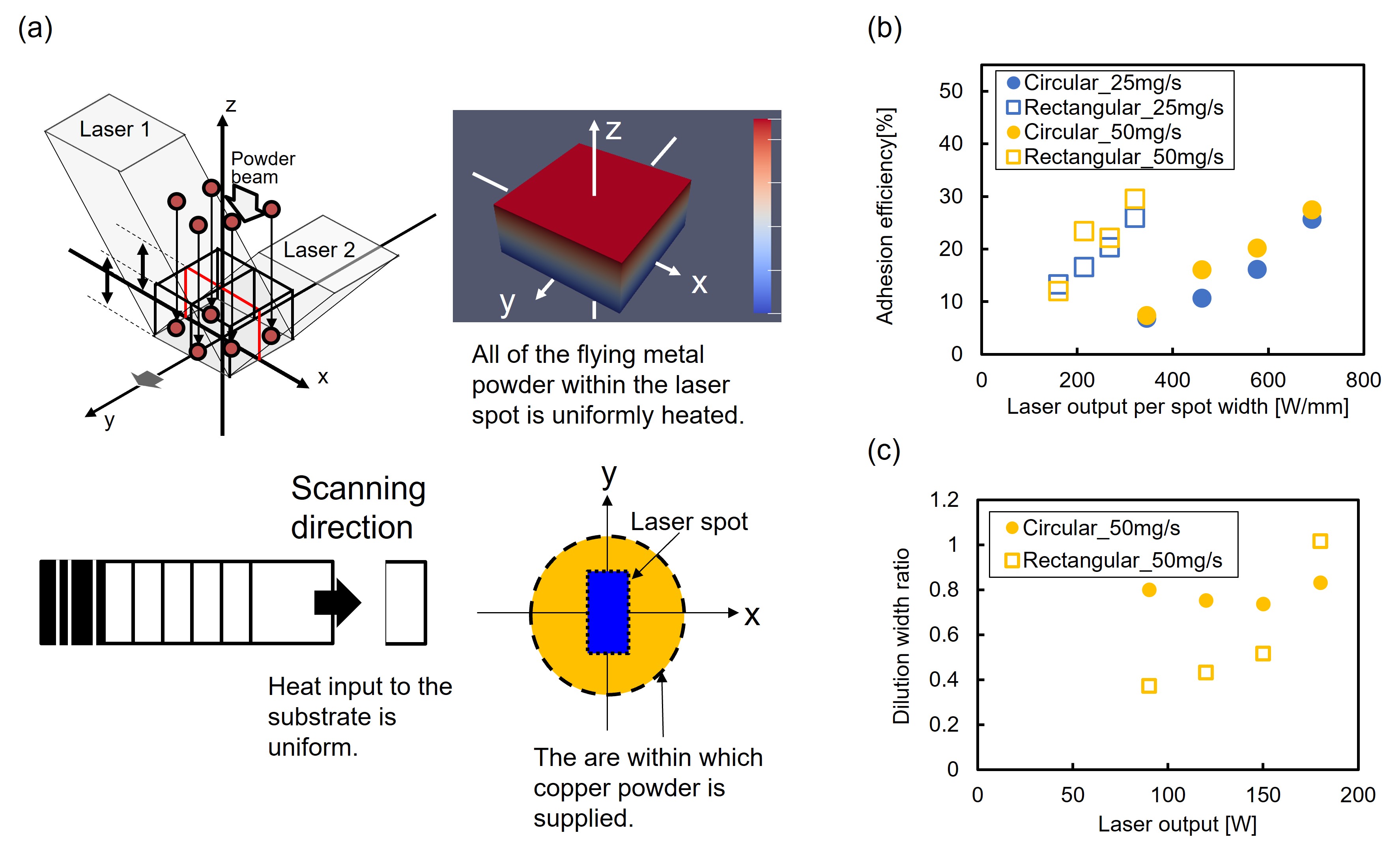
Conceptual diagram using a rectangular beam
1. Introduction
Pure copper is used in various applications owing to its high electrical and thermal conductivities, sliding properties, and strong antibacterial and viral inactivation effects. In particular, many bacteria and viruses attached to a pure copper surface are killed or inactivated in a short period of time 1,2. In modern society, where human mobility is high, infectious diseases can spread rapidly. Therefore, preventive measures against contact transmission in areas that are frequently touched are becoming increasingly important. Pure copper has high antibacterial and viral inactivation effects, and viruses that remain active for 4 h on stainless-steel surfaces can be inactivated within a few minutes on pure copper surfaces 3. However, pure copper is a low-strength and expensive metal 4. Therefore, by forming a pure copper coating layer only on the surface of a stainless-steel component, antibacterial and antiviral properties can be imparted while maintaining the mechanical strength of the substrate.
To form pure copper coating layers, we focused on a metal powder deposition method using a blue diode laser with a high light absorption rate for pure copper 5,6,7. The metal powder deposition method is a type of the additive manufacturing technology. This method forms a metal layer by laser irradiation while feeding metal powder. A multi-beam metal powder deposition method (Figs. 1(a) and (b)), in which metal powder is supplied from the center and multiple lasers irradiate from the periphery, allows for uniform heat input to the flying metal powder by the lasers, minimizing substrate melting. However, the multi-beam metal powder deposition method still suffers from limited powder adhesion efficiency (ratio of adhesion to the substrate to the amount of metal powder fed). In addition, temperature distribution occurs in the substrate owing to the uneven heat input into the substrate, making it difficult to control the mixed layer (dilution layer) between the layer and substrate (Fig. 1(c)). Therefore, a processing technology capable of forming a high-efficiency, high-quality, and pure copper coating layer with minimal dilution is required.
The reason for the low adhesion efficiency is that the heat input into the powder and substrate is different at the center and at the edge of the spot because the fiber-coupled blue diode laser is circular (Figs. 1(b) and (c)) and the thickness of the pure copper powder flow at the processing point is larger than the laser spot diameter (Fig. 1(d)).
As a result of numerically calculating the temperature distribution of flying metal powder (Figs. 1(b) and (f)), a rectangular beam profile is effective for uniform heating of the powder and substrate, as shown in Figs. 1(e)–(h). Therefore, in this study we investigated the effect of the beam profile on the powder adhesion efficiency and dilution behavior during pure copper coating formation using a multi-beam metal powder deposition method equipped with two rectangular-beam blue diode lasers.
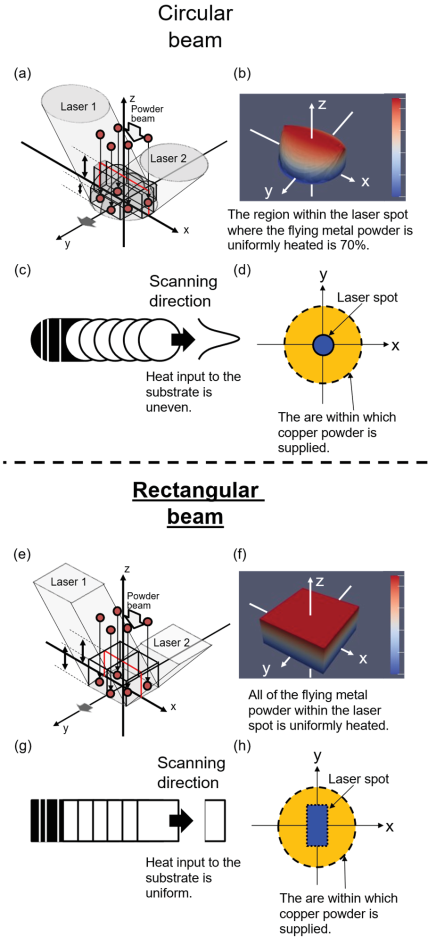
Fig. 1. Circular and rectangular beams: (a), (e) position relationship between laser and powder; (b), (f) distribution of the interaction distance between powder and laser (red indicates a longer heating time, while blue indicates a shorter heating time; with a circular beam, the distribution is non-uniform relative to the scanning direction, but with a rectangular beam, more uniform heating of the powder is possible); (c), (g) distribution of substrate heating, and (d), (h) position relationship between powder and laser spot.
2. Experimental Methods
The experimental setup and irradiation conditions of the lasers used in the experiment are shown in Fig. 2 and listed in Table 1. A multi-beam irradiation processing system equipped with two blue diode lasers (Blue Impact, Shimadzu Corporation) with a maximum output of 200 W was used. The chemical composition of pure copper powder (FAM-QCU 10–45 μm, Fukuda Metal Foil & Powder Co., Ltd.) is shown in Table 2. Pure copper powder with an average particle size of 31 μm was transported to the processing point at a supply rate of 25 mg/s and 50 mg/s using argon gas. The substrate was composed of stainless steel (SUS304). The laser scanning speed was fixed at 50 mm/s and the laser output varied from 60 to 180 W. The beam profile at the processing point was \(\phi\)260 μm (full width at half maximum, FWHM) for the circular shape and 560 μm \(\times\) 260 μm (FWHM) for the rectangular beam. The beam was swept along its longitudinal direction while pure copper layers were formed using a rectangular beam. For comparison, the spot size relative to the scanning direction was set the same for each beam shape. The length of the formed layer was 40 mm. The formed layer was cut perpendicular to the scanning direction, polished, and its cross-sectional area was measured using an optical microscope (VHX-7000, Keyence Co., Ltd.). The adhesion efficiency was calculated by dividing the powder feed rate by the layer area, as expressed in Eq. (1). Regarding the spot size, we compared spots of equal size in the direction parallel to the scanning direction for each beam profile. Because the spot widths differed, we compared the adhesion efficiency using the value obtained by dividing the laser output by the spot width.
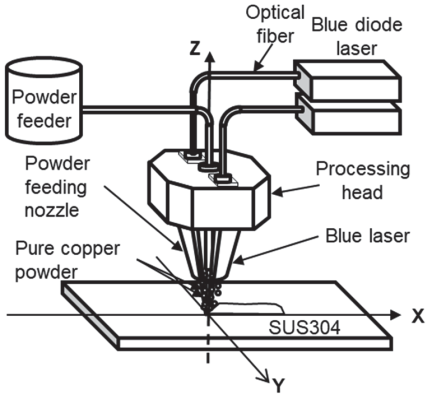
Fig. 2. Schematic diagram of experimental setup for pure copper coating with blue diode lasers.
The composition of the cross-section was analyzed using SEM/EDX (VE-9800, Keyence Co., Ltd.). Using EDX measurements of the cross-sectional composition of the coating, we measured the mixed layer (dilution layer) between the coating and substrate. The dilution was expected to be uniform within the coating when the substrate and powder were heated uniformly. Therefore, as shown in Fig. 3, line analysis was performed in the width direction of the coating at a depth of 1 μm from the substrate surface. The dilution width ratio was defined as the ratio of the width at which the copper concentration exceeded 20 wt% within the mixed region to the total coating width, as expressed in Eq. (2).
| Unit | Beam shape | ||
| Circular | Rectangular | ||
| Material of substrate | SUS304 | ||
| Substrate size (W \(\times\) L \(\times\) thickness) | mm | 50 \(\times\) 50 \(\times\) 3.0 | |
| Laser wavelength | nm | 450 | |
| Spot size (FWHM) | μm | \(\phi\)260 | 560 L \(\times\) 260 W |
| Laser output | W | 60, 90, 120, 150, 180 | |
| Material of metal powder | Pure copper | ||
| Powder feed rate | mg/s | 25, 50 | |
| Scanning speed | mm/s | 50 | |
| Shielding gas | Ar | ||
| Feed rate of gas | L/min | 10 | |
| Element | P | O | Cu |
| [wt%] | 0.03 | 0.03 | Balance |
The closer the dilution width ratio is to zero, the better the indicator that the coating is of high quality with minimal dilution throughout the entire coating area. The dilution ratio was only calculated when the coating was deposited and joined to the substrate.
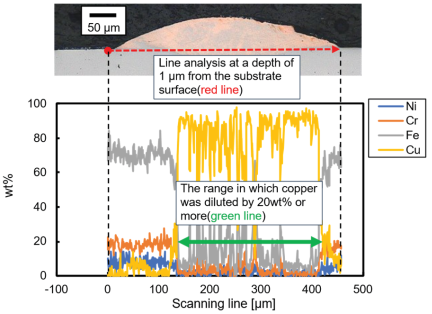
Fig. 3. Area where line analysis using EDX was performed (the red arrow line indicates the measurement line) and results of line analysis (the green line indicates the dilution width) at a laser output of 120 W with the circular beam profile.
3. Experimental Results
Figure 4 shows cross-sectional images of the pure copper layer formed. The layer was formed using a circular beam (left side of the figure) and a rectangular beam (right side of the figure), with the output varying as 60 W, 90 W, 120 W, and 150 W. The powder feed rate was fixed at 50 mg/s. When using a 60 W output, no layer was formed with either beam profile. For the circular beam, at 90 W, the mixed layer between the substrate and the layer was minimal. However, at 120 W and above, dilution occurred where the substrate and layer mixed. The color change in the cross-section also indicates that the substrate dissolved in the layer. Observation of the cross-sections using a rectangular beam revealed no noticeable dilution at 90 W and 120 W. At 150 W, pure copper dissolved in the interior of the substrate. Compared to the circular beam, the rectangular beam resulted in the formation of a higher-quality layer with less dilution between the substrate and coating layer. Furthermore, a coating layer with a large volume was achieved.
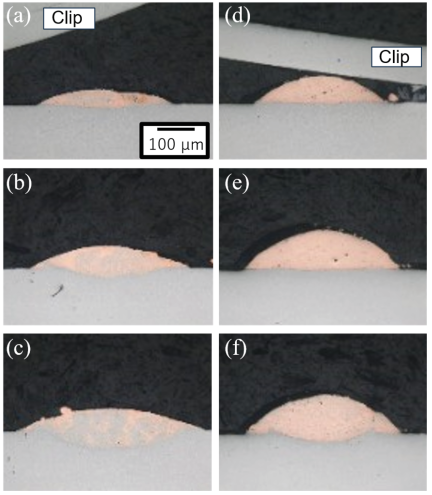
Fig. 4. Optical microscope images of pure copper layer cross-section using a circular beam at the laser output of (a) 90 W, (b) 120 W, and (c) 150 W; and using a rectangular beam at the laser output of (d) 90 W, (e) 120 W, and (f) 150 W.
Figures 5 and 6 show the coating formation conditions and the calculated coating cross-sectional area and adhesion efficiency, respectively. Because the spot diameters differed, the adhesion efficiency was compared using a value obtained by dividing the laser output by the spot diameter in the direction perpendicular to the scanning direction. The powder feed rate was set to 25 mg/s (blue) and 50 mg/s (yellow). The results obtained using the circular beam are plotted as solid circles, whereas those obtained using the rectangular beam are plotted as hollow squares. The adhesion efficiency represents the amount of pure copper powder used to form the coating out of the total amount of powder used, as expressed in Eq. (1). The density of pure copper was 8.96 g/cm\(^3\). Fig. 5 shows that for all laser outputs, the use of a rectangular beam tends to increase the coating area compared to a circular beam. Furthermore, even when the powder feed rate varied, the coating area remained larger for the rectangular beam. This is likely due to the more uniform heating of the substrate and powder, which leads to more efficient layer formation. Fig. 6 shows that higher powder feed rates tend to result in slightly higher adhesion efficiency. When comparing spot shapes, it was found that rectangular beams tend to achieve higher adhesion efficiency when the laser output per spot width is lower. This is thought to be due to the influence of differences in heating uniformity/non-uniformity, as these conditions are near the coating formation threshold.
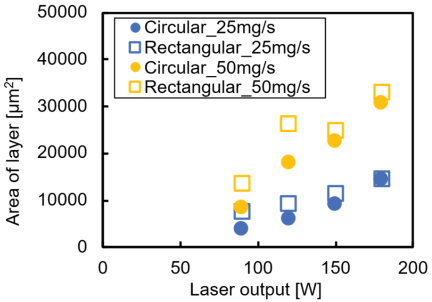
Fig. 5. Relationship between the laser output and coating area for the circular and rectangular beams.
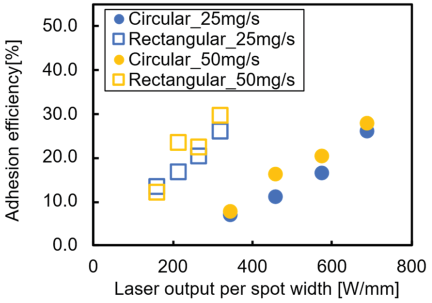
Fig. 6. Relationship between the laser output per spot width and adhesion efficiency for the circular and rectangular beams.
Figure 7 shows the EDX line profile measurement results for a pure copper layer using a rectangular beam. EDX measurements were performed at a depth of 1 μm from the substrate surface. The red arrows indicate the measurement location and EDX line measurement direction, whereas the green line indicates the width of the area where copper was diluted to 20 wt% or more on the substrate. At 90 W output, dilution occurred only at the center, whereas at 180 W output, dilution occurred across the entire coating area. A comparison with the results obtained using a circular beam (Fig. 3) revealed differences in the proportion of the dilution width depending on the laser output. Fig. 8 shows the results of measuring the dilution width ratio at a powder feed rate of 50 mg/s. For the circular beam, the dilution width ratio remained around 0.8 for all laser outputs, indicating that dilution occurred over approximately 80% of the layer width. In contrast, for the rectangular beam, the dilution width ratio tended to increase with the output, ranging from 0.4 to 0.5 between 90 and 150 W, and sharply increasing to nearly 1.0 at 180 W. Under low-output conditions, using a rectangular beam reduced the dilution width ratio to approximately half that of the circular beam. This is thought to be due to the uniform heat input to the substrate and powder, which reduces dilution across the entire layer. Furthermore, when using a rectangular beam at 180 W, the dilution width ratio increased drastically, resulting in a higher dilution width ratio than that of the circular beam. This is thought to be due to the overheating conditions causing dilution to occur at both the center and edges of the rectangular beam. This uniform heating likely caused a sharp increase in dilution at a high output.
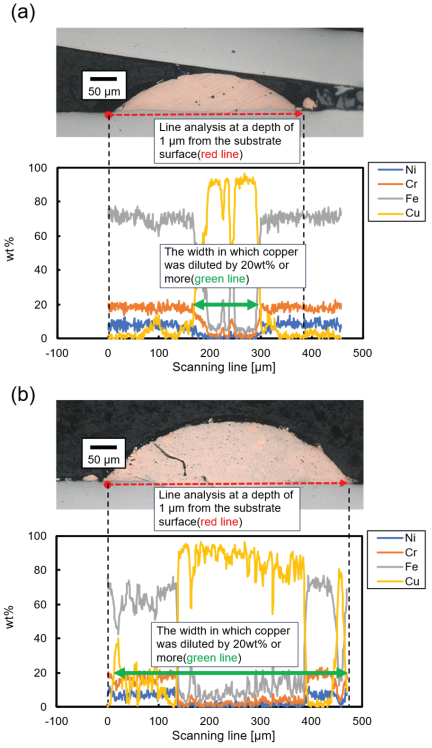
Fig. 7. Area where line analysis using EDX was performed the (red arrow line indicates the measurement line) and results of line analysis (the green line indicates the dilution width) at laser outputs of 90 W and 180 W with the rectangular beam profile.
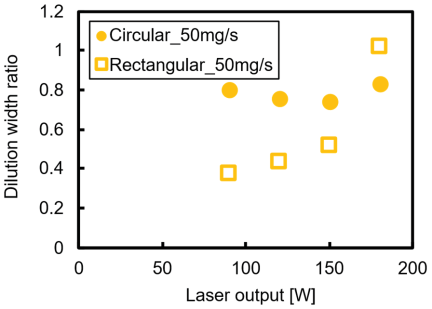
Fig. 8. Relationship between the laser output and dilution width ratio for the circular and rectangular beams.
4. Conclusion
The effect of the beam profile on the powder adhesion efficiency and dilution behavior during pure copper coating formation was investigated using a multi-beam metal powder deposition system equipped with two blue diode lasers.
A pure copper layer was successfully formed on a stainless-steel substrate using a rectangular beam profile. The spatial distribution of the heat input significantly influenced both the coating formation efficiency and dilution behavior. At a powder feed rate of 50 mg/s, the coating area increased with the rectangular beam, and the adhesion efficiency improved by up to twofold compared with that of the circular beam. EDX analysis revealed that the overall dilution was reduced, and the difference in dilution between the center and edge of the coating cross-section was significantly minimized.
These results indicate that uniform heat input achieved by a rectangular beam profile is highly effective in improving both the efficiency and coating quality in the multi-beam laser metal deposition of pure copper.
Acknowledgments
This research was conducted with support from the Ministry of Economy, Trade and Industry (METI) R&D Support Program for Growth-Oriented Technology SMEs Grant No.JPJ005698, JSPS KAKENHI Grant No.JP22K04776, the Amada Foundation (AF-2023235-C2), the New Energy and Industrial Technology Development Organization (NEDO) of Japan, and the Joint Usage/Research Center on Joining and Welding (JWRI), The University of Osaka, Japan. We acknowledge the cooperation of Shimadzu Corporation and Nichia Corporation in the development of the blue diode laser.
- [1] G. Grass, C. Rensing, and M. Solioz, “Metallic copper as an antimicrobial surface,” Appl. Environ. Microbiol., Vol.77, pp. 1541-1547, 2011. https://doi.org/10.1128/aem.02766-10
- [2] J. Konieczny and Z. Rdzawski, “Antibacterial properties of copper and its alloys,” Arch. Mater. Sci. Eng., Vol.56, Issue 2, pp. 53-60, 2012.
- [3] Japan Copper Development Association, “Test data on the antimicrobial and antiviral properties of copper,” (in Japanese). https://www.jcda.or.jp/speciality/koukin/contents01/index.html [Accessed February 25, 2026]
- [4] The Japan Institute of Metals and Materials, “Metal Handbook,” Maruzen, 2004.
- [5] K. Asano, M. Tsukamoto, Y. Sechi, Y. Sato, S. Masuno, R. Higashino, T. Hara, M. Sengoku, and M. Yoshida, “Laser metal deposition of pure copper on stainless steel with blue and IR diode laser,” Opt. Laser Technol., Vol.107, pp. 291-296, 2018. https://doi.org/10.1016/j.optlastec.2018.06.012
- [6] K. Takenaka, Y. Sato, K. Ono, Y. Funada, and M. Tsukamoto, “Pure copper layer formation on stainless-steel and aluminum substrate with a multibeam laser metal deposition system with blue diode laser,” J. Laser Appl., Vol.33, Article No.042033, 2021. https://doi.org/10.2351/7.0001645
- [7] K. Morimoto, Y. Sato, K. Takenaka, Y. Funada, Y. Hayashi, N. Abe, and M. Tsukamoto, “Effect of particle size distribution on pure copper layer formation in a multi-beam laser cladding system with pure copper powder and two blue diode lasers,” Appl. Phys. A, Vol.129, Article No.12, 2023. https://doi.org/10.1007/s00339-022-06187-4
This article is published under a Creative Commons Attribution-NoDerivatives 4.0 Internationa License.