
Research Paper:
In Situ Visualization of Bubble Formation During Selective Laser Melting of an Alumina Powder Bed
Daijiro Tokunaga†
 , Manabu Kodama
, Yuko Aono
, and Atsushi Hirata
, Manabu Kodama
, Yuko Aono
, and Atsushi Hirata
Department of Mechanical Engineering, Institute of Science Tokyo
2-12-1 Ookayama, Meguro-ku, Tokyo 152-8550, Japan
†Corresponding author

The behavior of bubble and pore formation during selective laser melting of ceramics remains unclear. In this study, in situ observations of a single laser scan over an alumina powder bed were performed using a simple near-infrared visualization system. A CO2 laser was scanned over a pressurized powder bed under various irradiation conditions, and the interior of the molten pool was recorded with a high-speed camera. The solidified beads were then analyzed by X-ray computed tomography. The observations revealed bubbles forming at the solid–liquid interface and migrating within the molten pool, which were ultimately trapped as pores in the solidified structure. In addition, a qualitative correlation was established between the pore distribution in the solidified structure and the bubble distribution observed in situ. The influence of laser irradiation conditions on pore formation behavior was systematically clarified. These results demonstrate the effectiveness of near-infrared observation techniques in selective laser melting of oxide ceramics.
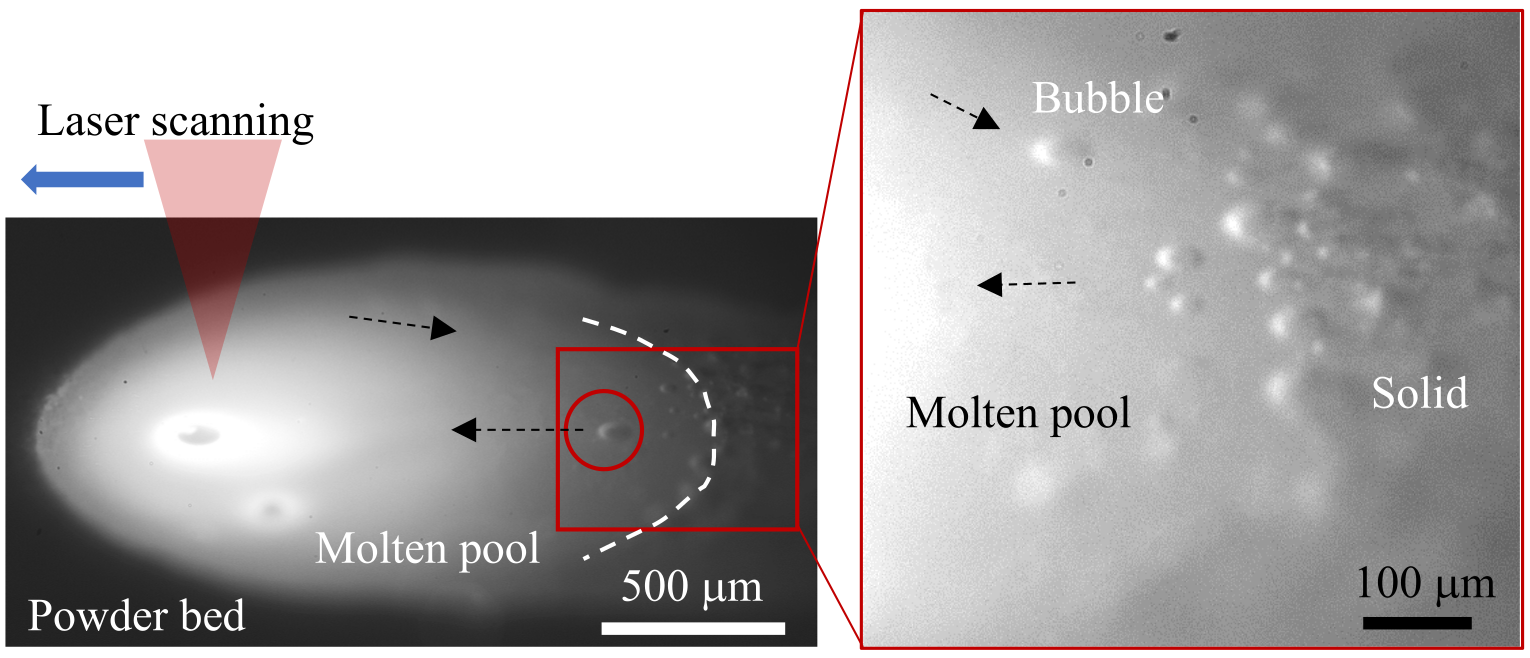
Molten pool formed on the alumina powder bed
Supplementary Material
Supplementary Material 1
Supplementary Material 2
Supplementary Material 3
Supplementary Material 4
Supplementary Material 5
- [1] A. Ur Rehman, A. Ullah, T. Liu, R. Ur Rehman, and M. U. Salamci, “Additive manufacturing of AlO ceramics with MgO/SiC contents by laser powder bed fusion process,” Front. Chem., Vol.11, Article No.1034473, 2023. https://doi.org/10.3389/fchem.2023.1034473
- [2] S. Yan et al., “Formation mechanism and process optimization of nano AlO-ZrO eutectic ceramic via laser engineered net shaping (LENS),” Ceram. Int., Vol.43, No.17, pp. 14742-14747, 2017. https://doi.org/10.1016/j.ceramint.2017.07.214
- [3] F. Verga et al., “Laser-based powder bed fusion of alumina toughened zirconia,” Addit. Manuf., Vol.31, Article No.100959, 2020. https://doi.org/10.1016/j.addma.2019.100959
- [4] N. Travitzky et al., “Additive manufacturing of ceramic-based materials,” Adv. Eng. Mater., Vol.16, No.6, pp. 729-754, 2014. https://doi.org/10.1002/adem.201400097
- [5] Y. Hosoya, D. Tokunaga, S. Momozono, Y. Aono, and A. Hirata, “Fundamental study on direct and serial joining of spherical alumina particles with CO laser,” J. Mater. Process. Technol., Vol.326, Article No.118314, 2024. https://doi.org/10.1016/j.jmatprotec.2024.118314
- [6] Y.-D. Qiu et al., “Balling phenomenon and cracks in alumina ceramics prepared by direct selective laser melting assisted with pressure treatment,” Ceram. Int., Vol.46, pp. 13854-13861, 2020. https://doi.org/10.1016/j.ceramint.2020.02.178
- [7] Y. Zhang et al., “Morphology and formation mechanism of cracks in AlO–ZrO eutectic ceramics fabricated via laser powder bed fusion,” J. Am. Ceram. Soc., Vol.107, No.4, pp. 2128-2142, 2024. https://doi.org/10.1111/jace.19586
- [8] J. Deckers, S. Meyers, J. P. Kruth, and J. Vleugels, “Direct selective laser sintering/melting of high density alumina powder layers at elevated temperatures,” Phys. Procedia, Vol.56, pp. 117-124, 2014. https://doi.org/10.1016/j.phpro.2014.08.154
- [9] Y. Zheng et al., “Cracks of alumina ceramics by selective laser melting,” Ceram. Int., Vol.45, No.1, pp. 175-184, 2019. https://doi.org/10.1016/j.ceramint.2018.09.149
- [10] Z. Shen et al., “Laser additive manufacturing of melt-grown AlO/GdAlO eutectic ceramic composite: Powder designs and crack analysis with thermo-mechanical simulation,” J. Eur. Ceram. Soc., Vol.42, No.14, pp. 6583-6598, 2022. https://doi.org/10.1016/j.jeurceramsoc.2022.07.020
- [11] H. Liu et al., “Effect of scanning speed on the solidification process of AlO/GdAlO/ZrO eutectic ceramics in a single track by selective laser melting,” Ceram. Int., Vol.45, No.14, pp. 17252-17257, 2019. https://doi.org/10.1016/j.ceramint.2019.05.281
- [12] F. Niu et al., “Microstructure and macro properties of AlO ceramics prepared by laser engineered net shaping,” Ceram. Int., Vol.44, No.12, pp. 14303-14310, 2018. https://doi.org/10.1016/j.ceramint.2018.05.036
- [13] H. Liu et al., “Insights into high thermal stability of laser additively manufactured AlO/GdAlO/ZrO eutectic ceramics under high temperatures,” Addit. Manuf., Vol.48, Article No.102425, 2021. https://doi.org/10.1016/j.addma.2021.102425
- [14] Z. Liu et al., “Formation mechanism and quantitative analysis of pores in AlO–ZrO ceramic different structures by laser additive manufacturing,” Ceram. Int., Vol.49, No.10, pp. 16099-16109, 2023. https://doi.org/10.1016/j.ceramint.2023.01.208
- [15] F. Li, Z. Liu, B. Li, Y. Wang, and Y. Zhang, “Pore formation model for direct laser deposition of AlO–ZrO ceramic,” J. Eur. Ceram. Soc., Vol.42, No.1, pp. 207-215, 2022. https://doi.org/10.1016/j.jeurceramsoc.2021.09.042
- [16] D. Triantafyllidis, L. Li, and F. H. Stott, “Mechanisms of porosity formation along the solid/liquid interface during laser melting of ceramics,” Appl. Surf. Sci., Vols.208-209, pp. 458-462, 2003. https://doi.org/10.1016/S0169-4332(02)01433-2
- [17] E. Li, Z. Zhou, L. Wang, R. Zou, and A. Yu, “Numerical studies of melt pool and gas bubble dynamics in laser powder bed fusion process,” Addit. Manuf., Vol.56, Article No.102913, 2022. https://doi.org/10.1016/j.addma.2022.102913
- [18] C. L. A. Leung et al., “In situ X-ray imaging of defect and molten pool dynamics in laser additive manufacturing,” Nat. Commun., Vol.9, Article No.1355, 2018. https://doi.org/10.1038/s41467-018-03734-7
- [19] Q. Guo et al., “In-situ full-field mapping of melt flow dynamics in laser metal additive manufacturing,” Addit. Manuf., Vol.31, Article No.100939, 2020. https://doi.org/10.1016/j.addma.2019.100939
- [20] J. K. R. Weber, S. Krishnan, C. D. Anderson, and P. C. Nordine, “Spectral absorption coefficient of molten aluminum oxide from 0.385 to 0.780 μm,” J. Am. Ceram. Soc., Vol.78, No.3, pp. 583-587, 1995. https://doi.org/10.1111/j.1151-2916.1995.tb08218.x
- [21] D. Tokunaga, Y. Aono, and A. Hirata, “Near-infrared in situ observation of bubble migration and crystal growth behavior in a laser-induced AlO molten pool,” J. Vis., Vol.28, No.6, pp. 1133-1142, 2025. https://doi.org/10.1007/s12650-025-01087-0
- [22] D. B. Hann, J. Iammi, and J. Folkes, “A simple methodology for predicting laser-weld properties from material and laser parameters,” J. Phys. D: Appl. Phys., Vol.44, Article No.445401, 2011. https://doi.org/10.1088/0022-3727/44/44/445401
- [23] H. Shen, J. Yan, and X. Niu, “Thermo-fluid-dynamic modeling of the melt pool during selective laser melting,” Materials, Vol.13, No.18, Article No.4157, 2020. https://doi.org/10.3390/ma13184157
- [24] S. Ishibashi et al., “Porosity and tensile properties of rhizoid porous structure fabricated using selective laser melting,” Int. J. Automation Technol., Vol.14, No.4, pp. 582-591, 2020. https://doi.org/10.20965/ijat.2020.p0582
- [25] A. Tawfik, M. Radwan, M. A. Attia, P. Bills, R. Racasan, and L. Blunt, “The detection of unfused powder in EBM and SLM additive manufactured components,” Int. J. Automation Technol., Vol.14, No.6, pp. 1025-1035, 2020. https://doi.org/10.20965/ijat.2020.p1025
- [26] A. Tawfik, P. Bills, and L. Blunt, “Development of an additive manufactured artifact to characterize unfused powder using computed tomography,” Int. J. Automation Technol., Vol.14, No.3, pp. 439-446, 2020. https://doi.org/10.20965/ijat.2020.p0439
- [27] E. Maire and P. J. Withers, “Quantitative X-ray tomography,” Int. Mater. Rev., Vol.59, No.1, pp. 1-43, 2014. https://doi.org/10.1179/1743280413Y.0000000023
- [28] A. Ohashi et al., “Stress distribution in the composite electrodes of sulfide all-solid-state lithium-ion batteries,” J. Power Sources, Vol.470, Article No.228437, 2020. https://doi.org/10.1016/j.jpowsour.2020.228437
- [29] H. Su et al., “Distribution control and formation mechanism of gas inclusions in directionally solidified AlO-ErAlO-ZrO ternary eutectic ceramic by laser floating zone melting,” J. Mater. Sci. Technol., Vol.66, pp. 21-27, 2021. https://doi.org/10.1016/j.jmst.2020.03.085
- [30] P. B. Oliete and J. I. Peña, “Study of the gas inclusions in AlO/YAlO and AlO/YAlO/ZrO eutectic fibers grown by laser floating zone,” J. Cryst. Growth, Vol.304, No.2, pp. 514-519, 2007. https://doi.org/10.1016/j.jcrysgro.2007.02.042
This article is published under a Creative Commons Attribution-NoDerivatives 4.0 Internationa License.