
Research Paper:
Comparative Behavioral Analysis of Expert and Novice Inspectors in Equipment Patrol Inspections
Yuya Mitake*,†
 , Hiroto Kitamori*, Yasushi Umeda*, Jun Ota*
, Masayoshi Kinoshita**, Shogo Tani**, and Fumihiko Nonaka**
, Hiroto Kitamori*, Yasushi Umeda*, Jun Ota*
, Masayoshi Kinoshita**, Shogo Tani**, and Fumihiko Nonaka**
*Graduate School of Engineering, The University of Tokyo
7-3-1 Hongo, Bunkyo-ku, Tokyo 113-8656, Japan
†Corresponding author
**Engineering & Capital Planning Department, ENEOS Corporation
Tokyo, Japan

In the maintenance domain, significant progress has been achieved through the integration of emerging technologies. In this study, we focused on industrial inspection processes, recognizing them as the core maintenance operations. Current technological solutions often rely heavily on models and data specific to the target facilities, often disregarding the critical role of human inspectors. In this study, ws aimed to extract strategic inspection knowledge from expert and novice inspectors in industrial inspections. A field study was conducted at an oil refinery in Japan, focusing on patrol inspections of plant equipment. Three expert inspectors (15–37 years of experience) and three novice inspectors (1–2 years of experience) performed inspections according to standard protocols, including predefined device lists and patrol routes. The results showed that the expert inspectors identified significantly more inspection points and demonstrated flexible inspection strategies based on device mechanisms and risk assessment, whereas the novice inspectors adhered closely to the prescribed procedures. In addition, the expert inspectors dynamically adjusted the inspection depth and focus according to equipment conditions and potential failure risks. These differences indicated that the performance of expert inspectors was driven by the integration of experience-based reasoning and situational judgment. Furthermore, the field study revealed variability in the inspection approaches, which enhanced the overall assessment of the plant by incorporating diverse perspectives. These findings provide concrete insights into the strategic knowledge underlying effective patrol inspections and offer implications for improving inspection training and knowledge transfer.
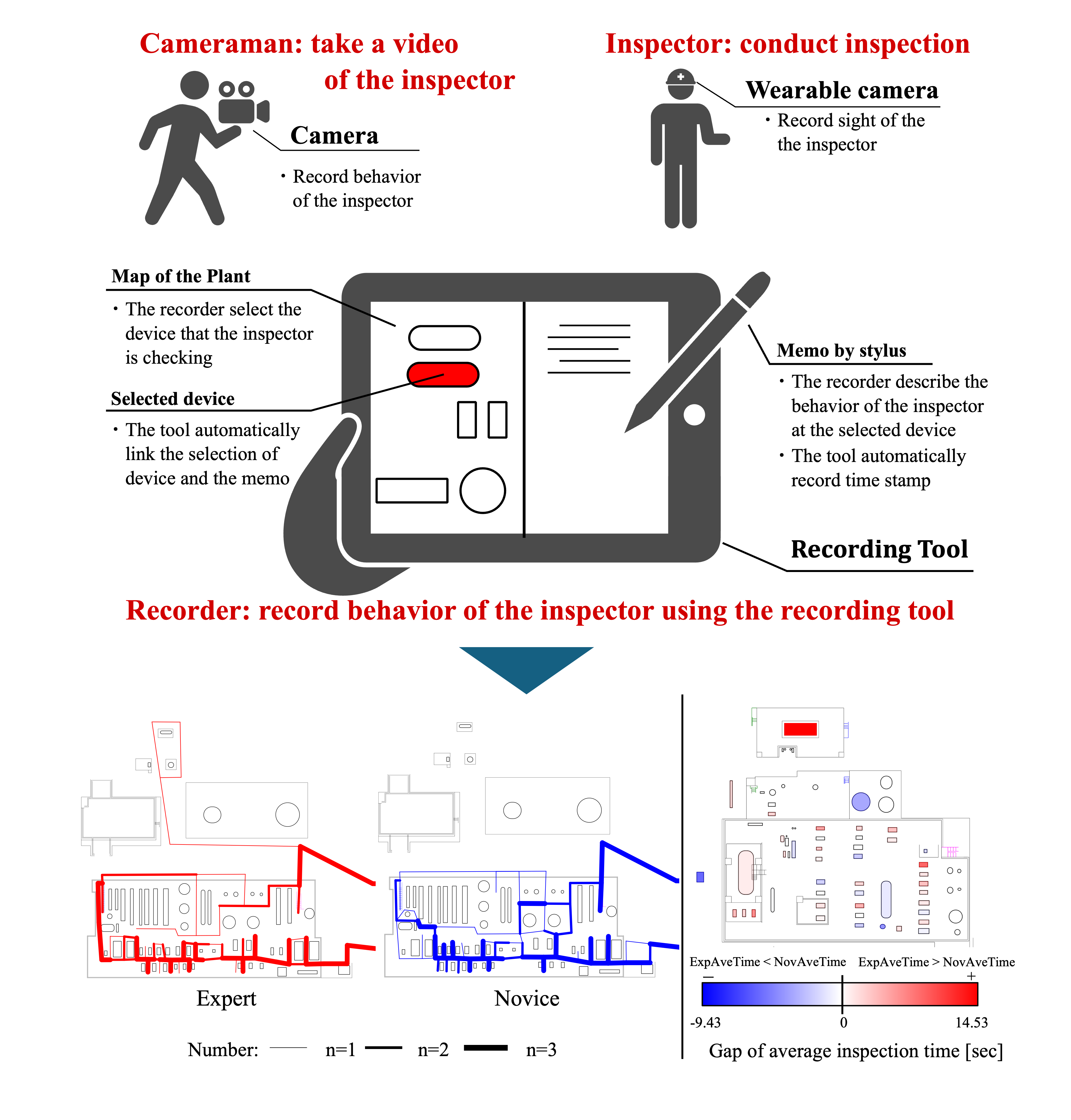
Comprehensive analysis of patrol inspections using recording and analysis system
- [1] S. Takata et al., “Maintenance: Changing role in life cycle management,” CIRP Ann., Vol.53, Issue 2, pp. 643-655, 2004. https://doi.org/10.1016/S0007-8506(07)60033-X
- [2] J. Cárcel-Carrasco and J.-A. Cárcel-Carrasco, “Analysis for the knowledge management application in maintenance engineering: Perception from maintenance technicians,” Appl. Sci., Vol.11, Issue 2, Article No.703, 2021. https://doi.org/10.3390/app11020703
- [3] R. Roy, R. Stark, K. Tracht, S. Takata, and M. Mori, “Continuous maintenance and the future – Foundations and technological challenges,” CIRP Ann., Vol.65, Issue 2, pp. 667-688, 2016. https://doi.org/10.1016/j.cirp.2016.06.006
- [4] S. M. R. Naqvi, M. Ghufran, S. Meraghni, C. Varnier, J.-M. Nicod, and N. Zerhouni, “Human knowledge centered maintenance decision support in digital twin environment,” J. Manuf. Syst., Vol.65, pp. 528-537, 2022. https://doi.org/10.1016/j.jmsy.2022.10.003
- [5] S. K. Ong and J. Zhu, “A novel maintenance system for equipment serviceability improvement,” CIRP Ann., Vol.62, Issue 1, pp. 39-42, 2013. https://doi.org/10.1016/j.cirp.2013.03.091
- [6] A. Shamsuzzoha, R. Toshev, V. Vu Tuan, T. Kankaanpaa, and P. Helo, “Digital factory – Virtual reality environments for industrial training and maintenance,” Interact. Learn. Environ., Vol.29, Issue 8, pp. 1339-1362, 2021. https://doi.org/10.1080/10494820.2019.1628072
- [7] F. Tanaka, M. Tsuchida, and M. Onosato, “Associating 2D sketch information with 3D CAD models for VR/AR viewing during bridge maintenance process,” Int. J. Autom. Technol., Vol.13, No.4, pp. 482-489, 2019. https://doi.org/10.20965/ijat.2019.p0482
- [8] F. Ansari, L. Kohl, J. Giner, and H. Meier, “Text mining for AI enhanced failure detection and availability optimization in production systems,” CIRP Ann., Vol.70, Issue 1, pp. 373-376, 2021. https://doi.org/10.1016/j.cirp.2021.04.045
- [9] V.-T. Nguyen, P. Do, A. Vosin, and B. Iung, “Artificial-intelligence-based maintenance decision-making and optimization for multi-state component systems,” Reliab. Eng. Syst. Saf., Vol.228, Article No.108757, 2022. https://doi.org/10.1016/j.ress.2022.108757
- [10] G. Jing, X. Qin, H. Wang, and C. Deng, “Developments, challenges, and perspectives of railway inspection robots,” Autom. Constr., Vol.138, Article No.104242, 2022. https://doi.org/10.1016/j.autcon.2022.104242
- [11] S. Halder and K. Afsari, “Robots in inspection and monitoring of buildings and infrastructure: A systematic review,” Appl. Sci., Vol.13, Issue 4, Article No.2304, 2023. https://doi.org/10.3390/app13042304
- [12] A. Shukla and H. Karki, “Application of robotics in onshore oil and gas industry—A review Part I,” Robot. Auton. Syst., Vol.75, pp. 490-507, 2016. https://doi.org/10.1016/j.robot.2015.09.012
- [13] A. Shukla and H. Karki, “Application of robotics in offshore oil and gas industry – A review Part II,” Robot. Auton. Syst., Vol.75, pp. 508-524, 2016. https://doi.org/10.1016/j.robot.2015.09.013
- [14] M. R. Saleem, R. Mayne, and R. Napolitano, “Evaluating human expert knowledge in damage assessment using eye tracking: A disaster case study,” Buildings, Vol.14, Issue 7, Article No.2114, 2024. https://doi.org/10.3390/buildings14072114
- [15] A. A. Tawfik, J. D. Gatewood, J. J. Gish-Lieberman, and C. W. Keene, “Exploring the differences between experts and novices on inquiry-based learning cases,” J. Form. Des. Learn., Vol.5, No.2, pp. 97-105, 2021. https://doi.org/10.1007/s41686-021-00062-w
- [16] R. Takamido et al., “Evaluation of expert skills in refinery patrol inspection: Visual attention and head positioning behavior,” Heliyon, Vol.8, Issue 12, Article No.e12117, 2022. https://doi.org/10.1016/j.heliyon.2022.e12117
- [17] R.-J. Dzeng, C.-T. Lin, and Y.-C. Fang, “Using eye-tracker to compare search patterns between experienced and novice workers for site hazard identification,” Saf. Sci., Vol.82, pp. 56-67, 2016. https://doi.org/10.1016/j.ssci.2015.08.008
- [18] N. Dadashi, D. Golightly, and S. Sharples, “Modelling decision-making within rail maintenance control rooms,” Cognition, Technology & Work, Vol.23, No.2, pp. 255-271, 2021. https://doi.org/10.1007/s10111-020-00636-x
- [19] S.-E. Dreyfus and H.-L. Dreyfus, “A five-stage model of the mental activities involved in directed skill acquisition,” California University Berkeley Operations Research Center, No.ORC802, 1980. https://doi.org/10.21236/ADA084551
- [20] European Commission, Directorate General for Research and Innovation, “Industry 5.0: Towards a sustainable, human-centric and resilient European industry,” Publications Office of the European Union, 2021. https://doi.org/10.2777/308407
- [21] L. Silvestri, A. Forcina, V. Introna, A. Santolamazza, and V. Cesarotti, “Maintenance transformation through Industry 4.0 technologies: A systematic literature review,” Comput. Ind., Vol.123, Article No.103335, 2020. https://doi.org/10.1016/j.compind.2020.103335
This article is published under a Creative Commons Attribution-NoDerivatives 4.0 Internationa License.