
Paper:
Spatio-Temporal Dynamics of Collective Disaster Event Cognition in the Digital Sphere: A Long-Term Case Study of the Great East Japan Earthquake (2011–2025)
Ryo Saito*1,†
 , Ryota Takano*2
, Pradytia Putri Pertiwi*3
, Mufidatun Khoiriyah*4
, Akihiro Aotani*5, Hiroyuki Miura*6
, Toshiaki Muramoto*7, and Osamu Murao*7
, Ryota Takano*2
, Pradytia Putri Pertiwi*3
, Mufidatun Khoiriyah*4
, Akihiro Aotani*5, Hiroyuki Miura*6
, Toshiaki Muramoto*7, and Osamu Murao*7
*1Graduate School of Information Sciences, Tohoku University
468-1 Aramaki Aza-Aoba, Aoba-ku, Sendai, Miyagi 980-8572, Japan
†Corresponding author
*2Graduate School of Informatics, Nagoya University
Nagoya, Japan
*3Faculty of Psychology, Gadjah Mada University
Yogyakarta, Indonesia
*4School of Engineering, Tohoku University
Sendai, Japan
*5Hiroshima University of Economics
Hiroshima, Japan
*6Hiroshima University
Higashi-Hiroshima, Japan
*7International Research Institute of Disaster Science, Tohoku University
Sendai, Japan

How does public cognition (e.g., awareness, attention, memory) of a disaster event change over time and become distributed across geographical space after the event occurs? This question addresses the spatio-temporal characteristics of collective disaster event cognition (CDEC). This study focuses on the Great East Japan Earthquake, a catastrophic disaster that struck the coastal region of Japan’s Tohoku area on March 11, 2011, resulting in over 20,000 people dead or missing. Using long-term data from the Google Trends service (supplemented by long-term Wikipedia pageview data), the study investigates the spatio-temporal dynamics of CDEC. Key temporal findings include a seasonal effect, in which Google Trends scores increased during the annual month of remembrance, and a milestone effect, where scores rose relatively higher during major anniversary years, such as the fifth and tenth anniversaries. Additionally, an association effect was observed. For example, attention increased in response to other major earthquakes, such as the 2016 Kumamoto Earthquake and the 2024 Noto Peninsula Earthquake. In the spatial dimension, analyzing the relationship between Google Trends scores and distance from the affected areas revealed a distance decay effect. This effect was more accurately captured by nonlinear models than by linear ones. Finally, this study discusses the theoretical and social implications of these findings and offers perspectives for elucidating the phenomenon of CDEC and informing future disaster risk reduction efforts.
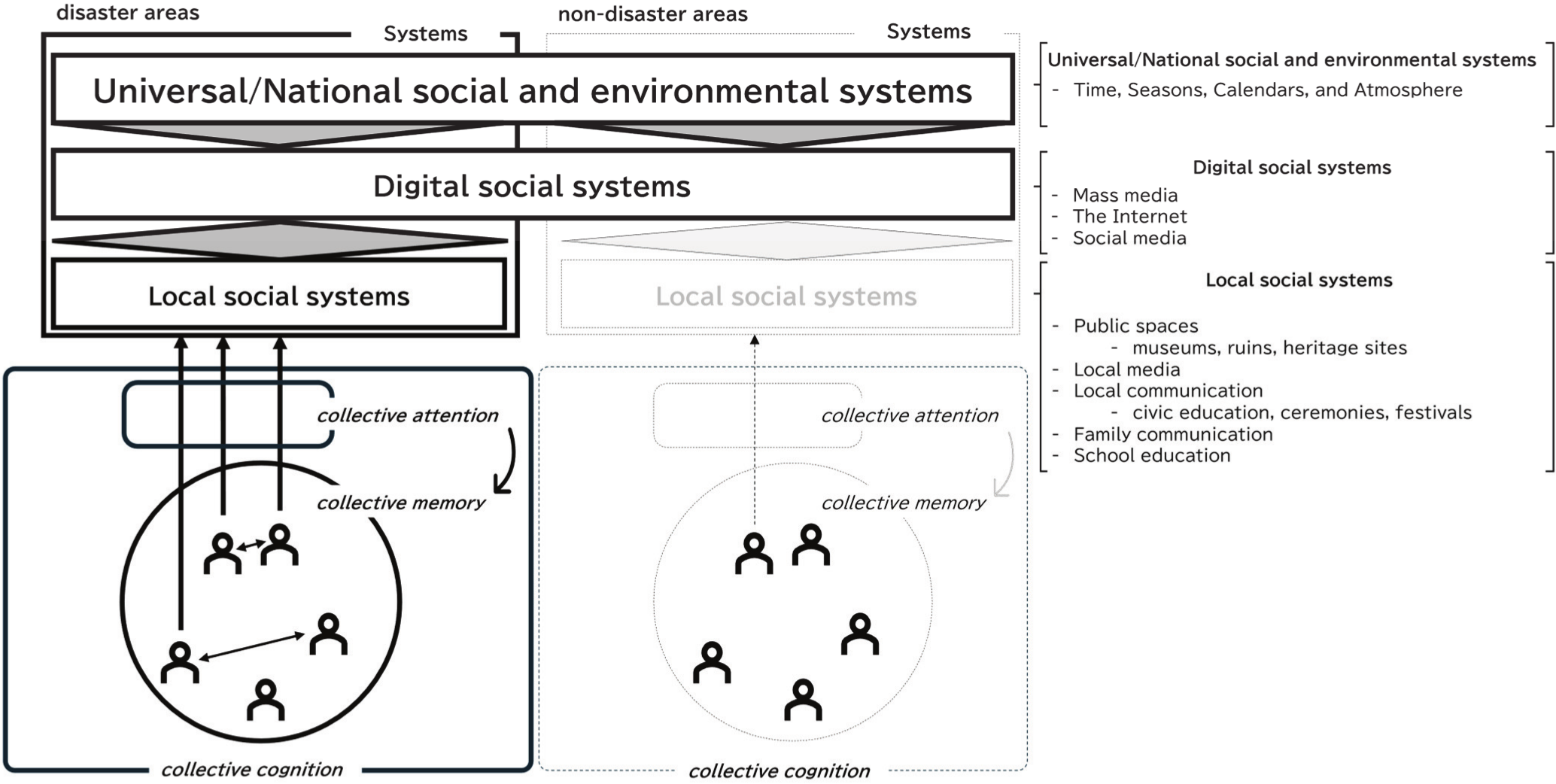
Socio-cognitive model of CDEC
- [1] University of Cambridge, “Darwin Correspondence Project.” https://www.darwinproject.ac.uk/ [Accessed July 31, 2025]
- [2] T. Terada, “Natural disasters and national defense,” Aozora Bunko, 1934. https://www.aozora.gr.jp/cards/000042/files/2509_9319.html [Accessed July 27, 2025]
- [3] R. Saito, M. Yasuda, T. Muramoto, and T. Oda, “The possibility of geographic area and time distribution of DRR education to represent disaster collective memory: A time geographic study of newspapers in Japan,” Inclusive and Integrated Disaster Reduction, pp. 472-480, 2024. https://doi.org/10.1007/978-3-031-81072-5_34
- [4] R. Saito, T. Muramoto, and T. Oda, “Differences of educational practices for disaster risk reduction in elementary and junior high school in coastal areas in three prefectures affected by the Great East Earthquake: A comparison study in prefectures and in types of school,” Research J. of Disaster Education, Vol.3, No.2, pp. 1-23, 2023 (in Japanese). https://doi.org/10.51004/rjde.3.2_1
- [5] N. Dasandi, S. Jankin, D. K. Pantera, and M. Romanello, “Public engagement with health and climate change around the world: A Google Trends analysis,” The Lancet Planetary Health, Vol.9, No.3, pp. e236-e244, 2025. https://doi.org/10.1016/S2542-5196(25)00029-4
- [6] S. P. Jun, H. S. Yoo, and S. Choi, “Ten years of research change using Google Trends: From the perspective of big data utilizations and applications,” Technological Forecasting and Social Change, Vol.130, pp. 69-87, 2018. https://doi.org/10.1016/j.techfore.2017.11.009
- [7] A. Mavragani, G. Ochoa, and K. P. Tsagarakis, “Assessing the methods, tools, and statistical approaches in Google Trends research: Systematic review,” J. of Medical Internet Research, Vol.20, No.11, Article No.e270, 2018. https://doi.org/10.2196/jmir.9366
- [8] Google, “FAQ about Google Trends data.” https://support.google.com/trends/answer/4365533?hl=en [Accessed May 24, 2025]
- [9] S. V. Nuti, B. Wayda, I. Ranasinghe, S. Wang, R. P. Dreyer, S. I. Chen, and K. Murugiah, “The use of Google Trends in health care research: A systematic review,” PLOS ONE, Vol.9, No.10, Article No.e109583, 2014. https://doi.org/10.1371/journal.pone.0109583
- [10] V. S. Arora, M. McKee, and D. Stuckler, “Google Trends: Opportunities and limitations in health and health policy research,” Health Policy, Vol.123, Issue 3, pp. 338-341, 2019. https://doi.org/10.1016/j.healthpol.2019.01.001
- [11] H. A. Carneiro and E. Mylonakis, “Google Trends: A web-based tool for real-time surveillance of disease outbreaks,” Clinical Infectious Diseases, Vol.49, Issue 10, pp. 1557-1564, 2009. https://doi.org/10.1086/630200
- [12] H. Choi and H. Varian, “Predicting the present with Google Trends,” Economic Record, Vol.88, Issue s1, pp. 2-9, 2012. https://doi.org/10.1111/j.1475-4932.2012.00809.x
- [13] D. Borup and E. C. M. Schütte, “In search of a job: Forecasting employment growth using Google Trends,” J. of Business & Economic Statistics, Vol.40, Issue 1, pp. 186-200, 2022. https://doi.org/10.1080/07350015.2020.1791133
- [14] E. Castelnuovo and T. D. Tran, “Google it up! A Google Trends-based uncertainty index for the United States and Australia,” Economics Letters, Vol.161, pp. 149-153, 2017. https://doi.org/10.1016/j.econlet.2017.09.032
- [15] E. Cebrián and J. Domenech, “Is Google Trends a quality data source?,” Applied Economics Letters, Vol.30, Issue 6, pp. 811-815, 2023. https://doi.org/10.1080/13504851.2021.2023088
- [16] G. Cervellin, I. Comelli, and G. Lippi, “Is Google Trends a reliable tool for digital epidemiology? Insights from different clinical settings,” J. of Epidemiology and Global Health, Vol.7, No.3, pp. 185-189, 2017. https://doi.org/10.1016/j.jegh.2017.06.001
- [17] I. Lolić, M. Matošec, and P. Sorić, “DIY Google Trends indicators in social sciences: A methodological note,” Technology in Society, Vol.77, Article No.102477, 2024. https://doi.org/10.1016/j.techsoc.2024.102477
- [18] J. Hölzl, F. Keusch, and C. Sajons, “The (mis)use of Google Trends data in the social sciences—A systematic review, critique, and recommendations,” Social Science Research, Vol.126, Article No.103099, 2025. https://doi.org/10.1016/j.ssresearch.2024.103099
- [19] E. J. Masicampo and N. Ambady, “Predicting fluctuations in widespread interest: Memory decay and goal-related memory accessibility in Internet search trends,” J. of Experimental Psychology: General, Vol.143, No.1, pp. 205-214, 2014. https://doi.org/10.1037/a0030731
- [20] N. Rouhani, D. Stanley, COVID-Dynamic Team, and R. Adolphs, “Collective events and individual affect shape autobiographical memory,” Proc. of the National Academy of Sciences, Vol.120, No.29, Article No.e2221919120, 2023. https://doi.org/10.1073/pnas.2221919120
- [21] S. Merrill and S. Lindgren, “The rhythms of social movement memories: The mobilization of Silvio Meier’s activist remembrance across platforms,” Social Movement Studies, Vol.19, Issues 5-6, pp. 657-674, 2020. https://doi.org/10.1080/14742837.2018.1534680
- [22] J. Kam, K. Stowers, and S. Kim, “Monitoring of drought awareness from Google Trends: A case study of the 2011–17 California drought,” Weather, Climate, and Society, Vol.11, Issue 2, pp. 419-429, 2019. https://doi.org/10.1175/WCAS-D-18-0085.1
- [23] S. P. Shariatpanahi, A. Jafari, M. Sadeghipour, N. Azadeh-Fard, K. Majidzadeh-A, L. Farahmand, and A. M. Ansari, “Assessing the effectiveness of disease awareness programs: Evidence from Google Trends data for the world awareness dates,” Telematics and Informatics, Vol.34, Issue 7, pp. 904-913, 2017. https://doi.org/10.1016/j.tele.2017.03.007
- [24] M. Kaatz, S. Springer, R. Schubert, and M. Zieger, “Representation of long COVID syndrome in the awareness of the population is revealed by Google Trends analysis,” Brain, Behavior, & Immunity-Health, Vol.22, Article No.100455, 2022. https://doi.org/10.1016/j.bbih.2022.100455
- [25] Z. D. U. Durmuşoğlu, “Using Google Trends data to assess public understanding on the environmental risks,” Human and Ecological Risk Assessment: An Int. J., Vol.23, Issue 8, pp. 1968-1977, 2017. https://doi.org/10.1080/10807039.2017.1350566
- [26] W. Hirst, J. K. Yamashiro, and A. Coman, “Collective memory from a psychological perspective,” Trends in Cognitive Sciences, Vol.22, Issue 5, pp. 438-451, 2018. https://doi.org/10.1016/j.tics.2018.02.010
- [27] J. V. Wertsch and H. L. Roediger III, “Collective memory: Conceptual foundations and theoretical approaches,” Memory, Vol.16, Issue 3, pp. 318-326, 2008. https://doi.org/10.1080/09658210701801434
- [28] P. Lorenz-Spreen, B. M. Mønsted, P. Hövel, and S. Lehmann, “Accelerating dynamics of collective attention,” Nature Communications, Vol.10, No.1, Article No.1759, 2019. https://doi.org/10.1038/s41467-019-09311-w
- [29] F. Wu and B. A. Huberman, “Novelty and collective attention,” Proc. of the National Academy of Sciences, Vol.104, No.45, pp. 17599-17601, 2007. https://doi.org/10.1073/pnas.0704916104
- [30] H. C. Lee, S. M. Broniarczyk, and J. Zheng, “Mapping collective consciousness to consumer research: In-person to virtual social presence,” J. of Consumer Psychology, Vol.34, Issue 4, pp. 694-704, 2024. https://doi.org/10.1002/jcpy.1435
- [31] G. Shteynberg, “The psychology of collective consciousness,” J. of Consumer Psychology, Vol.34, Issue 4, pp. 678-686, 2024. https://doi.org/10.1002/jcpy.1434
- [32] M. Mooijman, J. Hoover, Y. Lin, H. Ji, and M. Dehghani, “Moralization in social networks and the emergence of violence during protests,” Nature Human Behaviour, Vol.2, No.6, pp. 389-396, 2018. https://doi.org/10.1038/s41562-018-0353-0
- [33] K. Sasahara, W. Chen, H. Peng, G. L. Ciampaglia, A. Flammini, and F. Menczer, “Social influence and unfollowing accelerate the emergence of echo chambers,” J. of Computational Social Science, Vol.4, No.1, pp. 381-402, 2021. https://doi.org/10.1007/s42001-020-00084-7
- [34] D. Erokhin and N. Komendantova, “Analyzing public interest in geohazards using Google Trends data,” Geosciences, Vol.14, Issue 10, Article No.266, 2024. https://doi.org/10.3390/geosciences14100266
- [35] F. T. Gizzi, J. Kam, and D. Porrini, “Time windows of opportunities to fight earthquake under-insurance: Evidence from Google Trends,” Humanities and Social Sciences Communications, Vol.7, No.1, Article No.61, 2020. https://doi.org/10.1057/s41599-020-0532-2
- [36] C. Houser, B. Vlodarchyk, and P. Wernette, “Short communication: Public interest in rip currents relative to other natural hazards: Evidence from Google search data,” Natural Hazards, Vol.97, pp. 1395-1405, 2019. https://doi.org/10.1007/s11069-019-03696-z
- [37] J. Yeo and C. C. Knox, “Public attention to a local disaster versus competing focusing events: Google Trends analysis following the 2016 Louisiana flood,” Social Science Quarterly, Vol.100, Issue 7, pp. 2542-2554, 2019. https://doi.org/10.1111/ssqu.12666
- [38] A. Silver and S. Jackson, “Public attention during Hurricanes Florence and Michael,” Weather, Climate, and Society, Vol.15, Issue 2, pp. 425-435, 2023. https://doi.org/10.1175/WCAS-D-22-0090.1
- [39] D. M. Ahmad and J. Kam, “Disparity between global drought hazard and awareness,” npj Clean Water, Vol.7, No.1, Article No.75, 2024. https://doi.org/10.1038/s41545-024-00373-y
- [40] S. M. B. Shahabi-Haghighi and H. Hamidifar, “Exploring the link between drought-related terms and public interests: Global insights from LSTM-based predictions and Google Trends analysis,” Hydrological Processes, Vol.37, Issue 11, Article No.e15016, 2023. https://doi.org/10.1002/hyp.15016
- [41] J. J. Thompson, R. L. Wilby, T. Matthews, and C. Murphy, “The utility of Google Trends as a tool for evaluating flooding in data-scarce places,” Area, Vol.54, Issue 2, pp. 203-212, 2022. https://doi.org/10.1111/area.12719
- [42] Reconstruction Agency, “Recovery status and efforts since the Great East Japan Earthquake” (in Japanese). https://www.reconstruction.go.jp/topics/main-cat1/sub-cat1-1/20131029113414.html [Accessed May 24, 2025]
- [43] United Nations Office for Disaster Risk Reduction, “Sendai Framework for Disaster Risk Reduction 2015–2030,” 2015. https://www.undrr.org/publication/sendai-framework-disaster-risk-reduction-2015-2030 [Accessed May 24, 2025]
- [44] S. Dehaene, “The neural basis of the Weber–Fechner law: A logarithmic mental number line,” Trends in Cognitive Sciences, Vol.7, Issue 4, pp. 145-147, 2003. https://doi.org/10.1016/s1364-6613(03)00055-x
- [45] C. Donkin and R. M. Nosofsky, “A power-law model of psychological memory strength in short- and long-term recognition,” Psychological Science, Vol.23, Issue 6, pp. 625-634, 2012. https://doi.org/10.1177/0956797611430961
- [46] J. Gibbon and R. M. Church, “Time left: Linear versus logarithmic subjective time,” J. of Experimental Psychology: Animal Behavior Processes, Vol.7, No.2, pp. 87-108, 1981. https://doi.org/10.1037/0097-7403.7.2.87
- [47] C. T. Kello, G. D. A. Brown, R. Ferrer-i-Cancho, J. G. Holden, K. Linkenkaer-Hansen, T. Rhodes, and G. C. V. Orden, “Scaling laws in cognitive sciences,” Trends in Cognitive Sciences, Vol.14, Issue 5, pp. 223-232, 2010. https://doi.org/10.1016/j.tics.2010.02.005
- [48] D. C. Rubin and A. E. Wenzel, “One hundred years of forgetting: A quantitative description of retention,” Psychological Review, Vol.103, No.4, pp. 734-760, 1996. https://doi.org/10.1037/0033-295X.103.4.734
- [49] S. S. Stevens, “On the psychophysical law,” Psychological Review, Vol.64, No.3, pp. 153-181, 1957. https://doi.org/10.1037/h0046162
- [50] S. S. Stevens, “A scale for the measurement of a psychological magnitude: Loudness,” Psychological Review, Vol.43, No.5, pp. 405-416, 1936. https://doi.org/10.1037/h0058773
- [51] J. T. Wixted and E. B. Ebbesen, “On the form of forgetting,” Psychological Science, Vol.2, No.6, pp. 409-415, 1991. https://doi.org/10.1111/j.1467-9280.1991.tb00175.x
- [52] A. Clauset, C. R. Shalizi, and M. E. Newman, “Power-law distributions in empirical data,” SIAM Review, Vol.51, Issue 4, pp. 661-703, 2009. https://doi.org/10.1137/070710111
- [53] X. Gabaix, “Power laws in economics and finance,” Annual Review of Economics, Vol.1, No.1, pp. 255-294, 2009. https://doi.org/10.1146/annurev.economics.050708.142940
- [54] J. Laherrere and D. Sornette, “Stretched exponential distributions in nature and economy: ‘Fat tails’ with characteristic scales,” The European Physical J. B – Condensed Matter and Complex Systems, Vol.2, No.4, pp. 525-539, 1998. https://doi.org/10.1007/s100510050276
- [55] Wikipedia, “Wikipedia: Pageview statistics.” https://en.wikipedia.org/wiki/Wikipedia:Pageview_statistics [Accessed July 27, 2025]
- [56] Wikipedia, “Pageviews analysis” (in Japanese). https://pageviews.wmcloud.org/?project=ja.wikipedia.org&platform=all-access&agent=user&redirects=0&start=2015-07&end=2025-05&pages=東日本大震災 [Accessed July 27, 2025]
- [57] Cabinet Office, Government of Japan, “The disaster caused by the earthquake off the coast of Fukushima Prefecture in 2021,” White Paper on Disaster Management 2021, 2021.
- [58] NHK, “Kumamoto Earthquake: One additional disaster-related death confirmed in Kumamoto Prefecture, bringing the total death toll to 278,” April 11, 2025 (in Japanese). https://www3.nhk.or.jp/news/html/20250411/k10014776751000.html [Accessed May 24, 2025]
- [59] NHK, “Noto Peninsula Earthquake: Nine additional disaster-related deaths confirmed, bringing the total death toll to 616,” June 20, 2025 (in Japanese). https://www3.nhk.or.jp/news/html/20250620/k10014840121000.html [Accessed May 24, 2025]
- [60] Cabinet Office, Government of Japan, “Northern Osaka Earthquake,” White Paper on Disaster Management 2019, 2019.
- [61] J. R. Finley, “Expanded taxonomies of human memory,” Frontiers in Cognition, Vol.3, Article No.1505549, 2025. https://doi.org/10.3389/fcogn.2024.1505549
- [62] I. Momennejad, “Collective minds: Social network topology shapes collective cognition,” Philosophical Trans. of the Royal Society B, Vol.377, Issue 1843, Article No.20200315, 2022. https://doi.org/10.1098/rstb.2020.0315
- [63] J.-F. Orianne and F. Eustache, “Collective memory: between individual systems of consciousness and social systems,” Frontiers in Psychology, Vol.14, Article No.1238272, 2023. https://doi.org/10.3389/fpsyg.2023.1238272
- [64] J.-F. Orianne, D. Peschanski, J. Müller, B. Guillery, and F. Eustache, “The process of memory semantization as the result of interactions between individual, collective, and social memories,” Cortex, Vol.183, pp. 1-14, 2025. https://doi.org/10.1016/j.cortex.2024.11.001
- [65] F. Seeme, D. Green, and C. Kopp, “Ignorance of the crowd: Dysfunctional thinking in social networks,” Frontiers in Communication, Vol.10, Article No.1547489, 2025. https://doi.org/10.3389/fcomm.2025.1547489
- [66] M. Halbwachs, “La mémoire collective,” T. Koseki (Trans.), Kōrōsha, 1989.
- [67] T. Muramoto and R. Saito, “Disaster and the human mind,” T. Oda (Ed.), “Disaster Risk Reduction Workbook for Educators,” pp. 37-45, Asakura Publishing, 2021 (in Japanese).
- [68] H. L. Roediger III and K. A. DeSoto, “Forgetting the presidents,” Science, Vol.346, No.6213, pp. 1106-1109, 2014. https://doi.org/10.1126/science.1259627
- [69] H. L. Roediger III and K. A. DeSoto, “Recognizing the presidents: Was Alexander Hamilton president?,” Psychological Science, Vol.27, No.5, pp. 644-650, 2016. https://doi.org/10.1177/0956797616631113
- [70] R. Brown and J. Kulik, “Flashbulb memories,” Cognition, Vol.5, Issue 1, pp. 73-99, 1977. https://doi.org/10.1016/0010-0277(77)90018-X
- [71] A. R. A. Conway, L. J. Skitka, J. A. Hemmerich, and T. C. Kershaw, “Flashbulb memory for 11 September 2001,” Applied Cognitive Psychology, Vol.23, Issue 5, pp. 605-623, 2009. https://doi.org/10.1002/acp.1497
- [72] M. A. Conway and C. W. Pleydell-Pearce, “The construction of autobiographical memories in the self-memory system,” Psychological Review, Vol.107, No.2, pp. 261-288, 2000. https://doi.org/10.1037/0033-295X.107.2.261
- [73] A. Wilson and M. Ross, “The identity function of autobiographical memory: Time is on our side,” Memory, Vol.11, Issue 2, pp. 137-149, 2003. https://doi.org/10.1080/741938210
- [74] E. Tulving, “Episodic memory: From mind to brain,” Annual Review of Psychology, Vol.53, No.1, pp. 1-25, 2002. https://doi.org/10.1146/annurev.psych.53.100901.135114
- [75] D. C. Rubin, “The basic-systems model of episodic memory,” Perspectives on Psychological Science, Vol.1, Issue 4, pp. 277-311, 2006. https://doi.org/10.1111/j.1745-6916.2006.00017.x
- [76] B. M. Elzinga and J. D. Bremner, “Are the neural substrates of memory the final common pathway in posttraumatic stress disorder (PTSD)?,” J. of Affective Disorders, Vol.70, Issue 1, pp. 1-17, 2002. https://doi.org/10.1016/S0165-0327(01)00351-2
- [77] D. C. Rubin, D. Berntsen, and M. K. Bohni, “A memory-based model of posttraumatic stress disorder: Evaluating basic assumptions underlying the PTSD diagnosis,” Psychological Review, Vol.115, No.4, pp. 985-1011, 2008. https://doi.org/10.1037/a0013397
This article is published under a Creative Commons Attribution-NoDerivatives 4.0 Internationa License.