
Survey Report:
Developing and Implementing a Disaster Prevention Game to Enhance Local Understanding
Miri Shirokane†, Airi Yamada, Ryo Misawa, and Nobuhisa Matta

Okayama University
3-1-1 Tsushimanaka, Kita-ku, Okayama, Okayama 700-8530, Japan
†Corresponding author

This study developed and implemented a local disaster prevention sugoroku-style game to address challenges in preserving and transmitting regional knowledge in areas with high population mobility. Many Japanese communities face both natural and social vulnerabilities, and effective disaster education requires linking hazard knowledge with local characteristics. Conducted at Sonan Junior High School in Okayama, the project combined lectures, workshops, and a community engagement event. Students learned about regional topography, land use, and disaster history and used this knowledge to design quizzes, rules, and disaster scenarios for the game. The final sugoroku set included a map-based board, thematic quiz areas, and preparedness item cards, enabling players to predict damage and consider appropriate actions. After creating the game, students shifted from identifying familiar landmarks to describing concrete disaster impacts such as liquefaction or infrastructure collapse. Interaction with local residents further enriched learning through shared experiences. The model proved feasible in terms of time and cost, and its structure is easily adaptable to other regions by incorporating local information. The findings suggest that this participatory, place-based approach enhances imagination, self-efficacy, and intergenerational knowledge transfer, contributing to community-wide disaster preparedness. Future studies will examine long-term educational impacts and broader regional applications.
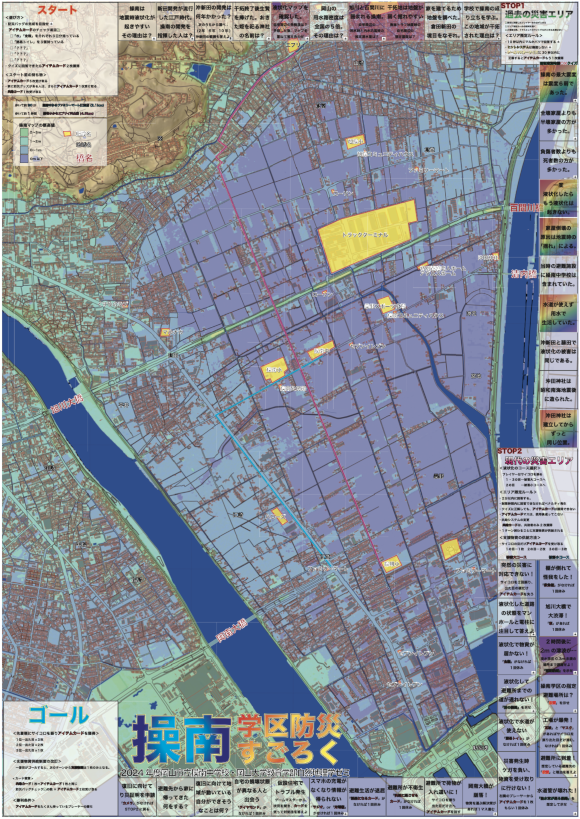
Disaster game made with students
- [1] T. Katada and M. Kanai, “The school education to improve the disaster response capacity: A case of ‘Kamaishi Miracle,’ ” J. Disaster Res., Vol.11, No.5, pp. 845-856, 2016. https://doi.org/10.20965/jdr.2016.p0845
- [2] J. Toyosawa, K. Karasawa, and N. Fukuwa, “Effects of disaster education for elementary school children on their guardians’ disaster preparedness action: Changes in children’s affect and cognition,” Japanese J. of Educational Psychology, Vol.58, No.4, pp. 480-490, 2010 (in Japanese). https://doi.org/10.5926/jjep.58.480
This article is published under a Creative Commons Attribution-NoDerivatives 4.0 Internationa License.