
Paper:
Creating Space for Disaster Lore Transmission Based on the Disaster Digital Archive: The Case of the 2014 Kamishiro Fault Earthquake Disaster Archive
Kotoe Uchiyama†, Daisuke Hirouchi, Satoko Nasu, Yasushi Sakakibara, and Iwao Kurasawa
Shinshu University
6-ro Nishi Nagano, Nagano 380-8544, Japan
†Corresponding author

This study uses the example of the 2014 Kamishiro Fault Earthquake Disaster Archive, which collects digital materials on the 2014 Kamishiro Fault Earthquake in Nagano Prefecture and makes them accessible on the Internet. It examines what constitutes an effective disaster digital archive in order to transmit disaster records and lessons learned within the local community, as well as the archive’s future outlook. The study further discusses the creation of a space for disaster lore transmission through the construction and utilization of a disaster digital archive. Since the 2014 Kamishiro Fault Earthquake is regarded as a local disaster even within Japan, both in terms of its limited geographical impact and its level of social recognition, the significance of preserving these disaster records lies primarily in their utilization by residents of the affected areas. The key to preserving such local disasters records lies in the self-directed use of disaster digital archives by local communities, particularly for learning-related purposes, such as school education, lifelong learning, and tourism. This study highlights the importance of interactive use between the digital archive (digital space) and off-site bases (real space), as well as the need for personnel training and the establishment of appropriate mechanisms to support disaster lore transmission. It proposes this approach as an effective means of disaster lore transmission, through which the experiences of past disasters are recorded and passed on to future generations.
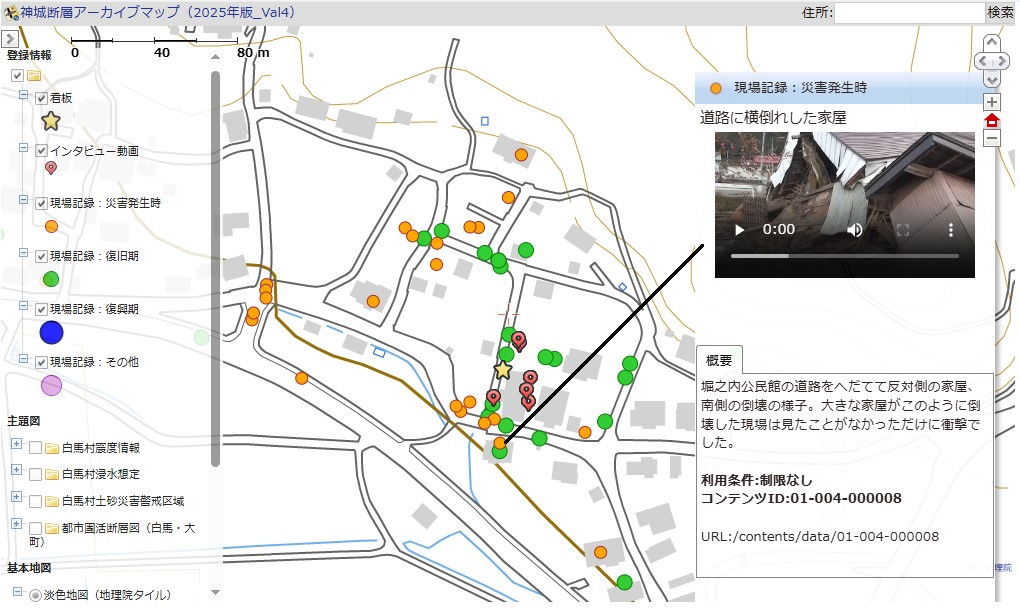
2014 Kamishiro Fault Earthquake Disaster Archive
- [1] A. Shibayama, M. Kitamura, S. P. Boret, and F. Imamura, “The state and visions of disaster archives as seen from the Great East Japan Earthquake,” J. of the Japan Society for Digital Archive, Vol.2, Issue 3, pp. 282-286, 2018 (in Japanese). https://doi.org/10.24506/jsda.2.3_282
- [2] M. Yamaguchi, “Symposium: A decade since the 2011 Great East Japan Earthquake: Expanding disaster digital archives in Japan: Roles of media in disaster education and passing down of disaster lessons,” The NHK Monthly Report on Broadcast Research, Vol.71, No.8, pp. 64-83, 2021.
- [3] R. Ishihara and N. Matsumura, “A study on the actual condition and the effects of disaster oral tradition in the coastal regions,” J. of Japan Society of Civil Engineers, Ser. D3 (Infrastructure Planning and Management), Vol.69, Issue 5, 2013 (in Japanese). https://doi.org/10.2208/jscejipm.69.I_101
- [4] S. Tanaka, “Immediately after: Damage and emergency response in tsunami disaster and reconstruction,” M. Takahashi, S. Tanaka, and F. Kimata (Eds.), “Aceh Following the 2004 Sumatra Earthquake,” Kokon-Shoin, pp. 99-104, 2014 (in Japanese).
- [5] Y. Hirakawa, S. Sato, K. Shirahata, and F. Imamura, “Consideration of relationship between tsunami monuments, tsunami inundation area, and human casualty—Case of the coastal area of Iwate Prefecture—,” J. of Japan Society of Civil Engineers, Ser. B2 (Coastal Engineering), Vol.72, Issue 2, pp. I_1621-I_1626, 2016 (in Japanese). https://doi.org/10.2208/kaigan.72.I_1621
- [6] M. Kanai, T. Katada, and H. Abe, “Study on tsunami disaster culture handed down from generation to generation in the coastal regions,” Infrastructure Planning Review, Vol.24, pp. 251-261, 2007 (in Japanese). https://doi.org/10.2208/journalip.24.251
- [7] F. Imamura, “The contemporary significance of disaster digital archives: Toward the creation of a new disaster prevention culture,” C. Suzuki (Ed.), “Digital Archive Basics 2 Using Disaster Records for the Future (Saigai Kiroku wo Mirai ni Ikasu),” Bensei-Sha, pp. 4-14, 2019 (in Japanese).
- [8] A. Shibayama, “The role of disaster archives, historical transition and current situation: Toward the creation of a new disaster prevention culture,” C. Suzuki (Ed.), “Digital Archive Basics 2 Using Disaster Records for the Future (Saigai Kiroku wo Mirai ni Ikasu),” Bensei-Sha, pp. 17-35, 2019 (in Japanese).
- [9] M. Ikeda and S. Sato, “Survey and analysis on the actual use of the Great East Japan Earthquake archives,” J. of Social Safety Science, Vol.37, pp. 219-226, 2020 (in Japanese). https://doi.org/10.11314/jisss.37.219
- [10] Miyagi Prefectural Government, “Great East Japan Earthquake Disaster Archive Miyagi,” 2015 (in Japanese). https://kioku.library.pref.miyagi.jp/ [Accessed August 31, 2025]
- [11] National Diet Library, “Hinagiku: National Diet Library Great East Japan Earthquake Archive,” 2013. https://kn.ndl.go.jp/#/ [Accessed August 31, 2025]
- [12] Koriyama City, “Koriyama Disaster Archive,” 2015 (in Japanese). http://jmapps.ne.jp/koriyama_shinsai_archive/ [Accessed August 31, 2025]
- [13] Otsuchi Town, “Tsumugi: Otsuchi Town Earthquake Archive,” 2017 (in Japanese). https://archive.town.otsuchi.iwate.jp/ [Accessed August 31, 2025]
- [14] Y. Kohno, H. Ueda, and S. Nakada, “Construction and provision of digital photographic archives by using the Japan Volcanological Data Network system: Application to the 1990–1995 Mount Unzen eruption disaster,” J. Disaster Res., Vol.17, No.5, pp. 600-608, 2022. https://doi.org/10.20965/jdr.2022.p0600
- [15] Iwate Prefecture Government, “Iwate Earthquake and Tsunami Archive—Hope,” 2017 (in Japanese). https://iwate-archive.pref.iwate.jp/ [Accessed August 31, 2025]
- [16] International Research Institute of Disaster Science, “Michinoku-Shinrokuden” (in Japanese). https://www.shinrokuden.irides.tohoku.ac.jp/ [Accessed August 31, 2025]
- [17] Kumamoto Prefectural Government, “Digital Archives of Kumamoto Disasters,” 2017 (in Japanese). https://www.kumamoto-archive.jp/ [Accessed August 31, 2025]
- [18] M. Koyama, A. Shibayama, M. Hiraoka, H. Arakawa, M. Ito, T. Inoue, and H. Muraoka, “Collecting and using disaster photographs and documents collection through a disaster workshop: Disaster archive Gifu,” J. of the Japan Society for Digital Archive, Vol.4, Issue 2, pp. 136-139, 2020 (in Japanese). https://doi.org/10.24506/jsda.4.2_136
- [19] Project Aceh Tsunami Archive, “Aceh Tsunami Archive,” 2013. https://aceh.mapping.jp/index.html [Accessed November 22, 2025]
- [20] University of Canterbury, “UC CEISMIC Canterbury Earthquakes Digital Archive,” 2011. https://www.ceismic.org.nz/ [Accessed November 22, 2025]
- [21] Balai Arsip Statis dan Tsunami, “Implementing Collaboration, BAST ANRI together with CSEAS Kyoto University and TDMRC USK Hold a Memorygraph Workshop,” August 21, 2024 (in Indonesian). https://bast.anri.go.id/page/publikasi/berita/detail/implementasi-kerjasama-bast-anri-bersama-cseas-kyoto-university-dan-tdmrc-usk-gelar-workshop-memorygraph [Accessed November 22, 2025]
- [22] J. Smithies, P. Millar, and C. Thomson, “Open principles, open data: The design principles and architecture of the UC CEISMIC Canterbury Earthquakes digital archive,” J. of the Japanese Association for Digital Humanities, Vol.1, No.1, pp. 10-36, 2015. https://doi.org/10.17928/jjadh.1.1_10
- [23] A. Shibayama and J. Gerster, “The vocabulary of natural disaster digital archives,” Tohoku J. of Natural Disaster Science, Vol.58, pp. 137-140, 2022 (in Japanese).
- [24] National Statistics Center, “e-Stat,” 2008 (in Japanese). https://www.e-stat.go.jp/stat-search/files?stat_infid=000032143614 [Accessed November 22, 2025]
- [25] The Headquarters for Earthquake Research Promotion,“Evaluation of Seismic Activity in November 2014,” 2014 (in Japanese). https://www.jishin.go.jp/main/chousa/14dec_nagano/index.htm [Accessed August 31, 2025]
- [26] D. Hirouchi, N. Sugito, and R. Shimizu, “Surface rupture and active fault associated with 2014 earthquake in northern Nagano Prefecture (Nagano Kamishiro Fault Earthquake),” Active Fault Research, Vol.41, Issue 41, pp. i-ii, 2014 (in Japanese). https://doi.org/10.11462/afr.2014.41_i
- [27] D. Hirouchi, N. Matsuta, N. Sugito, Y. Kumahara, S. Ishiguro, H. Kaneda, H. Goto, K. Kagohara, T. Nakata Y. Suzuki, M. Watanabe, H. Sawa, T. Miyauchi, and Research Group for the 2014 Kamishiro Fault Earthquake, “Surface rupture associated with the 2014 Naganoken-hokubu earthquake (Kamishiro Fault Earthquake), central Japan,” Active Fault Research, Vol.43, pp. 149-162, 2015 (in Japanese). https://doi.org/10.11462/afr.2015.43_149
- [28] Nagano Prefecture, “Record of the Nagano Prefecture Kamishiro Fault Earthquake Disaster: Connecting Memories, Linking to the Future” (in Japanese). https://www.pref.nagano.lg.jp/bosai/documents/kamishirodansoujisin.html [Accessed August 31, 2025]
- [29] Nagano Prefecture, “Overview of Damage in Nagano Prefecture from the Kamishiro Fault Earthquake,” 2014 (in Japanese). https://www.pref.nagano.lg.jp/bosai/kurashi/shobo/saigai/documents/kamishiro11261000.pdf [Accessed August 31, 2025]
- [30] S. Yokoyama, K. Uchiyama, and D. Hirouchi, “Set up of signboards in collaboration with the Kamishiro Fault Earthquake disaster archive,” Proc. of Annual Meeting of the Association of Japanese Geographers, Spring 2023, Vol.103, p. 264, 2023 (in Japanese). https://doi.org/10.14866/ajg.2023s.0_215
- [31] H. Kobota, “Curriculum development for disaster prevention education utilized the earthquake disaster archive: The case of Kamishiro Fault Earthquake in 2014,” Proc. of Annual Meeting of the Association of Japanese Geographers, Spring 2020, Vol.97, p. 298, 2020 (in Japanese). https://doi.org/10.14866/ajg.2020s.0_298
- [32] Reconstruction Agency of Japan, “Great East Japan Earthquake Lessons Learned & Know-How Gained,” 2021. https://www.reconstruction.go.jp/311kyoukun/pdf/kyokun/kyokun-en.pdf [Accessed August 31, 2025]
- [33] Ministry of Land, Infrastructure, Transport and Tourism Kyusyu District Transport Bureau, “Report on a Survey and Study Project on Tourism-Led Recovery from the Kumamoto Earthquake in Kumamoto City,” Ministry of Land, Infrastructure, Transport and Tourism, 2017 (in Japanese). https://dl.ndl.go.jp/pid/11516946 [Accessed August 31, 2025]
- [34] A. Ide, “The real value of dark tourism and the reconstruction process: What lies beyond ‘reconstruction,’ ” Disaster Recovery and Revitalization Review, Vol.7, No.1, pp. 49-56, 2015 (in Japanese).
- [35] K. Suzuki, “Reconstruction tourism as rhetoric of memory,” Proc. of Japan Institute of Tourism Annual Conf., Vol.31, pp. 357-360, 2016 (in Japanese).
- [36] T. Tamura and M. Iwafune, “Local reports on natural disasters: Significance, historic and recent examples, and requirements,” J. of Geography (Chigaku Zasshi), Vol.130, Issue 2, pp. 153-176, 2021 (in Japanese). https://doi.org/10.5026/jgeography.130.153
- [37] H. Suzuki, “A review of disaster archives of past natural disaster records focusing on tsunami events in the Sanriku coastal area and discussion,” J. of Geography (Chigaku Zasshi), Vol.130, Issue 2, pp. 177-196, 2021 (in Japanese). https://doi.org/10.5026/jgeography.130.177
- [38] K. Uchiyama and D. Hirouchi, “Development of the place for disaster tradition by practical using of the disaster digital archive,” Proc. of Annual Meeting of the Association of Japanese Geographers, Autumn 2021, Vol.100, p. 89, 2021 (in Japanese). https://doi.org/10.14866/ajg.2021a.0_95
This article is published under a Creative Commons Attribution-NoDerivatives 4.0 Internationa License.