
Research Paper:
Improving Learning Motivation in a Flipped-Classroom Teaching System Based on Expectancy-Value Theory and Timely Adjustments of Course Contents
Xiangfeng Tan
 , Jinhua She†
, Shumei Chen
, Sumio Ohno
, and Hiroyuki Kameda
, Jinhua She†
, Shumei Chen
, Sumio Ohno
, and Hiroyuki Kameda
Graduate School of Engineering, Tokyo University of Technology
1404-1 Katakuramachi, Hachioji, Tokyo 192-0982, Japan
†Corresponding author

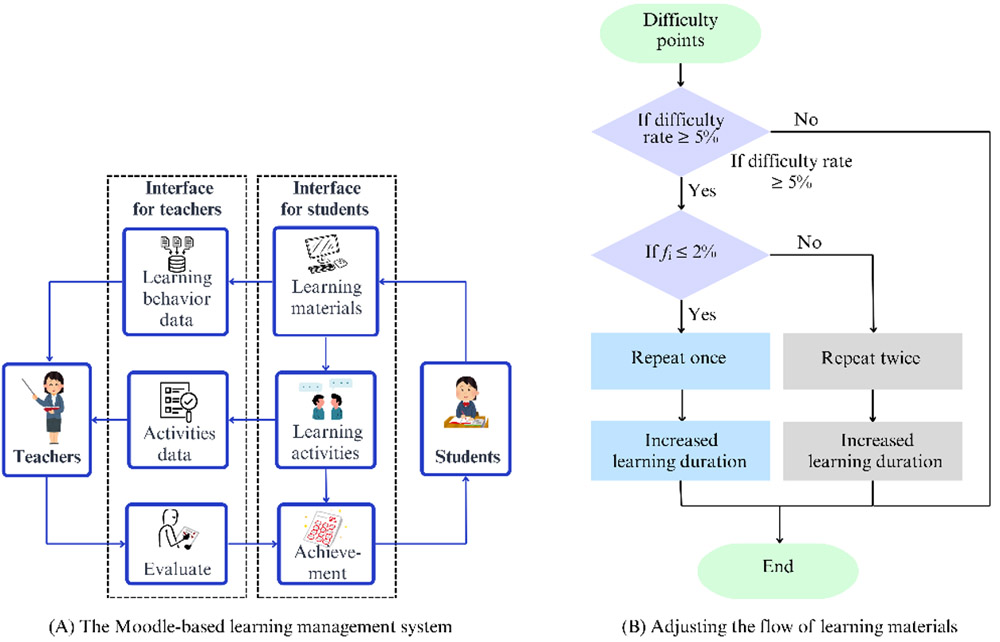
Enhancing students’ learning motivation is crucial in higher education. This paper presents a flipped-classroom teaching system that combines the expectancy-value theory and timely adjustments of course contents to improve student engagement. A newly developed evaluation framework assesses instructional effectiveness by analyzing students’ learning behaviors. The study first designed a Moodle-based learning management system that incorporated the theoretical framework, practical structure of the flipped-classroom course, and a course-adjustment model. Then, it developed a new evaluation framework for data acquisition, behavior analysis, and instructional effectiveness assessment. Teaching practice statistics using this system enable instructors to obtain a comprehensive picture of students’ learning behaviors, while descriptive statistics of learning behaviors provide an overview of students’ learning engagement. Finally, the paper summarizes the significance and contributions of this study and outlines future directions.
Adjustable workload-constrained MLMS design
- [1] X. Ding and V. Y. Mariano, “Learning status recognition method based on facial expressions in e-learning,” J. Adv. Comput. Intell. Intell. Inform., Vol.28, No.4, pp. 793-804, 2024. https://doi.org/10.20965/jaciii.2024.p0793
- [2] J. Kennedy, “Characteristics of massive open online courses (MOOCS): A research review, 2009–2012,” J. of Interactive Online Learning, Vol.13, No.1, pp. 1-16, 2014.
- [3] M. Fawaz and A. Samaha, “E-learning: Depression, anxiety, and stress symptomatology among Lebanese university students during COVID-19 quarantine,” Nursing Forum, Vol.56, No.1, pp. 52-57, 2021. https://doi.org/10.1111/nuf.12521
- [4] G. Akçayır and M. Akçayır, “The flipped classroom: A review of its advantages and challenges,” Computers & Education, Vol.126, pp. 334-345, 2018. https://doi.org/10.1016/j.compedu.2018.07.021
- [5] F. Ozdamli and G. Asiksoy, “Flipped classroom approach,” World J. on Educational Technology: Current Issues, Vol.8, No.2, pp. 98-105, 2016. https://doi.org/10.18844/wjet.v8i2.640
- [6] J. Nouri, “The flipped classroom: For active, effective and increased learning – especially for low achievers,” Int. J. of Educational Technology in Higher Education, Vol.13, No.1, Article No.33, 2016. https://doi.org/10.1186/s41239-016-0032-z
- [7] C. Mega, L. Ronconi, and R. De Beni, “What makes a good student? How emotions, self-regulated learning, and motivation contribute to academic achievement,” J. of Educational Psychology, Vol.106, No.1, pp. 121-131, 2014. https://doi.org/10.1037/a0033546
- [8] D. H. Schunk, “Self-efficacy and academic motivation,” Educational Psychologist, Vol.26, Nos.3-4, pp. 207-231, 1991. https://doi.org/10.1080/00461520.1991.9653133
- [9] A.-M. Cazan and B.-A. Schiopca, “Self-directed learning, personality traits and academic achievement,” Procedia – Social and Behavioral Sciences, Vol.127, pp. 640-644, 2014. https://doi.org/10.1016/j.sbspro.2014.03.327
- [10] A. E. Black and E. L. Deci, “The effects of instructors’ autonomy support and students’ autonomous motivation on learning organic chemistry: A self-determination theory perspective,” Science Education, Vol.84, No.6, pp. 740-756, 2000. https://doi.org/10.1002/1098-237X(200011)84:6<740::AID-SCE4>3.0.CO;2-3
- [11] S. Brownlow and R. D. Reasinger, “Putting off until tomorrow what is better done today: Academic procrastination as a function of motivation toward college work,” J. of Social Behavior and Personality, Vol.15, No.5, pp. 15-34, 2000.
- [12] M. van Dinther, F. Dochy, and M. Segers, “Factors affecting students’ self-efficacy in higher education,” Educational Research Review, Vol.6, No.2, pp. 95-108, 2011. https://doi.org/10.1016/j.edurev.2010.10.003
- [13] X. Tan, S. Chen, S. Ohno, H. Kameda, and J. She, “Using cluster analysis to explore students’ learning time preference in online education,” The 15th China-Japan Int. Workshop on Information Technology and Control Applications (ITCA 2024), unpublished.
- [14] I. M. Opara, “Teachers’ characteristics as determinants of their attitude towards continuous assessment practices,” American J. of Educational Research, Vol.6, No.10, pp. 1351-1355, 2018. https://doi.org/10.12691/education-6-10-3
- [15] J. M. Keller, “Development and use of the ARCS model of instructional design,” J. of Instructional Development, Vol.10, No.3, pp. 2-10, 1987. https://doi.org/10.1007/BF02905780
- [16] E. L. Deci and R. M. Ryan, “Self-determination theory,” P. A. M. Van Lange, A. W. Kruglanski, and E. T. Higgins (Eds.), “Handbook of Theories of Social Psychology: Vol.1,” pp. 416-437, Sage Publications, 2012. https://doi.org/10.4135/9781446249215.n21
- [17] A. Wigfield and J. S. Eccles, “Expectancy–value theory of achievement motivation,” Contemporary Educational Psychology, Vol.25, No.1, pp. 68-81, 2000. https://doi.org/10.1006/ceps.1999.1015
- [18] E. A. Locke and G. P. Latham, “Building a practically useful theory of goal setting and task motivation: A 35-year odyssey,” American Psychologist, Vol.57, No.9, pp. 705-717, 2002. https://doi.org/10.1037/0003-066X.57.9.705
- [19] A. Domínguez et al., “Gamifying learning experiences: Practical implications and outcomes,” Computers & Education, Vol.63, pp. 380-392, 2013. https://doi.org/10.1016/j.compedu.2012.12.020
- [20] H.-C. K. Hsu, C. V. Wang, and C. Levesque-Bristol, “Reexamining the impact of self-determination theory on learning outcomes in the online learning environment,” Education and Information Technologies, Vol.24, No.3, pp. 2159-2174, 2019. https://doi.org/10.1007/s10639-019-09863-w
- [21] J. L. Plass et al., “The impact of individual, competitive, and collaborative mathematics game play on learning, performance, and motivation,” J. of Educational Psychology, Vol.105, No.4, pp. 1050-1066, 2013. https://doi.org/10.1037/a0032688
- [22] S. Karabatak and H. Polat, “The effects of the flipped classroom model designed according to the ARCS motivation strategies on the students’ motivation and academic achievement levels,” Education and Information Technologies, Vol.25, No.3, pp. 1475-1495, 2020. https://doi.org/10.1007/s10639-019-09985-1
- [23] T. Hu et al., “The influence of ‘small private online course + flipped classroom’ teaching on physical education students’ learning motivation from the perspective of self-determination theory,” Frontiers in Psychology, Vol.13, Article No.938426, 2022. https://doi.org/10.3389/fpsyg.2022.938426
- [24] Y.-L. Chen, S. Lo, and J.-S. Cheng, “The impact of field-flipped courses on college students’ self-regulated learning and learning performance take a national university in central Taiwan as an example,” J. Adv. Comput. Intell. Intell. Inform., Vol.27, No.2, pp. 281-291, 2023. https://doi.org/10.20965/jaciii.2023.p0281
- [25] K. Takeda and S. Kajita, “Comfortable PandA: Student-developed extension for enhancing the usability of Sakai LMS at Kyoto University,” J. of Information Processing, Vol.32, pp. 1044-1055, 2024. https://doi.org/10.2197/ipsjjip.32.1044
- [26] L. Petrović, D. Stojanović, S. Mitrović, D. Barać, and Z. Bogdanović, “Designing an extended smart classroom: An approach to game-based learning for IoT,” Computer Applications in Engineering Education, Vol.30, No.1, pp. 117-132, 2022. https://doi.org/10.1002/cae.22446
- [27] P. Pimdee, A. Sukkamart, C. Nantha, T. Kantathanawat, and P. Leekitchwatana, “Enhancing Thai student-teacher problem-solving skills and academic achievement through a blended problem-based learning approach in online flipped classrooms,” Heliyon, Vol.10, No.7, Article No.e29172, 2024. https://doi.org/10.1016/j.heliyon.2024.e29172
- [28] X. Zhou, S. Chen, S. Ohno, J. She, and H. Kameda, “Motivational design for enhancing behavioral engagement in a flipped Chinese course,” Asia Pacific Education Review, Vol.25, No.5, pp. 1289-1303, 2024. https://doi.org/10.1007/s12564-023-09849-x
This article is published under a Creative Commons Attribution-NoDerivatives 4.0 Internationa License.